What Are The 7 Natural Wonders Of The World?
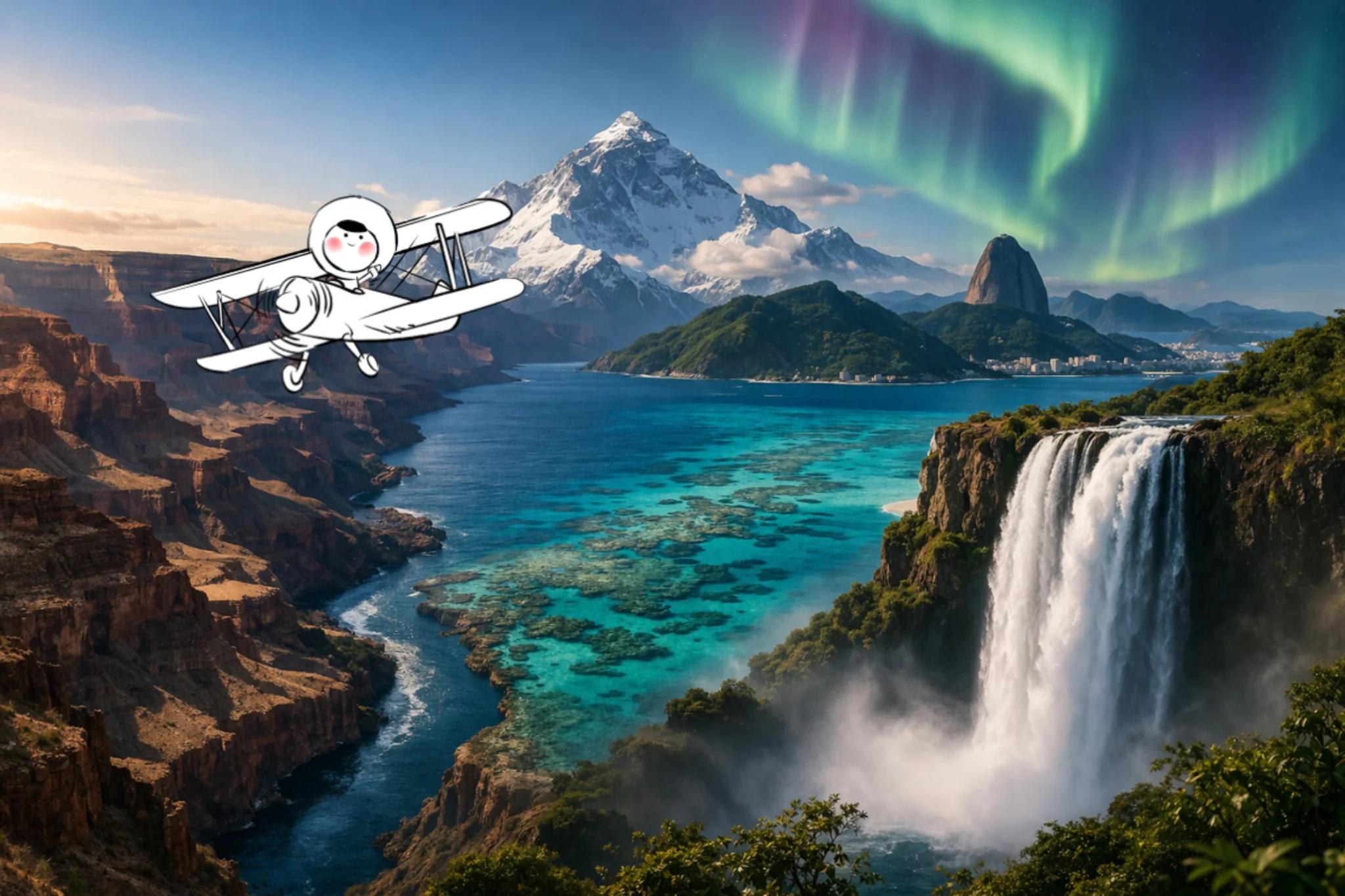
The 7 natural wonders of the world usually refer to a widely cited modern list that includes the Grand Canyon, Great Barrier Reef, Harbour of Rio de Janeiro, Mount Everest, Aurora Borealis, Parícutin Volcano, and Victoria Falls. It is not the same as a UNESCO ranking or the New 7 Wonders of the World.
The list is commonly presented as:
- Grand Canyon, United States
- Great Barrier Reef, Australia
- Harbour of Rio de Janeiro, Brazil
- Mount Everest, Nepal and Tibet
- Aurora Borealis, Arctic regions
- Parícutin Volcano, Mexico
- Victoria Falls, Zambia and Zimbabwe
These seven are linked by scale, rarity, and the force of natural processes over time.
Who Chose The 7 Natural Wonders Of The World?
This list is a modern, widely cited selection rather than a single official global designation. It sits outside UNESCO’s World Heritage system and outside the New 7 Wonders framework.
The term is used to describe seven natural places and phenomena that are often grouped together as some of the world’s most extraordinary natural sights.
The 7 Natural Wonders Of The World
1. Grand Canyon, United States
The Grand Canyon is one of the most recognizable landscapes on Earth. Carved over millions of years by the Colorado River, it is known for its enormous scale and exposed rock layers.
- Why it is considered a natural wonder: Its immense size and geological depth make it one of the planet’s most dramatic landforms
- Where it is: Northern Arizona, United States
- What makes it special: Its layered rock formations reveal a long geological history
- What to know before visiting: The South Rim is the easiest access point for most travelers, and spring and fall are often more comfortable than peak summer
2. Great Barrier Reef, Australia
The Great Barrier Reef is the world’s largest coral reef system and one of the most important marine environments on the planet. Its scale and biodiversity are what set it apart.
- Why it is considered a natural wonder: It is the largest coral reef system in the world
- Where it is: Off the coast of Queensland, Australia
- What makes it special: Its coral formations, marine life, and vast underwater ecosystem
- What to know before visiting: June to October is often a strong window for drier weather and clearer conditions
3. Harbour of Rio de Janeiro, Brazil
The Harbour of Rio de Janeiro is defined by the meeting of water, granite peaks, and Atlantic coastline. Its natural setting gives Rio one of the most distinctive urban landscapes in the world.
- Why it is considered a natural wonder: Its mountain-framed harbor setting is visually distinctive on a global scale
- Where it is: Rio de Janeiro, Brazil
- What makes it special: The contrast between Guanabara Bay, steep peaks, and the surrounding coastline
- What to know before visiting: The harbor is best appreciated from high viewpoints and as part of a wider Rio trip
4. Mount Everest, Nepal and Tibet
Mount Everest is the highest mountain above sea level on Earth. Its height alone gives it a singular place in the global imagination.
- Why it is considered a natural wonder: Its extreme elevation and physical scale make it one of the world’s most remarkable natural landmarks
- Where it is: On the border of Nepal and Tibet
- What makes it remarkable: It is the highest mountain on Earth above sea level
- What to know before visiting: Most travelers visit the Everest region, not the summit itself, and routes and permits vary by season and location
Get Eskimo eSIM to stay connected globally
Need internet? Here's what we recommend:

Fixed data plans
- No speed reduction
- No expiry, keep your data forever
- Transfer data to anyone
- Personal hotspot


5. Aurora Borealis, Arctic Regions
The Aurora Borealis is the only entry on this list that is a recurring natural phenomenon rather than a fixed landscape. It turns polar skies into shifting bands of light created by solar activity interacting with Earth’s atmosphere.
- Why it is considered a natural wonder: Its moving light displays are among nature’s most extraordinary spectacles
- Where you can see it: In parts of Norway, Finland, Iceland, Canada, and Alaska, among other Arctic regions
- What makes it special: Every display is shaped by natural conditions and never appears exactly the same way twice
- What affects visibility: Dark skies, clear weather, season, and solar activity
- Best time to go: In many northern destinations, September to March is the main viewing season
6. Parícutin Volcano, Mexico
Parícutin Volcano stands out because its birth was witnessed in modern times. It emerged from a cornfield in 1943, making it one of the rare volcanic formations whose growth was documented from the beginning.
- Why it is considered a natural wonder: Its formation was observed by people from the start
- Where it is: Michoacán, Mexico
- What makes it unusual: Very few volcanoes have such a clearly documented origin story
- What to know before visiting: It works best as part of a broader regional itinerary rather than as a standalone mainstream stop
7. Victoria Falls, Zambia and Zimbabwe
Victoria Falls is one of the world’s most dramatic waterfalls. The scale of the falling water, the spray, and the sound are what make the experience so memorable.
- Why it is considered a natural wonder: Its size and force make it one of the most powerful waterfalls on Earth
- Where it is: On the border of Zambia and Zimbabwe
- What makes it special: Its width, heavy flow, and dense rising mist
- What to know before visiting: Water levels change throughout the year, so the look and feel of the falls depend heavily on timing
Natural Wonders Vs. New 7 Wonders Of The World
The 7 natural wonders of the world and the New 7 Wonders of the World refer to different lists. Natural wonders are shaped by geology, water, climate, and other natural forces. The New 7 Wonders list focuses on human-made landmarks such as Machu Picchu, the Taj Mahal, and Petra. One list is about places formed by nature. The other is about monuments built by people.
Can You Visit All 7 Natural Wonders Of The World?
Yes, but most people would visit them over multiple trips, not in a single itinerary.
Some are easier to fit into broader travel plans, such as the Grand Canyon or Victoria Falls. Others need more planning. Aurora Borealis depends on the weather and season. Mount Everest usually means visiting the surrounding region rather than attempting a climb. The Great Barrier Reef and Parícutin Volcano also require more specific routing than a standard city trip.
For travelers coming from the US, UK, or Australia, flight times and regional access can vary widely. Some of these places work well as part of a larger regional journey, while others are major long-haul trips on their own.
Travel Tips For Visiting Natural Wonders Around The World
A little planning goes a long way with trips like these.
- Check seasonality before booking. Timing can affect visibility, weather, water levels, and access.
- Do not assume every wonder is easy to reach. Some have straightforward visitor infrastructure, while others need more advanced planning.
- Keep your itinerary realistic. Remote locations, border crossings, and long travel days can add more time than expected.
- Plan around the experience you want. Some places are best seen from viewpoints, while others are better experienced by boat, on foot, or as part of a longer route.
- Keep key travel details easy to access. That includes maps, tickets, transport bookings, and backup confirmations.
Stay Connected While Exploring Natural Wonders Around The World
The world’s most extraordinary places are spread across very different regions, and some are far from the kind of trip where you want to sort out connectivity on arrival. A stable connection helps with maps, transfer details, bookings, and last-minute changes.
That is where Eskimo fits naturally. For multi-country or long-range travel, the Global Plan makes the most sense, especially if you want a setup that stays simple across different trips. It is a practical option for travelers who want something flexible and easy to keep for future journeys.
New users also get free 500MB of Global Data valid for 2 years, which is useful for essentials when you first land, from maps and messages to booking access and transport coordination.
FAQs
What are the 7 natural wonders of the world?
A commonly used modern list includes the Grand Canyon, Great Barrier Reef, Harbour of Rio de Janeiro, Mount Everest, Aurora Borealis, Parícutin Volcano, and Victoria Falls.
Who chose the 7 natural wonders of the world?
The list is generally presented as a modern, widely cited selection, not a single UNESCO-issued ranking.
Is Aurora Borealis one of the natural wonders of the world?
Yes. In the commonly cited modern list, Aurora Borealis is one of the 7 natural wonders of the world.
Are the 7 natural wonders the same as the 7 wonders of the world?
No. The 7 natural wonders refer to natural places or phenomena, while the New 7 Wonders of the World refer to human-made landmarks.
Can you visit all 7 natural wonders of the world?
Yes, but most travelers would do that over multiple trips rather than one journey, because distance, seasonality, and access vary so much across the seven.