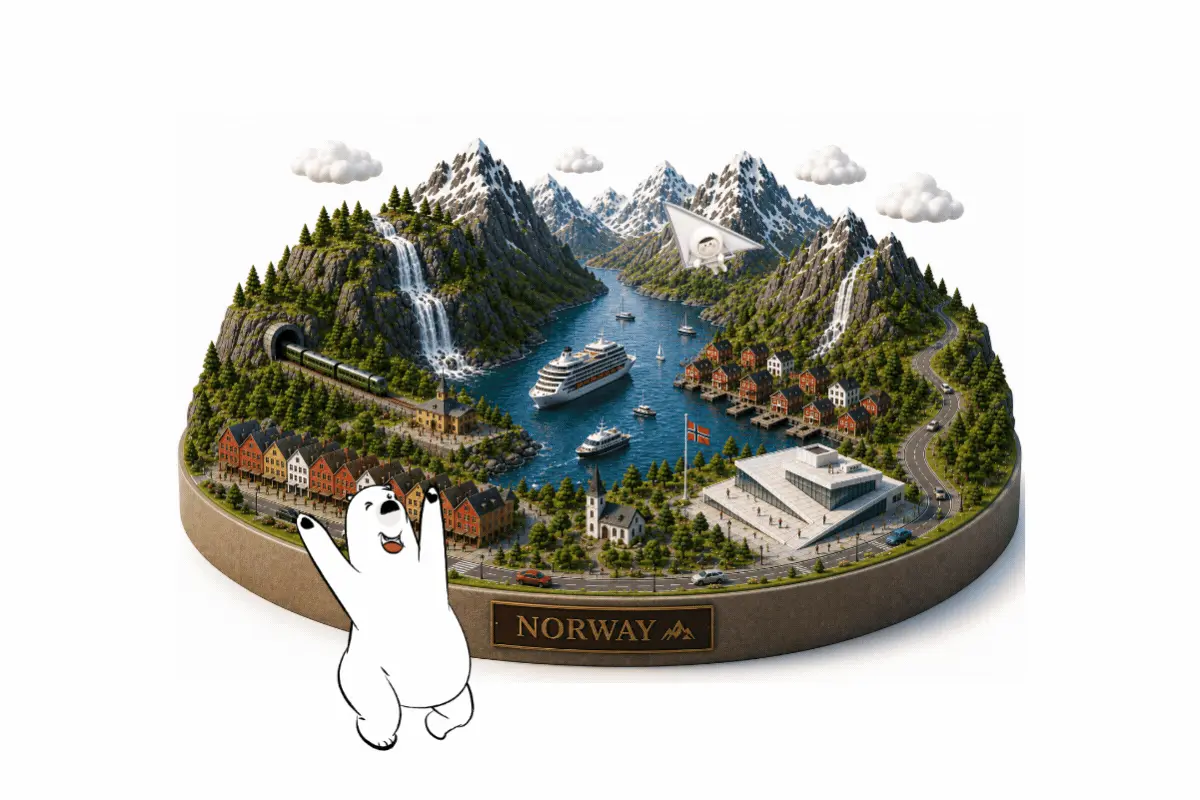
The best places to visit in Norway include Oslo, Bergen, the Lofoten Islands, Tromsø, Geirangerfjord, Flåm and Stavanger. First-time visitors should combine at least one city with a fjord region, while longer trips can include Arctic landscapes, mountain trails and coastal drives.
Norway stretches far from its southern coastline to the Arctic, so covering the entire country in one trip is rarely practical. A focused route through two or three connected regions usually creates a better experience than trying to rush between distant destinations.
The following places represent Norway’s strongest mix of scenery, culture, outdoor activities and accessibility.
Best Places To Visit In Norway
Oslo
Oslo is Norway’s capital and the most convenient starting point for many international visitors. The city combines museums, modern architecture, waterfront neighbourhoods and easy access to forests and islands.
Walk along the harbour from the Oslo Opera House to the redeveloped Bjørvika district, visit the National Museum and explore the sculptures at Vigeland Park. The Bygdøy peninsula is home to several museums focused on Norwegian maritime and cultural history.
Oslo also works well as the beginning of a rail journey toward Bergen, Flåm or central Norway.
Best for: Culture, architecture and first-time arrivals Suggested stay: Two to three days
Bergen
Bergen is one of the best places to visit in Norway for travellers who want a city base close to the western fjords. Its historic waterfront, mountain viewpoints and compact centre make it easy to explore without a car.
The colourful wooden buildings at Bryggen form part of a UNESCO World Heritage site. Visitors can also ride the Fløibanen funicular, explore the fish market and take boat trips into the surrounding fjord region.
Rain is common throughout the year, so carry a waterproof outer layer even when the forecast looks settled.
Best for: Fjord access, history and scenic city breaks Suggested stay: Two to four days
Geirangerfjord
Geirangerfjord is one of Norway’s most recognisable natural landscapes. Its narrow blue waterway is surrounded by steep mountains, high waterfalls and historic farms clinging to the slopes.
Popular viewpoints include Flydalsjuvet, Ørnesvingen and the higher Dalsnibba platform. Boat trips provide a closer view of waterfalls such as the Seven Sisters and the Suitor.
Geirangerfjord and Nærøyfjord are jointly protected as part of the West Norwegian Fjords UNESCO World Heritage site. UNESCO describes them as outstanding examples of classic fjord landscapes.
Best for: Iconic scenery, cruises and photography Suggested stay: One to two days
The Lofoten Islands
The Lofoten Islands rise from the Norwegian Sea in a chain of sharp mountains, sheltered beaches and traditional fishing villages. Reine, Henningsvær, Nusfjord and Å are among the most popular bases.
Summer brings long daylight hours for hiking, kayaking and road trips. Autumn and winter offer darker skies and opportunities to see the northern lights, although weather conditions can change quickly.
Distances may look short on a map, but narrow roads and frequent photo stops make journeys slower than expected. Staying for several days gives you more flexibility.
Best for: Road trips, hiking and Arctic coastal scenery Suggested stay: Four to seven days
Tromsø
Tromsø is the main urban centre of northern Norway and a practical base for Arctic activities. Winter visitors come for northern lights tours, dog sledding and snowy landscapes, while summer offers the midnight sun and long hiking days.
Within the city, visit the Arctic Cathedral, Polaria and the Polar Museum. The Fjellheisen cable car provides wide views across Tromsøya and the surrounding mountains.
Northern lights sightings are never guaranteed. Allow several nights and remain flexible around weather and cloud cover.
Best for: Northern lights and accessible Arctic experiences Suggested stay: Three to five days
Flåm
Flåm sits at the end of Aurlandsfjord and is best known for the Flåm Railway. The train climbs between Flåm and Myrdal through a steep valley filled with waterfalls, farms and mountain scenery.
The village is also a gateway to Nærøyfjord, where passenger boats travel between narrow cliffs and small settlements. Nearby Stegastein Viewpoint overlooks Aurlandsfjord from a platform extending above the mountainside.
Flåm becomes busy when cruise ships arrive. Staying overnight allows you to enjoy the area during quieter morning and evening hours.
Best for: Scenic rail journeys and fjord cruises Suggested stay: One to two days
Stavanger
Stavanger combines a historic coastal centre with access to Lysefjord and some of Norway’s most famous hiking routes. Its old town contains white wooden houses, narrow streets and small galleries.
The best-known excursion is Preikestolen, or Pulpit Rock, which rises approximately 604 metres above Lysefjord. The hike is exposed to changing weather, so suitable footwear and warm layers are important.
Visitors who prefer a less demanding day can explore the city’s museums, harbour and nearby beaches.
Best for: Hiking, coastal culture and Lysefjord Suggested stay: Two to three days
Nærøyfjord
Nærøyfjord is narrower and quieter than many of Norway’s larger fjords. Mountains rise sharply from the water, creating one of the country’s most enclosed and dramatic landscapes.
The common boat route connects Flåm with Gudvangen. It can be combined with trains and buses as part of a circular trip from Bergen or Oslo.
Kayaking is available during suitable conditions, while scenic cruises operate across several seasons. Check transport timetables carefully outside the busiest summer months.
Best for: Fjord cruises and peaceful scenery Suggested stay: One day or an overnight nearby
Ålesund
Ålesund is known for its Art Nouveau architecture and island setting on Norway’s western coast. Much of the centre was rebuilt after a major fire in 1904, creating a distinctive collection of decorated stone buildings.
Climb the steps to the Aksla viewpoint for a panorama across the town, islands and surrounding mountains. Ålesund is also a convenient gateway to Geirangerfjord, Hjørundfjord and the Sunnmøre Alps.
Best for: Architecture, coastal views and western fjord routes Suggested stay: Two days
Sognefjord
Sognefjord is Norway’s longest and deepest fjord, extending inland through a wide region of villages, mountains and smaller fjord branches. It offers more than a single viewpoint or cruise route.
Popular bases include Balestrand, Sogndal, Lærdal and Aurland. Travellers can combine fjord cruises with hiking, cycling, stave churches and visits to nearby glaciers.
Because the region is large, choose one section rather than attempting to cover every branch in a short stay.
Best for: Slow travel, villages and varied fjord experiences Suggested stay: Three to five days
Jotunheimen National Park
Jotunheimen is Norway’s leading mountain region and contains many of the country’s highest peaks. It attracts hikers with marked routes, mountain lodges, lakes and broad alpine valleys.
The Besseggen ridge is the best-known hike, but it is long, exposed and physically demanding. Easier walks are available around Gjendesheim, Lom and other entry points.
The main hiking season usually falls between late June and September, depending on snow and trail conditions.
Best for: Hiking and high-mountain landscapes Suggested stay: Two to four days
Trondheim
Trondheim offers a calmer city experience than Oslo or Bergen. It served as Norway’s medieval capital and remains an important centre for history, education and food.
Nidaros Cathedral is the city’s main landmark and one of northern Europe’s most significant medieval buildings. Visitors can also explore the colourful warehouses beside the Nidelva River and the old wooden neighbourhood of Bakklandet.
Trondheim is a useful stop on rail or coastal routes toward northern Norway.
Best for: Medieval history, food and relaxed city stays Suggested stay: Two days
Senja
Senja is Norway’s second-largest island and offers a quieter alternative to the better-known Lofoten Islands. Its western coast contains steep peaks, fishing villages, beaches and roadside viewpoints.
The National Scenic Route passes places such as Bergsbotn, Tungeneset and Ersfjordstranda. Hiking options range from short coastal walks to steep summit routes.
Public transport is limited, making a rental car the most practical option for exploring the island.
Best for: Scenic drives, hiking and fewer crowds Suggested stay: Three to five days
Get Eskimo eSIM to stay connected in Norway
Need internet in Norway? Here's what we recommend:

Fixed data plans
- No speed reduction
- No expiry, keep your data forever
- Transfer data to anyone
- Personal hotspot
Unlimited data plans
- Unlimited day pass
- Daily 3GB high-speed + 1Mbps unlimited after
- Personal hotspot
Hardangerfjord
Hardangerfjord is known for waterfalls, orchards, mountain plateaus and dramatic branches extending deep into western Norway. Spring fruit blossoms and autumn harvests give the region a different character from the steeper fjords farther north.
Vøringsfossen is one of the area’s major waterfalls, while Folgefonna National Park protects a large glacier and surrounding mountains. Odda is a common base for travellers hiking to Trolltunga.
The Trolltunga route is long and demanding. Guided winter trips and careful preparation may be necessary outside the main summer season.
Best for: Waterfalls, orchards and challenging hikes Suggested stay: Two to four days
The Atlantic Ocean Road
The Atlantic Ocean Road connects small islands and coastal communities through a sequence of bridges on Norway’s northwest coast. The route is short, but its setting makes it one of the country’s most photographed drives.
It works best as part of a longer road trip linking Molde, Kristiansund, Ålesund or the fjord region. Several stopping areas provide sea views and short walks.
Wind and rain can transform the character of the road quickly, so drive carefully and use marked parking areas.
Best for: Coastal road trips and photography Suggested stay: Half a day to one day
Røros
Røros is a former copper-mining town filled with preserved wooden buildings. Its compact centre provides a strong contrast to Norway’s fjords and modern cities.
The town and surrounding mining landscape are recognised by UNESCO for their cultural importance. Visitors can walk through historic streets, tour the old mining areas and learn how residents adapted to the region’s cold climate.
Winter brings snowy streets and a traditional atmosphere, while summer is easier for exploring the surrounding countryside.
Best for: History, wooden architecture and winter atmosphere Suggested stay: One to two days
Bodø
Bodø is a coastal city north of the Arctic Circle and a useful gateway to Lofoten, Helgeland and northern Norway. Its airport, railway terminus and ferry connections make it an important transport hub.
Nearby Saltstraumen is known for powerful tidal currents created as water moves through a narrow channel. Bodø also has mountain trails, coastal walks and the Norwegian Aviation Museum.
The city works particularly well for travellers continuing by ferry to Moskenes in Lofoten.
Best for: Northern transport connections and coastal nature Suggested stay: One to two days
Nordkapp
Nordkapp, or North Cape, is a high sea cliff on the island of Magerøya. Its visitor centre and globe monument overlook the Barents Sea from one of Europe’s most famous northern viewpoints.
The site is often reached from Honningsvåg by bus, tour or car. Summer visitors may experience the midnight sun, while winter access depends heavily on road and weather conditions.
Nordkapp is not the northernmost point of mainland Europe, but its dramatic location and road accessibility have made it a symbolic endpoint for northern journeys.
Best for: Arctic road trips and midnight-sun scenery Suggested stay: One to two days
Svalbard
Svalbard lies far north of mainland Norway and offers a distinctly polar environment. Longyearbyen is the main settlement and the starting point for organised excursions involving glaciers, boats, snowmobiles and wildlife observation.
Outside settlements, visitors generally need appropriate safety equipment and professional guidance because of polar bear risk and extreme conditions. Independent hiking is not comparable to walking in mainland national parks.
Flights usually connect Longyearbyen with Oslo or Tromsø. Svalbard requires extra time, preparation and budget, making it more suitable as a separate Arctic journey.
Best for: Polar landscapes and guided expeditions Suggested stay: Four to seven days
Kristiansand And Southern Norway
Kristiansand and Norway’s southern coast offer beaches, small harbour towns and a gentler summer atmosphere. The region is particularly popular with Norwegian families during the warmer months.
Kristiansand has a walkable centre, waterfront area and ferry connections to Denmark. Nearby towns such as Grimstad, Arendal and Lillesand are known for white wooden houses and active harbours.
This region is less dramatic than the western fjords but works well for relaxed coastal travel.
Best for: Summer holidays, families and coastal towns Suggested stay: Two to four days
Building A First Norway Route
Norway’s long distances mean that a sensible route depends on how much time you have.
For a short first visit, combine Oslo with Bergen and a nearby fjord excursion. Travellers with seven to ten days can add Flåm, Stavanger or Ålesund. Tromsø, Lofoten and Svalbard are better treated as separate northern extensions because reaching them requires additional flights, ferries or long overland journeys.
Useful first-trip combinations include:
- Oslo, Flåm and Bergen for cities, railways and fjords
- Bergen, Hardangerfjord and Stavanger for western Norway
- Ålesund and Geirangerfjord for coastal architecture and classic scenery
- Bodø and Lofoten for an Arctic road trip
- Tromsø and Senja for winter activities or northern summer landscapes
The official Visit Norway destination directory provides regional information for planning routes across the country.
Best Seasons For Visiting Norway
Summer from June to August provides the longest daylight hours and the widest access to hiking routes, mountain roads and fjord activities. It is also the busiest period in popular places such as Lofoten, Geiranger and Flåm.
Spring brings waterfalls and fruit blossoms in western Norway, although snow can remain on higher routes. Autumn offers colourful landscapes and quieter cities, while winter is best suited to northern lights trips, skiing and Arctic activities.
Weather can change quickly in every season. Pack layers, waterproof clothing and suitable footwear rather than relying only on the temperature forecast.
Travellers visiting around Easter, Constitution Day or Christmas should also review Norway’s public holidays and expected closures before confirming transport and attraction plans.
Practical Norway Travel Tips
A few choices can make a first trip easier:
- Focus on one region if you have less than a week.
- Book popular summer trains, ferries and accommodation early.
- Allow extra time for mountain roads and ferry crossings.
- Carry waterproof clothing throughout the year.
- Check hiking conditions rather than relying only on calendar seasons.
- Use public transport for major city and railway routes.
- Consider a rental car for Lofoten, Senja and remote fjord districts.
- Follow marked paths and local safety guidance in mountain areas.
- Avoid stopping on narrow roads solely for photographs.
- Download maps and travel confirmations before entering remote areas.
Norway’s railways, buses, ferries and domestic flights can be combined effectively, but schedules may be less frequent in rural areas and outside peak season.
Mobile Data Across Norway’s Cities And Fjords
Reliable mobile data helps with navigation, ferry updates, accommodation messages and changing weather conditions, especially when moving between cities and rural areas.
A Norway eSIM plan can be installed before departure and used without changing a physical SIM card. Eskimo’s fixed plans support hotspot sharing and have two-year validity, which is useful when data remains after the trip.
New users can also claim free 500MB of Global Data to test the service before choosing a larger plan.
FAQs:
What are the best places to visit in Norway for a first trip?
Oslo, Bergen, Flåm, Geirangerfjord and Stavanger create a strong first itinerary. They combine city attractions, scenic rail journeys and accessible fjord experiences.
How many days are enough for Norway?
Seven to ten days are enough for one focused route through southern or western Norway. Visiting the western fjords and Arctic north on the same trip usually requires more time.
Which part of Norway has the best scenery?
Western Norway is famous for Geirangerfjord, Nærøyfjord, Sognefjord and Hardangerfjord. Lofoten and Senja offer sharper Arctic mountains and dramatic coastal scenery.
Is Oslo or Bergen better for first-time visitors?
Oslo is better for major museums, architecture and international transport connections. Bergen is better for historic waterfront scenery and quick access to the fjords.
What is the best month to visit Norway?
June through August offers long daylight and broad access to roads and hiking areas. May and September can be quieter, while winter is better for northern lights and snow activities.