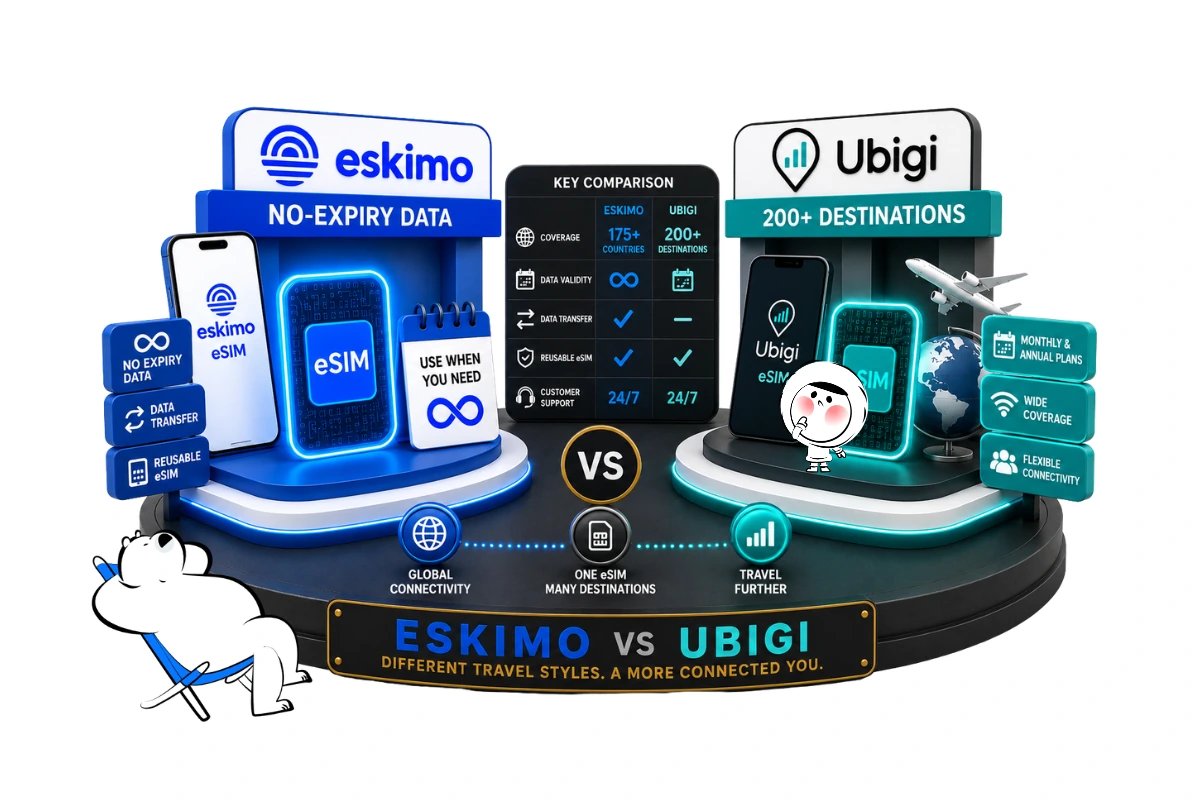
Eskimo and Ubigi both offer international travel eSIMs, but their strongest benefits are different. Eskimo focuses on flexibility after you buy fixed data, while Ubigi combines broad destination availability with one-off, monthly, and annual plan options.
Eligible Eskimo fixed data does not expire, paid fixed data can be transferred to another Eskimo user, and the same eSIM can remain installed for compatible plans across supported destinations. Ubigi advertises a reusable eSIM across 200+ destinations and offers recurring plans that can refresh the included allowance each month.
Ubigi advertises the broader overall destination footprint, while Eskimo covers 175 countries and regions. Neither provider has an advantage in every category, so price, validity, regional coverage, renewal structure, and what happens to unused data are more useful ways to compare them.
Ready to try Eskimo? New users can apply promo code WELCOME and get 50% off all data packages within 48 hours of signing up, with a maximum discount of US$15.
Eskimo vs Ubigi at a Glance
| What Matters | Eskimo | Ubigi | Why it matters |
| Overall availability | 175+ countries | 200+ destinations | Ubigi advertises the broader overall footprint |
| Fixed data | Available | Available | Both provide prepaid fixed-data plans |
| Fixed-data validity | No expiry | Plan-specific validity | Eligible Eskimo fixed data can remain available after the trip |
| Unlimited data | Available in supported destinations | Available in selected destinations | High-speed allowances and package rules vary |
| Recurring plans | Fixed data is not subscription-based | Monthly and Annual options available | Ubigi provides more subscriptions-style choices |
| Data transfer | Eligible paid fixed data can be transferred | Not advertised as a standard data-transfer feature | Eskimo users can move eligible purchased data to another Eskimo user |
| Reusable eSIM | One eSIM across supported destinationsOne eSIM across supported destinationsOne eSIM across supported destinationsOne eSIM across supported destinationsOne eSIM across supported destinations | One eSIM across 200+ destinations | Both reduce repeated eSIM installation between trips |
| Activation approach | Eligible fixed data has no expiry deadline | Smartstart on supported plans | Ubigi can start plan validity after first connection in a covered destination |
| Hotspot / data sharing | Supported on fixed plans | Data sharing allowed on supported plans | Both can connect another device where supported |
| Customer support | 24/7 human support | Customer support available | Support can matter when setup or connectivity issues occur abroad |
The main difference is the data model. Eskimo gives travelers flexibility with a purchased fixed balance, while Ubigi provides more ways to receive data through one-off, monthly, and annual packages.
In short: Eskimo is better aligned with travelers who want fixed data that can remain available between trips, while Ubigi is better aligned with travelers who want recurring allowances or need its broader advertised destination footprint.
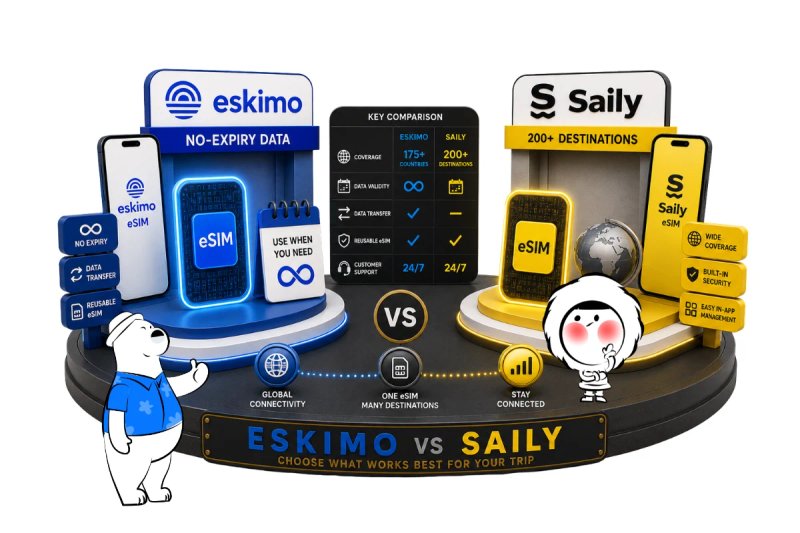
Travelers comparing different provider models can also see the Eskimo vs Saily comparison, where the trade-off shifts toward Eskimo’s data flexibility versus Saily’s security and privacy features.
Eskimo vs Ubigi Plan Structure And Pricing
Eskimo and Ubigi should not be compared using headline price alone because they do not always sell data using the same purchase model.
Eskimo’s eligible fixed plans work as prepaid data balances. You purchase an allowance for a Country, Regional, or Global plan, and eligible unused fixed data does not expire. There is no monthly renewal required simply to keep that remaining fixed data available.
Ubigi offers a broader mix of one-off, monthly, and annual plans. Monthly packages provide an allowance within a recurring billing cycle, while selected annual products provide a new allowance each month over a longer commitment.
That means a 5GB Eskimo fixed plan and a 5GB Ubigi monthly plan may contain the same headline amount of data, but they are not equivalent products.
| Pricing Factor | Eskimo | Ubigi |
| Fixed prepaid data | Available | Available |
| Monthly Plans | Fixed data does not require monthly renewal | Available |
| Annual plans | Not the core fixed-data model | Available in selected markets |
| Unused fixed data | No expiry on eligible fixed plans | Depends on selected plan and validity |
| Useful comparison metric | Total data needed across trips | Data needed per billing period |
| Automatic renewal | Not required for fixed data | Applies to recurring plans |
For a traveler taking one short trip, the useful question is how much data is needed for that journey and whether most of the allowance is likely to be consumed.
For someone traveling several times throughout the year, the calculation changes. An eligible Eskimo fixed balance can remain available between trips, while a Ubigi monthly plan is designed around receiving an allowance during each billing period.
For someone living abroad, studying overseas, working remotely, or traveling continuously, Ubigi’s recurring structure may be useful because a predictable allowance can refresh every month.
Neither pricing model is inherently cheaper. The better value depends on how frequently you travel, how quickly you consume data, whether unused data matters to you, and whether you want a fixed balance or recurring allowance.
Prices, allowances, validity conditions, regional coverage, and recurring-plan terms can change, so current package details should be checked before purchasing.
What Happens To Unused Data?
This is one of the clearest differences between Eskimo and Ubigi.
Eligible Eskimo fixed data does not expire. If you purchase 10GB and use 6GB during a trip, the remaining 4GB can stay available rather than disappearing because a fixed validity period has ended. Unlimited plans are different and continue to follow the duration and usage conditions of the purchased package.
That can be useful because travel data consumption is rarely perfectly predictable. Hotel Wi-Fi, offline maps, shorter itineraries, or simply using less mobile data than expected can leave part of an allowance unused.
Ubigi’s treatment of data depends on the package selected. One-off packages have defined validity periods, while recurring monthly packages provide an allowance according to their billing cycle. Selected annual products can provide a set allowance each month for 12 months.
Ubigi’s annual structure should not be treated as one large data pool unless the specific product says so. A plan providing 5GB each month for 12 months, for example, is different from purchasing 60GB that can be consumed at any pace throughout the year.
For predictable monthly consumption, a recurring allowance can work well. For irregular trips, Eskimo’s no-expiry fixed data reduces the pressure to consume purchased data within a particular travel period.
Eskimo also allows eligible paid fixed data to be transferred to another Eskimo user starting from 500MB. Free data and unlimited plans should not be treated as transferable fixed-data balances.
Coverage And Regional Plans
Ubigi advertises availability across 200+ destinations, while Eskimo currently advertises coverage across 175 countries and regions.
Ubigi therefore has the broader advertised overall footprint.
That does not mean every Ubigi regional package covers more destinations than its Eskimo counterpart. Regional eSIM definitions are not standardized between providers.
Eskimo offers geographic products including Europe, Asia Pacific, North America, Middle East, Africa, and Latin America. Ubigi uses regional groupings including Europe, Asia, Best Middle East, Best Africa, Best Latam, and other combinations.
A traveler visiting Japan, South Korea, Thailand, and Indonesia should therefore check those four countries directly rather than assuming that two packages carrying an Asia label provide identical coverage.
Network partners can also differ even when both providers support the same country. Eskimo’s best eSIM for Japan comparison shows why network availability, plan structure, and data flexibility can matter alongside the headline coverage number.
Reusable eSIMs
Both Eskimo and Ubigi support reusable eSIM profiles, so reusability alone is not a strong reason to choose one provider over the other.
Ubigi states that its eSIM can remain installed and be reused across supported destinations. Travelers can purchase another compatible package instead of installing a completely new eSIM profile for every trip.
Eskimo also uses one universal eSIM across compatible Country, Regional, and Global plans.
The more meaningful difference is what happens to the data associated with that eSIM. With Eskimo, eligible fixed data can remain available without expiry. With Ubigi, the allowance and its validity depend on whether the traveler selects a one-off, monthly, or annual package.
Travelers unfamiliar with the technology can also see how an eSIM for international travel works across destinations and partner networks.
Get Eskimo eSIM to stay connected globally
Need internet while travelling? Here's what we recommend:

Fixed data plans
- No speed reduction
- No expiry, keep your data forever
- Transfer data to anyone
- Personal hotspot


Hotspot Sharing And Data Transfer
Both providers support connecting other devices in supported circumstances.
Eskimo fixed plans support personal hotspot use. This can be useful for connecting a laptop, tablet, secondary phone, or another traveler’s device when Wi-Fi is unavailable.
Ubigi also allows data sharing on supported plans, subject to the device, selected package, and local network conditions.
Eskimo has a separate data-transfer feature. Eligible paid fixed-plan data can be transferred to another Eskimo user starting from 500MB.
These features solve different problems.
Hotspot sharing lets another device temporarily access the internet through the phone holding the eSIM. Data transfer moves eligible purchased data from one Eskimo user to another.
For couples, families, or groups where one traveler has more remaining data than another, account-to-account transfer can provide additional flexibility without requiring the travelers to remain physically together.
Activation And Smartstart
Both providers allow travelers to prepare an eSIM before departure, but their activation logic differs.
Ubigi uses Smartstart on supported plans. The plan can begin when the eSIM first connects to a supported network at a destination included in the package. Applicable plans can also have purchase-to-activation conditions, so travelers should check the selected package before buying far in advance.
Eskimo’s eligible fixed data does not have an expiry date. That reduces the need to time a fixed-data purchase around a short validity window.
Installing and checking an eSIM while reliable internet access is available before departure can reduce setup work after landing.
Unlimited Data
Both Eskimo and Ubigi offer unlimited products in supported destinations, but unlimited does not necessarily mean unrestricted full-speed data for the entire plan duration.
Usage policies can differ by product and destination.
A plan may include a defined amount of high-speed data before speeds are reduced for the remainder of a daily or other usage period. Allowances and reset rules can also vary between packages.
Eskimo unlimited plans similarly follow the duration and usage conditions stated for the purchased product.
Travelers considering unlimited data should compare the high-speed allowance, reduced speed, duration, destination coverage, and hotspot conditions rather than comparing only the word “unlimited.”
Eskimo vs Ubigi For Japan
Japan is a useful example because both providers have established eSIM offerings there.
Ubigi currently uses KDDI and NTT Docomo on applicable Japan coverage and offers several allowance and plan structures.
Eskimo currently uses SoftBank and KDDI for Japan and offers fixed and unlimited options. Eligible Eskimo fixed data does not expire.
The best eSIM for Japan comparison compares Eskimo and Ubigi alongside other providers using plan structure, network partners, data flexibility, and other practical factors.
For a single trip where most of the purchased allowance will be consumed, either provider may fit. For repeat visits, the distinction between plan-specific validity, recurring allowances, and no-expiry fixed data becomes more important.
Eskimo vs Ubigi For Frequent Travelers
The difference between the two providers becomes clearer when travel is repeated throughout the year.
Ubigi can suit travelers who use a relatively predictable amount of mobile data each month because its recurring plans can provide a fresh allowance with each billing period.
Eskimo is better aligned with frequent but irregular travel. Someone taking a weekend trip in February, a two-week holiday in June, and another trip in November may value having eligible unused fixed data remain available between journeys rather than buying around a monthly schedule.
Neither approach is universally better. The travel pattern determines which structure is more practical.
For another provider trade-off, Eskimo vs Saily compares Eskimo’s data flexibility with Saily’s security and privacy features.
Eskimo vs Ubigi For Multi-Country Travel
For a multi-country itinerary, start with the actual country list rather than the headline number of supported destinations.
Ubigi’s reusable eSIM and availability across 200+ destinations give it a broad overall footprint. Eskimo’s Country, Regional, and Global products operate within wider availability across 175 countries and regions.
The individual plan still matters.
A provider can support a country through a local plan without including that destination in every Regional or Global package. Two regional packages with similar names can also contain different countries.
Before buying, check every destination on the itinerary, relevant partner networks, the included allowance, whether the package is fixed or recurring, its validity or renewal conditions, and any hotspot requirements.
This is especially important for itineraries that cross several regions, where a Global plan may be more practical than purchasing separate regional packages.
Where Eskimo eSIM Can Give You More Value
Ubigi’s 200+ destination availability, reusable eSIM, Smartstart functionality, and recurring plan options are useful advantages. For travelers who need a predictable allowance every month, its recurring products can be more convenient than managing separate fixed-data purchases.
Eskimo’s value proposition is different.
Eligible fixed data does not expire, so unused purchased data can remain available instead of being tied to a short validity or monthly billing cycle. This is particularly useful when travel dates and data consumption are inconsistent.
Eligible paid fixed data can also be transferred to another Eskimo user starting from 500MB, giving travelers another way to use a balance that may otherwise remain with one person.
The distinction is therefore clearer than a price-per-GB comparison: Ubigi is stronger for recurring connectivity and broader advertised destination availability, while Eskimo is stronger for keeping purchased fixed data flexible between trips.
Someone living abroad for several months and using a similar amount of data every month may prefer Ubigi’s recurring structure. Someone taking several unrelated trips throughout the year may get more value from Eskimo’s fixed-data model.
Using Eskimo Across International Trips
International travel often requires mobile data for boarding passes, airport transfers, train reservations, accommodation messages, translation, navigation, and itinerary changes. Reception is generally stronger in cities and along major transport routes, while signal can vary in underground stations, rural areas, mountains, remote highways, and other locations with weaker local network coverage.
An Eskimo Global eSIM plan can support multi-country travel through one installed eSIM. Eskimo’s wider coverage across 175 countries and regions can also be useful for stopovers and future international trips, while no-expiry fixed data means an eligible unused balance can remain available instead of needing to be consumed during the current journey.
FAQs
How do Eskimo and Ubigi prices compare?
Eskimo and Ubigi use different plan structures, so headline prices are not always directly comparable. Eskimo’s eligible fixed plans let unused data remain available without expiry, while Ubigi offers one-off, monthly, and annual options with plan-specific validity or renewal conditions. Compare the amount of data you expect to use and how often you travel rather than price per GB alone.
Does Eskimo eSIM data expire?
Eligible Eskimo fixed data does not expire. Unlimited plans continue to follow the duration and usage conditions attached to the purchased package.
Does Ubigi eSIM data expire?
It depends on the package. Ubigi offers different plan structures, including one-off, monthly, and annual products, so validity and renewal conditions depend on the selected plan.
Does Ubigi cover more destinations than Eskimo?
Ubigi advertises availability across 200+ destinations, while Eskimo advertises coverage across 175 countries and regions. The individual Regional, Global, or destination-specific plan still needs to include the countries on your itinerary.
Which is better for frequent travel, Eskimo or Ubigi?
Ubigi can suit travelers who want a predictable recurring allowance, while Eskimo can suit frequent but irregular travelers because eligible fixed data does not expire between trips. The better choice depends on whether your data usage follows a regular billing cycle or changes from trip to trip.