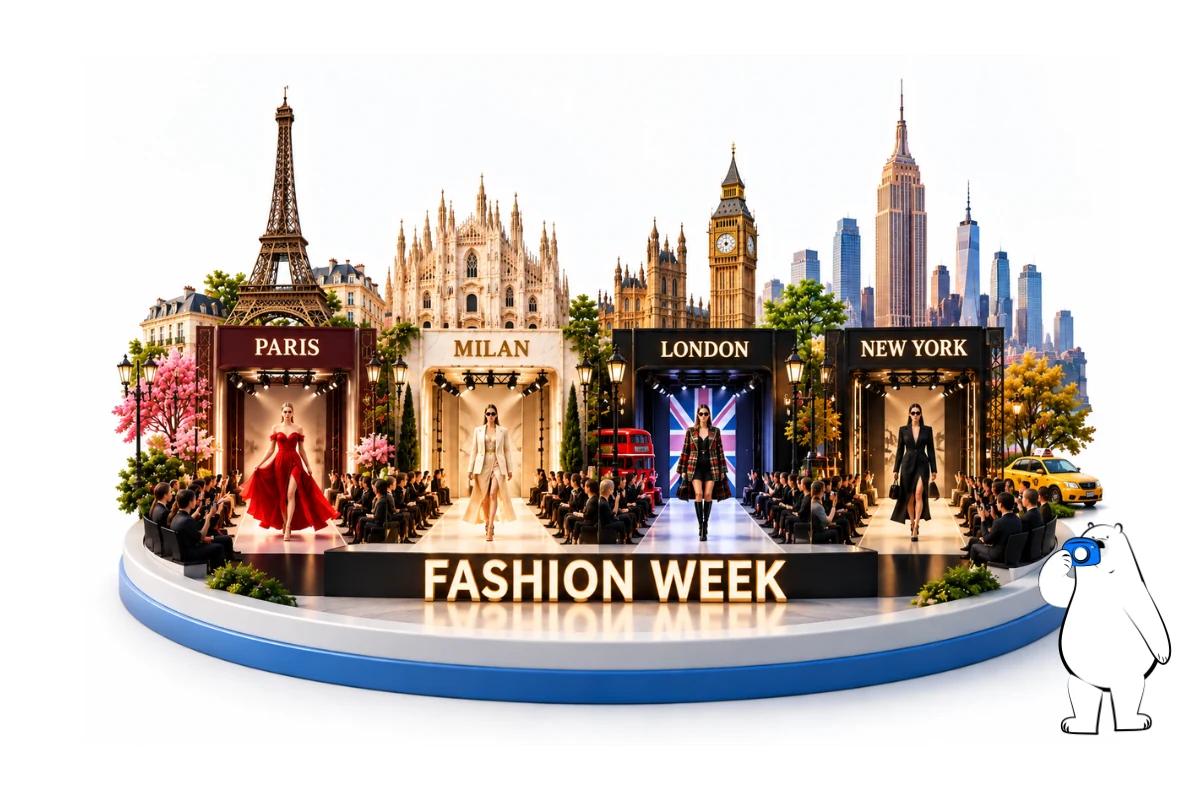
Paris is the city most traditionally associated with the title fashion capital of the world, but international fashion has four long-established centers: Paris, Milan, London and New York. Together, they are commonly described as fashion’s Big Four.
Each became influential for a different reason. Paris built its reputation around haute couture and luxury craftsmanship. Milan became a leading center of Italian ready-to-wear and luxury production. London developed an identity shaped by tailoring, design education and subculture. New York became a major center of American fashion through its designers, retailers, media and garment industry.
For travelers, those differences extend well beyond runway shows. They can be seen in shopping streets, department stores, ateliers, historic fashion districts and neighborhoods where clothing and design have become part of the city’s identity.
The Four Fashion Capitals Of The World
The traditional Big Four fashion capitals are New York, London, Milan and Paris.
Paris is best known for haute couture and French luxury. Milan is strongly associated with Italian design, craftsmanship and ready-to-wear. London combines bespoke tailoring with experimental fashion, while New York is closely tied to American sportswear, retail and commercial fashion.
All four host major Fashion Weeks. Their main womenswear events form the traditional Fashion Month circuit, usually following the sequence New York, London, Milan and Paris.
These identities are not rigid. Paris also has streetwear and independent designers, London has major luxury houses, Milan has experimental fashion, and New York has high-end craftsmanship. Their reputations reflect the traditions that helped each city become internationally influential.
Paris: Haute Couture And French Luxury
Paris has one of the strongest historical claims to the title fashion capital of the world.
The modern couture system began taking shape during the 19th century. The Fédération de la Haute Couture et de la Mode traces the development of haute couture to Charles Frederick Worth, who established his couture house at 7 Rue de la Paix in Paris in 1858.
In 1945, Haute Couture became a legally controlled designation in France. Only houses approved under the official criteria may use the Haute Couture designation.
This formal system helped strengthen Paris as a center where designers, specialist ateliers, fashion houses, craftspeople and luxury clients operated within the same industry.
Paris Fashion Week
The Fédération de la Haute Couture et de la Mode traces Paris Fashion Week to 1974. The organization now coordinates official womenswear and menswear calendars alongside the separate Haute Couture Week calendar.
Most runway shows are professional industry events rather than public attractions. Fashion activity can still spread beyond the official shows through exhibitions, store events, launches and other programs around Paris.
Fashion Week can increase demand around major luxury districts, hotels and restaurants. Travelers visiting specifically for the event should check the official FHCM calendars before arranging their trip because dates and schedules change each season.
Famous French fashion brands associated with Paris
Paris is closely tied to many of the most influential names in French fashion.
Chanel became one of the defining French fashion houses of the 20th century and remains closely associated with Parisian luxury.
Christian Dior established his fashion house in Paris in 1946, with his first collection presented the following year. The historic address at 30 Avenue Montaigne remains central to Dior’s identity.
Hermès traces its history to 1837, when Thierry Hermès opened a harness workshop in Paris before the business expanded into leather goods, fashion and other luxury products.
Louis Vuitton established his business in Paris in 1854, initially becoming known for trunks and packing.
Yves Saint Laurent, Givenchy, Celine, Balmain and Lanvin further strengthen the connection between Paris and French fashion.
Paris Fashion Week itself is international. Designers and houses participating in the city’s fashion calendar do not have to be French, and that international reach is part of Paris’s continuing influence.
Fashion districts in Paris
For luxury fashion, start around Avenue Montaigne and the surrounding Golden Triangle, where French and international houses operate major boutiques.
Rue Saint-Honoré has another dense concentration of designer fashion. Le Marais offers a broader mix of contemporary boutiques, vintage fashion and independent stores.
Boulevard Haussmann is home to major department stores including Galeries Lafayette and Printemps.
Travelers combining shopping with sightseeing can use Eskimo’s Paris attractions for first-time visitors to plan fashion districts alongside nearby landmarks.
Milan: Italian Fashion And Craftsmanship
Milan is a leading center of Italy’s modern fashion industry, bringing together design, commerce, luxury retail and links to the country’s wider manufacturing network.
Italy’s fashion history extends beyond Milan. Florence and Rome have also played important roles, but Milan became increasingly influential as Italian ready-to-wear expanded internationally during the second half of the 20th century.
The Camera Nazionale della Moda Italiana traces its institutional origins to 1958, when its predecessor was founded in Rome. Today, the organization is based in Milan and coordinates the city’s major fashion calendars.
Milan Fashion Week
Milano Fashion Week operates around official calendars coordinated by the Camera Nazionale della Moda Italiana.
Women’s collections are generally presented during major editions around February or March and September, with separate menswear calendars. Exact dates vary by season.
Travelers should not assume that runway tickets can simply be purchased. CNMI states that official Milano Fashion Week events are accessible by invitation and warns against unauthorized third parties claiming to sell access.
Public exhibitions, store activations and other fashion-related events can still give visitors ways to experience the atmosphere surrounding Fashion Week.
Famous Italian fashion brands associated with Milan
Prada began in Milan in 1913, when Mario Prada and his brother opened the first Prada store in the Galleria Vittorio Emanuele II. The early business specialized in luxury goods and travel accessories.
Giorgio Armani founded his company in Milan in 1975 and became particularly influential through his approach to tailoring and ready-to-wear.
Versace was founded by Gianni Versace in 1978 and became closely associated with Milan while developing its distinctive approach to Italian luxury fashion.
Dolce & Gabbana was founded in 1985 and became another major fashion house strongly connected with the city.
Moschino also has longstanding links with Milan.
Not every Italian label appearing at Milan Fashion Week was founded in Milan. The event represents the wider Italian and international fashion industry, so brands founded in the city should be distinguished from Italian labels originating elsewhere.
Fashion districts in Milan
The essential luxury fashion district is the Quadrilatero della Moda.
It is centered around Via Montenapoleone, Via della Spiga, Via Manzoni and Corso Venezia, with boutiques and showrooms extending through surrounding streets.
Nearby, the Galleria Vittorio Emanuele II combines historic architecture with luxury retail beside the Duomo.
Brera presents another side of Milan, with boutiques, galleries and design stores in a less formal setting.
Milan also appears among Eskimo’s best shopping destinations in the world, alongside Paris, London and New York.
London: Tailoring, Subculture And New Design
London’s fashion identity is built on contrasts.
Savile Row represents a long tradition of bespoke tailoring and specialist craftsmanship. Elsewhere, youth culture, music, design schools and independent designers have repeatedly pushed British fashion in new directions.
The result is a city where traditional tailoring, luxury fashion, street style and experimental design exist within the same fashion ecosystem.
London Fashion Week
London Fashion Week began in 1984 and marked its 40th anniversary in 2024.
The British Fashion Council uses the event to showcase established designers alongside emerging fashion talent.
Fashion Week activity can extend beyond invitation-only presentations. During the 40th-anniversary celebrations in February 2024, the BFC’s City Wide Celebration included hundreds of events and activations involving shops and brands across London.
Programs change each season, so travelers visiting specifically for Fashion Week should check the official BFC schedule before booking around a particular event.
Get Eskimo eSIM to stay connected globally
Need internet while travelling? Here's what we recommend:

Fixed data plans
- No speed reduction
- No expiry, keep your data forever
- Transfer data to anyone
- Personal hotspot


Famous British fashion brands associated with London
Burberry is one of Britain’s most recognizable luxury brands. Thomas Burberry founded the company in Basingstoke in 1856 rather than London, although the brand later developed a strong relationship with the capital.
Alexander McQueen was born in London and studied at Central Saint Martins after developing his tailoring skills in the city. His work became known for combining technical construction with dramatic runway presentation.
Vivienne Westwood became closely connected with London’s punk movement. Beginning in the early 1970s, Westwood and Malcolm McLaren operated influential shops at 430 King’s Road, an address closely associated with the development of punk fashion.
Stella McCartney has strong London connections and became a major name in contemporary British luxury.
Paul Smith originated in Nottingham rather than London, another reminder that British fashion and London fashion are closely related but not identical.
London’s importance developed through the convergence of designers, fashion schools, retailers, media, tailoring traditions and cultural movements.
Fashion districts in London
Begin with Savile Row for bespoke tailoring and nearby Bond Street for luxury fashion.
Carnaby retains strong connections with the fashion and popular culture of the 1960s while continuing to operate as a major shopping area.
King’s Road occupies an important place in London’s countercultural fashion history, while Soho and Covent Garden combine international labels with smaller retailers.
Vintage shoppers can also explore markets and specialist stores around the city. Eskimo’s overview of famous flea and street markets around the world includes London’s Portobello Road, known for antiques, collectibles and vintage finds.
New York: American Fashion And Commercial Power
New York developed into a major center of American fashion through its combination of design, manufacturing, retail, media and commerce.
By the 20th century, Manhattan had a substantial garment industry. The Garment District concentrated factories, showrooms, pattern makers, suppliers and designers within a relatively small part of Midtown.
New York City’s economic development authorities continue to describe the city as a center of the US fashion industry, supported by its concentration of designers, retailers and fashion businesses.
New York Fashion Week
Publicist Eleanor Lambert was a central figure in the development of New York’s fashion calendar.
In 1943, Lambert organized Fashion Press Week to promote American designers while World War II disrupted access to the European fashion industry.
The Council of Fashion Designers of America identifies Fashion Press Week as an important predecessor of modern New York Fashion Week.
During the 1990s, many runway shows were centralized through the 7th on Sixth initiative at Bryant Park. The CFDA acquired the Fashion Calendar in 2014 and has independently managed the official New York Fashion Week schedule since 2015.
Famous American fashion brands associated with New York
Ralph Lauren began building his fashion business in New York during the late 1960s before developing one of the most internationally recognized American lifestyle brands.
Calvin Klein was founded in New York City in 1968 and became influential across ready-to-wear, denim, underwear and fragrance.
Donna Karan developed fashion closely associated with the wardrobe of working urban women.
Marc Jacobs was born in New York and became one of the best-known American designers of his generation.
Michael Kors, Tory Burch and Coach also have major connections with New York’s fashion industry.
American fashion extends far beyond these brands, but New York provided designers with access to an unusually concentrated combination of retailers, fashion media and commercial infrastructure.
Fashion districts in New York
The Garment District is the historical starting point for travelers interested in the business behind American fashion.
Manufacturing in the neighborhood has declined from its peak, but the area retains connections with showrooms, suppliers and specialist garment businesses.
In August 2025, the New York City Landmarks Preservation Commission designated five garment-industry-related buildings in Midtown South as individual landmarks, recognizing their significance to New York’s garment history.
For shopping, Fifth Avenue and Madison Avenue remain major luxury retail corridors.
SoHo offers a broader combination of international fashion labels, contemporary brands and independent retail.
Travelers planning more than a shopping stop can pair these areas with Eskimo’s New York travel overview, which covers major neighborhoods and attractions across the city.
Fashion Month And The Big Four Circuit
The main womenswear Fashion Weeks traditionally follow this order:
New York → London → Milan → Paris
Together, this sequence is commonly referred to as Fashion Month.
Designers, buyers, editors, journalists, stylists and other industry professionals move between the four cities as collections are presented for upcoming seasons.
Exact dates change each season. Travelers planning around the events should check the official calendars from the CFDA, British Fashion Council, Camera Nazionale della Moda Italiana and Fédération de la Haute Couture et de la Mode before booking flights or hotels.
Fashion Week can increase demand for hotels and restaurant reservations and bring additional activity to major shopping districts, particularly around event venues and central fashion areas.
Choosing A Fashion Capital To Visit
Paris is particularly suited to travelers interested in haute couture, French luxury houses, historic department stores and the history of designer fashion.
Milan suits travelers interested in Italian luxury, craftsmanship and concentrated high-end shopping around the Quadrilatero della Moda.
London offers a strong contrast between traditional tailoring, vintage fashion, youth culture and experimental design.
New York combines American fashion history with major retail districts, contemporary brands and the legacy of the Garment District.
A multi-city trip is particularly practical between London, Paris and Milan. Eurostar directly connects London and Paris, while Milan can be added by air or as part of a longer journey through continental Europe.
New York generally works better as a separate transatlantic leg unless the itinerary is specifically organized around the Fashion Month circuit.
Fashion Cities Beyond The Big Four
The Big Four are not the only cities with international fashion influence.
Tokyo has a major avant-garde and street-fashion tradition. Seoul has developed a large contemporary fashion and retail scene, while Copenhagen has built international recognition around Scandinavian design and Copenhagen Fashion Week.
Shanghai, Florence and Antwerp also have significant fashion industries, design traditions, schools or events.
The term Big Four fashion capitals remains specifically associated with New York, London, Milan and Paris because of their long-established industries and positions within the international Fashion Week calendar.
Mobile Data Across The Four Fashion Capitals
Mobile data is particularly useful on a multi-city fashion trip for metro and rail tickets, store directions, restaurant reservations and checking Fashion Week schedules while moving between neighborhoods. Reception is generally stronger in populated city areas, although signal can weaken in underground stations, basements and dense indoor venues.
An Eskimo Global eSIM plan currently covers 126 countries and is designed for multi-country travel. Check the current Global plan destination list before booking to confirm every country on your itinerary. Eskimo also offers country and regional plans beyond destinations included in the Global plan. Fixed data plans do not expire, so unused data can remain available for another eligible trip.
New users can also claim a free 250MB Global eSIM.
FAQs:
What is the fashion capital of the world?
Paris is the city most traditionally associated with the title fashion capital of the world because of its haute couture history and concentration of major luxury houses. Modern international fashion is also strongly centered on Milan, London and New York.
What are the Big Four fashion capitals?
The traditional Big Four fashion capitals are New York, London, Milan and Paris. All four have influential fashion industries and host major international Fashion Weeks.
Which fashion capital is best for luxury shopping?
Paris and Milan have particularly high concentrations of luxury boutiques and flagship stores. London and New York also have major luxury districts alongside broader contemporary, heritage and independent shopping.
What is the order of Fashion Month?
The traditional main womenswear Fashion Month sequence is New York, London, Milan and Paris. Exact dates vary by season.
Can travelers attend Fashion Week?
Most major runway shows require invitations or industry accreditation. Public exhibitions, brand activations, store events and other fashion programs may be available depending on the city and season.