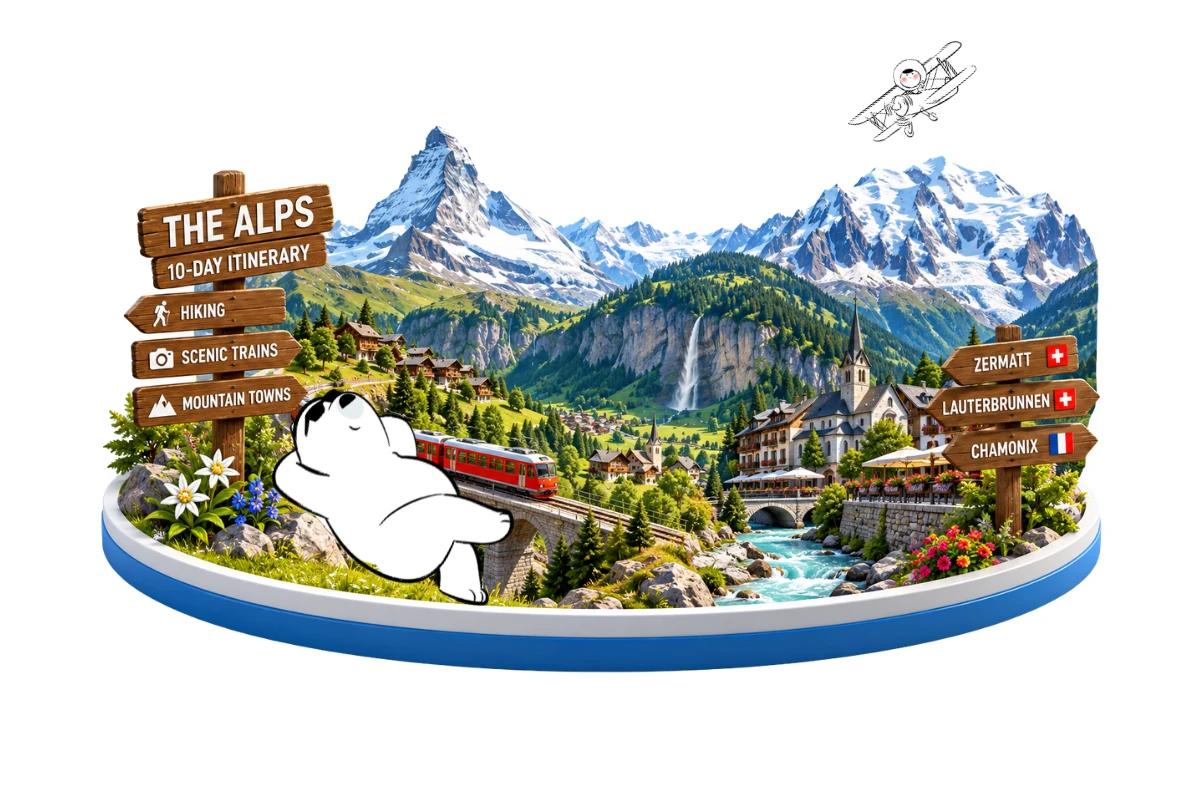
A first Alps trip works best when you limit the route to two countries and three main bases rather than changing hotels every day. For 10 days, a practical route is Lauterbrunnen in the Swiss Alps, Zermatt beneath the Matterhorn, then Chamonix in the French Alps.
This route keeps most long transfers on rail, gives you several full mountain days and still covers two very different parts of the Alps. It suits first-time visitors who care more about scenery, hiking, trains and mountain towns than large cities.
The biggest limitation is weather. Mountain railways, cable cars and hiking conditions can change quickly, so build flexibility into high-altitude days rather than tying every hour to a fixed attraction.
Where The Alps Are
The Alps stretch across eight countries: Austria, France, Germany, Italy, Liechtenstein, Monaco, Slovenia and Switzerland, according to the Alpine Convention.
For a first 10-day trip, trying to represent every Alpine country usually creates too much transport and not enough time in the mountains. Switzerland and France work particularly well together because they offer dense rail connections, established Alpine bases and a logical cross-border progression from the Jungfrau Region through Valais toward Chamonix.
10-Day Alps Itinerary At A Glance
A practical route is:
- Days 1–3: Lauterbrunnen and the Jungfrau Region
- Days 4–6: Zermatt and the Matterhorn
- Day 7: Scenic rail journey toward Chamonix
- Days 8–10: Chamonix and the French Alps
Fly into Zurich or another convenient Swiss gateway and travel toward the Jungfrau Region on arrival day. For the return journey, Geneva is one of the most practical major airports for Chamonix.
This itinerary deliberately uses only three bases. Moving less often gives you room to adjust hiking and mountain excursions around weather.
Days 1–3: Lauterbrunnen And The Jungfrau Region
Day 1: Travel to Lauterbrunnen
Head to Lauterbrunnen via Interlaken Ost.
The official Jungfrau railway information directs rail passengers through Interlaken Ost for onward connections to Lauterbrunnen.
Keep the arrival day simple. Walk through the village, see Staubbach Falls and settle into the valley rather than immediately spending heavily on a high-mountain excursion.
Lauterbrunnen works particularly well as a base because trains, cable cars and mountain railways connect it with Wengen, Mürren and other parts of the Jungfrau Region.
Day 2: Wengen or Mürren
Use the second day for one side of the valley.
Wengen is reached by mountain railway, while Mürren can be reached through the cable-car and mountain-rail connection from Lauterbrunnen. Both give you elevated views above the valley without requiring a car.
Choose one rather than rushing between both villages.
If hiking conditions are good, use the day for a moderate trail. If clouds close in around the peaks, village walks and lower-elevation routes are easier to rearrange than a prepaid high-altitude excursion.
Day 3: Jungfraujoch or a lower mountain day
Jungfraujoch is the obvious high-altitude option, but it does not need to be automatic.
The current Jungfrau transport system connects Grindelwald Terminal with Jungfraujoch using the Eiger Express and Jungfrau Railway. Check visibility and operating information before committing, particularly because this is one of the more expensive excursions on the route.
If the weather is poor, use the day for Grindelwald, Wengen, Mürren or another lower-elevation walk instead.
Travelers visiting during a Swiss holiday period can also check Eskimo’s Switzerland public holidays 2026 overview before locking in busy mountain days.
Days 4–6: Zermatt And The Matterhorn
Day 4: Lauterbrunnen to Zermatt
Travel south toward Zermatt and use the transfer day as part of the experience rather than treating it as lost time.
Zermatt is car-free, so rail is the natural way to arrive. Once there, much of the village can be explored on foot, with local electric transport also available.
Keep the first evening open for a village walk and your first Matterhorn views, weather permitting.
Day 5: Gornergrat or Matterhorn viewpoints
Use your first full Zermatt day for the classic mountain panorama.
Gornergrat is one of the simplest choices if you want high-altitude Matterhorn views without building the day around a long hike. The Gornergrat Railway starts in Zermatt and climbs into the high mountains above the resort.
In suitable summer conditions, you can combine mountain transport with walking sections rather than riding both ways.
Do not book your most expensive mountain day simply because it falls on Day 5. If the forecast is much clearer the following day, swap the plan.
Day 6: Hiking or a slower Zermatt day
Use the second full day for hiking, another mountain excursion or a lower-cost village day.
This is where the itinerary earns its breathing room. A tightly packed Alpine route can become expensive quickly once cable cars, mountain railways and restaurant meals are added.
Rail enthusiasts extending their trip east can also compare the experience with Eskimo’s best luxury train trips, which includes the Glacier Express route between Zermatt and St. Moritz.
Day 7: Cross From Switzerland To Chamonix
Travel from Zermatt through the Valais toward Martigny, then continue toward Chamonix.
This is one of the more scenic transfer days in the itinerary. Official Chamonix transport information confirms that the Mont-Blanc Express connects the Chamonix Valley with Martigny on the Swiss side via Vallorcine.
Check the live timetable before traveling because engineering works and seasonal schedules can change connections.
Arrive in Chamonix without planning a major summit excursion that afternoon. A simple town walk, dinner and early night make more sense after several train connections.
Days 8–10: Chamonix And The French Alps
Day 8: Chamonix Valley and Mont Blanc views
Use your first full French Alps day to get oriented in the valley.
Chamonix sits at the foot of Mont Blanc and has local rail and bus links running through the valley. The official Chamonix transport information is useful for current train, bus and construction updates.
Choose a high viewpoint only if conditions justify it. Cloud can obscure high-mountain views quickly, so keep a lower-altitude alternative ready.
Day 9: Hiking or high-mountain excursion
In summer, Chamonix offers extensive opportunities for hiking and other mountain activities across the valley.
Pick a route suitable for your experience and check weather, trail status and lift operations before leaving. Snow can remain on higher routes even when the town feels warm.
If you are not a confident mountain hiker, use marked lower-elevation trails or lift-assisted walks rather than treating every Alpine path as a casual stroll.
Get Eskimo eSIM to stay connected globally
Need internet while travelling? Here's what we recommend:

Fixed data plans
- No speed reduction
- No expiry, keep your data forever
- Transfer data to anyone
- Personal hotspot


Day 10: Chamonix and onward travel
Keep the final day flexible.
If your flight leaves late, use the morning for a short valley walk or café stop. Otherwise, travel directly toward Geneva.
Official Chamonix tourism information lists Geneva International Airport as a nearby major gateway and provides information on coach, shuttle and other transport connections from the valley.
If your trip overlaps a French public holiday, Eskimo’s France public holidays 2026 overview can help you anticipate busy dates and possible changes to opening hours.
Best Things To Do In The Alps
The strongest Alpine trips combine mountain transport with time outside stations and viewpoints.
For this route, useful experiences include:
- Walking through Lauterbrunnen Valley
- Taking mountain railways to Wengen or higher viewpoints
- Hiking above Mürren or Grindelwald
- Seeing the Matterhorn from Zermatt
- Riding the Gornergrat Railway
- Traveling between mountain regions by rail
- Hiking in the Chamonix Valley
- Using cable cars selectively rather than buying every summit excursion
Try not to treat the Alps as a checklist of famous peaks. Weather often decides which experience will be best on a particular day.
Getting Around The Alps By Train And Car
You do not need a car for this 10-day itinerary.
The Swiss section is particularly well suited to rail travel. Lauterbrunnen connects through Interlaken, while Zermatt is car-free and designed around train access.
The Switzerland-to-France section can also be completed by rail through Martigny and the Mont-Blanc Express toward Chamonix.
A rental car becomes more useful on an itinerary focused on remote valleys, road passes or smaller villages away from railway lines. It can also create extra complications in destinations where parking is restricted or unnecessary.
For this route, trains remove the need to arrange a cross-border rental-car return and allow everyone in the group to enjoy the scenery.
Best Time To Visit The Alps
The best season depends on what you want to do.
June to September is generally the easiest period for a hiking-focused version of this itinerary. More high trails and mountain transport systems typically operate during summer, although exact opening dates depend on snow, weather and maintenance.
Late spring and early autumn can bring quieter trails and attractive scenery, but some lifts and high hiking routes may operate on reduced schedules or close between seasons.
Winter turns the same regions into ski destinations. A winter itinerary needs different pacing because daylight is shorter, hiking options change and ski-area transport becomes the priority.
Do not assume that a sunny forecast in a valley guarantees clear conditions at 3,000 metres. Mountain weather can differ substantially from conditions in Zurich, Geneva or other lower-altitude cities.
Alps Trip Costs
The Alps are not a cheap destination, and mountain transport can materially increase the budget.
Your main costs are likely to be:
- Accommodation in Lauterbrunnen, Zermatt and Chamonix
- Intercity and mountain railway tickets
- Cable cars and high-altitude excursions
- Restaurant meals
- Travel insurance suitable for your planned activities
Booking accommodation early is sensible in Zermatt, the Jungfrau Region and Chamonix during popular summer periods and ski-season peaks.
Before buying a rail pass, compare its coverage against the exact mountain journeys you expect to take. Some high-mountain railways and cable cars use separate fares or offer discounts rather than full inclusion.
How Much Time You Need In The Alps
Seven days can work, but you will need to remove a base.
For a one-week trip, choose either Lauterbrunnen plus Zermatt or one Swiss base plus Chamonix rather than squeezing all three into a rushed schedule.
Ten days is the better balance for a first Swiss and French Alps trip. It gives you several complete mountain days and enough flexibility to move activities when weather changes without turning every transfer into a rushed travel day.
With 14 days, you can slow the route further or add another region, such as Lake Geneva, the eastern Swiss Alps, northern Italy or Austria.
Mobile Data Across The Alps
Mobile data helps with digital train tickets, platform changes, mountain-weather forecasts and hiking maps throughout this route. Coverage is generally stronger in towns, resorts and along major transport corridors, while signal may weaken in railway tunnels, narrow valleys, remote hiking areas and high mountain terrain.
An Eskimo Europe eSIM plan can provide data across the Swiss and French sections of the trip. Eskimo’s broader network extends across 175 countries and regions overall, which can be useful for European stopovers and future international trips. The universal eSIM means one reusable Eskimo eSIM can support eligible destinations without installing a new eSIM each time you cross a border.
New users can also claim a free 250MB Global eSIM.
FAQs:
Where are the Alps?
The Alps span eight countries: Austria, France, Germany, Italy, Liechtenstein, Monaco, Slovenia and Switzerland. They form one of Europe’s major mountain systems.
How many days do you need for the Alps?
Seven days works for one or two bases, while 10 days gives a first-time visitor enough time for three bases without changing hotels constantly. Two weeks allows a slower route or an additional Alpine region.
Can you travel the Alps by train?
Yes. Switzerland is particularly rail-friendly, and routes also cross into the French Alps. Lauterbrunnen, Zermatt and Chamonix can all be combined largely by train, although current schedules and engineering works should be checked before travel.
What is the best time to visit the Alps?
June to September is generally the easiest period for hiking and mountain sightseeing. Winter suits skiing, while late spring and autumn can be quieter but may have more limited high-altitude transport and trail access.
Should you visit the Swiss Alps or French Alps first?
For this route, starting in Switzerland works well because the Jungfrau Region and Zermatt connect naturally by rail before continuing west through Martigny toward Chamonix in France.