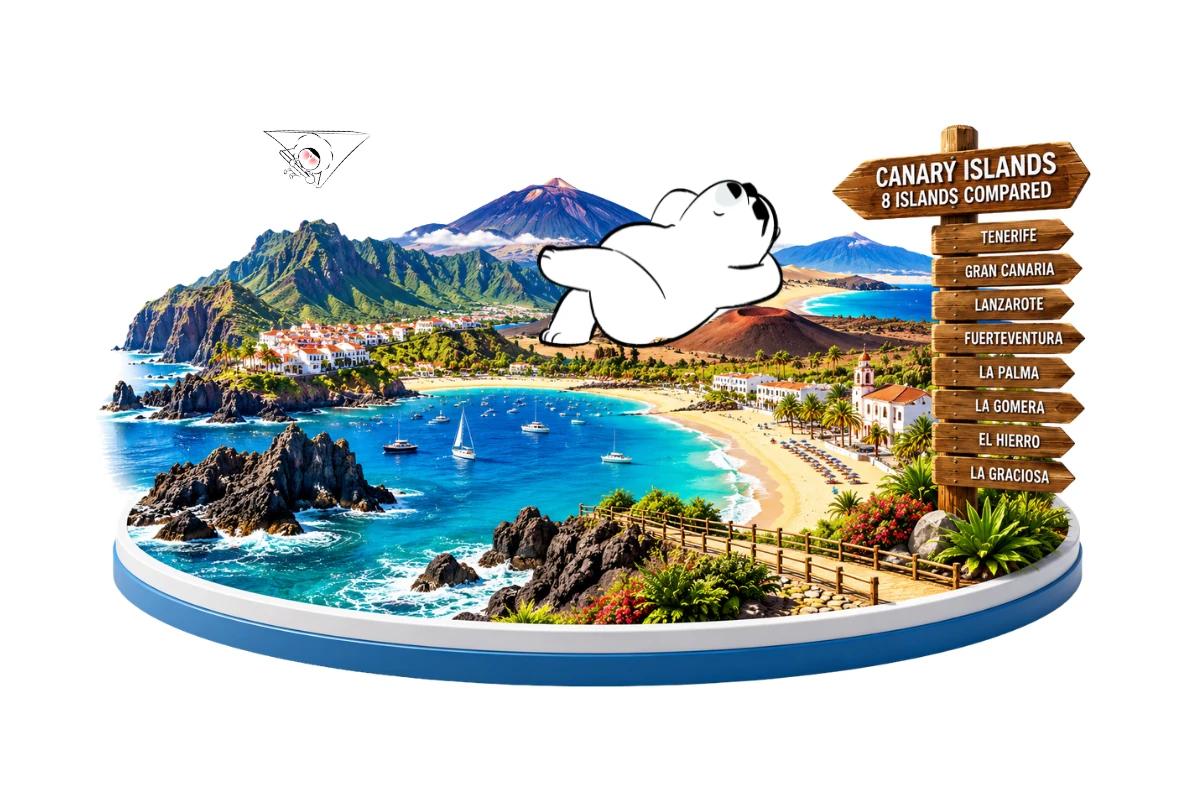
There is no single best Canary Island for every traveler. Tenerife is the strongest all-round choice for a first visit, Gran Canaria offers the widest mix of city, beach and mountain experiences, Lanzarote stands out for volcanic scenery, and Fuerteventura is the clearest choice for long beaches and wind sports. The smaller western islands make more sense if hiking, nature and a slower pace matter more than large resorts or nightlife.
The Canary Islands are a Spanish archipelago in the Atlantic Ocean. Spain’s official tourism website identifies eight islands: Tenerife, Gran Canaria, Fuerteventura, Lanzarote, La Palma, La Gomera, El Hierro and La Graciosa.
That variety means choosing the right island matters more than simply choosing “the Canaries.” A resort holiday in southern Tenerife feels very different from hiking on La Gomera, driving through Lanzarote’s lava landscapes or spending quiet beach days on La Graciosa.
Canary Islands At A Glance
The Canary Islands belong to Spain but have a climate and landscape shaped by their Atlantic location, volcanic origins and trade winds.
Official tourism information describes generally mild temperatures throughout the year, although conditions vary between islands, coasts and elevations. Mountainous islands can have much cooler and cloudier interiors while lower coastal areas remain warmer and sunnier.
Tenerife and Gran Canaria have the broadest mix of cities, resorts, beaches and mountain landscapes. Fuerteventura and Lanzarote feel more open and arid, while La Palma, La Gomera and El Hierro lean more heavily toward hiking and nature.
La Graciosa is the smallest and most stripped-back choice. Spain’s official tourism information describes it as an island without asphalted roads, making walking and cycling particularly important for getting around.
Travelers comparing the Canaries with other warm-weather European islands can also use Eskimo’s best European islands to visit to compare Tenerife with Mallorca, Madeira and other alternatives.
Choosing The Right Canary Island
Tenerife
Best for: First-time visitors, mixed itineraries, beaches, mountains and nightlife
Tenerife is the easiest island to recommend if you want several types of holiday without changing islands.
You can combine beach resorts in the south with historic towns, forested landscapes and Teide National Park. Mount Teide is Spain’s highest peak and creates a dramatic mountain centre that contrasts sharply with the island’s coastal resorts.
Tenerife also offers a broad accommodation range, making it practical for couples, families and groups with different priorities.
Choose Tenerife if you want beach days, hiking, sightseeing and evening entertainment to fit into the same week.
Gran Canaria
Best for: Variety, city life, beaches, mountain scenery and resorts
Gran Canaria is the strongest alternative to Tenerife for travelers who want several distinct experiences on one island.
The landscape changes from southern beaches and dunes to mountains, ravines and inland villages. Las Palmas de Gran Canaria also gives the island a genuine city dimension that many smaller Canary Islands do not have.
Choose Gran Canaria if you want urban energy, beach time and scenic driving without making the holiday entirely resort-based.
Lanzarote
Best for: Volcanic landscapes, architecture, road trips and distinctive scenery
Lanzarote feels visually different from the larger resort islands.
Its strongest appeal is the combination of lava fields, volcanic cones, low-rise settlements and landscapes shaped by eruptions. Timanfaya National Park is one of the major volcanic landmarks highlighted by Spain’s official tourism website.
The island works particularly well for travelers who enjoy driving between viewpoints, volcanic sites, beaches and smaller towns.
Choose Lanzarote if scenery and atmosphere matter more than nightlife.
Fuerteventura
Best for: Beaches, surfing, windsurfing, kitesurfing and open landscapes
Fuerteventura is the island to prioritize if the beach is doing most of the work.
The island has an open, dry landscape and long stretches of coastline. Its official tourism information highlights trade winds that help make the island particularly suitable for windsurfing and kitesurfing.
Fuerteventura is less about packed sightseeing itineraries and more about beaches, water sports, coastal driving and space.
Choose it if you would happily trade major cities and busy nightlife for long beach days.
La Palma
Best for: Hiking, stargazing, volcanic scenery and active trips
La Palma suits travelers whose ideal island holiday involves walking shoes more often than beach loungers.
Its steep volcanic landscapes, forests and high-elevation terrain make it a strong choice for hiking-focused trips. The island also has a strong reputation for dark-sky observation and stargazing.
Driving can take longer than distances suggest because of mountain roads and elevation changes, so La Palma rewards slower travel.
Choose it if nature is the main reason for your trip.
La Gomera
Best for: Hiking, forests, valleys and quieter travel
La Gomera is smaller and less resort-driven than Tenerife or Gran Canaria.
Its identity is closely tied to dramatic ravines, mountain roads and laurel forest. Garajonay National Park forms the natural centrepiece of the island and is one of the archipelago’s major protected landscapes.
Many travelers reach La Gomera by ferry from Tenerife, making the two islands relatively easy to combine.
Choose La Gomera if hiking and scenery matter more than beaches or nightlife.
El Hierro
Best for: Remote nature, diving and very slow travel
El Hierro suits travelers who actively want somewhere quieter and less developed.
Its appeal comes from volcanic coastline, natural pools, diving and small-scale island life. Ferry connections with Tenerife are available, although reaching El Hierro generally requires more planning than arriving on Tenerife, Gran Canaria or Lanzarote.
Choose El Hierro if its relative isolation is part of the attraction rather than an inconvenience.
Get Eskimo eSIM to stay connected globally
Need internet while travelling? Here's what we recommend:

Fixed data plans
- No speed reduction
- No expiry, keep your data forever
- Transfer data to anyone
- Personal hotspot


La Graciosa
Best for: Quiet beaches, cycling, walking and a minimalist island escape
La Graciosa is the most stripped-back option in the archipelago.
The island has no asphalted roads and relatively little development. Beaches, walking and cycling form a much larger part of the experience than major attractions or resort facilities.
Boats connect La Graciosa with Lanzarote, making it particularly suitable as a side trip or short stay.
Choose La Graciosa if your ideal island day involves walking, cycling, swimming and keeping the schedule light.
Best Canary Islands For Beaches
Fuerteventura is the strongest choice if beach quality and space are your main priorities. Its long coastline and open landscapes create a more beach-focused holiday than La Palma or La Gomera.
Gran Canaria works better if you want beaches combined with restaurants, nightlife, city life and mountain trips. Its southern coast has established resort areas, while the interior and north provide a more rugged contrast.
Tenerife also works well for travelers who want plenty of beach time without making the entire trip revolve around the coast.
Lanzarote suits travelers who prefer volcanic surroundings and smaller coastal stops alongside their beach days.
Best Canary Islands For Hiking And Nature
La Palma and La Gomera are the strongest choices if hiking is the central reason for traveling.
La Palma combines volcanic terrain, forests and high-elevation landscapes. La Gomera is more compact, with deep ravines and laurel forest shaping much of the island experience.
Tenerife is the most flexible option for travelers who want serious mountain scenery without giving up beaches, resorts and nightlife.
El Hierro is quieter still and suits walkers who prefer remote landscapes with fewer major tourism centres.
Best Canary Islands For Nightlife And Resorts
Tenerife has the broadest combination of large resorts, restaurants, nightlife and daytime activities.
Gran Canaria is another strong option, particularly if you want to combine resort areas with Las Palmas and the mountainous interior.
Lanzarote and Fuerteventura both have established resort zones but generally suit travelers looking for a calmer evening rhythm.
La Palma, La Gomera, El Hierro and La Graciosa are better choices if nightlife is low on your priority list.
Canary Islands Weather And Best Time To Visit
The Canary Islands work as year-round destinations because temperatures generally remain mild and the seasonal contrast is less extreme than in much of mainland Europe.
Official tourism information describes mild winters and warm summers, although local conditions depend on island, altitude, terrain and exposure to the trade winds.
Winter is especially attractive for travelers escaping colder European weather, while spring and autumn work well for hiking, sightseeing and road trips.
Summer suits beach holidays and water sports. Wind can be more noticeable in exposed areas, particularly on Fuerteventura.
Do not assume every island has identical weather. Tenerife, Gran Canaria and La Palma can have very different conditions between their coasts and high mountain areas. Sunshine at sea level can coexist with cloud, stronger wind or substantially cooler temperatures inland.
If your dates overlap national or regional celebrations, Eskimo’s Spain public holidays 2026 overview can help with wider trip planning.
Getting Around The Canary Islands
Flying is generally the fastest option for longer inter-island journeys, while ferries are particularly useful between nearby islands.
Current Fred. Olsen Express information lists crossings between Lanzarote and Fuerteventura as short as roughly 25 to 35 minutes, depending on the service. Tenerife to La Gomera can take around 50 minutes on current fast-ferry services.
Other useful ferry links include Tenerife with Gran Canaria, La Palma and El Hierro.
Do not plan island hopping as though every change is a quick transfer. Reaching the port, checking in, boarding, collecting a rental car and traveling to your next accommodation can turn a short crossing into a substantial part of the day.
Hiring a car is particularly useful on Tenerife, Gran Canaria, Lanzarote, Fuerteventura and La Palma if you want to explore beyond resort areas.
How Many Days To Spend In The Canary Islands
For most first trips, one island for five to seven nights is easier and more rewarding than trying to collect several islands in a single week.
A seven-night Tenerife or Gran Canaria trip gives you enough time for beaches, inland scenery and several day trips without constant repacking.
With around 10 to 14 nights, combining two islands becomes much more practical. Tenerife and La Gomera work well together, as do Lanzarote and Fuerteventura, because their ferry connections are relatively straightforward.
Trying to visit three or four islands during a short holiday usually creates more transfer time than meaningful exploration.
Mobile Data Across The Canary Islands
Mobile data is useful for checking ferry schedules, inter-island flight updates, driving routes, hiking maps and changing weather conditions. Reception is generally stronger in towns, resorts and along major roads, while signal can vary in mountain areas, valleys, remote trails and less populated stretches of coastline.
An Eskimo Spain eSIM plan can provide data across a Canary Islands trip. Eskimo’s broader network extends across 175 countries and regions overall, which is useful if the Canaries are part of a wider Spain, Europe or international itinerary. No-expiry fixed data means unused data can remain available for a later trip instead of needing to be used before leaving the islands.
New users can also claim a free 250MB Global eSIM.
FAQs:
Where are the Canary Islands?
The Canary Islands are a Spanish archipelago in the Atlantic Ocean, southwest of mainland Spain and northwest of Africa.
Which Canary Island is best for first-time visitors?
Tenerife is the easiest all-round choice for many first-time visitors because it combines beaches, Mount Teide, resorts, towns, hiking and nightlife without requiring an island change.
Which Canary Island has the best beaches?
Fuerteventura is the strongest choice if long beaches, surfing and wind sports are your priorities. Gran Canaria and Tenerife are better if you want beaches combined with larger resorts, restaurants and more varied sightseeing.
What is the weather like in the Canary Islands?
The Canary Islands generally have mild temperatures throughout the year, with warm summers and mild winters. Conditions still vary by island, altitude and exposure, particularly in mountainous areas.
How many Canary Islands are there?
Spain’s official tourism website identifies eight Canary Islands: Tenerife, Gran Canaria, Fuerteventura, Lanzarote, La Palma, La Gomera, El Hierro and La Graciosa.