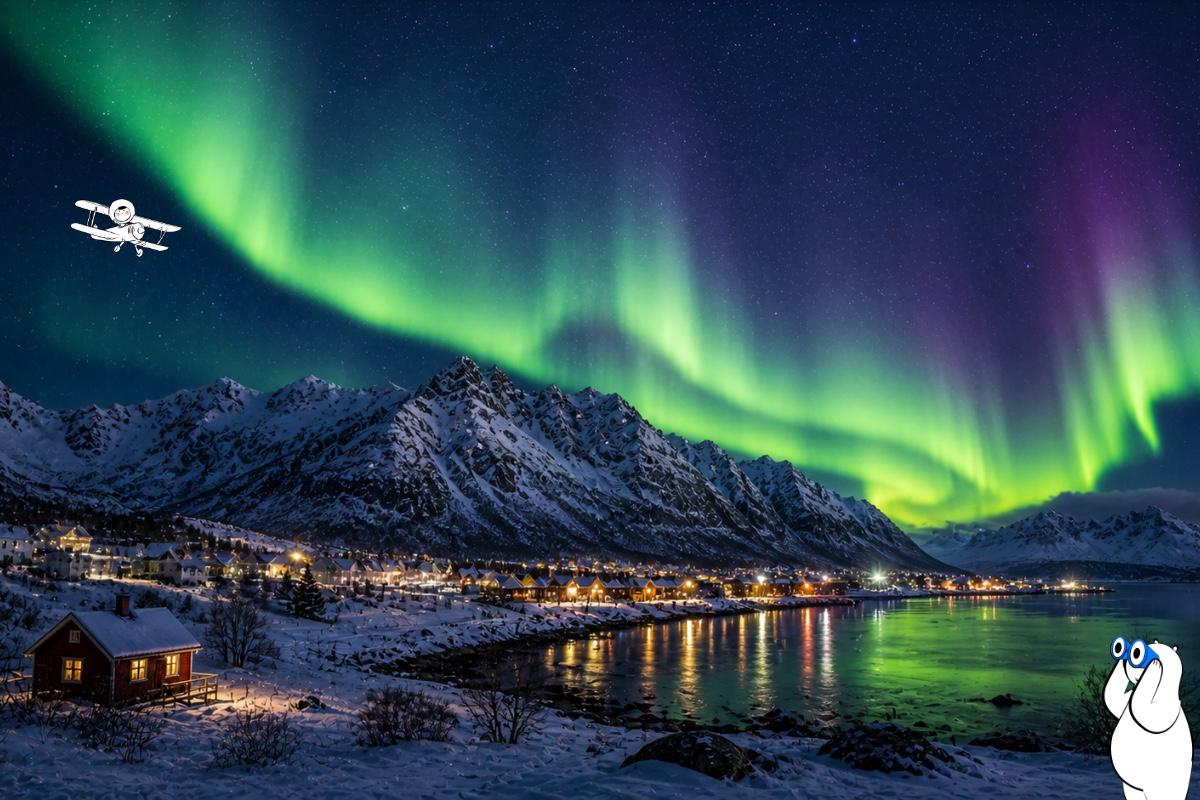
The best places to see northern lights are northern cities and towns close to the auroral oval, with long dark nights, clear skies, and easy access to darker viewing areas. Strong choices include Tromsø, Alta, Rovaniemi, Abisko, Reykjavik, Fairbanks, Yellowknife, Whitehorse, Kangerlussuaq, Longyearbyen, Murmansk, and several remote Arctic towns across Russia.
The northern lights are never guaranteed. You need darkness, clear weather, low light pollution, and active space weather. A good base gives you more nights to try, more ways to move away from clouds, and enough winter activities to make the trip worthwhile even when the sky stays quiet.
Best Places to See Northern Lights in Europe
1. Tromsø, Norway
Tromsø is one of the easiest Arctic cities to see northern lights. It sits in northern Norway, has frequent aurora tours, and gives travelers quick access to darker fjords and valleys outside the city. Visit Tromsø describes the city as one of the best places in the world to see the northern lights.
Best for: first-time aurora trips, guided tours, restaurants, and winter activities.
2. Alta, Norway
Alta calls itself the City of Northern Lights, and it is a quieter alternative to Tromsø. It works well for travelers who want Arctic landscapes, snow activities, and a less crowded base in northern Norway. Visit Alta also uses “city of northern lights” in its official destination branding.
Best for: a calmer Norway aurora trip with a strong Arctic character.
3. Narvik, Norway
Narvik is useful for travelers who want mountains, fjords, skiing, and northern lights in one trip. It is less famous than Tromsø, but its northern location and dramatic scenery make it a practical base when conditions are clear.
Best for: fjords, rail journeys, skiing, and a less obvious Norway route.
4. Bodø, Norway
Bodø is farther south than Tromsø and Alta, so aurora chances are lower. It can still work during active periods, especially if you leave the brighter city areas. Visit Norway includes Bodø among Arctic destinations for northern lights experiences in Northern Norway.
Best for: travelers pairing northern lights attempts with coastal Norway.
5. Longyearbyen, Svalbard
Longyearbyen is remote, expensive, and unforgettable. During Svalbard’s polar night, darkness can last through the day, which makes aurora viewing possible at unusual hours when conditions are right. Visit Svalbard says northern lights can even be seen at midday during the Polar Night.
Best for: rare Arctic travel, polar night, and adventure-focused trips.
6. Rovaniemi, Finland
Rovaniemi is the most accessible Lapland base for families and first-time visitors. It offers northern lights tours, snowy forests, reindeer experiences, and easy winter logistics. Visit Rovaniemi actively promotes northern lights experiences in Lapland.
Best for: families, Lapland cabins, Santa Claus Village, and soft adventure.
7. Levi, Finland
Levi is a ski resort town in Finnish Lapland where northern lights can be paired with skiing, snowmobiling, cabins, and glass-roof stays. The official Levi tourism site notes that auroras can begin when evenings darken in August, though winter offers longer nights.
Best for: skiing, resort comfort, and winter activities.
8. Inari, Finland
Inari is quieter and farther north than Rovaniemi. It has darker surroundings, lakeside stays, Sámi culture, and strong wilderness appeal. Visit Inari notes that clear and dark skies give the best chance of seeing northern lights.
Best for: quiet Lapland, culture, and darker skies.
9. Ivalo and Saariselkä, Finland
Ivalo and Saariselkä are practical northern Finland bases with airport access, resorts, cabins, and open wilderness nearby. Saariselkä is especially useful for travelers who want comfort without staying in a larger town.
Best for: couples, cabins, glass-roof stays, and less light pollution.
10. Abisko, Sweden
Abisko is one of Sweden’s strongest aurora bases, known for dark skies, mountain scenery, and access to Abisko National Park. Visit Sweden includes Abisko among the best places for northern lights in Arctic Sweden.
Best for: serious aurora watching, photography, and quiet landscapes.
11. Kiruna, Sweden
Kiruna has airport access, winter tours, and easy links to Abisko and nearby aurora areas. It is also a useful base for travelers interested in ice hotels and Arctic accommodation.
Best for: Swedish Lapland, ice hotels, and easy regional connections.
12. Reykjavik, Iceland
Reykjavik is not the darkest aurora base, but it is one of the easiest to reach. Many travelers stay in the capital and join evening tours to darker places outside the city. It also works well with a wider Iceland trip
Best for: first-time Iceland trips, easy flights, and flexible day tours.
13. Akureyri, Iceland
Akureyri is a stronger northern Iceland base than Reykjavik for travelers who want quieter surroundings. Visit Akureyri, says northern lights can often be seen in North Iceland from late August through April on clear, dark nights.
Best for: North Iceland scenery, smaller-city comfort, and road trips.
14. Húsavík, Iceland
Húsavík is a small coastal town in North Iceland with darker surroundings than the capital. It suits travelers who want a slower winter trip, open skies, and access to northern Iceland’s landscapes.
Best for: quiet coastal stays and a slower Iceland route.
15. Murmansk, Russia
Murmansk is above the Arctic Circle and is one of Russia’s better-known northern lights bases. Nearby areas such as Teriberka and Kirovsk are often included in regional winter routes. The Murmansk region’s tourism site highlights Teriberka and Kirovsk as key places to visit in the region.
Best for: travelers who have checked current entry rules, flight access, and official travel advice.
16. Teriberka, Russia
Teriberka sits on the Barents Sea coast and is often used for aurora trips from Murmansk. It is more remote and weather-exposed than the city, but the open coastal setting can be dramatic in winter.
Best for: Arctic coast scenery and guided trips from Murmansk.
17. Kirovsk, Russia
Kirovsk is located on the Kola Peninsula and can work for winter trips that combine snow, mountains, and aurora hunting. It is less straightforward for many international travelers than Nordic destinations, so current travel conditions matter.
Best for: mountain scenery and a more niche Russia route.
Best Places to See Northern Lights in North America
1. Fairbanks, Alaska
Fairbanks is one of North America’s strongest northern lights bases. It sits under the auroral oval, has aurora lodges and tours, and offers hot springs and winter activities nearby. Explore Fairbanks lists its aurora season as August 21 to April 21.
Best for: high aurora potential, hot springs, and U.S.-based travelers.
Get Eskimo eSIM to stay connected globally
Need internet? Here's what we recommend:

Fixed data plans
- No speed reduction
- No expiry, keep your data forever
- Transfer data to anyone
- Personal hotspot


2. Anchorage, Alaska
Anchorage is more accessible than Fairbanks, but aurora chances are usually better farther north or away from city lights. The official Anchorage tourism site says the aurora can be seen near Anchorage from late September to mid-April.
Best for: travelers who want Alaska with easier flights and broader trip options.
3. Yellowknife, Canada
Yellowknife is one of the most famous aurora destinations in Canada. The City of Yellowknife says mid-November to early April is usually the best period, with late summer to early autumn also offering chances.
Best for: strong aurora odds, dedicated viewing tours, and cold-weather adventure.
4. Whitehorse, Canada
Whitehorse is a practical Yukon base with tours, hot springs, winter landscapes, and easier logistics than some remote northern towns. The best viewing usually happens outside the city, where the sky is darker.
Best for: Yukon scenery, road-trip energy, and a softer Arctic experience.
5. Churchill, Canada
Churchill is best known for polar bears, but it can also be a northern lights destination. It is remote and seasonal, so it works best for travelers who want a specialist nature trip rather than a simple city break.
Best for: wildlife-focused travelers and remote northern Canada.
6. Dawson City, Canada
Dawson City has dark skies, historic character, and a remote Yukon setting. It is more niche than Whitehorse, but it can be a rewarding winter base for travelers who want somewhere less expected.
Best for: history, dark skies, and adventurous Yukon travel.
7. Kangerlussuaq, Greenland
Kangerlussuaq is one of Greenland’s stronger aurora bases because it is inland, with a drier climate than many coastal towns. Visit Greenland promotes the country as a northern lights destination, and Kangerlussuaq is widely used for aurora-focused trips.
Best for: Greenland aurora trips, ice sheet access, and remote landscapes.
8. Nuuk, Greenland
Nuuk gives travelers a capital-city base with access to Greenlandic culture, tours, and nearby dark-sky areas. Visit Nuuk highlights northern lights viewing in Greenland’s capital, with the best results away from bright lights.
Best for: Greenland with more services, culture, and easier urban comfort.
Best Places to See Northern Lights in Asia
1. Yakutsk, Russia
Yakutsk is extremely cold in winter and can be seen to have aurora activity, but it is not as simple or reliable for leisure travelers as Fairbanks, Tromsø, or Yellowknife. It works best for experienced travelers who are already planning a Siberia trip.
Best for: extreme winter travel and experienced Arctic travelers.
2. Salekhard, Russia
Salekhard sits on the Arctic Circle and has a clear northern identity. Arctic Russia notes that the city’s 66th Parallel landmark marks the Arctic Circle, and visitors may even see the northern lights there if conditions align.
Best for: Arctic Circle travel and a less common Russia itinerary.
3. Norilsk, Russia
Norilsk is very far north, but it is not a simple leisure destination. Access can be restricted, logistics are complex, and winters are severe. Treat it as a specialist destination, not a casual northern lights base.
Best for: highly experienced travelers with proper permissions and local planning.
Best Time to See the Northern Lights
The best time to see the northern lights is usually September to March, when northern destinations have longer nights and darker skies. Some places stretch wider. Fairbanks, for example, lists August 21 to April 21 as its aurora season, while North Iceland often has viewing chances from late August through April on clear, dark nights.
The best conditions are simple:
- Clear skies
- Long darkness
- Low light pollution
- Strong aurora activity
- At least three nights in the destination
NOAA’s Space Weather Prediction Center provides aurora forecast tools for short-term monitoring, which can help when deciding whether to go out at night.
How to Choose the Best Region
Choose Europe for the easiest mix of aurora tours, winter activities, and well-developed travel infrastructure. Norway, Finland, Sweden, Iceland, and Svalbard offer many practical bases.
Choose North America for strong aurora zones, wilderness, and colder, darker settings. Fairbanks, Yellowknife, Whitehorse, and Greenland are excellent for travelers who want nature-led trips.
Choose Asia only if you are comfortable with more complex travel. Most practical Asian options are in northern Russia, where access, rules, transport, and current travel advice should be checked carefully before booking.
Simple Data for Nights That Change Quickly
Northern lights trips move with the weather. A clear sky may mean changing pickup points, checking aurora forecasts, messaging tour guides, or using maps late at night in cold conditions.
Eskimo works well for multi-country aurora trips because the Global Plan can cover different regions without switching physical SIM cards between stops. Its 2-year data validity is useful when one winter trip does not use all your data.
New Eskimo users also get free 500MB of Global Data, enough for light travel essentials such as maps, messages, and checking aurora updates after arrival.
FAQs
What is the best city to see the Northern Lights?
Tromsø, Fairbanks, Yellowknife, Rovaniemi, Alta, and Abisko are among the best bases. Tromsø is one of the easiest for first-time travelers, while Fairbanks and Yellowknife are especially strong in North America.
Which region is best for seeing the northern lights?
Europe is best for easy planning and winter activities. North America is best for wilderness and strong aurora zones. Northern Asia is possible, but it usually requires more complex travel planning.
Can you see the northern lights from a city?
Yes, but darker areas outside the city are usually better. City lights can make weak auroras harder to see, so tours often drive to open areas with less light pollution.
Can you see the northern lights in Europe?
Yes. Norway, Finland, Sweden, Iceland, Svalbard, and parts of northern Russia are among Europe’s main aurora regions.
Can you see the northern lights in North America?
Yes. Alaska, northern Canada, and Greenland are some of the best places in North America to see the northern lights.
Can you see the northern lights in Asia?
Yes, but practical options are limited. Northern Russia offers possible viewing areas, including parts of Siberia and Arctic Russia, but these trips often require more planning than European or North American aurora destinations.
What month is best to see the northern lights?
September to March is the safest general window. December, January, and February have very long nights, while September, October, and March can offer a better mix of darkness and milder weather.