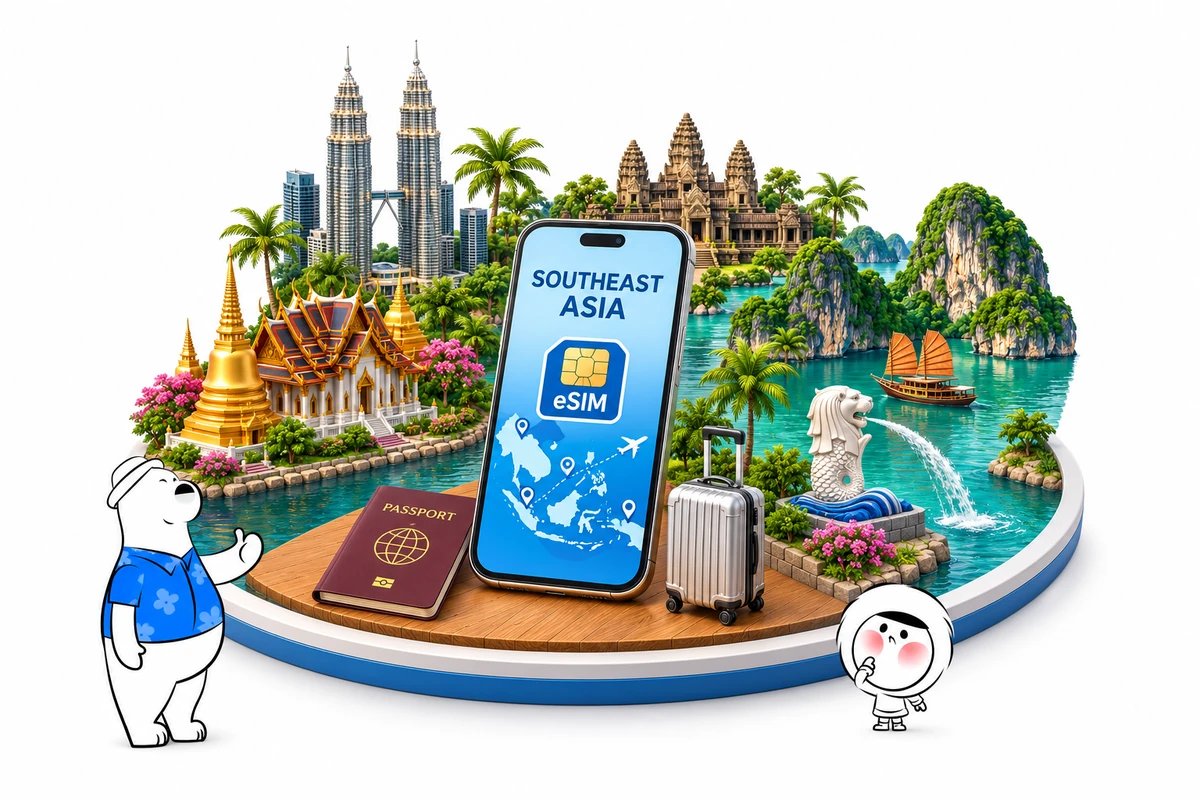
Choosing the best multi country esim for southeast asia travel guide 2026 means selecting a single digital profile that covers multiple regional networks automatically. A regional data plan suits travelers crossing several borders, though remote rural areas and island passages require realistic expectations about local signal speeds.
Overland routes connecting Thailand, Cambodia, Vietnam, and Malaysia often present varying network standards. Using one regional profile removes the chore of buying physical airport cards at every immigration checkpoint.
Hardware compatibility remains a fundamental requirement. Unlocked devices with active eSIM functionality switch between local partner carriers without physical card swapping or unexpected home-carrier bills.
Why Choose the Best Multi Country eSIM for Southeast Asia Travel Guide 2026
A single digital profile eliminates the recurring registration steps required by national telecommunications regulators across the region. Travelers preserve their primary phone number for two-factor authentication while routing data through regional cellular agreements.
Multi-country digital profiles activate automatically upon arrival in each new destination. According to digital connectivity guidelines shared by the Association of Southeast Asian Nations, cross-border travel integration benefits significantly from unified telecommunications access. This arrangement prevents travelers from waiting in long airport queues to register physical plastic cards with identity passports.
Physical SIM swaps also introduce the risk of losing your original micro-chip. Maintaining an active digital profile ensures instant map access the moment you clear customs at major hubs such as Bangkok Suvarnabhumi Airport or Singapore Changi Airport.
Southeast Asia Backpacking SIM Card vs eSIM Comparison
Choosing between local airport cards and a regional digital profile depends on itinerary length, budget, and route complexity. While airport vendors often pitch high-data promotional packages, regional digital profiles offer immediate cross-border utility.
This southeast asia backpacking sim card vs esim comparison highlights the operational trade-offs for independent travelers navigating the region:
| Feature | Regional Multi-Country eSIM | Local Airport SIM Card | Home Carrier International Roaming | Pocket Wi-Fi Rental |
| Initial Setup | Instant digital download via QR code | In-person queue and passport scan | Automatic upon landing | Counter collection and deposit fee |
| Border Crossing Flexibility | High; switches networks automatically | Zero; requires a new card per country | High; expensive daily fees apply | Moderate; device must support local bands |
| Primary Number Retention | Yes, dual-SIM mode active | No, replaces physical SIM card | Yes, original SIM stays active | Yes, phone connects via Wi-Fi |
| Device Battery Impact | Standard smartphone battery use | Standard smartphone battery use | Standard smartphone battery use | Requires recharging a second battery |
| Budget Predictability | Fixed upfront cost, transparent usage | Low per-country, but costs multiply | High daily charges, risk of bill shock | Daily rental fee plus insurance |
Local cards purchased at street kiosks may offer cheap local gigabytes, but each requires separate passport registration under national real-name laws. Regional digital plans remove that repetitive administrative friction across every border stop.
How to Use One eSIM Across Thailand Vietnam Cambodia
Using a single profile across the popular Indochina loop requires configuring data roaming settings on your smartphone before crossing international frontiers. Once installed, the profile switches carrier connections automatically as you move between partner networks.
Understanding how to use one esim across thailand vietnam cambodia comes down to three operational steps:
1. Install the digital profile before departure while connected to stable home or hotel Wi-Fi.
2. Label the secondary profile as "Travel Data" in your device cellular settings.
3. Turn on data roaming for the travel profile while keeping data roaming switched off on your domestic primary card.
When traveling between major cultural attractions and famous landmarks in Southeast Asia, local carrier handoffs occur in the background. In Thailand, your phone typically hooks into AIS or TrueMove networks; across Cambodia, it shifts to Smart or Cellcard; in Vietnam, it links with Viettel or Vinaphone.
If a connection fails after crossing an overland checkpoint such as Aranyaprathet-Poipet, toggle airplane mode for ten seconds. This forces the device modem to scan and latch onto the nearest supported local tower.
Get Eskimo eSIM to stay connected globally
Need internet while travelling? Here's what we recommend:

Fixed data plans
- No speed reduction
- No expiry, keep your data forever
- Transfer data to anyone
- Personal hotspot


Multi Country Data Plan Southeast Asia Budget Guide
Managing data costs requires balancing consumption habits against actual needs for transit navigation, ride-hailing, and accommodation check-ins. Streaming video on mobile data drains allocations rapidly, whereas navigation tools require modest bandwidth.
Applying this multi country data plan southeast asia budget guide helps independent travelers determine realistic data allocations:
- Light usage (1GB to 3GB per month): Ideal for map lookups, taxi apps, and basic messaging.
- Moderate usage (5GB to 10GB per month): Supports daily photo uploads, translation tools, and route planning.
- Heavy usage (15GB to 30GB per month): Necessary for remote work, hotspot tethering, and frequent video calls.
Relying on accommodation Wi-Fi for bulk downloads and backups preserves your mobile data balance. Preparing hardware is equally critical, so check Southeast Asia plug types and travel adapters to keep power banks charged during lengthy overland bus rides.
Southeast Asia Cross Border Data Roaming Tips 2026
Border regions and remote islands present specific signal challenges that travelers should anticipate before leaving urban centers. Mobile network base stations near national borders sometimes broadcast overlapping radio frequencies.
Following these practical southeast asia cross border data roaming tips 2026 keeps mobile access steady:
- Manually select partner networks if your device locks onto a weak cross-border signal from the country you just exited.
- Download offline navigation map areas for northern Laos, rural Cambodia, and the Vietnamese highlands where mountain passes obstruct high-frequency cellular bands.
- Keep background app refreshes restricted to save battery and conserve mobile data during long transit journeys.
- Verify that your device remains carrier-unlocked before leaving home, as network-locked handsets cannot activate regional profiles.
In busy border towns, cell towers often experience congestion during peak immigration hours. Having digital boarding passes and visa documents saved offline ensures smooth passage even during temporary signal drops.
Mobile Data for Cross-Border Southeast Asia Trips
Mobile data helps travelers book ride-hailing cars at busy railway stations, translate street signs, show digital border documents, and navigate train connections across Southeast Asia. Network coverage is generally robust in capital cities like Bangkok, Kuala Lumpur, and Hanoi, while signal strength may weaken during rural bus transit, inside remote limestone karst valleys, or on ferry crossings between distant islands.
An Eskimo Regional APAC eSIM plan can be installed before your journey begins. Eskimo's wider coverage footprint across 175 countries and regions is useful for travelers connecting through international flight hubs in East Asia or continuing onward to other global destinations, while no-expiry fixed data ensures that any unused gigabytes remain valid for future international travel.
New users can also claim a free 500MB Global eSIM.
Frequently Asked Questions
Can I keep my WhatsApp number when using a regional eSIM in Southeast Asia?
Yes, installing a travel digital data plan allows you to route mobile internet through the travel profile while keeping your personal WhatsApp account linked to your original telephone number. When prompted by messaging apps, choose the option to keep your existing phone number.
Do I need a passport to activate a Southeast Asia travel eSIM?
Most regional travel profiles do not require in-person passport registration before activation. This differs from physical local cards purchased at airports, which mandate in-person passport scanning and biometric verification under local telecommunications laws.
How does overland border crossing affect mobile data reception?
At overland borders, signal handoffs may take a couple of minutes while your handset detaches from the previous country's network and authenticates on the new local partner carrier. Toggling airplane mode on and off usually speeds up the initial network handshake.
Is mobile hotspot sharing supported on regional travel profiles?
Yes, standard regional travel plans allow mobile personal hotspot tethering to laptops, tablets, or travel companions. Ensure your device APN settings match carrier instructions to maintain stable tethering connections.
Conclusion
A multi-country regional digital profile offers the most practical connectivity solution for travelers visiting several Southeast Asian destinations on a single journey. It removes airport queues, avoids foreign SIM registration requirements, and keeps secondary authentication methods accessible on your primary number. Before departing, verify that your smartphone is carrier-unlocked, install your chosen regional profile, and download offline transit backups for rural sectors. Taking these straightforward steps guarantees reliable data access across every regional border crossing.