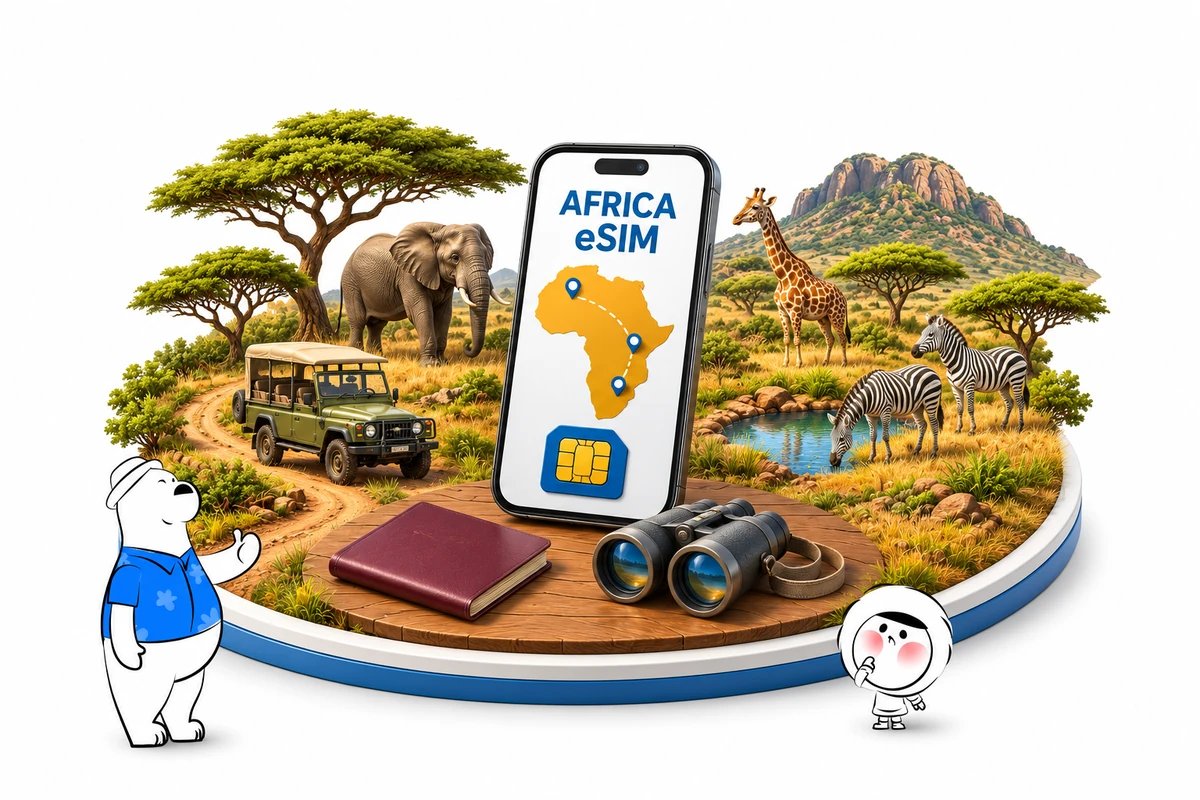
Finding the best multi country esim for africa safari travel guide 2026 comes down to cross-border network flexibility and offline reliability across major game reserves. A single digital profile eliminates airport SIM registration queues across Kenya, Tanzania, and South Africa, keeping navigation and digital permits active throughout remote wildlife regions.
Multi-destination African itineraries rarely stay within a single telecommunications border. Flying between the Maasai Mara, the Serengeti, and Victoria Falls traditionally required swapping physical SIM cards at every airstrip. A regional or global digital plan maintains continuous connectivity across borders without unexpected roaming penalties. Don't forget to check eSim on IOS and eSim on Android.
Why Cross-Border Safari Itineraries Require a Multi-Country Profile
Multi-destination safari routes cross national borders where domestic SIM cards instantly stop functioning. Having a single profile ready before touching down prevents communication blackouts at remote land crossings and regional bush airstrips.
Safari itineraries routinely link Kenya and Tanzania or pair South Africa with Botswana, Zambia, and Zimbabwe. Each country maintains separate telecommunications operators, such as Safaricom in Kenya, Vodacom in Tanzania, and MTN in South Africa. Buying individual local SIM cards at every border post requires mandatory biometric registration, passport scans, and local currency exchanges that delay transfers.
A multi-country profile automatically switches to supported partner towers the moment your bush plane lands across the frontier. This continuous handoff keeps park entry QR codes accessible and ensures private safari guides can reach you during flight schedule adjustments.
Best Multi Country eSIM for Africa Safari Travel Guide 2026 Comparison
Choosing between an international digital SIM, airport plastic cards, home carrier roaming, and portable Wi-Fi routers depends on route complexity and device flexibility. A multi-country digital profile provides the highest convenience for multi-stop circuits.
Evaluating practical connectivity options requires reviewing total costs, setup friction, and performance across remote national parks.
| Connection Method | Typical Multi-Country Cost | Border Transition Friction | Registration Requirement | Best Travel Context |
| Multi-Country Travel eSIM | Moderate fixed data rates | Automatic network handoff | In-app digital profile download | Multi-country flights, overland bush crossings |
| Local Airport Physical SIM | Low local rates per country | High; must buy new SIM per country | In-person passport scan, biometric registration | Single-country trips staying over three weeks |
| Home Carrier Roaming | High daily fees ($10 to $15 per day) | Automatic partner roaming | None; uses existing domestic contract | Short business stops or single-day layovers |
| Portable Pocket Wi-Fi | High device rental plus daily data | Moderate; requires regional device | Rental pickup and return logistics | Large families sharing one stationary connection |
While local physical cards offer low domestic gigabyte rates, managing multiple plastic chips on dusty game drives risks losing your primary home SIM. Home carrier roaming fees quickly multiply into hundreds of dollars on a two-week itinerary. A multi-destination profile remains the most practical middle ground.
Cellular Coverage Realities Across East and Southern African Reserves
Cellular signals across African wildlife reserves follow main lodges and park entrance gates rather than open wilderness tracks. Network towers concentrate around park headquarters, tourist lodges, and paved transit corridors.
Major wildlife agencies such as the Kenya Wildlife Service and Tanzania National Parks increasingly rely on cashless digital payment systems and electronic gate permits. Having an active data connection at the gate accelerates processing. However, signal penetration drops sharply once game vehicles venture deep into river valleys, dense acacia woodlands, or distant savannah plains.
Lodges located inside reserves often route satellite connections through local Wi-Fi in central dining pavilions. Mobile data serves as an essential bridge during daytime transit between camps, during airport transfers, and while navigating road closures.
Regional Data Roaming and Overland Border Crossing Practicalities
Overland borders between safari hubs present unique telecommunications hurdles that require advance preparation. Maintaining active service safeguards your transit paperwork when crossing busy frontiers such as the Namanga border between Kenya and Tanzania.
Following practical cross border regional esim data roaming africa travel tips helps protect data balances and battery life. Setting heavy cloud backups to run exclusively on lodge Wi-Fi preserves mobile gigabytes for essential GPS routing, ranger communications, and flight updates. In addition, downloading offline satellite maps in Google Maps or Maps.me ensures navigation remains functional when driving through remote conservancies without tower reception.
Financial planning for remote wildlife expeditions also requires factoring in transport surcharges and park conservation fees. Much like reviewing how much does a trip to Japan cost before finalizing flights, budgeting for regional connectivity in advance keeps safari operational expenses predictable.
Get Eskimo eSIM to stay connected globally
Need internet while travelling? Here's what we recommend:

Fixed data plans
- No speed reduction
- No expiry, keep your data forever
- Transfer data to anyone
- Personal hotspot


How to Set Up Your Device for a Multi-Destination African Journey
Configuring your mobile phone prior to international departure prevents connection failures at transit airports. Completing digital activation on a stable home Wi-Fi network ensures your device identifies foreign cell towers immediately upon landing.
Understanding how to activate esim for multi destination africa trip involves five straightforward technical steps:
1. Confirm your smartphone is carrier-unlocked and compatible with digital SIM profiles.
2. Install the digital data profile using the provider QR code or official mobile application while connected to reliable home Wi-Fi.
3. Label the new profile clearly as "Safari Data" to distinguish it from your primary domestic SIM.
4. Keep your primary physical SIM assigned to incoming emergency SMS messages while disabling its data roaming toggle.
5. Turn on data roaming exclusively for your newly installed travel data line once your aircraft touches down in Africa.
Restarting the device after landing prompts the phone to scan and attach to the strongest local partner network without manual APN configuration.
Evaluating Budget Options for Southern and East African Travel Circuits
Selecting the cheapest regional esim for southern and east africa tourist routes requires looking beyond initial price tags to data longevity. Fixed data bundles that force expiration within seven or fourteen days often result in wasted gigabytes on slow-paced safari itineraries.
Safari itineraries combine days of intensive wildlife viewing with relaxed lodge stays. During days spent entirely at camps with working Wi-Fi, mobile consumption drops to near zero. Paying for daily unlimited passes usually wastes money, whereas purchasing a fixed gigabyte package without an artificial expiration date ensures every megabyte remains usable throughout the journey.
Mobile Data for an African Safari Expedition
Mobile data proves indispensable on an African itinerary for verifying domestic flight schedules on bush airstrips, managing electronic park tickets, tracking wildlife sightings with camp guides, and navigating remote transfer roads. Signal strength is generally reliable in gateway hubs such as Nairobi, Arusha, and Johannesburg, while reception frequently weakens or disappears in deep river ravines, remote savannah sectors, and secluded wilderness camps.
A Global eSIM plan offers multi-destination coverage across 175 countries and regions, allowing international travelers to fly between African safari hubs, European layovers, and onward destinations on a single profile. The included no-expiry fixed data ensures that any unused gigabytes remain fully preserved on your device for future international vacations rather than disappearing when your safari ends.
New users can also claim a free 500MB Global eSIM.
Frequently Asked Questions
Which mobile network operators provide the best coverage on African safari routes?
Safaricom in Kenya, Vodacom in Tanzania, and MTN or Vodacom in South Africa generally maintain the widest rural tower coverage across national parks. Multi-country digital profiles automatically attach to these leading local carriers based on roaming agreements.
Will my travel data connection work inside Serengeti and Maasai Mara game reserves?
Mobile data functions reliably near major reserve gates, visitor centers, and primary airstrips. However, signal drops to zero in vast open savannah sectors and remote valleys, making downloaded offline maps essential for game drives.
Can I share my cellular connection with other travelers during a safari road trip?
Yes, fixed data plans allow personal hotspot tethering, enabling you to share data with a companion's tablet or secondary phone during overland drives.
What should I do if my phone displays no service after crossing an African land border?
Toggle airplane mode on for ten seconds, turn it off, and verify that the data roaming switch is enabled for your travel profile. If connection fails, open cellular settings and manually select an approved partner network from the network selection menu.
Conclusion
Securing a reliable multi-country digital connection streamlines multi-stop safari itineraries across Kenya, Tanzania, and Southern Africa. Having a pre-installed digital profile removes the hassle of local airport registrations, supports electronic park gate clearances, and keeps communication lines open across diverse game reserves.
Audit your device compatibility, install your chosen regional profile before departing home, and preload offline navigation maps for your specific national park routes. This balanced setup delivers practical peace of mind, letting you focus fully on the wildlife experience ahead.