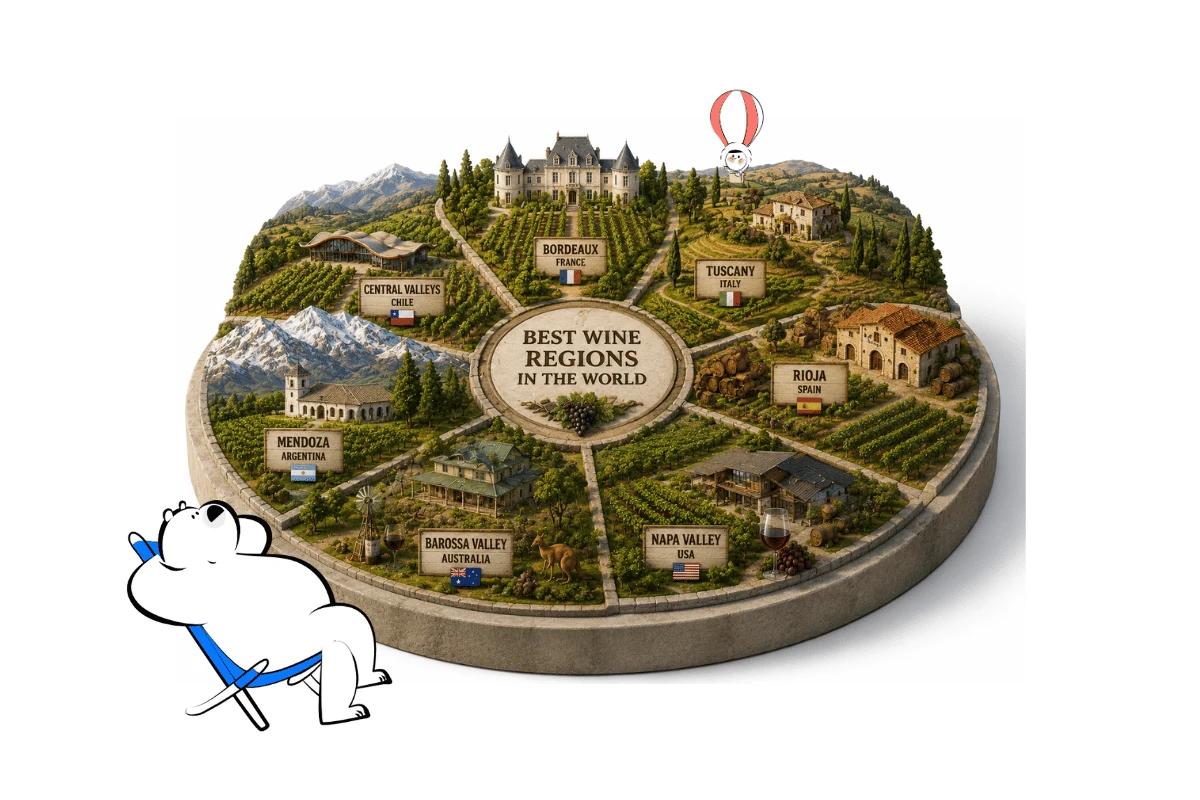
The best wine regions in the world include Bordeaux and Burgundy in France, Tuscany and Piedmont in Italy, Rioja and Ribera del Duero in Spain, Napa Valley in California, the Barossa Valley in Australia, and Mendoza in Argentina.
The right choice depends on the experience you want. France suits travelers drawn to historic estates and detailed classifications, Tuscany combines wine with medieval towns, Napa emphasizes polished tasting experiences, and Mendoza pairs Malbec with dramatic views of the Andes.
Most winery visits require advance reservations, especially during harvest season and on weekends. Transport also matters because many vineyards sit outside cities and villages where public services may be limited.
French Wine Regions
France contains some of the world’s most famous wine-producing regions, each associated with particular grapes, landscapes, and food traditions.
Bordeaux
Bordeaux suits travelers who want grand estates, structured red wines, and easy access from a major city.
The vineyards spread around the Gironde estuary and the Dordogne and Garonne rivers. Well-known areas include Médoc, Saint-Émilion, Pomerol, Graves, and Sauternes.
Many properties require appointments, and visitors should avoid assuming that every château accepts walk-ins. Bordeaux works best as a two or three-day trip, particularly if combining the city with Saint-Émilion or the Médoc wine route.
Burgundy
Burgundy is better for visitors interested in small vineyard plots, historic villages, and the idea of terroir, where tiny differences in location influence the wine.
The Route des Grands Crus runs for roughly 80 kilometers through celebrated villages including Gevrey-Chambertin, Nuits-Saint-Georges, Beaune, and Pommard. France’s official tourism board highlights Burgundy’s UNESCO-listed vineyard climats and its unusually high concentration of prestigious appellations.
Burgundy is easier to appreciate with a guide or advance research because neighboring vineyards can produce very different wines.
Provence And The Rhône
Provence is associated with rosé, Mediterranean scenery, and vineyard visits that fit naturally into a wider southern France itinerary.
The Rhône Valley offers another strong route, including northern areas known for Syrah and southern destinations such as Châteauneuf-du-Pape. Travelers planning the region can connect wine visits with Eskimo’s overview of what to see in Southern France.
Italian Wine Regions
The Italian wine regions are closely tied to regional cooking, historic towns, and landscapes that often feel inseparable from the tasting experience.
Tuscany
Tuscany is one of the best wine regions to visit for first-time wine travelers because it combines famous wines with Florence, Siena, hill towns, farm stays, and scenic roads.
Key areas include Chianti Classico, Montalcino, Montepulciano, San Gimignano, and the Tuscan coast. Italy’s national tourism board recommends routes through Chianti, Montalcino, Montepulciano, and other vineyard areas, with wineries often paired with olive oil, local dishes, and village visits.
A car is useful outside the main cities, but travelers who plan to taste should book a driver or organized tour. A wider route can follow Eskimo’s 10-day Italy itinerary, which includes Tuscany and the Chianti area.
Piedmont
Piedmont in northern Italy is known for Barolo, Barbaresco, Nebbiolo, truffles, and small towns surrounded by vineyard-covered hills.
It generally feels quieter than Tuscany and suits travelers who prioritize food and wine over major sightseeing. Alba, Barolo, La Morra, and the Langhe hills make practical bases.
Autumn is particularly popular because of harvest activity and seasonal food events. Check Italy’s public holidays and travel seasons before booking, since holidays and festivals can affect accommodation and opening hours.
Spanish Wine Regions
Spanish wine regions often provide strong value, distinctive food pairings, and a mix of traditional underground cellars and modern winery architecture.
Rioja
Rioja is one of Spain’s most accessible wine country destinations. Logroño works well as a base, while Haro is known for historic wineries around the Barrio de la Estación.
Spain’s official tourism portal describes La Rioja as a major wine tourism destination with dozens of wineries open for guided visits, vineyard activities, tastings, and food experiences.
Rioja is especially appealing for travelers who want to combine wineries with tapas bars, compact towns, and a manageable driving route.
Ribera Del Duero
Ribera del Duero follows the Duero River through parts of Burgos, Segovia, Soria, and Valladolid.
The route is strongly associated with Tempranillo-based wines, underground cellars, castles, and roast lamb. Spain’s tourism board describes a 115-kilometer wine route connecting villages, historic sites, and wineries across the Castilian plateau.
A car or organized tour is usually more practical than public transport for visiting multiple wineries.
California Wine Regions
California has several important wine regions, but Napa Valley remains the most internationally recognized.
Napa Valley
Napa Valley suits travelers who want organized tastings, high-quality restaurants, luxury accommodation, and straightforward trip planning.
The valley lies northeast of San Francisco and contains hundreds of wineries, tasting rooms, restaurants, and private tour options. The official tourism organization recommends limiting a day to roughly two or three winery visits because tastings often take around 90 minutes and travel time between estates adds up.
Reservations are commonly required, particularly for estate tours and special experiences. Tasting fees are also generally higher than in many European wine regions.
Sonoma County
Sonoma offers a broader and often more relaxed alternative, with vineyard areas stretching from inland valleys toward the Pacific coast.
It works well for travelers who want wineries alongside small towns, farms, redwood landscapes, and coastal drives. Distances can be larger than expected, so focus on one part of the region each day rather than building an overpacked itinerary.
Australian Wine Regions
Australian wine regions range from cool coastal areas to warm inland valleys.
Get Eskimo eSIM to stay connected globally
Need internet? Here's what we recommend:

Fixed data plans
- No speed reduction
- No expiry, keep your data forever
- Transfer data to anyone
- Personal hotspot


Barossa Valley
The Barossa Valley in South Australia is one of the country’s best-known wine destinations and is particularly associated with Shiraz and rich red wines.
Tourism Australia describes it as one of Australia’s oldest wine regions, with more than 150 wineries and around 80 cellar doors. It is roughly an hour’s drive from Adelaide, making it suitable for a day trip or weekend stay.
A guided tour is sensible for travelers planning several tastings. Those driving should select a designated driver and avoid trying to cover too many cellar doors in one day.
Margaret River
Margaret River in Western Australia combines vineyards with beaches, forests, caves, and a strong food scene.
It is better treated as a multi-day destination because the region is several hours south of Perth and attractions are spread across a large area. Cabernet Sauvignon and Chardonnay are among its best-known styles.
South American Wine Regions
South American wine regions often combine high-altitude vineyards, distinctive landscapes, and comparatively affordable tasting experiences.
Mendoza
Mendoza is Argentina’s leading wine tourism destination and the region most closely associated with Malbec.
The main vineyard areas include Luján de Cuyo, Maipú, and the Uco Valley. Argentina’s official tourism board describes Mendoza as the country’s largest wine-producing province and promotes winery visits against the backdrop of the Andes.
Mendoza city is a convenient base, but many wineries are far apart. Hire a driver, join a tour, or choose accommodation within a vineyard area.
Chile’s Central Valleys
Chile’s principal wine routes extend through valleys near Santiago and farther south, including Maipo, Casablanca, Colchagua, Cachapoal, Curicó, and Maule.
Casablanca is associated with cooler-climate white wines, while Maipo and Colchagua are better known for reds. Chile’s tourism authority recommends using private transport, tours, buses, or selected rail connections, depending on the valley.
These regions suit travelers who want to combine wine with Santiago, Valparaíso, the Andes, or a longer route through central Chile.
Old World And New World Wine Regions
Old World wine regions generally refer to traditional European producers such as France, Italy, Spain, Portugal, and Germany.
Travel experiences often focus on historic appellations, regional rules, inherited vineyards, local food, and small villages. Labels may emphasize the place of origin more strongly than the grape variety.
New World wine regions include destinations such as the United States, Australia, Argentina, Chile, New Zealand, and South Africa.
These regions often make grape varieties easier to identify on labels and may offer more contemporary visitor facilities. The distinction is useful, but it is not a strict measure of quality or winemaking style.
Best Time To Visit Wine Regions
The best season depends on the hemisphere and the kind of experience you want.
In Europe and North America, September and October often bring harvest activity, changing vineyard colors, and strong demand. Wineries may be busy with production, so visitor access can become more limited.
Spring offers greener landscapes and fewer visitors, while summer provides long daylight hours but higher temperatures and larger crowds.
In Australia, Argentina, Chile, and South Africa, harvest generally falls earlier in the calendar year because they are in the Southern Hemisphere. Exact timing varies by region, weather, elevation, and grape variety.
Book accommodation and winery appointments early during harvest festivals and popular weekends.
Practical Wine Region Travel Tips
Choose one compact area per day. A wine regions map may make destinations look close even when winding rural roads create long journeys.
Reserve tastings directly with wineries whenever possible. Confirm arrival time, language, duration, price, food options, and cancellation terms.
Do not drive after drinking. Use a tour, taxi, local driver, or a designated driver, especially in rural areas with limited public transport.
Wear comfortable shoes and bring layers. Vineyard tours may include gravel paths, cellars, caves, outdoor terraces, and changing temperatures.
Use spittoons during tastings, drink water, and eat regularly. Tasting does not require finishing every pour.
Check whether children are accepted before booking. Some wineries welcome families, while others restrict tastings or cellar tours to adults.
Mobile Data Across Wine Regions
Mobile data helps with winery reservations, rural navigation, translation, opening-hour updates, and arranging transport between vineyards. Coverage is generally stronger in towns and along major roads, while reception may weaken in valleys, cellars, remote estates, and sparsely populated countryside.
An Eskimo Global eSIM plan supports wine trips spanning several countries. Eskimo’s coverage across 175 countries and regions is useful for routes combining France, Italy, Spain, the United States, Australia, or South America, while the universal eSIM allows one reusable eSIM to support multiple eligible destinations without installing a new one for each trip.
New users can also claim free 500MB of Global Data.
FAQ
What are the best wine regions in the world for first-time visitors?
Tuscany, Rioja, Napa Valley, Bordeaux, and Mendoza are strong choices because they combine established wineries, tourism services, accommodation, and attractions beyond wine.
Which country has the most famous wine regions?
France is often associated with the largest number of globally famous regions, including Bordeaux, Burgundy, Champagne, the Rhône Valley, the Loire Valley, and Alsace.
Which wine region is best for scenery?
Tuscany, Mendoza, the Douro Valley, Stellenbosch, and the Barossa Valley are especially known for combining vineyards with dramatic landscapes.
Do wineries require reservations?
Many do, particularly in Bordeaux, Burgundy, Napa Valley, Tuscany, and during harvest season. Always check the winery’s official booking policy before arriving.
Can you visit wine regions without drinking?
Yes. Many regions offer vineyard walks, food experiences, architecture, museums, cycling routes, village visits, and alcohol-free options, although availability varies by winery.