
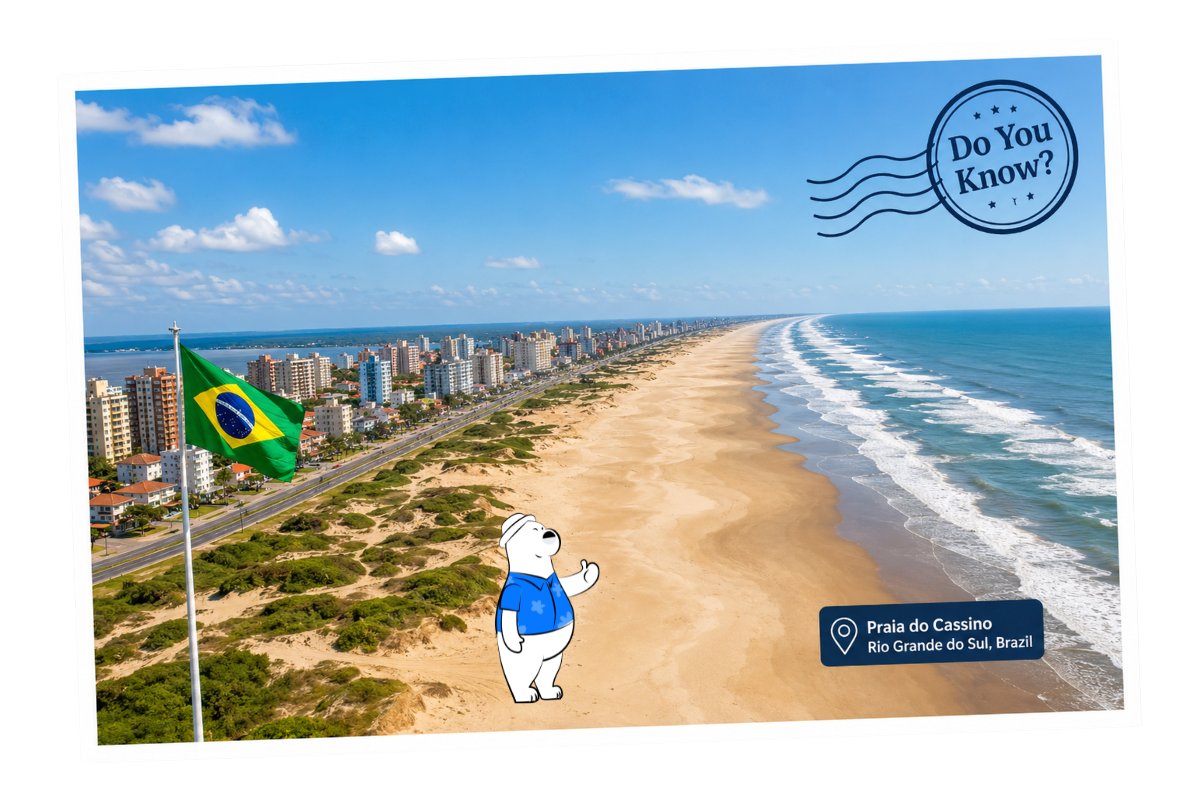
Praia do Cassino in southern Brazil is widely cited as the longest beach in the world, extending for about 254 kilometers along the Atlantic coast of Rio Grande do Sul.
However, the record depends on how a beach is measured. Praia do Cassino is often described as the longest continuous sandy beach, while Cox’s Bazar in Bangladesh is commonly recognized as the longest unbroken natural sea beach.
Where Praia Do Cassino Is Located
Praia do Cassino lies in the municipality of Rio Grande, near Brazil’s border with Uruguay. The main resort area is around 22 kilometers from central Rio Grande and about 334 kilometers from Porto Alegre by road.
According to the Rio Grande municipal tourism authority, the coastline stretches for approximately 254 kilometers and forms one of South America’s longest continuous beaches.
The beach is known locally as Praia do Cassino, or Cassino Beach. Its enormous scale becomes clearer away from the developed resort area, where the sand continues toward remote dunes, wetlands, and coastal landscapes.
Why The Record Is Complicated
“Longest,” “largest,” and “biggest beach in the world” do not always describe the same record.
Praia do Cassino’s claim is based on its exceptionally long, continuous sandy coastline. Some measurements include connected coastal sections extending south toward the Uruguayan border, which can affect the total distance.
Cox’s Bazar in Bangladesh is usually described more specifically as the world’s longest natural unbroken sandy sea beach. Official Bangladesh tourism sources give its length as roughly 120 kilometers.
The fairest comparison is:
- Praia do Cassino: Widely cited as the longest continuous sandy beach
- Cox’s Bazar: Widely cited as the longest unbroken natural sea beach
Different definitions allow both claims to appear in travel and geographic references.
Get Eskimo eSIM to stay connected in Brazil
Need internet in Brazil? Here's what we recommend:

Fixed data plans
- No speed reduction
- No expiry, keep your data forever
- Transfer data to anyone
- Personal hotspot


Visiting Cassino Beach
Cassino Beach is more than a geographic record. Visitors can walk along the shore, watch migratory birds, explore protected dunes, surf during suitable conditions, and visit the Molhes da Barra breakwaters.
One unusual feature is that vehicles are permitted on sections of the beach. Drivers should follow local restrictions and take extra care around soft sand, changing tides, wildlife, and other visitors.
The resort area has hotels, restaurants, shops, and seasonal services. Summer draws the largest crowds, while quieter periods better reveal the extraordinary scale of the coastline.
Travelers planning a wider trip can explore other famous landmarks in Latin America or compare Brazil with the most visited countries in South America.
Mobile Data On Brazil’s Southern Coast
Mobile data can help with driving directions, changing weather, accommodation messages, and locating services around Praia do Cassino. Reception is generally stronger near the resort and Rio Grande, while it may weaken along remote sections of beach, dunes, wetlands, and sparsely populated coastal roads.
An Eskimo Brazil eSIM plan can be prepared before arrival. Eskimo’s coverage across 175 countries and regions is useful for travelers continuing into Uruguay or other South American destinations, while no-expiry fixed data can remain available for another trip if the full allowance is not used in Brazil.
New users can also claim free 500MB of Global Data.
FAQs:
FAQ
Where is the longest beach in the world?
Praia do Cassino is in Rio Grande do Sul, southern Brazil. It is widely cited as the world’s longest continuous sandy beach.
How long is Praia do Cassino?
Local government tourism sources describe Praia do Cassino as extending for approximately 254 kilometers along Brazil’s Atlantic coast.
Is Praia do Cassino longer than Cox’s Bazar?
Praia do Cassino is generally cited as longer overall. Cox’s Bazar holds the more specific claim of being the longest unbroken natural sandy sea beach.
Can visitors drive on Praia do Cassino?
Vehicles are allowed on sections of the beach, but access can depend on local conditions and regulations. Drivers should avoid soft sand, wildlife areas, and changing tides.
Which country has the longest beach?
Brazil holds the widely reported claim through Praia do Cassino, although Bangladesh’s Cox’s Bazar is recognized under the narrower natural unbroken sea beach category.