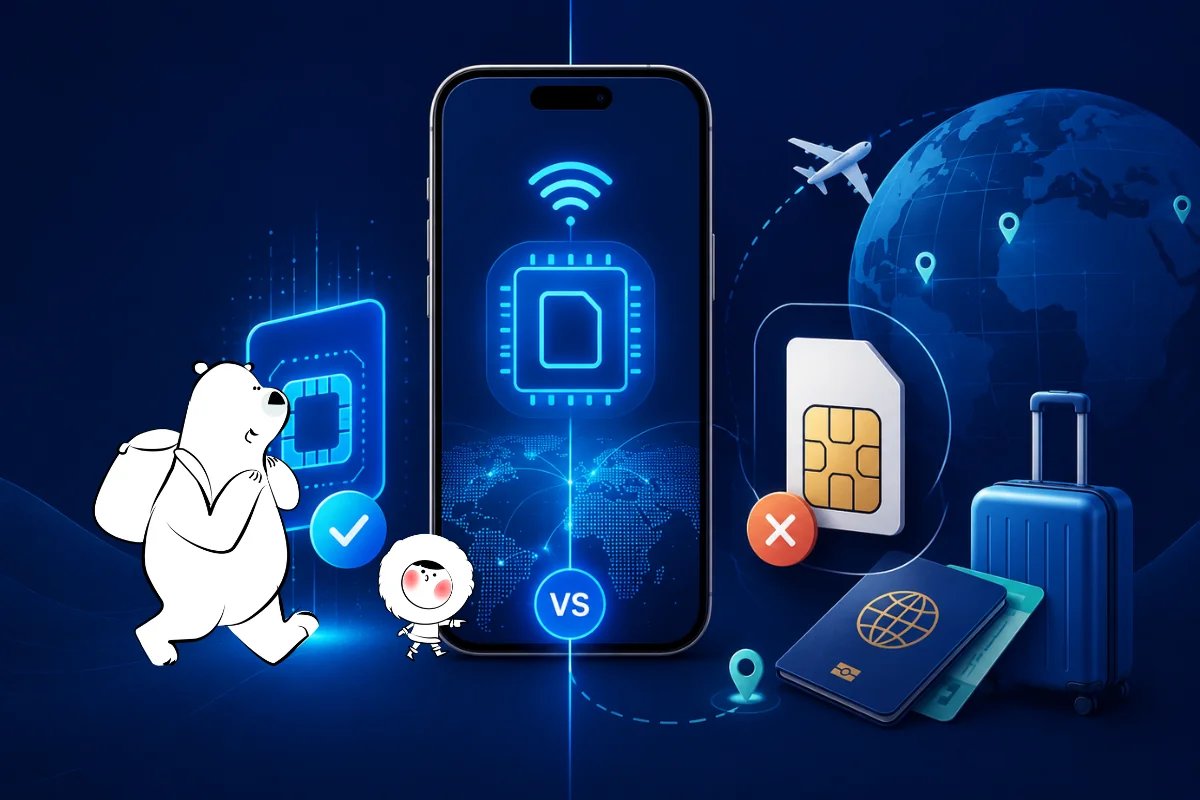
eSIM is usually better than physical SIM for travel because it is faster to set up, easier to manage, and does not require swapping a card after you land. A physical SIM can still make sense if your phone does not support eSIM, you need a local number, or you often move one SIM between different devices.
| Situation | Better Option |
| Short international trips | eSIM |
| Multi-country travel | eSIM |
| Older phones | Physical SIM |
| Data before arrival | eSIM |
| Local calls and SMS | Depends on the plan |
| Switching between phones often | Physical SIM |
| Keeping your main number active | eSIM with dual SIM |
What Is the Difference Between eSIM and Physical SIM?
An eSIM is a digital SIM built into your phone. Instead of inserting a plastic card, you install a mobile plan through an app, QR code, or manual setup. A physical SIM is the removable card that goes into your phone’s SIM tray.
Both connect your phone to a mobile network. The difference is how the plan is stored and managed. With a physical SIM, your mobile plan sits on a removable card. With an eSIM, your plan is stored as a digital profile on your device.
That makes eSIM especially useful for travel. You can install a plan before departure, keep your main SIM active, and turn on mobile data when you arrive.
eSIM vs Physical SIM Pros and Cons at a Glance
The main difference is convenience. eSIM is usually easier for travel, while physical SIM is still useful for older phones and specific local plans.
| Factor | eSIM | Physical SIM |
| Setup | Digital setup by app, QR code, or manual details | Insert a SIM card into the phone |
| Travel Convenience | Can be installed before arrival | Usually bought after arrival |
| Compatibility | Needs an eSIM-compatible device | Works on more older phones |
| Switching plans | Easier to switch digitally | Requires swapping cards |
| Physical risk | Cannot be lost as a loose card | Can be lost, damaged, or removed |
| Local number | Depends on provider and plan | Often easier with local carriers |
| Best for | Travel data, dual SIM, frequent trips | Older phones, local numbers, device switching |
Why eSIM Is Usually Better for Travel
eSIM is the stronger choice for most travelers because it solves a common arrival problem: needing mobile data before you have time to find a local SIM.
With an eSIM, you can set up your plan before your trip and connect when you reach your destination. That helps with maps, ride-hailing apps, hotel directions, messaging, translation, and checking bookings.
eSIM is especially helpful if you:
- Travel internationally
- Visit more than one country
- Want data ready before landing
- Do not want to open your SIM tray
- Want to keep your main number active
- Mainly use data for apps, browsing, and messaging
Many travel eSIMs are data-only, so check whether calls and SMS are included if you need them. For most app-based travel needs, mobile data is enough. For more setup context, see how eSIM works for international trips.
When a Physical SIM Still Makes Sense
A physical SIM is still practical in some situations. It is familiar, widely supported, and easy to move between phones with SIM trays.
Choose a physical SIM if:
- Your phone does not support eSIM
- You need a local mobile number
- You need standard calls and SMS from a local carrier
- You are staying long-term in one country
- You often switch one SIM between several devices
- Your destination has limited eSIM availability
A physical SIM can work well for long stays, local paperwork, banking, delivery apps, or services that require a local number. The trade-off is convenience. You may need to buy it after arrival, compare plans in person, show ID, or wait for activation.
Get Eskimo eSIM to stay connected globally
Need internet while travelling? Here's what we recommend:

Fixed data plans
- No speed reduction
- No expiry, keep your data forever
- Transfer data to anyone
- Personal hotspot


Signal Strength and Speed: Is There a Difference?
eSIM does not automatically have a better or worse signal than a physical SIM. Signal depends on the network behind the plan, the coverage area, carrier partners, congestion, your phone model, and whether 4G or 5G is supported.
A physical SIM on a weak network can be slower than an eSIM on a stronger network. The reverse can also be true. The SIM format itself is not the deciding factor.
For travel, check:
- Destination coverage
- Supported networks
- 4G or 5G availability
- Hotspot support
- Fair usage terms, especially for unlimited plans
If 5G matters to you, check whether your destination, device, and plan support it.
Security: Is eSIM Safer Than Physical SIM?
eSIM can reduce some physical security risks because there is no loose card to steal, lose, or remove from your phone. If your phone is stolen, someone cannot simply take out the eSIM and place it into another device.
That does not make eSIM risk-free. Mobile accounts can still be targeted through phishing, weak passwords, fake support messages, or account takeover attempts. Only install eSIM profiles from trusted providers, and avoid scanning unknown QR codes.
Physical SIMs also have risks. They can be removed from a lost phone, swapped, damaged, or misplaced. For either SIM type, protect your mobile account and avoid relying only on SMS for important security checks when stronger options are available.
Using eSIM and Physical SIM Together
Many modern phones let you use eSIM and a physical SIM at the same time. A common travel setup is simple: keep your physical SIM for your main number and use eSIM for travel data.
This helps you receive important calls or texts on your usual number while using a separate data plan abroad. It can also help you avoid roaming charges if you turn off data roaming on your home SIM.
Battery use can increase when two SIM lines are active, especially in areas with weak signal or when 5G and hotspot are used heavily. For longer days out, set your travel eSIM as the mobile data line, turn off data roaming on your home SIM, and disable hotspot when you are done.
Some phones can store multiple eSIM profiles, but the number of active SIMs depends on the device. iPhone support also varies by model and region.
A Cleaner Setup for Travel Data
For most trips, the simplest setup is to keep your usual SIM for your main number and use a travel eSIM for mobile data. You avoid SIM swapping, reduce arrival stress, and stay connected without depending on airport kiosks or public Wi-Fi.
Eskimo is built for travelers who want mobile data without changing physical SIM cards. The Global Plan is the most flexible option when your trip is not limited to one country. Eskimo’s 2-year data validity with rollover also helps if you travel irregularly or have data left after a trip.
New Eskimo users can claim a free 500MB of Global Data on a compatible device.
FAQs
Is eSIM better than physical SIM?
eSIM is usually better for travel because it is faster to set up, easier to switch, and does not require a removable card. Physical SIM is still useful for older phones, local numbers, and some long-stay plans.
What is the main difference between eSIM and physical SIM?
An eSIM is a digital SIM profile stored on your device. A physical SIM is a removable card inserted into your phone. Both connect your phone to a mobile network.
Does eSIM have better signal than physical SIM?
No. Signal quality depends on network coverage, carrier partners, congestion, your phone, and the plan you use. The SIM format alone does not decide signal strength.
Is eSIM safer than physical SIM?
eSIM can be safer against physical theft because it cannot be removed like a plastic SIM card. You still need to protect your mobile account and avoid suspicious setup links or QR codes.
Can I use eSIM and a physical SIM at the same time?
Yes, many dual-SIM phones support one physical SIM and one eSIM at the same time. This is useful if you want to keep your main number active while using travel data abroad.
Should I remove my physical SIM when using eSIM?
Usually no. You can keep your physical SIM installed. To avoid roaming charges, turn off data roaming on your physical SIM and set your eSIM as the mobile data line.
How do I know if my phone supports eSIM?
Check your phone’s cellular settings, device specifications, or carrier support page. Many recent iPhones, Google Pixel phones, and Samsung Galaxy models support eSIM, but compatibility varies by model and region.
Is eSIM good for international travel?
Yes. eSIM is one of the easiest options for international travel because you can install a data plan before departure and connect after arrival without buying a physical SIM at the airport.