
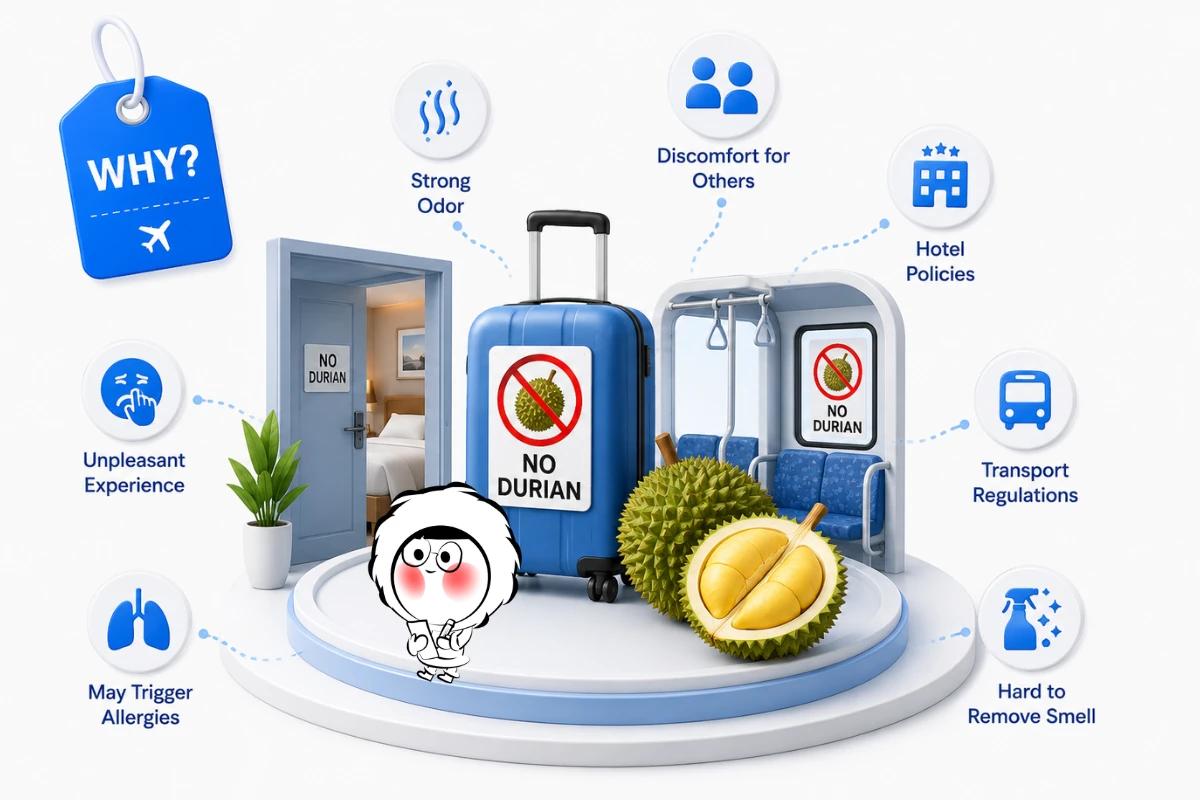
Durian is banned or restricted in some hotels, vehicles, and public spaces because its powerful smell can spread quickly and remain in enclosed areas. The fruit is usually not illegal nationwide. Most restrictions are individual policies created to protect other guests and passengers from a persistent odor.
Rules vary between hotels, transport operators, airports, airlines, and destinations. A crossed-out durian sign normally means the fruit is not allowed in that particular space, not that owning or eating durian is a crime.
The Science Behind Durian’s Strong Smell
Durian releases a complex mixture of volatile aroma compounds. Research has identified sulfur compounds as major contributors to its onion-like, cabbage-like, or gas-like notes, while esters produce sweeter and fruitier aromas.
A review published by ACS Food Science & Technology explains that sulfur compounds and esters dominate durian’s aroma profile. Different varieties and stages of ripeness can produce different combinations and concentrations.
The smell becomes difficult to manage because these compounds evaporate easily and disperse through the air. In a hotel room, train carriage, taxi, or aircraft cabin, the aroma may reach other people before the fruit is even opened.
Restrictions Protect Shared Indoor Spaces
Hotels may prohibit fresh durian in rooms, lifts, corridors, and common areas. The smell can enter fabrics, carpets, curtains, ventilation systems, and soft furnishings, making it harder to remove before the next guest arrives.
Public transport restrictions serve a similar purpose. A sealed carriage or bus gives the odor little room to escape, while passengers cannot easily move away from it.
Common locations where travelers may encounter restrictions include:
- Hotel rooms and lobbies
- Trains and buses
- Taxis and ride-hailing vehicles
- Airports and airline cabins
- Shopping centers
- Indoor attractions
- Rental cars
Policies vary, so check signs and ask staff before carrying fresh durian inside.
Venue Policies Are Not The Same As National Laws
A durian restriction is often a house rule or transport policy rather than a national ban.
Hotels can set conditions for food brought onto their property. Airlines can decide which strong-smelling items are allowed in cabin or checked baggage. Transport operators can also restrict items that may inconvenience passengers.
Rules may differ even within the same destination. One hotel may allow durian in a designated outdoor area, while another may charge a cleaning fee if it is brought into a room.
Customs and agricultural regulations are separate. A country may restrict fresh fruit imports because of plant-health or biosecurity rules, even when eating locally purchased durian is legal.
Durian Rules On Flights
Airline rules are not universal.
Changi Airport notes that durian may have few general carry-on restrictions, but travelers should still check with their airline. Singapore Airlines states that durian is not permitted in cabin or checked baggage unless arrangements are made with the airline before travel.
Other carriers may accept processed durian products or professionally sealed packaging while refusing fresh whole fruit. Check the operating airline’s baggage policy before reaching the airport, especially on connecting itineraries.
Do not assume that placing fresh durian inside several plastic bags will make it acceptable. The smell can escape, and packaging may not meet airline or customs requirements.
Get Eskimo eSIM to stay connected globally
Need internet? Here's what we recommend:

Fixed data plans
- No speed reduction
- No expiry, keep your data forever
- Transfer data to anyone
- Personal hotspot


Fresh And Packaged Durian May Be Treated Differently
Restrictions often focus on fresh, cut, or ripe durian because it releases the strongest odor.
The following products may be handled differently:
- Sealed durian sweets
- Durian biscuits
- Packaged cakes
- Frozen pulp
- Vacuum-packed fruit
- Durian-flavored snacks
Packaging does not guarantee acceptance. Airlines, hotels, border authorities, and transport operators can still apply their own rules.
Carrying And Eating Durian Respectfully
The easiest approach is to eat durian where it is sold or in a designated outdoor area.
Practical tips include:
- Ask the vendor where the fruit can be eaten
- Check hotel rules before buying it
- Avoid taking fresh durian onto public transport
- Use a taxi only after confirming with the driver
- Keep packaged products sealed
- Check airline rules before flying
- Review customs rules before crossing a border
- Dispose of shells in the correct waste area
For broader etiquette, transport, food, and neighborhood planning, use the Singapore Travel Guide.
Mobile Data For A Southeast Asia Food Trip
Mobile data helps with translating signs, checking hotel policies, finding durian markets, reviewing transport rules, and locating designated eating areas. Coverage is generally stronger in cities and along major transport routes, while reception may weaken inside underground stations, rural plantations, or remote roadside areas.
An Eskimo Asia Pacific eSIM plan suits trips through destinations such as Singapore, Malaysia, Thailand, Indonesia, and the Philippines. Eskimo’s coverage across 175 countries and regions is useful for stopovers and onward journeys beyond Southeast Asia, while the universal eSIM lets travelers keep one reusable eSIM across multiple eligible destinations.
New users can also claim free 500MB of Global Data.
FAQs:
Why is durian banned in some hotels?
Hotels may prohibit durian because its odor can spread through rooms, corridors, lifts, carpets, curtains, and ventilation systems.
Is durian illegal in Singapore?
No. Durian is sold and eaten widely in Singapore. Restrictions usually apply to specific hotels, vehicles, transport systems, or indoor venues.
Can you take durian on a plane?
It depends on the airline. Some prohibit fresh durian in both cabin and checked baggage, while others may accept certain sealed products. Check before flying.
Why does durian smell so strong?
Its aroma comes from a complex mixture of volatile compounds, especially sulfur compounds and fruity esters.
Can packaged durian be taken on public transport?
Possibly, but packaging does not override local rules. Keep it sealed and follow signs or instructions from the transport operator.
The topic, title, structure, and caution against treating venue policies as universal law follow the approved validation report.