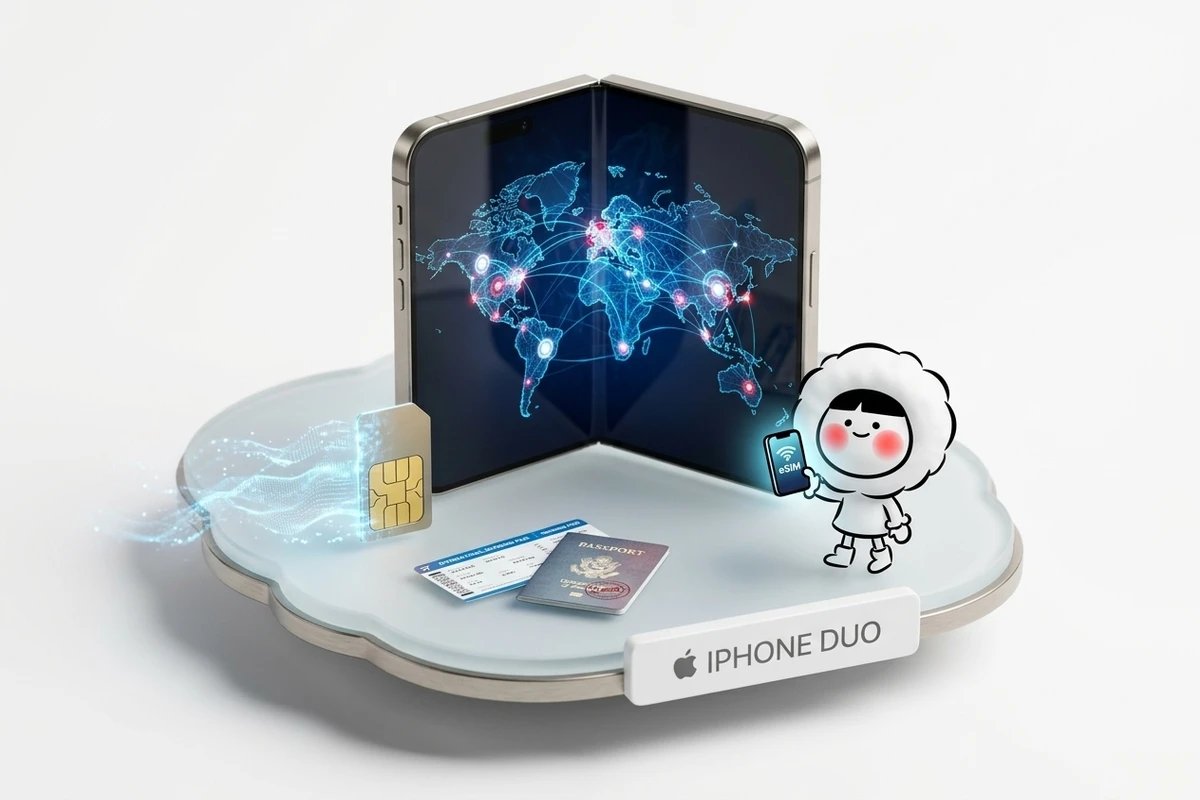
Rumors surrounding Apple’s entry into dual-screen and foldable mobile hardware have reached a fever pitch. Internally discussed by industry analysts as the "iPhone Duo," this rumored device represents a substantial departure from the classic rectangular glass slab that has defined Cupertino’s smartphone lineup since 2007. Featuring a dual-display clamshell or inward-folding architecture, the iPhone Duo aims to combine compact pocketability with tablet-grade screen real estate.
Beyond physical display innovation, the iPhone Duo is expected to advance Apple's transition toward entirely portless and trayless connectivity. With the elimination of physical SIM slots across modern US iPhone generations, the iPhone Duo will push dual active eSIM technology to the forefront. For international travelers and digital nomads, this hardware evolution changes how we manage international data roaming across borders.
Here is an analysis of the rumored Apple iPhone Duo: verified supply-chain leaks, expected launch schedules, estimated retail pricing, hardware specifications, and practical advice on utilizing multi-profile eSIM connectivity.
Don't forget to check How to set up eSim on iOS!.
What Is the Apple iPhone Duo?
The iPhone Duo is Apple’s reported project targeting the expanding dual-screen and book-style foldable smartphone market. Patents filed with the US Patent and Trademark Office (USPTO) show Apple exploring self-healing display materials, multi-gear micro-hinges, and split-chassis thermal architectures designed to eliminate visible screen creases.
Unlike competitor models that rely on a single delicate folding panel prone to plastic deformation, Apple's engineering approach focuses on two synchronized high-refresh-rate OLED panels separated by an invisible magnetic seam, or a specialized ultra-thin glass (UTG) hinge. This allows the device to function in three distinct orientations:
- Closed Clamshell: A compact exterior cover screen for quick notifications, widgets, and single-handed messaging.
- Open Tablet Canvas: A 7.8-inch square workspace ideal for split-screen multitasking, document editing, and expansive map navigation.
- Tent or Laptop Stand Mode: A self-supporting 90-degree angle for hands-free video calls and media playback without a kickstand.
Rumored Apple iPhone Duo Release Date
Apple maintains a disciplined annual product introduction cycle, traditionally unveiling flagship iPhone hardware during its September keynote presentation, with retail distribution beginning within ten to fourteen days.
Industry supply-chain reports from display manufacturers in South Korea and assembly partners in Taiwan indicate that initial trial production runs for the dual-screen chassis began in mid-2026. Given Apple’s rigorous durability validation standards—requiring folding displays to withstand over 300,000 fold cycles without optical distortion—analysts anticipate the official announcement during the Fall 2027 Keynote.
Pre-orders will follow Apple’s standard Friday morning window immediately following the keynote, with global deliveries commencing the subsequent week in tier-one launch markets including the United States, the United Kingdom, Australia, Singapore, Germany, and France.
Expected Price and Storage Tiers
Given the precision engineering required for durable hinges, dual titanium outer frames, and synchronized dual OLED panels, the Apple iPhone Duo will command premium pricing positioned above the iPhone Pro Max series.
Expected pricing brackets based on component bill of materials (BOM) estimates:
| Storage Configuration | US Retail (USD) | UK Retail (GBP) | Australia (AUD) | Singapore (SGD) |
| 256 GB Base | $1,599 | £1,499 | A$2,499 | S$2,299 |
| 512 GB Mid-Tier | $1,799 | £1,699 | A$2,799 | S$2,599 |
| 1 TB Flagship | $1,999 | £1,899 | A$3,099 | S$2,899 |
Trade-in promotions through major telecommunication carriers and direct Apple financing programs will likely soften initial upfront purchase costs, with monthly installment plans structured over 24 or 36 months.
Get Eskimo eSIM to stay connected globally
Need internet while travelling? Here's what we recommend:

Fixed data plans
- No speed reduction
- No expiry, keep your data forever
- Transfer data to anyone
- Personal hotspot


Technical Specifications and Hardware Architecture
The iPhone Duo is expected to introduce several hardware milestones designed to handle the thermal and battery demands of powering dual high-brightness displays:
- Processor: Next-generation Apple Silicon (A20 Pro or M-series bionic hybrid) built on an advanced 2-nanometer gate-all-around (GAA) fabrication node for maximum power efficiency.
- Displays: Dual Super Retina XDR OLED displays supporting ProMotion 1–120Hz adaptive refresh rates, reaching peak outdoor brightness of 2,600 nits.
- Chassis Materials: Grade 5 Titanium exterior frame with ceramic-shielded curved back panels for drop resistance.
- Camera System: Periscope telephoto system offering 5x optical zoom, accompanied by 48MP main and ultra-wide sensors engineered flush into the rear chassis.
- Battery Architecture: Split dual-cell battery design distributing thermal mass evenly across both halves of the folding frame, delivering up to 26 hours of continuous video playback.
The Dual eSIM Revolution: What It Means for International Travel
The transition toward trayless smartphones began in earnest when Apple removed the physical SIM card slot from US-spec iPhone 14 models. The iPhone Duo expands this philosophy globally by utilizing an advanced Dual Active eSIM controller.
Rather than swapping tiny plastic nano-SIM cards with paperclips in foreign airports—a process fraught with the risk of losing your domestic SIM card—the iPhone Duo allows travelers to maintain multiple digital profiles simultaneously on a single handset.
How Dual Active eSIM Enhances International Roaming
- Keep Your Primary Number Active for Verification: Dual active standby allows your home carrier's eSIM to remain connected for essential incoming two-factor authentication (2FA) SMS codes and emergency banking notifications.
- Dedicated Travel Data Line: Route all high-bandwidth mobile data, map routing, and web browsing through a dedicated regional or local travel eSIM profile, bypassing carrier roaming fees that often charge $10 to $15 per day.
- No Lost Nano-SIMs: Physical cards are easily misplaced during transit; digital eSIM profiles reside securely in your iPhone’s encrypted secure enclave.
For frequent travelers, utilizing an international provider such as an Eskimo Global eSIM provides reliable 4G and 5G connectivity across 80+ countries with a single digital download. Eskimo eSIM data balances remain valid for two full years, meaning unused data does not expire at the end of a short trip. Furthermore, travelers can instantly transfer unused data allowances to family members or travel companions directly through the Eskimo mobile application.
Whether navigating busy streets on Google Maps, booking high-speed train tickets in Europe, or ordering ride-shares across Southeast Asia, having an active data connection ready upon touchdown eliminates airport queues and inflated local vendor pricing.
Practical Pre-Order Advice for Future iPhone Duo Buyers
Before committing to a pre-order when Apple opens reservations, consider these practical checkpoints:
- Verify Carrier Unlock Status: If purchasing through a mobile carrier subsidy, ensure the phone is unlocked or can be unlocked after minimum contract terms. An unlocked device is essential for downloading third-party international travel eSIMs.
- Check Global Frequency Band Compatibility: Apple typically produces two or three regional hardware variants (US mmWave vs Global Sub-6 GHz). Ensure the model you purchase supports standard global 5G NR and LTE bands utilized across Europe and Asia.
- Consolidate Existing eSIM Profiles: iOS allows users to store eight or more eSIM profiles in memory, with two active concurrently. Review your existing domestic profiles and remove obsolete temporary travel profiles before transferring your data to the new device via Apple’s native Quick Start transfer tool.
Frequently Asked Questions
Will the Apple iPhone Duo have a physical SIM card tray?
Current industry consensus indicates the iPhone Duo will follow Apple's trajectory toward completely trayless hardware, relying exclusively on digital eSIM technology in the United States and potentially across all international shipping markets.
Can I use two eSIM lines simultaneously on the iPhone Duo?
Yes. The iPhone Duo will support Dual Active eSIM (Dual SIM Dual Standby), allowing you to keep your primary domestic phone number active for calls and SMS while simultaneously running a dedicated travel data eSIM profile for mobile internet.
What is the expected starting price of the Apple iPhone Duo?
Industry component estimates place the starting retail price at approximately $1,599 USD for the base 256 GB configuration, reflecting the sophisticated hinge mechanics and dual OLED display hardware.
How does international data roaming work on a dual-screen device?
Data roaming functions identically to standard iOS devices, with mobile data traffic managed through Settings > Cellular. You assign mobile data priority to your travel eSIM while leaving voice and SMS assigned to your primary line.
Will my existing eSIM transfer automatically to the iPhone Duo?
Yes. iOS includes native eSIM Quick Transfer, allowing you to move active eSIM profiles directly from your previous iPhone over Bluetooth and Wi-Fi during the initial device setup process without contacting carrier support.