
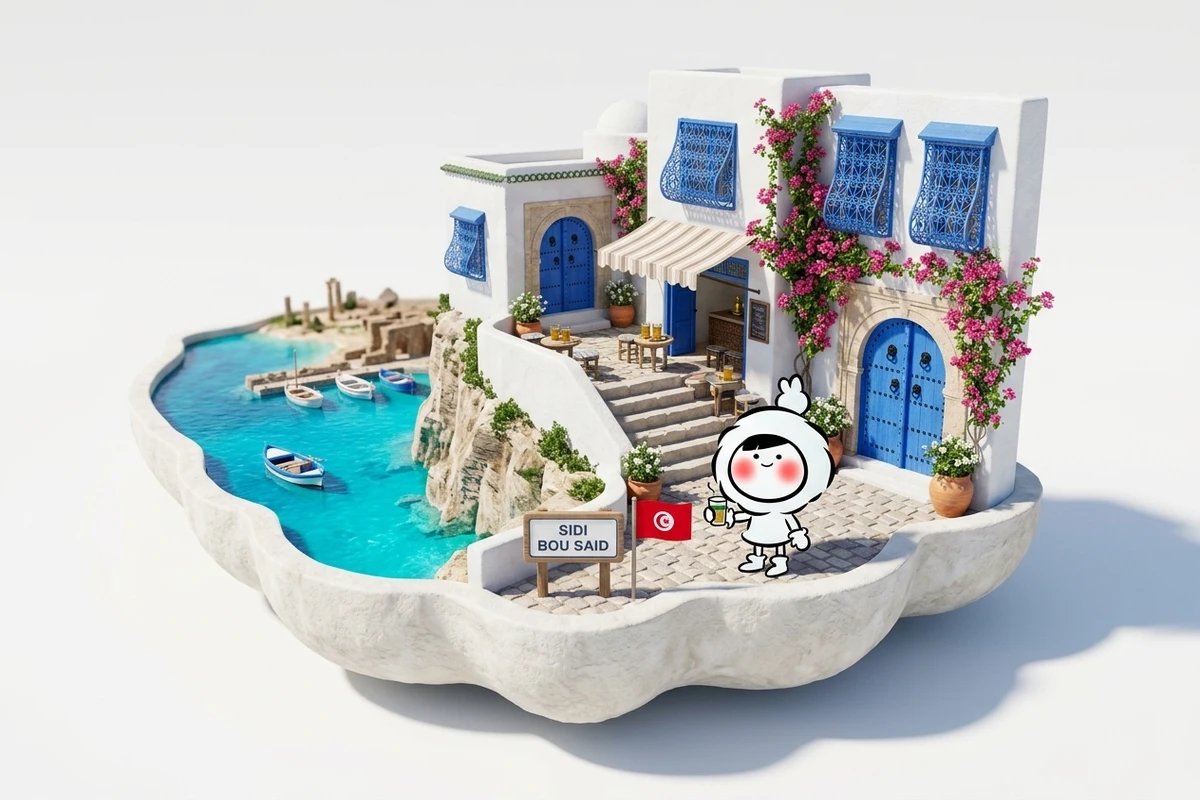
Perched atop a steep cliff 100 meters above the Gulf of Tunis, Sidi Bou Said is one of North Africa’s most visually iconic coastal enclaves. Renowned for its uniform palette of gleaming whitewashed walls, cobalt-blue arched doorways, and ornate wrought-iron moucharabieh window screens, this artistic village has attracted European painters, writers, and international travelers for over a century.
Named after the 13th-century Sufi scholar Abu Said al-Baji, who established a sanctuary here, the village became a protected architectural heritage site in the 1920s thanks to French musicologist Baron Rodolphe d’Erlanger.
Today, Sidi Bou Said provides a quiet, pedestrian-friendly contrast to the bustling avenues of central Tunis, located just 20 kilometers to the southwest.
Here is a practical travel guide to visiting Sidi Bou Said: key sights, historic cliffside cafés, transit from Tunis, combined day trips to ancient Carthage, and mobile connectivity recommendations.
Top Things to Do in Sidi Bou Said
Sidi Bou Said is best explored on foot. Cobblestone pathways wind through residential quarters lined with bougainvillea vines, jasmine shrubs, and ceramic tile fountains.
1. Wander the Blue-and-White Medina Alleys
The village’s main spine, Rue Habib Thameur, leads up from the lower square to the village summit.
Take time to branch off into the quiet side streets such as Rue Sidi Bou Fares and Rue Hedi Zarrouk.
Notice the studded wooden doors featuring traditional Islamic crescent, star, and geometric motifs, alongside the heavy iron knockers, one sounding a deep tone for male visitors and another a higher pitch for female visitors.
2. Visit Ennejma Ezzahra Palace
Built between 1912 and 1922 as the private estate of Baron Rodolphe d’Erlanger, Ennejma Ezzahra (“Star of Venus”) is a masterwork of Neo-Moorish architecture.
Set into the cliffside with sweeping Mediterranean views, the palace features carved stucco plasterwork, inlaid cedar ceilings, Italian marble fountains, and Andalusian gardens.
Today it houses the Centre des Musiques Arabes et Méditerranéennes, preserving an extensive national collection of historical Arabic string and percussion instruments.
3. Drink Mint Tea at Legendary Cliffside Cafés
No visit to Sidi Bou Said is complete without experiencing its café culture.
Café des Nattes (Kahouat el-Alia)
Perched atop a grand flight of stone stairs in the upper village square, this 19th-century café was historically frequented by artists such as Paul Klee, August Macke, and Simone de Beauvoir.
Sit inside on the traditional woven reed mats (nattes) or on the outdoor balcony to enjoy traditional green tea brewed with fresh mint and toasted pine nuts (thé aux pignons).
Café des Délices (Sidi Chaabane)
Built in tiered open-air terraces stepping down the cliff toward the marina, this café provides uninterrupted 180-degree sunset panoramas across the Gulf of Tunis.
While prices are higher due to its location, the view across the bay is unmatched.
4. Walk Down to Sidi Bou Said Marina and Beach
A winding pedestrian staircase descends from the upper cliffs down to the small harbor.
Here, local fishermen dock alongside private yachts, and a sandy crescent beach offers swimming during summer months, flanked by casual seafood restaurants serving grilled sea bream (dorade) and Tunisian brik pastries.
Combining Sidi Bou Said with Ancient Carthage
Sidi Bou Said shares a coastline with the legendary ruins of Carthage, located just 3 kilometers south.
Visitors can easily combine both destinations in a single day trip:
- Antonine Baths (Thermes d’Antonin): The largest Roman public bath complex outside Rome, positioned directly on the water’s edge with colossal surviving marble columns.
- Byrsa Hill and Carthage National Museum: The historic acropolis of Punic Carthage, featuring surviving Punic residential foundations beneath Roman ruins and sweeping views over the Mediterranean basin.
- The Tophet of Carthage: An ancient sanctuary and cemetery preserving hundreds of inscribed Punic votive stelae dedicated to the gods Tanit and Baal Hammon.
Carthage is an inscribed UNESCO World Heritage Site and is connected to Sidi Bou Said via a short ride on the local TGM light rail train.
For more first-time African travel recommendations, consult Eskimo’s guide to the best African countries for first-time visitors.
Getting to Sidi Bou Said: Transport and Logistics
Sidi Bou Said is easily accessible from Tunis and the primary international airport.
Via TGM Light Rail Train (Recommended)
The Tunis-Goulette-Marsa (TGM) commuter line traditionally operates from Tunis Marine rail station, located at the eastern end of Avenue Habib Bourguiba in central Tunis.
The journey takes approximately 30 minutes under normal operating conditions, stopping at Sidi Bou Said station at the foot of the hill.
The reference fare is approximately 1.50 TND (€0.45) for first class. Confirm current fares, operating schedules, and any service disruptions before traveling.
Via Yellow Taxi
Licensed yellow metered street taxis operate throughout greater Tunis.
A metered ride from downtown Tunis or Tunis-Carthage International Airport (TUN) to Sidi Bou Said typically takes 20 to 25 minutes, depending on traffic.
The reference fare is approximately 15 to 25 TND (€4.50–€7.50), although actual charges may vary.
Always ensure the driver switches on the dashboard meter (compteur) upon departure.
Get Eskimo eSIM to stay connected in Tunisia
Need internet in Tunisia? Here's what we recommend:

Fixed data plans
- No speed reduction
- No expiry, keep your data forever
- Transfer data to anyone
- Personal hotspot

Local Costs, Currency, and Etiquette
Tunisia uses the Tunisian Dinar (TND). Currency import and export are restricted, so visitors should review current customs rules and exchange money or withdraw dinars at local ATMs upon arrival.
Tea & Pastries
Mint tea with pine nuts at Café des Nattes costs approximately 4 to 6 TND (€1.20–€1.80).
Fresh Tunisian bambalouni, piping hot ring doughnuts dusted in sugar, from the village bakery cost approximately 1 to 2 TND (€0.30–€0.60).
Palace Entry
Ennejma Ezzahra admission is approximately 5 to 7 TND (€1.50–€2.10).
Cultural Etiquette
While Sidi Bou Said is accustomed to international tourists, modest dress covering shoulders and knees is appreciated when wandering quiet residential alleys away from the main beach.
Official safety advice and entry visa requirements can be reviewed via the UK Foreign Travel Advice for Tunisia.
Best Time to Visit Sidi Bou Said
Spring (April to June) and Autumn (September to November)
The most comfortable seasons, offering sunny skies, blossoming jasmine, and pleasant daytime temperatures that can reach approximately 22°C to 27°C (71°F–81°F).
These months are particularly suitable for walking through the village, exploring Carthage, and enjoying outdoor cafés.
Summer (July and August)
Warm and dry, with temperatures sometimes exceeding 34°C (93°F).
Summer is ideal for swimming at the marina beach, although afternoon cobblestone walking requires sun protection.
Winter (December to February)
Mild daytime temperatures around 16°C (61°F), with occasional coastal rain showers.
The village is generally peaceful and less crowded during this period.
Mobile Internet and Connectivity in Sidi Bou Said
Having steady mobile data is useful in Tunisia for navigating winding medina streets, checking TGM train schedules, and arranging local transport.
Purchasing a physical SIM card after arriving at Tunis-Carthage Airport may require passport registration and additional time at a mobile operator counter.
An alternative is to arrange an Eskimo travel eSIM before your flight.
An Eskimo eSIM offers several travel-friendly features:
- Mobile Data Connectivity: Access supported mobile networks in eligible destinations without replacing your physical SIM card.
- Two-Year Data Validity: Eligible Eskimo data plans offer 24-month validity, giving travelers more flexibility than many short-duration tourist SIM packages.
- Data Transfer: Share eligible data with travel companions through the Eskimo mobile application.
- Keep Your Existing WhatsApp and Number: Continue using your existing phone number for WhatsApp while using the eSIM for mobile data. Receiving SMS on your home line depends on your carrier and roaming settings.
Before purchasing, check the Eskimo website for current Tunisia coverage, supported networks, plan availability, and compatible devices.
Frequently Asked Questions
How much time should I spend in Sidi Bou Said?
A half-day (3 to 4 hours) is sufficient to explore the primary alleys, visit Ennejma Ezzahra Palace, and enjoy mint tea at Café des Nattes.
If combining the village with the archaeological ruins of Carthage, plan a full day (6 to 8 hours).
How do I get from central Tunis to Sidi Bou Said?
Take the TGM light rail train from Tunis Marine station to Sidi Bou Said station when the service is operating normally.
The journey traditionally takes approximately 30 minutes.
Alternatively, hire a metered yellow city taxi. The journey generally takes around 20 to 25 minutes, depending on traffic.
Confirm current train schedules and fares before departure.
What is the specialty pastry in Sidi Bou Said?
The village’s signature treat is the bambalouni, a light and airy Tunisian yeast doughnut fried fresh in oil and coated in granulated sugar.
It is traditionally eaten warm while walking the main street.
Can you visit Carthage on the same day?
Yes. The Carthage archaeological sites, including the Antonine Baths, Byrsa Hill, and Roman Amphitheater, are located close to Sidi Bou Said.
A combined day trip is straightforward by taxi or local rail when services are available.
Does my international mobile plan cover Tunisia?
Coverage depends on your mobile carrier and roaming package.
Some international plans exclude Tunisia from their standard allowances, which can result in additional roaming charges.
Before traveling, check your carrier’s Tunisia roaming rates and compare them with available travel eSIM plans.