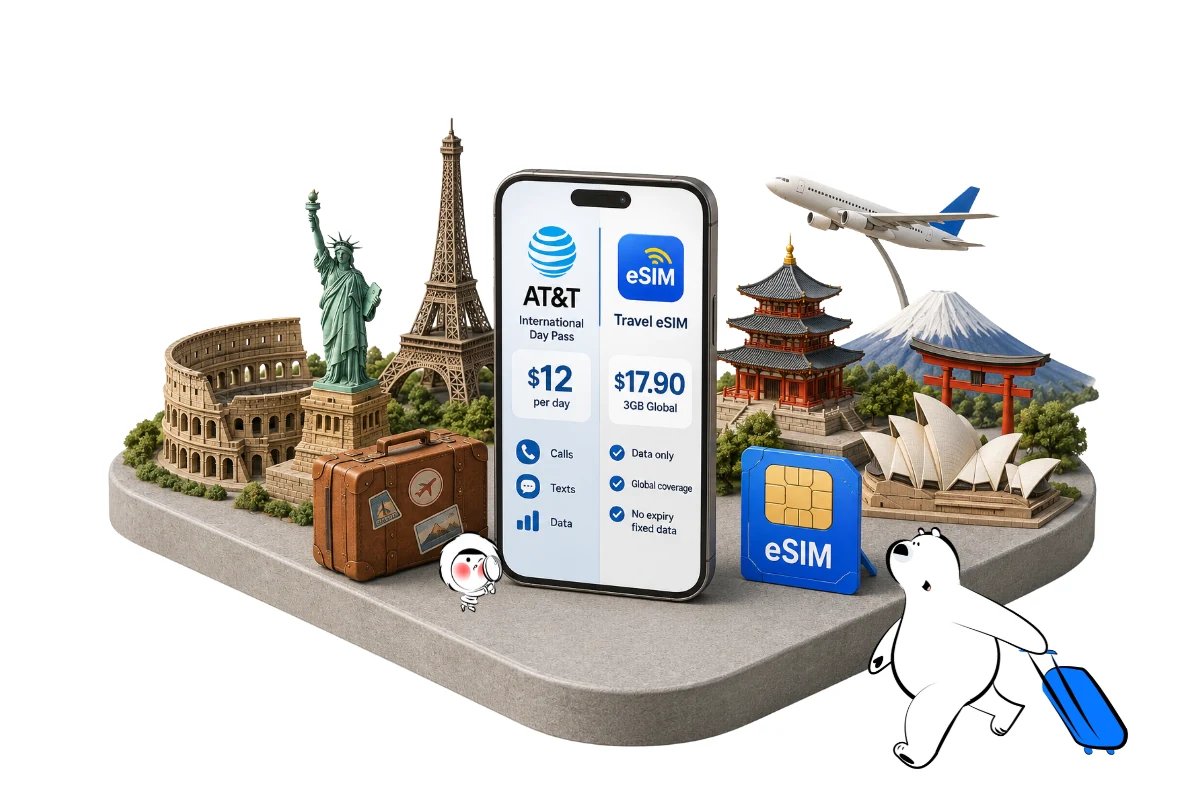
The AT&T international plan can be convenient for travelers who want to keep using their existing phone number, calls, texts, and mobile data abroad. AT&T International Day Pass costs $12 per qualifying 24-hour period for the first eligible line on land, with charges capped at 10 qualifying periods per billing cycle under the applicable terms.
A travel eSIM may cost less, especially if you mainly need mobile data for maps, messaging, and bookings. Instead of paying a daily roaming fee, you can purchase a prepaid data allowance based on your destination and expected usage.
For short trips or travelers who need traditional calls and SMS, AT&T may be worth the extra cost. For data-focused travelers, comparing prepaid eSIM prices before departure can reveal meaningful savings.
AT&T International Plans Explained
AT&T offers several international connectivity options, but their availability depends on your domestic wireless plan, destination, and account eligibility.
For many eligible postpaid customers, AT&T International Day Pass is the primary option for international roaming.
It lets you use your existing AT&T service on participating overseas networks without purchasing a separate SIM or eSIM.
AT&T International Day Pass
According to AT&T’s official International Day Pass information, the service offers:
- $12 per qualifying 24-hour period for the first eligible line used on land.
- $6 per qualifying 24-hour period for each additional eligible line used on the same calendar day.
- Coverage in more than 210 destinations.
- Access to eligible domestic calling, texting, and data benefits.
- A maximum of 10 daily charges per line during a billing cycle for qualifying land and air usage.
A charge begins when you first make or receive a call, send a text message, or use cellular data in an included destination.
That starts a 24-hour charging period. Additional qualifying usage within that period does not create another daily charge for the same line.
A 24-hour charging period is not the same as a calendar day. For example, if qualifying usage begins at 8 p.m. on Monday, the initial 24-hour period continues until approximately 8 p.m. on Tuesday, even though it spans two dates.
If qualifying usage continues after that period ends, another daily charge may apply.
Simply receiving an ordinary SMS message does not normally trigger a daily charge.
The service uses your existing domestic plan benefits, subject to eligibility, coverage, and applicable restrictions.
International Coverage Included in AT&T Domestic Plans
Some AT&T plans already include international roaming benefits.
For example, eligible unlimited plans may include calling, texting, and data in Mexico and Canada without additional International Day Pass charges.
Certain premium plans also include benefits in selected Latin American destinations.
These inclusions vary by plan and can change.
Before adding an international roaming package, check your current AT&T plan and confirm whether your destination is already covered.
AT&T International Day Pass for Cruises
AT&T International Day Pass also supports participating cruise ships.
The cruise option costs $20 per qualifying 24-hour period and covers eligible usage at sea and on land during that period, subject to AT&T’s cruise-specific terms.
AT&T advertises eligible unlimited talk and text, plus 500MB of data per 24-hour period at the best available speed.
After 500MB of data usage within a 24-hour period, speeds may be reduced to a maximum of 512Kbps on certain participating ships. The highest available data speed is restored at the beginning of the next qualifying 24-hour period.
Actual speeds depend on the ship, available maritime network, congestion, and applicable service conditions.
The $20 cruise rate is separate from the ordinary $12 land-based rate.
The 10-charge cap for eligible land and air travel does not apply to cruise charges. AT&T charges the applicable cruise fee for each qualifying period of cruise usage, including periods involving both land and sea connectivity.
For details, review AT&T’s cruise connectivity information.
A standard travel eSIM generally uses land-based mobile networks and should not be expected to connect to a ship’s maritime cellular network while at sea.
AT&T International Day Pass Cost in 2026
AT&T International Day Pass charges depend on the number of qualifying 24-hour periods in which you use your phone abroad and whether your trip crosses a billing-cycle boundary.
For one eligible line using the service on land, the additional charges would be:
- 3 qualifying periods: $36
- 5 qualifying periods: $60
- 7 qualifying periods: $84
- 10 qualifying periods: $120
- 14 qualifying periods: $120 if all qualifying usage falls within one billing cycle.
These examples assume qualifying usage in the stated number of 24-hour periods and exclude regular domestic plan charges, taxes, and other applicable fees.
The important detail is AT&T’s 10-charge cap per eligible line, per billing cycle, for qualifying land and air International Day Pass usage.
After 10 qualifying daily charges within the same billing cycle, additional eligible land and air usage during that cycle does not generate further daily fees for that line.
However, the cap resets with the next billing cycle.
It does not mean every international trip has a universal $120 maximum, and it does not apply to cruise charges.
Eligibility also depends on the customer’s domestic wireless plan, destination coverage, and account status.
Trips That Cross Two Billing Cycles
A trip spanning two AT&T billing cycles may generate more than 10 daily charges overall.
For example, imagine a 14-day trip where you trigger seven qualifying 24-hour periods before your billing cycle resets and seven afterward.
The calculation would be:
- First billing cycle: 7 × $12 = $84
- Second billing cycle: 7 × $12 = $84
- Total additional charge: $168
By contrast, 14 qualifying periods within one billing cycle would generally reach the $120 cap for eligible land and air usage.
These calculations assume that the qualifying 24-hour periods are allocated to the billing cycles as described. Actual charges depend on when each period begins and how AT&T applies its billing rules.
Check your billing-cycle dates before departure, particularly if your trip lasts more than a week.
AT&T International Day Pass for Two Travelers
AT&T International Day Pass costs $12 for the first eligible line per qualifying 24-hour period. Additional eligible lines on the same account may qualify for a reduced $6 charge when used on the same calendar day as the first line.
Each line’s charging period begins with its own qualifying usage, so billing periods may not align.
For two qualifying lines:
- First line: $12 per qualifying period.
- Second eligible line: $6 per qualifying period.
- Combined charge: $18 when both lines qualify for the reduced-rate arrangement.
For seven qualifying periods, the combined additional cost would be $126 if both lines meet the applicable conditions throughout the trip.
For 10 qualifying periods within one billing cycle, the combined charge would reach $180 under the same assumptions.
This can make AT&T more competitive for couples or families sharing an account, especially when everyone needs traditional calling and texting.
However, two separate prepaid travel eSIMs may still cost less if both travelers mainly need mobile data.
AT&T International Roaming Charges Without Day Pass
Travelers who use AT&T abroad without an eligible international package may face pay-per-use roaming charges.
Depending on the destination and service terms, charges can apply to:
- Cellular data.
- Outgoing and answered incoming calls.
- Sent SMS messages.
- Other international mobile services.
Background activity can also consume mobile data.
For example, your phone may automatically synchronize email, refresh apps, or upload photos while connected to an overseas cellular network.
These activities can lead to charges even when you are not actively browsing.
If you do not plan to use AT&T roaming, review your phone settings before departure.
For additional guidance, see Eskimo’s article on how to avoid roaming charges while traveling.
AT&T International Plan vs Travel eSIM: Cost Comparison
The biggest difference between AT&T International Day Pass and a travel eSIM is the pricing structure.
AT&T charges for qualifying 24-hour periods of usage, while most travel eSIMs provide a prepaid data allowance.
A travel eSIM is not automatically cheaper in every situation.
The result depends on the destination, trip duration, data requirements, and whether you need traditional calls and SMS.
Comparing Seven Days of International Travel
Consider a traveler visiting Japan for seven days.
If the traveler triggers seven AT&T International Day Pass charging periods, the additional charge would be:
7 qualifying periods × $12 = $84
Now consider a prepaid travel eSIM.
Eskimo’s Global eSIM plans include a 3GB fixed-data option with a standard price of US$17.90 and a promotional price of US$8.95, as verified on October 26, 2026.
Using the standard price for comparison:
- AT&T International Day Pass: $84
- Eskimo Global eSIM, 3GB: $17.90 standard price
- Potential savings: $66.10
At the US$8.95 promotional price, the potential savings increase to US$75.05.
This comparison assumes 3GB is sufficient for the entire trip and that the traveler does not incur separate AT&T roaming charges.
The two products are not identical.
AT&T includes eligible traditional calling and texting through the existing number, while the travel eSIM provides mobile data.
Prices and promotions are subject to change. Check the official provider websites for current rates and availability.
Understanding the Break-Even Point
For a single eligible AT&T line on land, International Day Pass costs $12 for each qualifying 24-hour period until the billing-cycle cap applies.
That means:
- A $12 travel eSIM costs the same as one qualifying AT&T period.
- A $24 travel eSIM costs the same as two qualifying AT&T periods.
- A $36 travel eSIM costs the same as three qualifying AT&T periods.
- A $60 travel eSIM costs the same as five qualifying AT&T periods.
These are price comparisons, not equivalent-service comparisons.
The travel eSIM must provide enough data for the trip, and the traveler must be comfortable relying primarily on internet-based communication.
If additional data purchases or AT&T roaming charges are required, the savings may be smaller.
Calls, SMS, and Mobile Data
AT&T International Day Pass and travel eSIMs serve different communication needs.
Get Eskimo eSIM to stay connected globally
Need internet while travelling? Here's what we recommend:

Fixed data plans
- No speed reduction
- No expiry, keep your data forever
- Transfer data to anyone
- Personal hotspot


Keeping Your AT&T Phone Number
International Day Pass allows eligible travelers to use their existing AT&T number for traditional calls and SMS.
This can be useful for:
- Business calls.
- Family communications.
- Traditional SMS messages.
- Contacts who do not use internet-based messaging apps.
Most travel eSIMs are data-only.
They generally do not provide a new number for ordinary cellular calls or SMS.
However, apps such as WhatsApp, FaceTime, and Telegram can use a travel eSIM’s internet connection.
If traditional calling is essential, keeping AT&T service available may be worth the additional cost.
Receiving Verification Codes Abroad
Some travelers need access to their original number for banking notifications or one-time verification codes.
A travel eSIM does not automatically replace that function.
On compatible dual-SIM devices, you may be able to keep your AT&T line enabled while using the travel eSIM for mobile data.
However, making or answering calls, sending SMS, or allowing qualifying AT&T data usage may trigger International Day Pass charges.
Receiving an ordinary SMS generally does not trigger the daily fee by itself.
Because verification methods vary, check your banking and authentication arrangements before departure.
Data Usage and Speed
AT&T International Day Pass uses the applicable benefits of your eligible domestic plan.
Travel eSIMs typically provide a specified amount of data or an unlimited package with usage conditions.
For light and moderate users, a few gigabytes may cover:
- Maps and navigation.
- Messaging.
- Restaurant searches.
- Travel bookings.
- Occasional browsing.
Streaming video, uploading large files, and frequent hotspot use require considerably more data.
Estimate your needs before comparing prices.
International Coverage and Device Compatibility
AT&T International Day Pass supports more than 210 destinations.
Eskimo offers country, regional, and global eSIM plans, but coverage depends on the specific package selected.
Eskimo Global eSIM Coverage
Eskimo’s broader portfolio advertises coverage across 175 countries and regions, while its Global eSIM package currently advertises 126-country coverage.
These figures refer to different coverage scopes and should not be treated as interchangeable.
The free 500MB Global eSIM promotion also advertises 126-country coverage.
Before purchasing or activating a plan, check that your destination appears in the coverage list for that specific package.
This is especially important for travelers visiting several countries or remote territories.
Checking Whether Your AT&T Phone Supports a Travel eSIM
To use a travel eSIM, your device must support eSIM technology and be carrier-unlocked.
An eSIM-compatible phone may still reject another provider’s eSIM if it is locked to AT&T.
On an iPhone:
- Open Settings.
- Select General.
- Tap About.
- Find Carrier Lock.
- Check whether the status says No SIM restrictions.
If the device is locked, contact AT&T to check whether it qualifies for unlocking.
Android steps vary by manufacturer and model.
For additional guidance, read Eskimo’s guide to checking and unlocking network-locked iPhones and Android devices.
When AT&T International Day Pass Is Worth It
AT&T International Day Pass is a practical option when convenience and access to your existing phone service matter more than minimizing mobile data costs.
It is particularly useful for short trips.
For example, a traveler who triggers one qualifying 24-hour period abroad would pay $12 in additional Day Pass charges. That may be a reasonable trade-off for avoiding a separate setup process.
AT&T can also make sense for business travelers who regularly need traditional calls and SMS.
Families sharing an eligible account may benefit from the reduced daily rate for additional lines.
Travelers with substantial data requirements should also compare the service against the cost of purchasing a larger travel eSIM package.
When a Travel eSIM Offers Better Value
A travel eSIM is often attractive when mobile data is the main requirement.
For example, travelers who use WhatsApp for communication, Google Maps for navigation, and travel apps for bookings may not need traditional cellular calling throughout their trip.
Prepaid data can also make spending easier to predict.
Instead of accumulating daily charges, you select an allowance based on expected usage.
A regional or global eSIM may be particularly convenient for travelers visiting multiple countries.
However, a travel eSIM is not always the cheapest choice.
Heavy data users may need a larger package, while travelers who continue using AT&T for calls and SMS may incur charges from both services.
Compare the total expected cost rather than looking only at the advertised eSIM price.
How to Avoid AT&T Roaming Charges When Using a Travel eSIM
Installing a travel eSIM does not automatically disable AT&T roaming.
If your AT&T line remains active, qualifying usage can still trigger International Day Pass charges.
Configure both lines before departure to reduce that risk.
Set the Travel eSIM as Your Mobile Data Line
On a compatible iPhone:
- Open Settings.
- Select Cellular or Mobile Data.
- Tap Cellular Data.
- Choose your travel eSIM.
- Turn off Allow Cellular Data Switching.
This helps prevent your phone from automatically switching mobile data back to AT&T.
On Android, open your SIM or mobile network settings and select the travel eSIM as the preferred mobile data connection.
Menu names vary by manufacturer.
Turn Off Data Roaming on Your AT&T Line
Disable data roaming specifically for your AT&T line if you do not intend to use its international data service.
Some travel eSIMs require data roaming to be enabled on the travel eSIM line.
These settings are independent.
Disabling AT&T data roaming does not necessarily prevent charges for calls or sent SMS messages.
If you want to prevent all AT&T cellular usage, turning off the AT&T line entirely is the more reliable option.
Be aware that doing so also prevents that line from receiving traditional calls and SMS.
Review Wi-Fi Calling Before Traveling
Wi-Fi Calling may allow eligible AT&T customers to make and receive calls over Wi-Fi.
However, charges depend on the type of call, destination, and applicable AT&T terms.
Do not assume that every international call made through Wi-Fi Calling is free.
Check AT&T’s current rules before relying on this feature.
Download Essential Travel Information
Save important information before departure, including:
- Offline maps.
- Hotel addresses.
- Flight confirmations.
- Train tickets.
- Emergency contacts.
This reduces mobile data consumption and helps when local coverage is unavailable.
Choosing Between AT&T International Day Pass and a Travel eSIM
The right option depends on your travel habits.
AT&T International Day Pass is generally more suitable when:
- You need traditional calls and SMS through your existing number.
- Your trip is short.
- You prefer not to install another eSIM.
- You have high data requirements.
- Several eligible travelers share one AT&T account.
A travel eSIM is worth considering when:
- You mainly need internet access.
- You are traveling for several days or longer.
- You want prepaid data spending.
- You use messaging and calling apps.
- Your phone is eSIM-compatible and carrier-unlocked.
Some travelers may benefit from keeping both options available.
For example, a travel eSIM can handle everyday data while AT&T remains available for essential communications.
However, any qualifying AT&T usage may still trigger a Day Pass charge.
Stay Connected Abroad With Eskimo eSIM
Travelers often need mobile data immediately after landing to check airport transfers, navigate unfamiliar streets, retrieve bookings, and contact accommodation providers. A prepaid travel eSIM can support these everyday tasks, although signal quality still depends on local networks, terrain, and congestion.
An Eskimo Global eSIM plan provides prepaid mobile data for international trips. Travelers can select a package that suits their expected usage and use it for navigation, messaging, and travel bookings without relying on AT&T’s daily roaming charges. Its no-expiry fixed data feature means unused eligible data can remain available for a future trip.
New users can also claim free 500MB of Global Data.
FAQs
How much does the AT&T international plan cost per day?
AT&T International Day Pass costs $12 per qualifying 24-hour period for the first eligible line on land. Additional eligible lines may qualify for a $6 rate when the applicable same-calendar-day conditions are met. Eligible land and air charges are capped at 10 daily fees per line during a billing cycle.
Is AT&T International Day Pass automatically activated?
International Day Pass must be available on your eligible AT&T line. Once added, it generally remains available for future trips. A daily charge starts when qualifying usage occurs in an included destination. AT&T may also automatically add the service for eligible customers in certain circumstances, so check your account before traveling.
Can I use a travel eSIM with my AT&T phone?
Yes, if your phone supports eSIM technology and is carrier-unlocked. You can use a travel eSIM for mobile data while retaining your AT&T line, but qualifying AT&T usage may still trigger roaming charges.
Does AT&T charge international roaming fees in Mexico and Canada?
Many eligible AT&T domestic plans include calling, texting, and data in Mexico and Canada without additional International Day Pass charges. Coverage and eligibility depend on your specific plan.
Is a travel eSIM cheaper than AT&T International Day Pass?
A travel eSIM can cost less, particularly for travelers who mainly need mobile data. AT&T International Day Pass may be more practical when traditional calls, SMS, or substantial data usage are important. Compare the total price and included services for your destination before choosing.