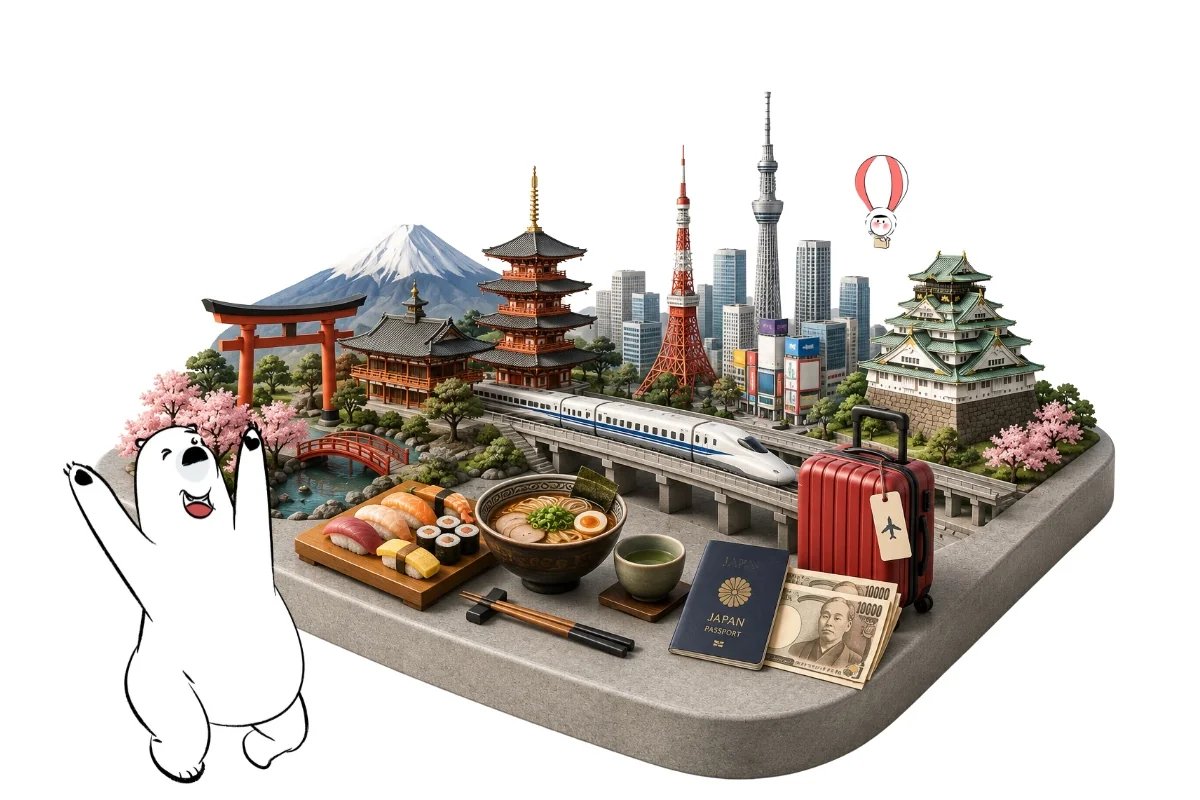
A trip to Japan costs approximately $60 to $100 per person per day on a budget, $120 to $220 for mid-range travel, or $250 to $500 or more for luxury travel. These estimates cover accommodation, food, local transportation, and everyday sightseeing, excluding international flights and major intercity journeys.
For a 10-day Japan vacation, a mid-range traveler should budget approximately $1,200 to $2,200 for expenses within Japan. Adding an estimated $700 to $1,500 for round-trip economy flights from the United States brings the total to approximately $1,900 to $3,700 per person, before major intercity transportation, travel insurance, and shopping.
Japan can be affordable for travelers who use public transportation, stay in business hotels, and eat at casual restaurants. However, accommodation prices during cherry blossom season, Golden Week, and other busy periods can significantly increase the overall cost.
All prices are in US dollars unless stated otherwise. Japanese yen examples use ¥150 per US$1 as an illustrative calculation rate, not a live exchange rate. Prices are approximate and may change depending on travel dates, availability, location, and market conditions. Estimates reflect planning assumptions reviewed in October 2026.
Japan Trip Cost at a Glance
Your Japan travel budget depends mainly on accommodation, food, transportation, sightseeing, and the number of destinations you visit.
The daily estimates below are per person, per day. They include an accommodation allowance for every travel day, making it easier to compare trips of different lengths.
This is a simplified planning method. Actual accommodation costs depend on the number of hotel nights booked.
For example, a 10-day itinerary may require nine hotel nights. If the accommodation allowance is $70 per day, the simplified budget includes $700 for hotels, while nine nights at the same rate would cost $630.
That creates a potential saving of $70 compared with the daily budgeting estimate.
For travelers sharing a hotel room, accommodation costs are divided between occupants. Solo travelers booking private rooms may spend more.
Budget travel in Japan
Estimated daily cost: $60 to $100 per person
Budget travelers typically choose hostels or inexpensive hotels, casual restaurants, local transportation, and free or low-cost attractions.
A practical daily allowance is:
- Accommodation: $25 to $45
- Food and drinks: $15 to $25
- Local transportation: $5 to $10
- Attractions and miscellaneous expenses: $15 to $20
Total: $60 to $100 per day
This allowance covers ordinary daily spending, including sightseeing. Paid attractions are already included in the final category and should not be added again unless they exceed the allowance.
A budget traveler might stay in a hostel, eat ramen or rice bowls, use local trains, and visit public parks, shrines, and historic neighborhoods.
Long-distance train tickets and international flights are additional.
Mid-range travel in Japan
Estimated daily cost: $120 to $220 per person
Mid-range travelers can stay in comfortable hotels, eat at standard restaurants, and visit paid attractions without closely monitoring every expense.
A practical daily allowance is:
- Accommodation: $50 to $100
- Food and drinks: $30 to $50
- Local transportation: $10 to $20
- Attractions and miscellaneous expenses: $30 to $50
Total: $120 to $220 per day
The accommodation allowance assumes two adults sharing a room. Private accommodation for solo travelers may cost more.
The attractions and miscellaneous allowance covers ordinary admission fees, small purchases, and incidental expenses. Major attractions, premium experiences, and shopping should be budgeted separately when they exceed this amount.
Luxury travel in Japan
Estimated daily cost: $250 to $500 or more per person
Luxury travel may include premium hotels, traditional ryokan stays, fine dining, private transportation, and exclusive experiences.
Accommodation and dining usually account for the largest increases.
Luxury hotels in Tokyo and Kyoto can cost considerably more during major holidays and popular travel seasons.
What’s included in the estimates
The daily budgets cover:
- Accommodation
- Food and drinks
- Local trains, subways, and buses
- Everyday sightseeing and ordinary attraction admission
- Small miscellaneous expenses
They exclude:
- International airfare
- Major intercity train journeys
- Travel insurance
- Shopping
- Expensive optional attractions and premium experiences
Sightseeing is already included in the daily allowance. Travelers should add separate attraction costs only when their planned activities exceed the amount allocated for attractions and miscellaneous expenses.
For consistency, trip-length estimates multiply the daily budget by the number of travel days.
A seven-day trip uses seven daily allowances, while a 10-day trip uses 10.
This approach includes a full accommodation allowance for every travel day. Travelers booking fewer hotel nights can subtract the unused accommodation allowance when calculating their final budget.
Japan Trip Cost for 7, 10 and 14 Days
Trip duration is one of the clearest ways to estimate your total Japan vacation cost.
The following figures use the daily allowances established above.
They exclude international flights, major intercity transportation, travel insurance, and shopping.
One-week Japan trip budget
For seven days in Japan:
- Budget travel: $420 to $700 per person
- Mid-range travel: $840 to $1,540 per person
- Luxury travel: $1,750 to $3,500 or more per person
A one-week itinerary works well for Tokyo and nearby destinations or a focused visit to the Kansai region.
Travelers visiting Tokyo, Kyoto, and Osaka within seven days should allow additional money for intercity transportation.
Ten-day Japan trip budget
For 10 days in Japan:
- Budget travel: $600 to $1,000 per person
- Mid-range travel: $1,200 to $2,200 per person
- Luxury travel: $2,500 to $5,000 or more per person
Ten days provides enough time to visit Tokyo, Kyoto, and Osaka without changing accommodation every night.
For a mid-range trip, adding an estimated $700 to $1,500 for round-trip US airfare brings the total to approximately $1,900 to $3,700 before major intercity journeys and other excluded expenses.
Travelers staying nine hotel nights rather than 10 can adjust their accommodation allowance accordingly.
Two-week Japan trip budget
For 14 days in Japan:
- Budget travel: $840 to $1,400 per person
- Mid-range travel: $1,680 to $3,080 per person
- Luxury travel: $3,500 to $7,000 or more per person
Two weeks allows more flexibility for regional destinations, day trips, and slower travel.
The number of long-distance journeys can affect the total more than the number of days alone.
Japan trip cost for couples and families
Couples can reduce per-person accommodation costs by sharing a hotel room.
For example, two adults spending $150 each per day would need approximately $3,000 for 10 days of in-country expenses under the simplified daily budgeting model.
If their itinerary requires nine hotel nights, the actual accommodation total may be lower.
Families should also account for larger rooms, transportation tickets, attraction admission, and children’s meals.
Japanese hotel rooms can be compact, and some properties charge according to occupancy.
Check room capacity and booking conditions rather than assuming four travelers can share a standard double room.
Daily Travel Costs in Japan
Accommodation, food, and transportation usually account for the largest share of everyday travel spending.
Japan offers options across a wide range of budgets, although location and season can substantially affect prices.
Hotels, hostels and accommodation
Accommodation prices vary between Tokyo, Kyoto, Osaka, smaller cities, and rural destinations.
The Japan National Tourism Organization provides indicative accommodation costs in its official Japan budget travel information.
Approximate accommodation starting prices include:
- Youth hostels: from around ¥3,000 per person per night
- Budget hotels: from around ¥6,000 per single room per night
- Mid-range hotels: from around ¥10,000 per double room per night
- Four-star hotels: from around ¥30,000 per double room per night
- Traditional ryokan: from around ¥10,000 per person per night, sometimes including meals
These figures are estimated starting prices, not fixed rates or guaranteed booking offers.
Actual accommodation prices may be higher depending on the destination, property, travel dates, room type, and availability.
Central Tokyo and Kyoto can be particularly expensive during cherry blossom season and major holidays.
For better value, compare business hotels near railway stations with properties in popular tourist districts.
Food and drinks
A standard Japan food budget is approximately $30 to $50 per person per day.
This is a practical allowance for travelers eating at casual restaurants, noodle shops, cafés, and other everyday dining establishments.
Food expenses vary according to dining preferences:
- Budget dining: $15 to $25 per day
- Standard dining: $30 to $50 per day
- Luxury dining: $80 or more per day
The standard allowance is used in the mid-range trip calculations.
For example, a traveler could spend approximately:
- Breakfast: ¥700 to ¥1,000
- Lunch: ¥1,200 to ¥2,000
- Dinner: ¥2,000 to ¥3,500
- Snacks and drinks: ¥600 to ¥1,000
That produces an illustrative daily range of ¥4,500 to ¥7,500, equivalent to approximately $30 to $50 using the article’s budgeting conversion.
The Japan National Tourism Organization’s dining price examples show that simpler meals can cost considerably less.
Travelers can reduce expenses by choosing lunch specials, ramen shops, curry restaurants, supermarkets, and convenience stores.
For affordable local specialties, explore popular Japanese street foods, including takoyaki, yakisoba, and onigiri.
Local trains, subways and buses
Public transportation is generally one of the most economical ways to explore Japanese cities.
According to Tokyo Metro’s official fare information, standard adult paper tickets range from approximately ¥180 to ¥330, depending on the distance traveled.
IC card fares can be slightly lower.
For ordinary sightseeing in Tokyo or Osaka, allowing approximately ¥800 to ¥1,500 per day is a practical starting estimate.
Actual transportation costs depend on the number of journeys, distances traveled, operators, and ticket types.
Airport express services and longer journeys may cost more.
IC cards such as Suica, PASMO, and ICOCA can simplify payments, although discounts depend on the operator and ticket type.
Shinkansen and intercity travel
Japan’s Shinkansen bullet trains are convenient for traveling between major cities, but long-distance journeys can increase your budget substantially.
For a Tokyo-to-Kyoto journey, allow approximately ¥13,000 to ¥15,000 for an ordinary-class one-way ticket as an estimated planning range.
This is not a guaranteed fare. Actual ticket prices depend on the train service, seat type, departure date, availability, and booking conditions.
For the Tokaido Shinkansen, the official Smart EX booking service provides journey information and available ticket prices.
Travelers planning several long-distance journeys should compare individual fares with the Japan Rail Pass.
As of October 30, 2026, the official Japan Rail Pass website lists the following adult ordinary-class prices for online purchases:
- Seven days: ¥50,000
- Fourteen days: ¥80,000
- Twenty-one days: ¥100,000
For purchases through overseas JR-designated agencies, the listed prices are:
- Seven days: ¥53,000
- Fourteen days: ¥84,000
- Twenty-one days: ¥105,000
The revised overseas agency prices took effect on October 1, 2026. The official online prices remain unchanged under the current pricing arrangement.
The pass is not automatically the cheapest option.
For a simple Tokyo-Kyoto-Osaka itinerary, individual tickets may cost less than a nationwide pass.
Some Shinkansen services, including Nozomi and Mizuho, require an additional special ticket when using the Japan Rail Pass.
For route comparisons and practical buying advice, see whether the JR Pass is worth it for your Japan itinerary.
Get Eskimo eSIM to stay connected in Japan
Need internet in Japan? Here's what we recommend:

Fixed data plans
- No speed reduction
- No expiry, keep your data forever
- Transfer data to anyone
- Personal hotspot
Unlimited data plans
- Unlimited day pass
- Daily 3GB high-speed + 1Mbps unlimited after
- Personal hotspot


Attractions, connectivity and insurance
Many Japanese parks, neighborhoods, shrines, and sightseeing areas are free to explore.
Paid attractions vary considerably.
Some temples and museums charge only a few hundred yen, while observation decks, theme parks, guided experiences, and major attractions can cost significantly more.
For everyday sightseeing, use the attractions and miscellaneous allowance already included in your daily budget:
- Budget travelers: $15 to $20 per day
- Mid-range travelers: $30 to $50 per day
These amounts cover ordinary sightseeing and miscellaneous spending combined. They are not additional charges.
For example, a mid-range traveler allocating $35 per day to attractions and miscellaneous expenses already has $350 included in a 10-day budget.
There is no need to add another $350 unless the itinerary includes activities that exceed the original allowance.
Travelers should budget separately for:
- Theme park admission exceeding the daily allowance
- Premium guided tours
- Travel insurance
- Mobile data or roaming
- Shopping and souvenirs
- Airport transfers not covered by the local transportation allowance
Travel insurance costs depend on age, residence, trip duration, medical coverage, and optional benefits.
Review policy exclusions before choosing a plan.
Flights to Japan and Other Upfront Costs
International airfare is often one of the largest expenses for travelers visiting Japan.
Prices depend on departure region, airline, travel season, booking date, cabin class, baggage allowance, and availability.
Airfare by departure region
For preliminary budgeting, travelers can use these approximate round-trip economy airfare ranges:
- United States: $700 to $1,500 or more
- United Kingdom: $800 to $1,500 or more
- Australia: $400 to $1,000 or more
- Singapore: $250 to $650 or more
Important: These prices are approximate estimates for budgeting purposes, not live airline quotes or guaranteed fares. Actual prices are subject to change depending on airline, season, travel class, departure airport, booking date, availability, and market conditions.
Travelers should compare current fares directly with airlines operating their intended routes.
For official schedules and booking prices, consult carriers such as Japan Airlines and All Nippon Airways.
Compare the full fare after adding baggage, seat selection, and other applicable charges.
Travel insurance, entry rules and fees
Travel insurance should be included in the overall trip budget, particularly when medical expenses or cancellations could create significant financial losses.
Entry requirements depend on nationality and passport type.
Some travelers can enter Japan for short tourism visits without obtaining a visa in advance, while others must apply before departure.
Check the Japan National Tourism Organization’s official travel information and the relevant Japanese embassy or consulate before booking.
Japan also has accommodation taxes in certain destinations, while international departure taxes may already be included in airline tickets.
Review booking details to avoid counting taxes twice.
Tokyo, Kyoto and Osaka Budget Example
A 10-day Tokyo, Kyoto, and Osaka itinerary is a practical starting point for first-time visitors.
Consider the following route:
- Tokyo: four days
- Kyoto: three days
- Osaka: three days
The example uses a consistent $150 per-person daily budget, assuming two adults share accommodation.
Daily spending allowance
Each traveler budgets:
- Accommodation: $70
- Food and drinks: $35
- Local transportation: $10
- Attractions and miscellaneous expenses: $35
Total: $150 per day
The $35 attractions allowance already includes everyday sightseeing. It should not be added again when calculating the trip total.
Ten-day in-country budget
Using the simplified daily model:
10 days × $150 = $1,500 per person
This covers accommodation, standard dining, local transportation, and everyday sightseeing.
However, a 10-day itinerary commonly requires nine hotel nights rather than 10.
Using the same accommodation allowance:
- Accommodation in the daily model: 10 × $70 = $700
- Accommodation for nine nights: 9 × $70 = $630
- Difference: $70
The adjusted calculation is:
- Accommodation for nine nights: $630
- Food for 10 days: $350
- Local transportation for 10 days: $100
- Attractions and miscellaneous expenses for 10 days: $350
Adjusted in-country total: $1,430 per person
The simplified $1,500 estimate remains useful for comparing trip lengths, while $1,430 represents the more specific nine-night itinerary.
Both calculations use the same daily spending assumptions.
Intercity transportation
Allow an additional $120 per person for the Tokyo-to-Kyoto Shinkansen journey and transportation between Kyoto and Osaka.
This is an estimated planning allowance, not a live ticket quote.
Actual fares depend on the train service, travel date, and ticket type.
International airfare
For this example, assume a $900 round-trip economy flight from the United States.
This is an illustrative airfare estimate within the regional planning range.
Total estimated trip cost
Using the simplified daily budget:
- Daily expenses: $1,500
- Intercity transportation: $120
- Round-trip international airfare: $900
Simplified total: $2,520 per person
Using the more specific nine-night accommodation calculation:
- Adjusted in-country expenses: $1,430
- Intercity transportation: $120
- Round-trip international airfare: $900
Adjusted total: $2,450 per person
The difference is $70, representing the accommodation allowance for one night that is not required.
Adding a 10% contingency allowance to the adjusted total:
$2,450 × 10% = $245
Adjusted total including contingency: $2,695 per person
This estimate excludes travel insurance, shopping, and expensive optional attractions.
Travelers can use the simplified daily model for early planning, then replace the accommodation allowance with actual hotel costs once their itinerary is confirmed.
Cheapest Times to Visit Japan
Travel costs often rise during periods of strong domestic and international demand.
Choosing flexible dates can make a substantial difference, particularly for hotels and flights.
Peak seasons and Golden Week
Japan’s busiest travel periods often include:
- Cherry blossom season, generally from late March into April in major destinations
- Golden Week, from late April into early May
- Obon, generally around mid-August
- New Year, particularly late December and early January
- Popular autumn foliage periods
Exact cherry blossom and autumn foliage timing varies by region and year.
Hotels in Tokyo and Kyoto can become expensive during peak sightseeing periods.
Golden Week also creates strong domestic demand for trains, accommodation, and attractions.
Lower-cost travel periods
Travelers seeking cheaper accommodation may find better availability during parts of January, February, June, and September.
However, there are exceptions.
New Year holidays, ski destinations, festivals, school holidays, and major events can create local price increases.
June is part of the rainy season in many regions, while late summer and early autumn can bring typhoons.
The cheapest period is not necessarily the best choice for every itinerary.
Ways to reduce flight and hotel costs
Flexible travel dates can help reduce expenses.
Compare weekday and weekend departures, and check several nearby airports where practical.
Book accommodation early for cherry blossom season, Golden Week, and popular autumn destinations.
Refundable hotel bookings can provide flexibility, but compare their prices with non-refundable alternatives.
Travelers planning their first visit can also review essential Japan travel tips covering transportation, payments, and practical preparation.
Practical Ways to Save Money in Japan
Japan offers several ways to reduce expenses without sacrificing the main travel experiences.
Choose accommodation near public transportation
A slightly cheaper hotel far from a railway station may create additional transportation costs and travel time.
Compare accommodation prices with the cost of daily journeys.
Business hotels near convenient stations can offer good value.
Avoid unnecessary rail passes
Calculate your planned intercity journeys before purchasing a nationwide Japan Rail Pass.
If you are staying mostly in Tokyo or visiting only Tokyo and Kyoto, individual tickets may be more economical.
Regional rail passes can sometimes offer better value for concentrated itineraries.
Use casual restaurants and lunch specials
Affordable Japanese meals are widely available.
Ramen shops, curry restaurants, rice-bowl chains, supermarkets, and convenience stores can help control food spending.
Lunch specials may offer better value than dinner at the same restaurant.
Balance paid attractions with free activities
Japan has many free sightseeing opportunities.
Walking through historic neighborhoods, visiting public parks, exploring markets, and seeing the exterior of famous landmarks can fill substantial parts of an itinerary.
Reserve your attraction budget for experiences that matter most to you.
Carry some Japanese yen
Cards are widely accepted in major cities, but cash remains useful at some smaller restaurants, markets, temples, and rural businesses.
Carry a modest amount of yen rather than relying entirely on card payments.
Check international card fees and ATM charges before departure.
Keep an emergency budget
Unexpected expenses can include transportation changes, additional accommodation, medical needs, or lost belongings.
Adding a contingency allowance of approximately 10% to 15% to your estimated trip expenses provides a useful buffer.
For example, a $1,500 in-country budget would benefit from an additional $150 to $225 in reserve.
Staying Connected During Your Japan Trip
Mobile data helps travelers check Shinkansen departure information, use Tokyo and Osaka train navigation apps, translate restaurant menus, and access digital attraction tickets. Coverage is generally stronger in major cities and along established transport routes, although reception may weaken in underground stations, tunnels, mountainous areas, and remote destinations.
An Eskimo Japan eSIM plan provides a mobile data option for travelers visiting Japan. Eskimo’s wider coverage extends across 175 countries and regions, which can be useful for travelers continuing to South Korea, Taiwan, or other eligible destinations, or planning future international trips. No-expiry fixed data allows unused data from an eligible fixed plan to remain available for another trip rather than being lost at the end of the holiday.
New users can also claim a free 500MB Global eSIM.
Frequently Asked Questions
How much does a trip to Japan cost for one person?
A 10-day mid-range trip costs approximately $1,900 to $3,700 per person, including estimated US airfare but excluding major intercity travel and optional expenses.
How much does a one-week trip to Japan cost?
Budget approximately $420 to $700 for budget travel or $840 to $1,540 for mid-range expenses within Japan, excluding flights.
How much does a two-week trip to Japan cost?
Allow approximately $840 to $1,400 for budget travel or $1,680 to $3,080 for mid-range in-country expenses, before flights.
How much cash should I carry in Japan?
Carry enough yen for small purchases, cash-only businesses, and emergencies. Cards can cover many larger expenses.
Is Japan expensive for tourists in 2026?
Japan can be affordable with casual dining and public transportation. Peak-season hotels and long-distance trains are often the biggest budget pressures.