
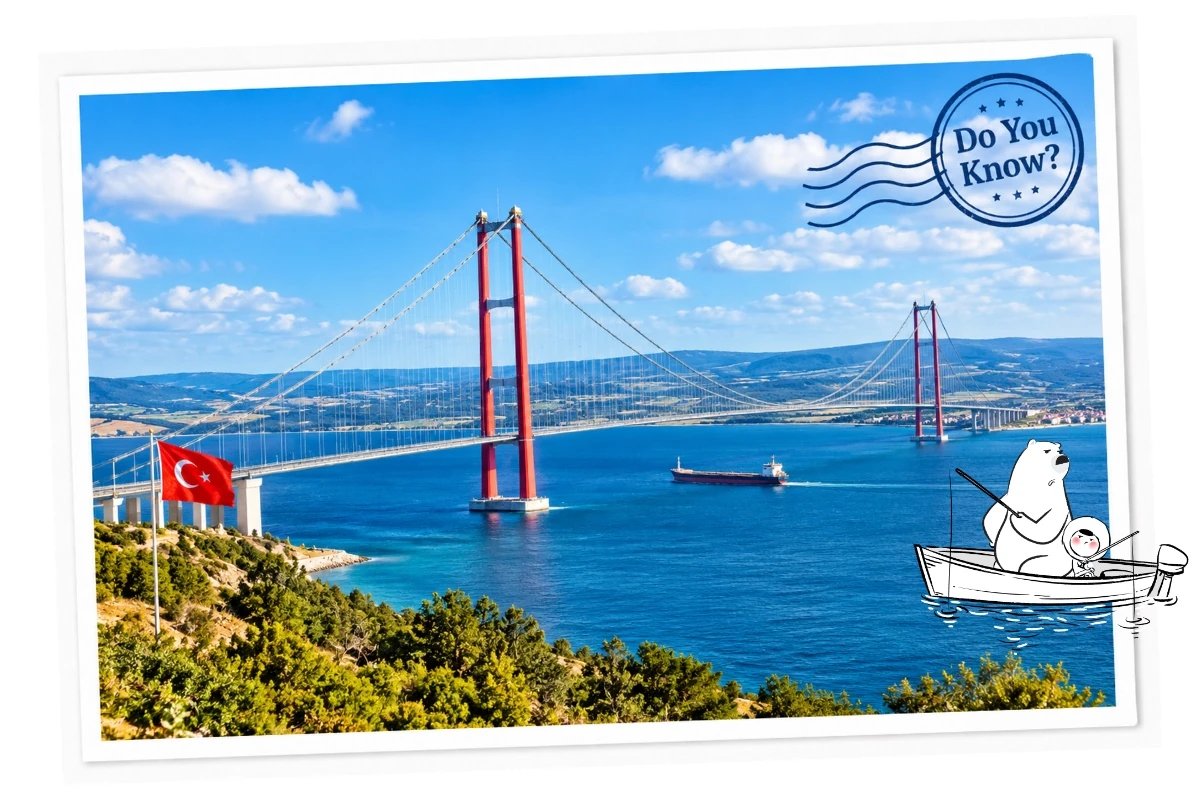
The longest suspension bridge in the world by main-span length is the 1915 Çanakkale Bridge in Türkiye. Its central span stretches 2,023 metres (6,637 feet) across the Çanakkale Strait, also known internationally as the Dardanelles. Guinness World Records recognizes it as the record holder for the longest suspension bridge span.
The bridge connects Gelibolu on the European side of Türkiye with Lapseki on the Asian side. It opened to traffic on March 18, 2022, creating the first continuous road connection across the Çanakkale Strait.
There is one important distinction behind the record: “longest suspension bridge” refers to the main span between the two principal towers, not necessarily the bridge’s total end-to-end length. A bridge can therefore be longer overall without holding the suspension-bridge span record. The phrase “largest suspension bridge in the world” is also sometimes used for this record, but main-span length is the more precise measurement.
Are you planning a trip? Try Eskimo! New users can apply promo code WELCOME within 24 hours of signing up and get 50% off data packages, up to a maximum discount of US$15. Promotion eligibility and terms can change, so check the current offer before purchasing.
How Suspension Bridge Length Is Measured
Suspension bridges have several measurements, including total bridge length, tower height and the length of the central suspended section.
For world records, the key measurement is generally the main span, the distance between the two main towers. The Golden Gate Bridge authority uses the same measurement when comparing major suspension bridges.
This distinction matters because total bridge length can include side spans, approaches and viaducts that extend far beyond the main suspended section.
According to Türkiye’s General Directorate of Highways, the 1915 Çanakkale Bridge has:
- Main span: 2,023 metres
- Side spans: 770 metres each
- Bridge length: 3,563 metres
- Total crossing with approach viaducts: 4,608 metres
- Steel tower height: 318 metres
- Traffic lanes: six, with three in each direction
The Location Of The 1915 Çanakkale Bridge
The crossing spans the Çanakkale Strait in northwestern Türkiye, connecting Gelibolu with Lapseki.
The strait separates the European and Asian sides of Türkiye and links the Aegean Sea with the Sea of Marmara. Its location has given the waterway strategic and historical importance for centuries.
The bridge forms part of the Malkara-Çanakkale Motorway and provides an alternative road corridor between the two sides of the Marmara region. Before it opened, vehicles crossing this section of the strait depended on ferries. The General Directorate of Highways says the bridge reduced the crossing itself to around six minutes.
Travelers planning a wider journey through the country can combine the Çanakkale region with destinations such as Istanbul, İzmir, Antalya or Cappadocia.
Why The Main Span Is Exactly 2,023 Metres
The 2,023-metre span was deliberately chosen rather than being simply the result of the distance engineers needed to cross.
The figure represents 2023, the centenary year of the Republic of Türkiye. The bridge’s dimensions contain another historical reference too.
Its 318-metre steel towers reference March 18, commemorating the Çanakkale naval victory of March 18, 1915. The year 1915 in the bridge’s name also refers to the Çanakkale campaign during the First World War. These design details are documented by Turkish government authorities.
The result is a bridge whose record-breaking dimensions also carry national historical symbolism.
The Bridge That Held The Record Before It
Before the Turkish crossing opened, the Akashi Kaikyo Bridge in Japan held the main-span record.
Its central span measures 1,991 metres, linking Kobe on Honshu with Awaji Island across the Akashi Strait. NASA records its main span at 1,991 metres.
The Japanese bridge opened in 1998 and remained the benchmark for long-span suspension bridges for more than two decades.
The 1915 Çanakkale Bridge extended that record by 32 metres when it opened in 2022.
Other Long Suspension Bridges Around The World
The record becomes clearer when the Çanakkale crossing is compared with several other exceptionally long suspension bridges.
Akashi Kaikyo Bridge, Japan
With a 1,991-metre main span, the Akashi Kaikyo Bridge remains one of the closest challengers to the current record. It crosses the Akashi Strait between Kobe and Awaji Island.
Yangsigang Yangtze River Bridge, China
Wuhan’s Yangsigang Yangtze River Bridge has a 1,700-metre main span. The double-deck crossing carries road traffic over the Yangtze River and opened in 2019.
Xihoumen Bridge, China
The Xihoumen Bridge has a 1,650-metre main span and connects islands in China’s Zhoushan archipelago.
Get Eskimo eSIM to stay connected globally
Need internet while travelling? Here's what we recommend:

Fixed data plans
- No speed reduction
- No expiry, keep your data forever
- Transfer data to anyone
- Personal hotspot


Great Belt East Bridge, Denmark
Denmark’s Great Belt East Bridge has a 1,624-metre main span and forms part of the fixed transport connection between the Danish islands of Zealand and Funen.
Osmangazi Bridge, Türkiye
Another major Turkish crossing, the Osmangazi Bridge spans the Gulf of İzmit. Its main span measures 1,550 metres, while the bridge itself extends for 2,682 metres.
The 1915 Çanakkale Bridge Vs The Golden Gate Bridge
The Golden Gate Bridge may be more recognizable internationally, but its main span is considerably shorter.
San Francisco’s landmark has a 1,280-metre main span, compared with 2,023 metres for the record holder in Türkiye.
That makes the Çanakkale span 743 metres longer.
The comparison also illustrates almost a century of progress in suspension-bridge engineering. The Golden Gate Bridge opened in 1937 and once held the world record itself. Modern engineering has since pushed main spans beyond two kilometres.
Crossing The 1915 Çanakkale Bridge
The 1915 Çanakkale Bridge is a motorway crossing rather than a conventional sightseeing attraction. Travelers driving between the European and Asian sides of the Çanakkale region can use it as part of the Malkara-Çanakkale Motorway.
The crossing itself takes around six minutes under normal conditions, according to the General Directorate of Highways.
The bridge is tolled. As of January 1, 2026, the official toll for a Class 1 vehicle is ₺995, including VAT. Different vehicle classes pay different rates, so drivers should check the latest official 1915 Çanakkale Bridge toll information before traveling.
Domestic road demand can increase around national and religious holidays. Eskimo’s overview of Turkey public holidays in 2026 can help drivers identify holiday periods and long weekends that may affect travel planning.
The Engineering Behind The Record
Suspension bridges carry their roadway using vertical suspenders attached to large main cables. Those cables pass over the towers before being secured at massive anchorages on either side.
This arrangement allows engineers to create very long central spans without placing supporting piers throughout the waterway below.
The 1915 Çanakkale Bridge adds another distinctive engineering feature: its roadway uses a twin-box steel deck, with two separate aerodynamic box sections connected by transverse beams. According to project engineering documentation, the arrangement was developed to improve aerodynamic stability for the exceptionally long 2,023-metre span.
Engineers also had to account for wind, seismic conditions, traffic loads and structural movement. The finished bridge carries six motorway lanes across a main span longer than two kilometres.
Visiting Çanakkale And The Surrounding Region
The bridge is most relevant to travelers exploring Çanakkale Province, the Gallipoli Peninsula or northwestern Türkiye by road.
Çanakkale is closely associated with the Gallipoli campaign and the Çanakkale battles of 1915. Travelers can combine a drive across the bridge with historical sites around the Gallipoli Peninsula or continue toward destinations along Türkiye’s Aegean side.
Spring can be a comfortable period for a wider Türkiye itinerary, particularly for travelers combining cultural destinations with outdoor sightseeing. Eskimo’s overview of the best countries to visit in spring includes Türkiye among its April and May recommendations.
Because the bridge is part of a motorway, drivers should focus on the road rather than treating the crossing as a stopping point for photographs. Use designated viewpoints or safe stopping areas elsewhere if you want to photograph it.
Mobile Data Around Çanakkale
Mobile data can help with motorway navigation, current toll information, ferry alternatives, accommodation bookings and traffic conditions around Çanakkale and the Gallipoli Peninsula. Reception is generally stronger around towns and established transport corridors, while signal quality can vary on rural roads and less populated coastal stretches.
An Eskimo Turkey eSIM plan can be installed before arrival. Eskimo’s coverage across 175 countries and regions can also be useful for travelers combining Türkiye with other international destinations, while no-expiry fixed data means unused fixed data can remain available for another trip.
New users can also claim free 250MB of Global Data. Current public information for the free offer states that it can be used in 110+ countries, so travelers should check the latest supported destinations before departure.
FAQs:
What is the longest suspension bridge in the world?
The 1915 Çanakkale Bridge in Türkiye holds the world record by main-span length. Its central span measures 2,023 metres, or 6,637 feet.
How long is the 1915 Çanakkale Bridge?
Its main span is 2,023 metres. The bridge itself measures 3,563 metres, while the total crossing reaches 4,608 metres when the approach viaducts are included.
Where is the world’s longest suspension bridge?
It crosses the Çanakkale Strait in northwestern Türkiye between Gelibolu in Europe and Lapseki in Asia.
What was the longest suspension bridge before 1915 Çanakkale?
Japan’s Akashi Kaikyo Bridge held the record with a 1,991-metre main span before the 1915 Çanakkale Bridge opened in 2022.
Is the Golden Gate Bridge the longest suspension bridge in the world?
No. The Golden Gate Bridge has a 1,280-metre main span, compared with the 2,023-metre main span of the 1915 Çanakkale Bridge.