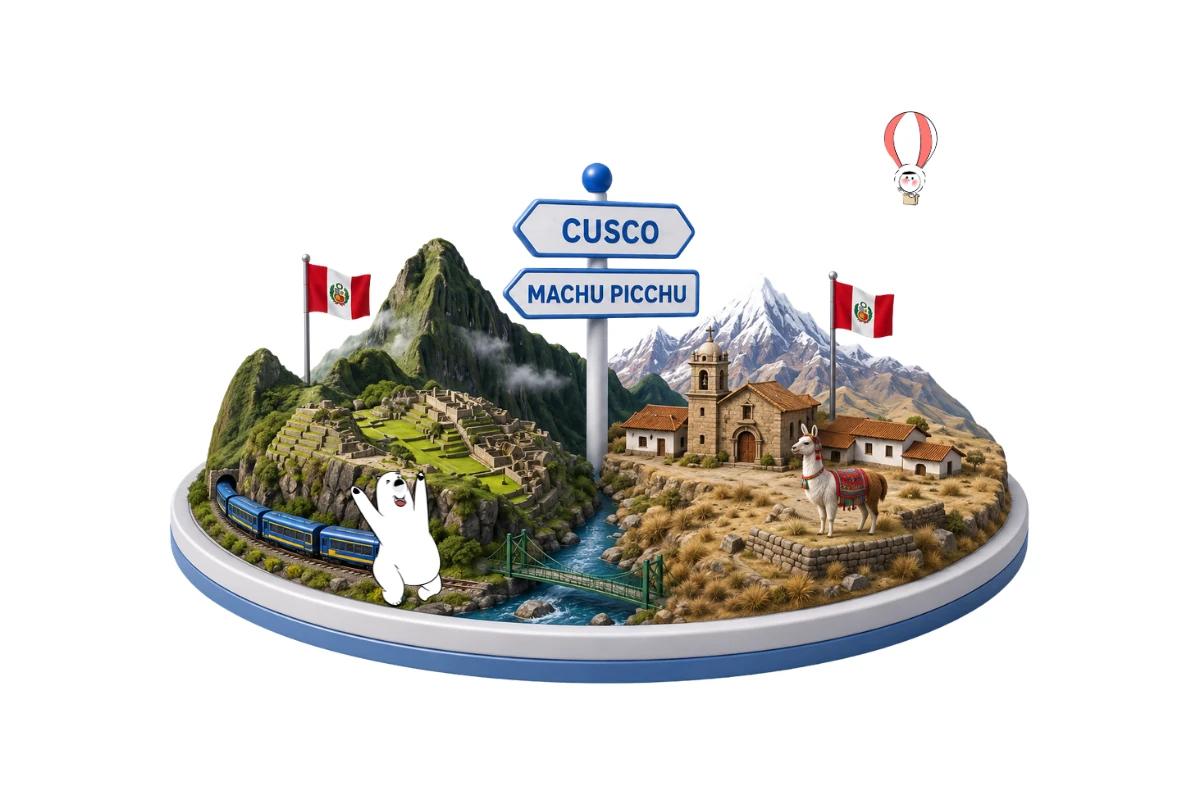
Machu Picchu is a 15th-century Inca site in Peru's Cusco Region, about 2,430 meters above sea level. A first visit is easiest to plan around three decisions: choose your entrance circuit and route, match transport to your assigned entry time, and allow enough time in the Cusco region to adjust to altitude.
Most travelers reach Machu Picchu Pueblo by train, then continue uphill to the archaeological site by bus or on foot. The ruins themselves can fit into half a day, but the overall Peru trip is more comfortable when Machu Picchu is combined with at least one night in the Sacred Valley or Machu Picchu Pueblo instead of being squeezed into a rushed return from Cusco.
Quick planning priorities:
- Choose and book your Machu Picchu route before committing to fixed train times.
- Leave a practical buffer between train arrival and your assigned entrance slot.
- Carry the passport or accepted identity document used for your booking.
- Build acclimatization time into the Cusco portion of the trip.
- Pack for changing mountain weather rather than relying on a single-day forecast.
What Is Machu Picchu And Why Is It Important?
Machu Picchu is an Inca archaeological complex built above the Urubamba Valley during the height of the Inca Empire. Its terraces, stone buildings, ceremonial spaces, paths, stairways, and water systems were integrated into exceptionally steep terrain rather than laid out on flat ground.
The wider Historic Sanctuary of Machu Picchu is recognized by UNESCO as a mixed cultural and natural World Heritage property. Its importance comes from both the surviving Inca-built environment and the surrounding transition between the Andes and upper Amazon basin.
For wider heritage context, Eskimo's roundup of UNESCO World Heritage Sites to visit includes Machu Picchu among other major cultural and natural sites around the world.
Where Is Machu Picchu?
Machu Picchu is in southern Peru's Cusco Region. The nearest tourism hub is Machu Picchu Pueblo, often called Aguas Calientes, which sits below the archaeological site in the Urubamba Valley.
Cusco is the main gateway for most international visitors, but Ollantaytambo in the Sacred Valley is often a more convenient rail departure point. This is why many itineraries naturally combine Cusco, the Sacred Valley, and Machu Picchu rather than treating the archaeological site as an isolated day trip.
Machu Picchu Tickets And Circuits
Machu Picchu uses a route-based entry system rather than one unrestricted visitor path. The official site currently lists three circuits grouping ten routes, and the route printed on your ticket determines which viewpoints, archaeological sectors, and mountain areas you may access.
| Circuit | General Focus | Best Fit |
| Circuit 1: Panoramic | Upper terraces and elevated viewpoints, with some seasonal route options | Travelers prioritizing broad landscape views and photography |
| Circuit 2: Machupicchu Clásico | Classic archaeological routes through central areas of the site | Most first-time visitors wanting a balanced ruins-and-viewpoints experience |
| Circuit 3: Machupicchu Realeza | Lower archaeological sectors plus routes including Waynapicchu | Travelers prioritizing specific archaeological areas or mountain hikes |
The official Machu Picchu website maintains the current circuit and route list. Routes 1-C, 1-D, 3-C, and 3-D are currently marked as high-season options, so check the live route page before buying rather than relying on an older itinerary.
Where to buy official Machu Picchu tickets
Peru's Ministry of Culture directs visitors to Tu Boleto for official online Machu Picchu ticket sales. The booking process requires a route, date, entry time, and visitor identification details.
For 2026, the Ministry of Culture maintains a normal carrying capacity of up to 4,500 visitors per day and authorizes a maximum of 5,600 on specified high-demand dates. The 2026 Ministry of Culture resolution identifies those higher-capacity dates and confirms Tu Boleto as the sales platform.
If your dates are fixed, secure the archaeological route first. Train tickets can then be chosen around the confirmed entry time instead of forcing the visit into whatever route remains available.
Which Machu Picchu Circuit Should You Choose?
The best circuit depends on what matters most to you rather than on one universal ranking.
- Choose Circuit 1 if elevated scenery and panoramic viewpoints are the priority.
- Choose Circuit 2 if you want the most balanced first-time combination of central archaeological areas and familiar Machu Picchu views.
- Choose Circuit 3 if a lower archaeological route or a specific mountain option such as Waynapicchu is central to your visit.
Your ticket applies to a specific route, so compare the official route maps before payment if a particular viewpoint, structure, or hike is important to you.
How To Get To Machu Picchu
For most travelers, the simplest journey is from Cusco or the Sacred Valley to Machu Picchu Pueblo by train, followed by the final climb to the archaeological entrance by shuttle bus or on foot.
Via Ollantaytambo
Ollantaytambo is a practical rail departure point because it sits inside the Sacred Valley and allows you to split the journey rather than beginning everything from Cusco on the same day. Staying in the Sacred Valley before the train can also make an early Machu Picchu entry easier to manage.
From Cusco
Some rail itineraries begin in or around Cusco, while others combine road and rail depending on the operator, season, and departure. Check the current train operator schedule for your travel date because station arrangements and transfer patterns can vary.
By trekking route
The Inca Trail and alternative treks should be treated as separate trip experiences, not simply as substitutes for a train ticket. They require more physical preparation and logistics, and some routes involve permits or organized support.
Get Eskimo eSIM to stay connected globally
Need internet while travelling? Here's what we recommend:

Fixed data plans
- No speed reduction
- No expiry, keep your data forever
- Transfer data to anyone
- Personal hotspot


How Much Time Do You Need At Machu Picchu?
A half-day is enough for many visitors to complete their assigned archaeological route. The more important timing decision is where to stay before and after the visit.
A same-day return from Cusco is possible with suitable connections, but it creates a long chain of transfers. Sleeping in Machu Picchu Pueblo makes an early entry easier, while a Sacred Valley stay can reduce the rail journey and give the wider itinerary a calmer pace.
For a first trip, two nights across the Sacred Valley and Machu Picchu Pueblo portion of the itinerary usually provide more flexibility than treating Machu Picchu as one compressed excursion.
Best Time To Visit Machu Picchu
Machu Picchu is open year-round, but the drier Andean months generally offer a better chance of clear mountain views. May through September is typically drier, while wetter months bring greener scenery, more cloud, and a greater chance of rain.
The trade-off is demand. Drier months overlap with some of Peru's busiest travel periods, so ticket, train, and hotel availability can become tighter. Holiday periods can add another layer of domestic demand, and Eskimo's Peru public holidays overview is useful for checking long weekends and major travel dates before booking.
Morning or afternoon?
Morning slots are popular but are not automatically superior. Early cloud can obscure views, while afternoon entries may fit more comfortably with a morning train. Choose the time that works with your route, transport, and tolerance for an early start rather than assuming sunrise is essential.
Machu Picchu Altitude And Acclimatization
Machu Picchu sits at approximately 2,430 meters above sea level, which is lower than Cusco. Many travelers therefore encounter stronger altitude effects in Cusco before they reach Machu Picchu.
Altitude responses vary. Headache, fatigue, nausea, poor sleep, or shortness of breath can occur at elevation. Give yourself time to adjust, stay hydrated, avoid immediately overloading the itinerary with demanding activity, and seek medical help if symptoms become severe or worsen.
If a mountain hike or multi-day trek is part of the trip, acclimatization should be treated as part of the schedule rather than an optional extra.
What To Pack For Machu Picchu
The standard archaeological routes do not require expedition equipment, but a few items matter because of sun exposure, rain, altitude, and uneven stone paths.
- Passport or accepted identity document associated with your ticket
- Comfortable walking shoes with good grip
- Light rain jacket or poncho
- Sunscreen and a hat
- A small daypack
- Personal medication
- Offline copies of tickets, booking references, and accommodation details
The official Machu Picchu code of conduct prohibits bags larger than 40 × 35 × 20 cm inside the site and restricts items including food, umbrellas, tripods, selfie sticks, and drones. Check the current rules before packing your day bag because the site restrictions are stricter than an ordinary sightseeing stop.
Three Planning Mistakes That Can Disrupt The Visit
Building every connection too tightly
Train transfers, hotel check-in, shuttle queues, and mountain weather add uncertainty. Leave a practical buffer around the entry time rather than designing the day around perfect connections.
Choosing a circuit by name alone
The route determines what you actually see. Read the current route description and map before booking if a specific viewpoint or hike is a priority.
Ignoring peak domestic travel dates
Peruvian holidays and long weekends can affect accommodation, trains, and flights around Cusco as well as Machu Picchu. Check national holiday dates before finalizing a tightly scheduled itinerary.
How Machu Picchu Fits Into A Wider Peru Trip
Machu Picchu is Peru's most recognizable landmark, but it makes more sense geographically when paired with Cusco and the Sacred Valley. Travelers with additional time can then extend the trip toward Lima, Arequipa, Lake Titicaca, the Amazon, or other regions rather than repeatedly backtracking through Cusco.
For travelers comparing Machu Picchu with other major heritage attractions, Eskimo's famous landmarks around the world places it alongside other destination-defining sites and helps frame how much planning different landmark trips require.
Using Mobile Data Around Machu Picchu
Mobile data is useful around Cusco, the Sacred Valley, and Machu Picchu Pueblo for train updates, digital tickets, hotel messages, maps, weather checks, and transport changes. Coverage is generally stronger in towns and along established transport corridors, while reception can weaken in steep valleys, tunnels, mountain sections, and remote trails.
A Peru eSIM plan is the most relevant Eskimo option for a Peru-only trip, while Eskimo coverage across 175 countries and regions can also support onward travel elsewhere in South America or future international trips using the same eSIM. Eskimo fixed data plans do not expire, so unused data can remain available after the Machu Picchu portion of the journey.
New users can also claim free 500MB of Global Data.
FAQs
Is Machu Picchu worth visiting?
Yes for travelers interested in Inca history, archaeology, mountain scenery, or major World Heritage sites. The main drawback is that tickets, routes, and transport require more advance planning than a typical attraction visit.
Can you visit Machu Picchu without a tour?
You can arrange the entrance ticket and transport independently. A guide can add historical context, but independent logistics are possible as long as you follow the route and current visitor rules attached to your ticket.
How far in advance should you book Machu Picchu?
Book as early as practical if your dates are fixed, you are traveling during a busy period, or a specific circuit or mountain route matters. Availability varies by route and entry time, so there is no single booking window that guarantees every option.
What is the altitude of Machu Picchu?
Machu Picchu is about 2,430 meters above sea level. Cusco is higher, so travelers often notice altitude effects there before reaching the archaeological site.
Where should you buy official Machu Picchu tickets?
Peru's Ministry of Culture directs visitors to Tu Boleto for official online ticket sales.