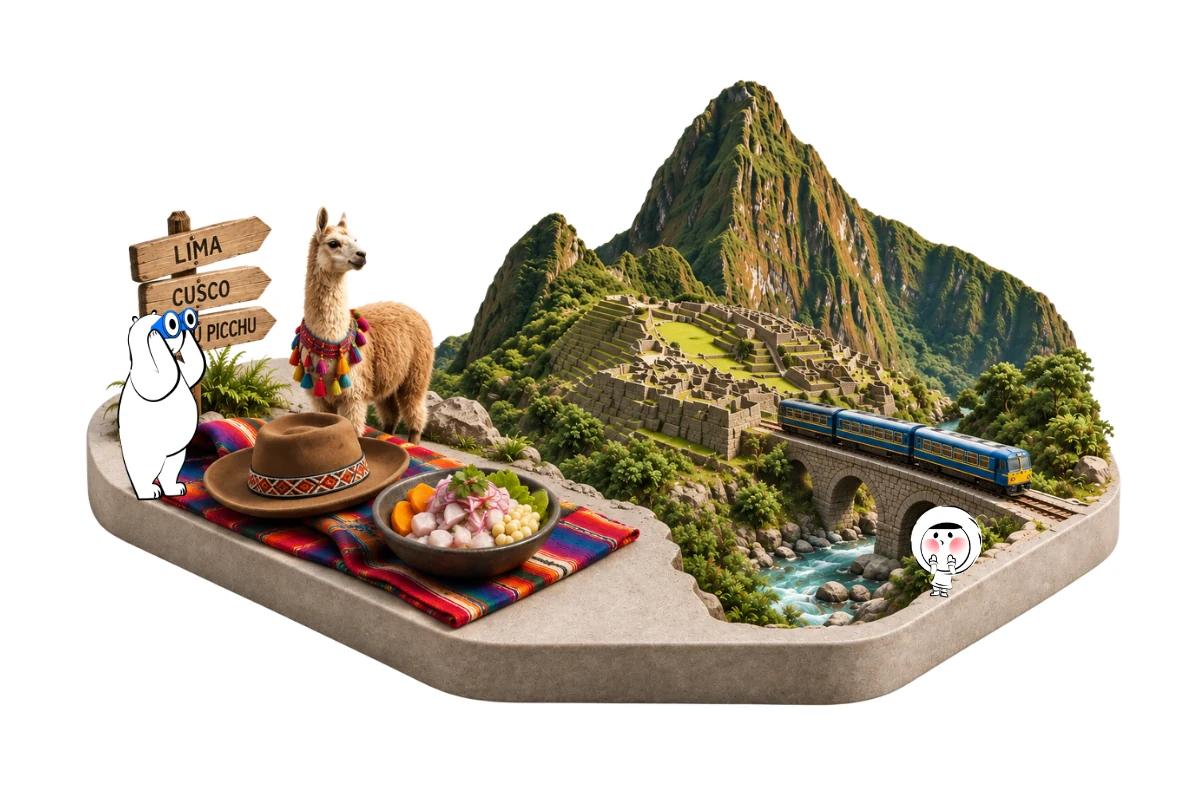
Peru combines major archaeological sites, high-altitude Andean cities, Pacific coast, desert landscapes, and Amazon rainforest, but distances and elevation make good planning essential. For most first-time travelers, 10 to 14 days gives enough time for Lima, Cusco, the Sacred Valley, and Machu Picchu without turning the trip into a race between airports and train stations.
A shorter seven-day trip is possible if you concentrate on Lima and the Cusco region. Longer trips create room for Arequipa, Lake Titicaca, the Amazon, or the desert around Ica and Paracas.
Practical planning matters most around trip length, itinerary order, transport, altitude, weather, money, and packing, especially when a route combines Peru’s coast with high-altitude destinations in the Andes.
Peru At A Glance
Peru sits on the western side of South America and stretches from the Pacific coast across the Andes to the Amazon basin. Lima is the capital and the main international gateway, while Cusco is the principal base for trips to the Sacred Valley and Machu Picchu, so its better you check Peru Public Holiday 2026 before plan it.
Spanish is the most widely used language, while Quechua, Aymara, and other Indigenous languages are also spoken. The currency is the Peruvian sol (PEN).
Peru’s geography is one reason itineraries require more thought than the map initially suggests. Lima is near sea level, while Cusco sits high in the Andes. Journeys between major destinations may involve flights, long-distance buses, trains, or combinations of several transport types.
Travelers still choosing which destinations deserve space in their schedule can also look at Eskimo’s overview of the most visited countries in South America, which includes Peru and its major tourism regions.
Best Time To Visit Peru
There is no single best month for every part of Peru because the coast, Andes, and Amazon have different climates.
For Cusco, Machu Picchu, and much of the Andes, the drier months generally run from around May to October. Clearer conditions make this period popular for hiking and outdoor sightseeing, although popular sites and transport can also be busier.
The wetter Andean period generally falls between November and April. Rain can affect hiking conditions and transport, but landscapes are greener and some destinations may feel less crowded outside major holiday periods.
Lima and Peru’s Pacific coast follow a different pattern. Summer falls roughly from December to March, when conditions are typically warmer and brighter along the coast.
Check regional forecasts rather than packing for “Peru weather” as one climate. A trip combining Lima, Cusco, and Machu Picchu can involve noticeably different temperatures and conditions within a few days.
Travel dates can also overlap with national holidays and domestic travel peaks, when transport and accommodation demand may increase.
How Many Days To Spend In Peru
Ten to 14 days is a practical first-trip range for travelers who want to combine Lima, the Cusco region, and Machu Picchu.
Seven days works best when the itinerary stays focused. Trying to add southern Peru, the Amazon, Lake Titicaca, and multiple Andean destinations to a one-week trip creates too much transit time.
With two weeks, the route becomes considerably more flexible. You can spend several nights acclimatizing around Cusco, visit Machu Picchu without immediately rushing onward, and add another region.
Travelers with three weeks or more can build a broader overland route through southern Peru or include an Amazon stay.
7-Day Peru Itinerary
A seven-day Peru itinerary should prioritize Lima, Cusco, the Sacred Valley, and Machu Picchu rather than attempting to cover the entire country.
Days 1–2: Lima
Arrive in Lima and use the first two days for the historic center, coastal districts, museums, and Peruvian food.
Keeping the first part of the trip near sea level also avoids immediately combining a long international journey with high-altitude sightseeing.
Days 3–4: Cusco
Fly from Lima to Cusco and keep the first day relatively light while adjusting to the altitude.
Use the following day for Cusco’s historic center and nearby archaeological sites. Avoid packing the schedule too tightly, particularly if you are not accustomed to high elevations.
Day 5: Sacred Valley
Travel through the Sacred Valley, with stops depending on your route and transport arrangements. Ollantaytambo is particularly practical because trains toward Machu Picchu depart from the area.
Spending the night here can also reduce backtracking to Cusco.
Day 6: Machu Picchu
Travel to Machu Picchu according to your booked train and entrance times.
Entry is controlled through timed tickets and designated visitor routes, so buy admission through Peru’s official Ministry of Culture Tu Boleto platform and confirm the route attached to your ticket before traveling.
For more background on the journey, Eskimo’s Machu Picchu travel overview covers the route from Lima through Cusco and the practical challenges of reaching the site.
Day 7: Return
Return toward Cusco for your onward journey. If your international flight departs from Lima, avoid relying on a tight same-day connection between separately booked domestic and international flights.
This route suits travelers with limited time who want Peru’s best-known historical destinations without adding another region.
10-Day Peru Itinerary
Ten days provides a better balance between sightseeing and transit.
A practical route is:
- Days 1–2: Lima
- Days 3–4: Cusco and acclimatization
- Days 5–6: Sacred Valley and Ollantaytambo
- Day 7: Machu Picchu
- Day 8: Return to Cusco
- Days 9–10: Additional Cusco time or a carefully selected day trip
The extra days matter most around Cusco. Instead of landing at altitude and immediately moving toward Machu Picchu, you have more room to adjust and recover from transport days.
Travelers particularly interested in hiking should build the schedule around their chosen trek rather than trying to squeeze a multi-day hike into the itinerary above.
14-Day Peru Itinerary
Two weeks allows you to add another region without sacrificing the core Lima, Cusco, Sacred Valley, and Machu Picchu route.
One workable structure is:
- Days 1–2: Lima
- Days 3–4: Cusco
- Days 5–6: Sacred Valley
- Day 7: Machu Picchu
- Day 8: Return to Cusco
- Days 9–10: Arequipa
- Days 11–12: Colca Canyon area
- Days 13–14: Return toward Lima and departure
Another option is to use the final four to five days for an Amazon stay instead of southern Peru.
The better choice depends on what you want from the trip. Arequipa and the Colca region extend the Andean experience, while an Amazon itinerary introduces a completely different landscape and climate.
Avoid adding both unless you have additional days. Peru rewards slower routing more than collecting destinations at speed.
Getting Around Peru
Peru’s size and terrain mean travelers often use several forms of transport during one trip.
Get Eskimo eSIM to stay connected in Peru
Need internet in Peru? Here's what we recommend:

Fixed data plans
- No speed reduction
- No expiry, keep your data forever
- Transfer data to anyone
- Personal hotspot


Domestic flights
Flights are useful for covering major distances, particularly between Lima and Cusco. They can save substantial time compared with long overland journeys.
Weather and operational conditions can affect schedules, so avoid extremely tight connections when an important train, international flight, or timed attraction ticket follows.
Long-distance buses
Intercity buses connect many Peruvian cities and can be useful for routes where flying is inconvenient.
Journey times can be long, especially through mountainous areas. Choose established operators and compare departure points, arrival times, and service levels before booking.
Trains
Tourist trains are particularly important around the Cusco and Machu Picchu route.
Book popular departures in advance and check exactly which station your ticket uses. “Cusco” departures do not always mean a train leaves from the historic center itself, and some journeys involve road transfers.
Taxis and local transport
Taxis, ride-hailing services, buses, and shared local transport are available in larger cities, although options vary by destination.
Arrange airport transport in advance when arriving late at night, and confirm prices before using taxis that do not operate with a meter or app-based fare.
Altitude And Acclimatization
Altitude deserves a place in any Peru travel plan because several popular Andean destinations sit well above sea level.
Cusco is around 3,400 meters above sea level, while Machu Picchu itself is lower. Travelers arriving directly from Lima may therefore notice the elevation soon after reaching Cusco.
Common advice is to keep the first day at altitude relatively easy, stay hydrated, limit strenuous activity initially, and allow your body time to adjust.
Altitude affects people differently regardless of age or fitness. If symptoms become severe or continue to worsen, seek medical assistance rather than simply pushing through a packed itinerary.
This is another reason to avoid scheduling a demanding hike immediately after landing in Cusco.
Money And Payments
Peru uses the Peruvian sol (PEN).
Cards are commonly accepted by many hotels, restaurants, and larger businesses in tourist areas, but carrying some cash remains useful for smaller purchases, markets, local transport, tips, and businesses outside major urban centers.
ATMs are available in larger cities and tourism hubs. Check your bank’s foreign transaction and withdrawal fees before traveling.
Avoid carrying more cash than you need for the day, and use ATMs in secure, well-trafficked locations such as banks, shopping centers, or established commercial areas where possible.
What To Pack For Peru
Packing depends heavily on your itinerary.
For a typical Lima, Cusco, Sacred Valley, and Machu Picchu route, useful items include:
- Comfortable walking shoes
- Lightweight layers
- A warmer layer for cool Andean mornings and evenings
- Waterproof outerwear during wetter periods
- Sun protection
- Refillable water bottle
- Small daypack
- Portable power bank
- Any personal medication
- Copies of important travel documents
Layering is more useful than packing for one fixed temperature. Conditions can change substantially between the coast, high-altitude cities, valleys, and mountain sites.
If you are trekking, use a separate packing list based on the route, season, elevation, and requirements of your trekking operator.
Booking Machu Picchu
Machu Picchu is the part of a Peru itinerary that benefits most from advance planning.
Entrance tickets use specific routes and entry periods rather than unrestricted access to the entire archaeological site. Availability can become limited, particularly during popular travel periods.
Buy admission through Peru’s official Ministry of Culture Tu Boleto platform and make sure you understand the circuit attached to your ticket before booking connecting transport.
Train tickets and accommodation around Machu Picchu should then be coordinated with that entrance time.
Do not assume you can arrive in the area and choose any route or entry time on the day.
The official Peru tourism website is also useful for checking current destination information while planning other parts of the country.
Practical Peru Travel Tips
A few planning decisions can make a Peru itinerary much easier.
Leave room for altitude. Do not schedule your hardest physical activity immediately after arriving in Cusco.
Book fixed-date attractions first. Secure Machu Picchu admission before building flights, trains, and hotels around it.
Avoid excessive backtracking. Moving through Cusco, the Sacred Valley, Ollantaytambo, and Machu Picchu in a logical sequence can save time.
Keep transport buffers. Mountain weather, road conditions, and operational delays can affect journey times.
Carry some cash. Card acceptance is strongest in larger tourism businesses and less consistent for small transactions.
Download essential information. Offline maps, hotel addresses, ticket confirmations, and important travel documents are useful when reception weakens.
Check current requirements before departure. Entry rules and operational conditions can change, so verify official information for your nationality and itinerary close to your travel date.
Travelers watching costs can also compare Peru with neighboring destinations in Eskimo’s overview of budget-friendly countries in South America.
Mobile Data For A Peru Trip
Mobile data is useful for checking domestic flight and train updates, navigating Lima and Cusco, retrieving Machu Picchu bookings, and messaging hotels or transport providers. Reception is generally more dependable in cities and established tourism areas, while signal can weaken on mountain roads, remote hiking routes, valleys, and rural stretches of the Andes.
Peru is currently listed among Eskimo’s supported eSIM destinations. Eskimo’s broader network footprint extends across 175 countries and regions overall, which can be useful for stopovers and future international trips, while the Universal eSIM lets travelers keep one reusable Eskimo eSIM installed for multiple eligible destinations.
New users can also claim a free 250MB Global eSIM.
FAQs:
How many days are enough for Peru?
Around 10 to 14 days works well for a first trip covering Lima, Cusco, the Sacred Valley, and Machu Picchu. Seven days is possible if you keep the route focused, while two weeks or more allows you to add another region.
What is a good Peru itinerary for first-time visitors?
A practical first-time route is Lima, Cusco, the Sacred Valley, Ollantaytambo, and Machu Picchu. With additional time, you can add Arequipa and Colca Canyon or choose an Amazon stay.
What is the best time to visit Peru?
For the Andes and Machu Picchu, the drier period from roughly May to October is popular for outdoor travel. Peru has several climate zones, however, so the best timing depends on whether your itinerary includes the coast, mountains, or Amazon.
Should I book Machu Picchu in advance?
Yes. Machu Picchu uses timed admission and designated visitor routes, and availability can become limited. Secure your entrance through Peru’s official Ministry of Culture ticket platform before arranging connecting trains and accommodation.
How should I prepare for altitude in Peru?
Allow time to acclimatize after reaching high-altitude destinations such as Cusco. Keep your first day relatively light, stay hydrated, and avoid scheduling strenuous activity immediately after arrival.