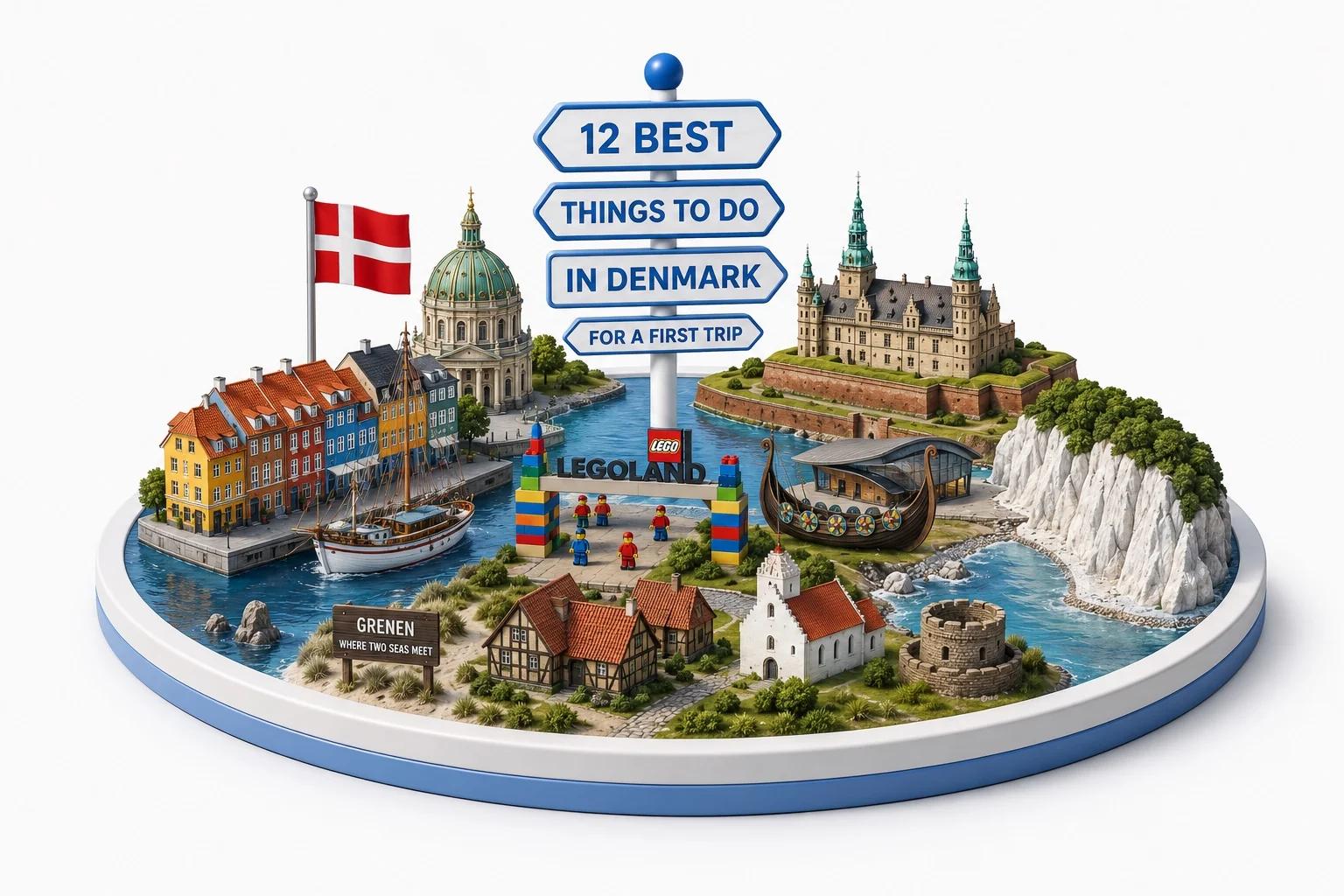
The best things to do in Denmark combine Copenhagen’s canals and historic streets with royal castles, Viking history, family attractions, coastal landscapes, and smaller cities such as Aarhus and Odense. For a first trip, Copenhagen is the natural starting point, but some of Denmark’s most memorable places lie beyond the capital.
If time is limited, prioritize Copenhagen, one major castle, and a day trip into the countryside or along the coast. With a week or longer, adding Funen or Jutland gives you a much broader picture of the country.
Best Things to Do in Denmark
1. Explore Nyhavn and central Copenhagen
Location: Copenhagen Best for: First-time visitors, architecture, dining, city walks
Nyhavn is one of Denmark’s most recognizable sights, with brightly painted townhouses lining a historic canal filled with boats. It is touristy, but its central location makes it an easy starting point for exploring Copenhagen.
Continue on foot toward Amalienborg Palace, the waterfront, Christianshavn, and the historic center rather than treating Nyhavn as a destination on its own. Copenhagen is compact enough that several major Denmark tourist attractions can fit comfortably into the same day.
2. Spend an evening at Tivoli Gardens
Location: Copenhagen Best for: Families, couples, rides, evening atmosphere Entry: Ticket required
Opened in 1843, Tivoli Gardens combines amusement rides, landscaped gardens, restaurants, concerts, and seasonal decorations in central Copenhagen.
It works particularly well later in the day, when the park lights come on and you can combine rides with dinner or an evening walk. Tivoli operates in distinct seasons rather than following one year-round schedule, so check the official Tivoli opening calendar before visiting.
Families planning a Denmark trip can also find Copenhagen among Eskimo’s best places to travel with kids, thanks to its manageable transport, playgrounds, and family-focused attractions.
3. Visit Kronborg Castle
Location: Helsingør, North Zealand Best for: History, architecture, Shakespeare connections
Kronborg Castle stands at the narrow stretch of water between Denmark and Sweden and is one of the country’s most significant historic landmarks.
The UNESCO-listed castle is widely associated with Elsinore in Shakespeare’s Hamlet, but its real history as a royal fortress and strategic stronghold is just as compelling.
Helsingør is reachable from Copenhagen by train, making Kronborg one of the easiest major castle trips to add to a stay in the capital.
4. See Viking ships in Roskilde
Location: Roskilde, Zealand Best for: Viking history, archaeology, families
Roskilde makes a strong day trip for travelers interested in Denmark’s Viking past. Its Viking Ship Museum centers on five original Viking Age ships excavated from Roskilde Fjord.
The city also has Roskilde Cathedral, another UNESCO World Heritage Site and the burial place of Danish monarchs.
Because Roskilde has direct rail connections with Copenhagen, it is one of the easiest ways to add Viking and royal history without changing hotels.
5. Walk above the cliffs at Møns Klint
Location: Island of Møn Best for: Nature, hiking, photography, coastal scenery
Møns Klint offers a striking contrast to Denmark’s cities and castles. Its white chalk cliffs extend along roughly seven kilometers of coastline and rise as high as 128 meters above the Baltic Sea. The site is part of a UNESCO World Heritage area.
You can follow trails through the cliff-top forest, use viewpoints along the 267-meter boardwalk, or descend toward the beach. The full staircase to the shore involves hundreds of steps, so the boardwalk is a useful alternative for visitors who want views without the steep descent.
Møns Klint is just under two hours south of Copenhagen by car, and public transport is more limited than at many urban attractions. Renting a car is often the more practical option.
6. Discover Aarhus and Den Gamle By
Location: Aarhus, Jutland Best for: Culture, museums, city breaks
Denmark’s second-largest city is worth adding if your trip extends beyond Copenhagen.
One of its signature attractions is Den Gamle By, an open-air museum where historic buildings and reconstructed streets show different periods of Danish urban life.
Aarhus also offers the ARoS art museum, waterfront architecture, cafés, and a compact center. It works particularly well as the urban base for travelers exploring Jutland.
7. Follow Hans Christian Andersen through Odense
Location: Odense, Funen Best for: Literature, culture, families
Odense is closely associated with Hans Christian Andersen, the Danish author behind stories including The Little Mermaid, The Ugly Duckling, and The Emperor’s New Clothes.
The H.C. Andersen House uses architecture, exhibitions, sound, and storytelling to explore his life and imaginative world.
Odense sits between Copenhagen and mainland Jutland, making it a convenient stop if you are traveling across Denmark rather than staying entirely in the capital.
Get Eskimo eSIM to stay connected in Denmark
Need internet in Denmark? Here's what we recommend:

Fixed data plans
- No speed reduction
- No expiry, keep your data forever
- Transfer data to anyone
- Personal hotspot


Unlimited data plans
- Unlimited day pass
- Daily 3GB high-speed + 1Mbps unlimited after
- Personal hotspot
8. Take the family to LEGOLAND Billund
Location: Billund, Jutland Best for: Families, LEGO fans, theme parks Entry: Ticket required
LEGO was created in Billund, and the town remains one of Denmark’s biggest family destinations.
LEGOLAND Billund combines themed rides and attractions with Miniland, where elaborate LEGO models recreate buildings, landscapes, and recognizable scenes.
Billund is also home to LEGO House, making it possible to build a larger LEGO-focused visit rather than spending only a few hours at the theme park. Check operating dates and tickets before traveling, especially outside the main summer season.
9. Stand where two seas meet at Grenen
Location: Skagen, North Jutland Best for: Coastlines, photography, road trips
At Denmark’s northern tip, Grenen forms a long spit of sand where the waters of the Skagerrak and Kattegat meet.
The landscape around Skagen feels markedly different from Copenhagen. Wide beaches, dunes, shifting light, and distinctive yellow houses make the area particularly rewarding for travelers driving through northern Jutland.
Swimming at Grenen itself is unsafe because of strong currents, so come for the walk and scenery rather than a dip in the water.
10. Experience Bornholm
Location: Baltic Sea Best for: Cycling, beaches, villages, slower trips
Bornholm is one of the best places to visit in Denmark if you have enough time to move beyond the main Copenhagen-to-Jutland route.
The Baltic island combines rocky coastline, sandy beaches, fishing villages, forests, smokehouses, cycling routes, and medieval round churches. Hammershus, the ruins of a large medieval fortress, adds another historical layer.
Bornholm deserves more than a rushed day trip. A few nights give you time to explore the island at a slower pace.
11. Eat your way through Danish food culture
Location: Nationwide Best for: Food, markets, local culture
Some of the most rewarding things to do in Denmark happen around a table rather than at a landmark.
Try smørrebrød, the traditional open-faced rye-bread sandwiches topped with combinations such as herring, meat, eggs, or seafood. Bakeries are another easy entry into Danish food culture, with pastries, breads, cakes, and cinnamon-based treats appearing throughout the country.
Copenhagen has the greatest concentration of internationally known restaurants, but traditional dishes, bakeries, markets, and regional specialties are available far beyond the capital.
12. Cycle like a local
Location: Copenhagen and cities across Denmark Best for: Active travelers, city exploration
Cycling is part of everyday transport in Denmark, particularly in Copenhagen. Renting a bicycle can turn the journey between attractions into part of the experience.
Copenhagen is the easiest place for visitors to try it because of its extensive cycling infrastructure and relatively flat terrain. Follow local lane rules carefully, signal before turning or stopping, and avoid standing in cycle lanes while sightseeing.
Outside the capital, cycling can also be an excellent way to experience smaller towns, islands, and stretches of coastline.
Planning Your First Denmark Trip
For a short visit, three or four days in Copenhagen can cover the capital plus a day trip to places such as Helsingør or Roskilde.
With around a week, you can combine Copenhagen with Odense and Aarhus, or dedicate part of the trip to nature at Møns Klint. Travelers with more time can extend farther into Jutland, Skagen, or Bornholm.
Spring through early autumn generally gives you the widest choice for outdoor sightseeing. Summer brings long daylight hours and a busy events calendar, while spring and early autumn can suit travelers who prefer fewer peak-season crowds.
Denmark’s rail network makes travel between major cities relatively straightforward. More remote coastal and rural attractions may be easier with a car, particularly Møns Klint and multi-stop routes through Jutland.
For official destination information and regional trip planning, VisitDenmark is a useful place to check current attraction and transport information before departure.
Getting Online While Exploring Denmark
Mobile data can help with train tickets between Copenhagen, Odense, and Aarhus, cycling navigation, attraction bookings, and checking ferry or bus connections for places farther from the main cities. Reception is generally stronger in cities and along major transport routes, while coverage can vary on remote coastlines, rural roads, and smaller islands.
An Eskimo Denmark eSIM plan is the most relevant option for a Denmark-only trip. Eskimo’s coverage across 175 countries and regions is useful if Denmark is one stop on a longer Scandinavian or European itinerary, while no-expiry fixed data means any unused fixed data can remain available for a future trip.
New users can also claim free 500MB of Global Data.
FAQs:
What are the best things to do in Denmark for first-time visitors?
Start with Copenhagen, Tivoli Gardens, a royal castle such as Kronborg, and either Roskilde or Møns Klint. With more time, add Odense, Aarhus, Skagen, or Bornholm.
How many days do you need in Denmark?
Around five to seven days gives most first-time visitors enough time for Copenhagen plus one or two destinations elsewhere in Denmark. Three or four days works well for a Copenhagen-focused trip.
What are the best places to visit in Denmark outside Copenhagen?
Strong choices include Møns Klint, Roskilde, Odense, Aarhus, Billund, Skagen, and Bornholm. The best combination depends on whether you prefer history, family attractions, cities, or nature.
Is Denmark easy to explore without a car?
Major cities such as Copenhagen, Odense, Aarhus, and Roskilde are well suited to train and public transport travel. A car becomes more useful for rural attractions, coastal areas, and routes such as Møns Klint or a wider Jutland road trip.
Which Denmark tourist attractions are best for families?
Tivoli Gardens, LEGOLAND Billund, LEGO House, the Viking Ship Museum, and National Aquarium Denmark are strong family choices. Copenhagen is also featured in Eskimo’s family travel recommendations because of its manageable transport and child-friendly attractions.