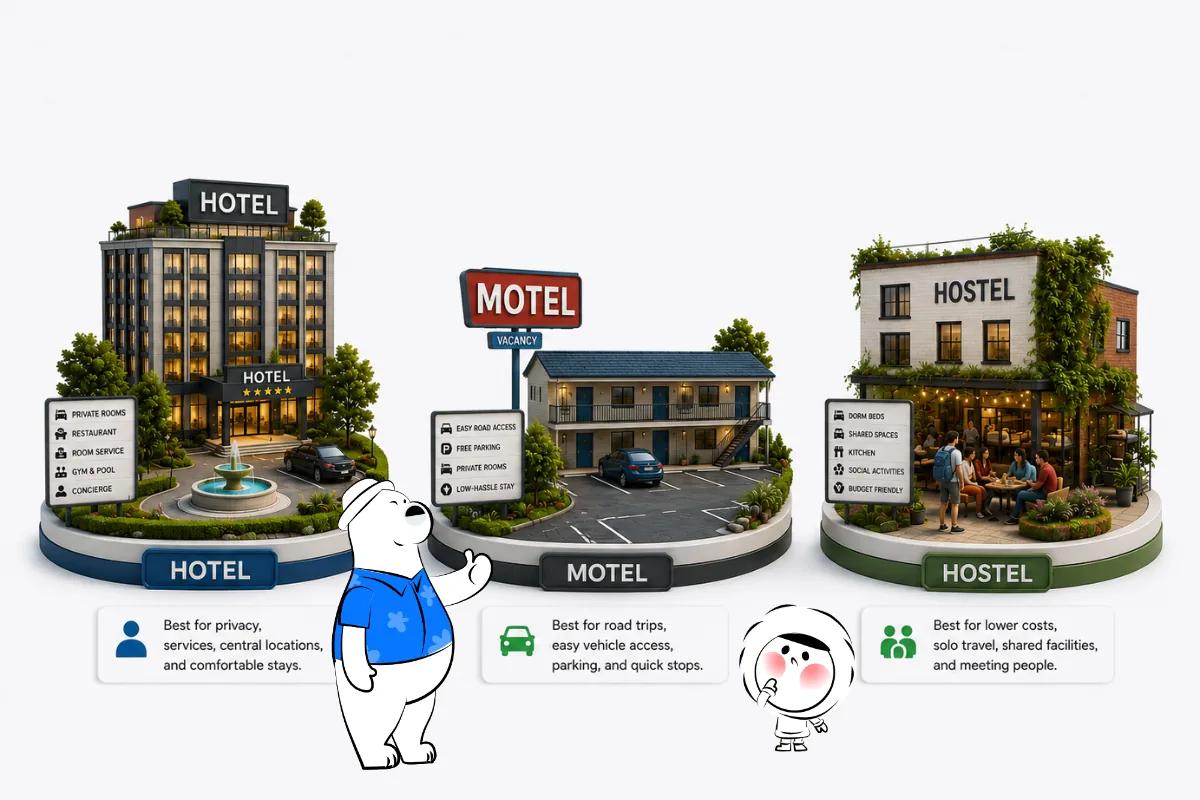
A hotel is usually the best choice for privacy and services. A motel prioritizes convenient road access and parking, making it particularly useful for drivers. A hostel often provides the lowest-cost option for solo travelers booking a dorm bed and typically has a more social atmosphere.
The hotel vs motel vs hostel decision depends on what matters most for your trip. A couple on a city break may value a private hotel room, a driver crossing the United States may prefer a roadside motel, while a solo backpacker may choose a hostel to reduce costs and meet other travelers.
The categories can overlap. Hostels may have private rooms, motels can offer facilities associated with hotels, and properties within the same category can provide very different experiences.
Hotel vs Motel vs Hostel: The Main Differences
The quickest way to compare the three is by considering how each type of accommodation is normally used:
- Hotel: Best for privacy, services, central locations, and comfortable longer stays.
- Motel: Best for road trips, easy vehicle access, parking, and practical overnight stops.
- Hostel: Best for lower-cost solo travel, backpacking, shared facilities, and meeting other travelers.
Price is only one part of the decision. Room configuration, privacy, facilities, parking, location, and atmosphere can have a greater effect on whether a property suits a particular trip.
What Is a Hotel?
A hotel is an accommodation property where guests typically book a private room or suite. Hotels range from small independent properties to large international brands, so facilities and service levels vary widely.
Depending on the property, facilities may include:
- Private bathroom
- Reception or front desk
- Housekeeping
- Luggage storage
- Breakfast or restaurants
- Room service
- Gym or swimming pool
- Business facilities
- Concierge services
Not every hotel provides all of these amenities. A budget city hotel may offer little beyond a private room and reception, while an upscale property may have restaurants, pools, spas, and extensive guest services.
Hotels work particularly well when privacy, predictable facilities, central locations, or additional services matter more than finding the lowest possible price.
Travelers planning longer stays while working remotely can also compare workspace, internet quality, location, and total cost when choosing accommodation as a digital nomad.
What Is a Motel?
A motel is accommodation designed primarily around motor vehicle access. The term developed from “motor hotel,” reflecting its close association with road travel.
A traditional motel commonly has parking immediately outside or close to guest rooms, allowing travelers to arrive, park, sleep, and continue driving without navigating a large property.
Motels are particularly associated with North American road travel, although motel-style properties exist elsewhere.
Typical characteristics can include:
- Convenient access from a highway or major road
- Parking close to rooms
- Private rooms
- Short, practical stays
- Fewer shared facilities than many full-service hotels
- Locations outside dense city centers
The familiar image of every motel having exterior room doors facing a parking lot is too rigid. Modern properties vary, and some operate much more like budget hotels.
For travelers, the more useful distinction is the motel’s orientation toward motorists rather than one specific architectural feature.
What Is a Hostel?
A hostel is accommodation built around affordable rooms or beds and shared facilities. Instead of booking an entire room, guests can often reserve one bed in a dormitory.
Dorms may contain bunk beds or individual beds and can range from small rooms shared by a few travelers to much larger spaces. Bathrooms may also be shared.
Hostels commonly provide some combination of:
- Dormitory accommodation
- Shared bathrooms
- Communal kitchens
- Lounges or social spaces
- Lockers
- Laundry facilities
- Organized activities or tours
Facilities vary considerably between properties.
Staying in a hostel does not always mean sleeping in a dorm. Many hostels also sell private single, double, twin, or family rooms.
A private hostel room can therefore provide a useful middle ground for travelers who enjoy communal spaces but do not want to share their sleeping area.
Price And How You Pay
Hostels often have the lowest entry price because a dormitory guest is paying for one bed rather than an entire private room.
Hotels and motels normally charge for a room, although occupancy rules and charges for additional guests can vary.
That makes dorm accommodation particularly attractive for solo travelers. The calculation can change for couples, families, and groups.
Two travelers paying separately for hostel beds may sometimes find that a basic private room costs a similar amount. A family needing several beds may also get better value from one private room, depending on occupancy rules.
Compare the total booking cost, not just the lowest advertised nightly rate. Taxes, breakfast, parking, lockers, towels, and property-specific fees can change the final price.
Location can change the calculation too. A cheap property far from the places you plan to visit may add significant transport costs. Comparing a tourist area with a cheaper suburb can help determine whether a lower room rate actually reduces the total cost of the trip.
Privacy And Room Type
Hotels and motels generally have the advantage for privacy because their standard product is a private room.
A hostel dorm works differently. Travelers may sleep in the same room as people they have never met, and bathrooms or other facilities may be shared.
Dorm arrangements vary considerably. Some provide privacy curtains, individual lights, power sockets, and secure lockers. Women-only dormitories are also available at some hostels.
Travelers who want access to hostel common areas without sharing their sleeping space can look for a private room.
For solo travelers, accommodation choice can also affect how comfortable arrival and late-night travel feel. Recent reviews, reception hours, transport access, and room arrangements are among the practical considerations covered in Eskimo’s solo travel safety tips for women.
Get Eskimo eSIM to stay connected globally
Need internet while travelling? Here's what we recommend:

Fixed data plans
- No speed reduction
- No expiry, keep your data forever
- Transfer data to anyone
- Personal hotspot


Amenities And Services
Hotels can provide the broadest range of amenities, but the hotel label does not guarantee specific facilities.
A full-service hotel may have restaurants, a pool, room service, a gym, conference rooms, and staffed reception. A small budget hotel may provide little more than accommodation and basic guest services.
Motels tend to focus on what travelers need for a practical overnight stop. Convenient parking and road access may matter more than extensive leisure facilities.
Hostels often put more emphasis on shared amenities. A communal kitchen can reduce meal costs, while lounges and common areas make meeting other guests easier.
Check the facilities of the specific property before booking rather than assuming they are included because it is described as a hotel, motel, or hostel.
Location And Parking
Location is one of the clearest practical differences between hotels and motels.
Hotels can be found in city centers, airport districts, beach areas, business districts, resorts, and many other locations. Central hotels can be convenient for travelers relying on walking or public transport.
Motels are more closely associated with roads. They can be useful on driving itineraries because reaching the property and parking may be simpler than navigating a dense city center.
Hostels are common in destinations popular with independent travelers, including major cities and established backpacking routes. Many are positioned near public transport, nightlife, or major attractions.
For a road trip, parking and easy vehicle access may outweigh additional amenities. For a short urban break without a car, a central hotel or hostel near public transport can make much more sense.
Social Atmosphere
Hostels generally provide the strongest social environment of the three.
Shared kitchens, lounges, dormitories, walking tours, bar areas, and organized activities can create opportunities to meet other travelers. This is one reason hostels are popular with solo travelers and backpackers.
Hotels typically provide more separation between guests. That can suit couples, families, business travelers, or anyone who values privacy and quiet.
Motels tend to be more functional. Many guests arrive by car, stay overnight, and continue their journey the next day, so social interaction is rarely the main reason for booking one.
Individual properties can break these patterns. A quiet hostel may feel less social than a lively hotel, so recent guest reviews are more useful than relying entirely on the accommodation category.
Which Accommodation Should You Choose?
The best option depends on the type of trip and the facilities you actually need.
Couples
A hotel is usually the easiest choice for couples prioritizing privacy, convenient locations, and on-site services.
A private hostel room can work for budget-conscious couples who enjoy communal spaces. A motel may be more practical on a road trip where parking and a straightforward overnight stop matter most.
Families
A hotel often works well for families because private rooms, reception services, breakfast, pools, and other facilities can simplify day-to-day logistics.
Hostels with family or private rooms can also be worth considering, particularly where a shared kitchen helps reduce meal costs.
Check occupancy policies before booking. Some hostel dormitories have age restrictions or may not accommodate young children.
Solo travelers
A hostel can be useful for solo travelers who want to reduce accommodation costs or meet other people.
Travelers who prioritize privacy, quiet, or a private bathroom may prefer a hotel. A private hostel room can offer a compromise between the two.
Backpackers
Hostels are a natural match for backpacking because dorm beds, communal kitchens, luggage facilities, and social spaces suit travelers moving between destinations on a budget.
Price should not be the only filter. Location, security, lockers, reception hours, cleanliness, and recent reviews can matter more than a small difference in the nightly rate.
Road trips
A motel can be the most practical option when accommodation is primarily a stop between driving days.
Easy road access and nearby parking reduce the effort required to unload luggage and leave again the following morning.
A motel becomes less compelling if you plan to spend several days exploring a dense city center without driving.
Business trips and remote work
A hotel is usually the more practical choice when you need private workspace, predictable services, quiet surroundings, or convenient access to a business district.
Do not assume hotel Wi-Fi will meet work requirements. Check recent guest feedback and contact the property about connection quality if reliable internet access is essential.
Look Beyond the Accommodation Label
Hotel, motel, and hostel labels are useful starting points, but they cannot tell you everything about an individual property.
Before booking, check:
- Exact location: Consider walking distances, public transport, road access, and the surrounding area.
- Total price: Include taxes and additional property charges.
- Room type: Confirm whether you are booking a private room, a private room with a shared bathroom, or a dormitory bed.
- Parking: Drivers should confirm availability, access, and any charges.
- Recent reviews: Look for repeated comments about noise, cleanliness, security, Wi-Fi, and staff.
- Check-in arrangements: Confirm reception or self-check-in options if arriving late.
- Cancellation policy: A cheaper non-refundable booking can become costly if plans change.
A well-rated private hostel room can suit a trip better than a poorly located hotel. A simple roadside motel can be more useful than a luxury city property when all you need is a convenient overnight stop.
Choose the property that solves the practical needs of the trip rather than relying on the category name alone.
Mobile Data Between Accommodation Stops
Mobile data can help with navigation, public transport updates, booking confirmations, late-arrival messages, and finding alternative accommodation while moving between properties. Reception is generally stronger in populated areas and along major transport routes, while signal may weaken on rural roads, in mountains, tunnels, and other remote areas.
An Eskimo Global eSIM plan can cover eligible destinations on a multi-country trip. Eskimo offers coverage across 175 countries and regions overall, which can be useful for stopovers and future international journeys, while the destinations included in a specific Global plan should be checked before travel. No-expiry fixed data can remain available for a later trip if the full allowance is not used.
New users can also claim free 500MB of Global Data.
FAQs:
What is the main difference between a hotel, motel, and hostel?
A hotel primarily offers private rooms and may provide extensive guest services. A motel is oriented toward motorists and convenient road access, while a hostel commonly offers dorm beds, shared facilities, and a more social environment.
Is a motel cheaper than a hotel?
Sometimes, but not always. Motel prices depend on location, demand, property quality, and travel dates. Compare the total rate for specific properties rather than assuming a motel will automatically cost less.
Are hostels always shared rooms?
No. Dormitories are common, but many hostels also offer private rooms. Bathrooms and other facilities may still be shared, so check the exact room description before booking.
Which is better, a hotel or hostel?
Choose a hotel if privacy and services are priorities. Choose a hostel if lower accommodation costs or meeting other travelers matters more. A private hostel room can provide elements of both.
Is a motel good for a road trip?
Yes. Motels can be particularly practical for road trips because many are located near major roads and designed around convenient vehicle access and parking.