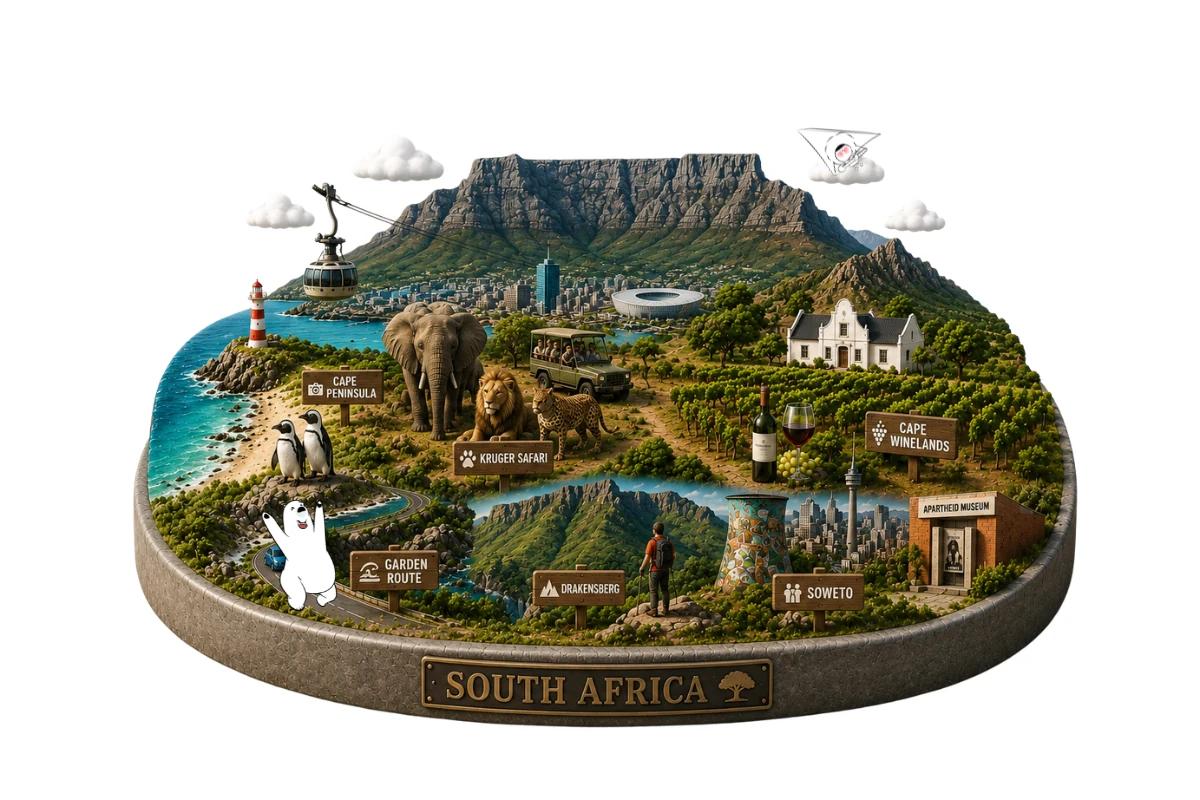
The best things to do in South Africa range from seeing wildlife in Kruger National Park and exploring Cape Town to driving the Garden Route, visiting the Winelands, hiking in the Drakensberg, and discovering the country’s food and history.
South Africa suits travelers who want variety. A single trip can combine a major city, safari, coastline, mountains, vineyards, and cultural experiences, although the distances between regions mean you need to plan your route carefully.
For a first visit, Cape Town and a safari make a strong foundation. Add the Garden Route, Johannesburg, or the Drakensberg if you have more time.
Choose Your South Africa Experience
Different parts of the country suit different trips:
- First visit: Cape Town, Cape Peninsula, and a safari
- Wildlife: Kruger National Park and surrounding reserves
- Road trip: Garden Route
- Food and wine: Cape Winelands
- Hiking: Drakensberg and Table Mountain
- History: Johannesburg and Soweto
- Coast: Cape Peninsula, Garden Route, and KwaZulu-Natal
- Families: Cape Town, penguins, beaches, and selected wildlife reserves
South Africa is large, so trying to fit everything into a short holiday can mean spending too much time in transit. Pick two or three regions rather than treating every major attraction as essential.
See Cape Town From Table Mountain
Best for: First-time visitors, views, hiking Where: Cape Town Time needed: Half a day
Table Mountain is one of the most recognizable South Africa attractions. From the plateau, you can look across Cape Town, Table Bay, Lion’s Head, and the surrounding mountains.
You can hike up or use the Table Mountain Aerial Cableway. The cableway is weather-dependent and can close when conditions are unsuitable, so avoid building an inflexible itinerary around a single time slot.
For the 2026/27 season, an online adult return ticket costs R475. Operating hours vary, and weather can affect service, so confirm the latest conditions and ticket information on the official Table Mountain Aerial Cableway website before visiting.
If you are short on time, Table Mountain is one of the strongest choices for your first day in Cape Town.
Go On Safari In Kruger National Park
Best for: Wildlife, photography, first safari Where: Limpopo and Mpumalanga Time needed: At least two to three days
A safari belongs near the top of most lists of things to do in South Africa, and Kruger National Park is the country’s best-known place to start.
Kruger covers nearly two million hectares and can be explored independently by car or through guided game drives. Wildlife includes elephants, lions, leopards, rhinos, buffalo, giraffes, zebras, and a huge variety of birds.
Self-driving gives you control over your route and pace. Guided drives can help with spotting and interpreting wildlife, while SANParks morning drives leave half an hour before official gate opening times.
Do not underestimate the distances. Wildlife stops can slow journeys considerably, and entrance and camp gates operate on set schedules. SANParks recommends allowing additional time beyond its minimum travel estimates, so check the current Kruger gate information before planning your route.
For a wider comparison beyond South Africa, Eskimo’s best safari destinations in Africa covers Kruger alongside major wildlife destinations in Tanzania, Kenya, Botswana, and Zimbabwe.
Meet The Penguins At Boulders Beach
Best for: Wildlife, families, Cape Peninsula trips Where: Simon’s Town, near Cape Town Time needed: One to two hours
Boulders Beach gives visitors the unusual chance to see African penguins close to a major city.
The protected colony sits around sheltered beaches and granite boulders near Simon’s Town. Boardwalks allow visitors to observe the birds while helping protect the colony and its habitat.
Boulders works particularly well as part of a Cape Peninsula day trip rather than as an isolated journey. Combine it with coastal viewpoints, Simon’s Town, and the route toward Cape Point.
Keep your distance from the penguins and follow conservation rules. They are wild animals, even when they appear comfortable around visitors.
Drive The Cape Peninsula
Best for: Scenery, couples, photography, road trips Where: Cape Town and the Cape Peninsula Time needed: Full day
The Cape Peninsula is one of the easiest ways to see how varied South Africa’s coastal scenery can be.
A typical day can include coastal suburbs, Chapman’s Peak Drive, Boulders Beach, Cape Point, and the Cape of Good Hope area. The landscape shifts between cliffs, ocean, beaches, mountains, and small coastal communities.
Leave enough time for stops. The appeal is not simply reaching Cape Point but enjoying the route itself.
Weather and road conditions can affect exposed coastal sections, so check conditions before setting out.
Spend A Day In The Cape Winelands
Best for: Food, wine, couples, slower travel Where: Stellenbosch, Franschhoek, Paarl Time needed: Full day or overnight
The Cape Winelands provide a completely different experience from Cape Town despite being within easy reach of the city.
Stellenbosch and Franschhoek are the best-known bases, surrounded by vineyards and mountains. Wine estates range from historic properties to modern tasting rooms, with many offering restaurants, cellar tours, gardens, and food pairings.
You do not need to be serious about wine to enjoy the region. The scenery, food, architecture, and relaxed pace make it worthwhile even for travelers who skip tastings.
If you plan to drink, arrange a driver, tour, or other transport rather than driving yourself.
Take A Garden Route Road Trip
Best for: Road trips, nature, beaches, adventure Where: Western and Eastern Cape Time needed: Three to five days
The Garden Route is one of the best places to visit in South Africa if you prefer moving through a landscape rather than staying in one city.
Popular stops include Wilderness, Knysna, Plettenberg Bay, and Tsitsikamma. Depending on your route, you can mix beaches, forest walks, lagoons, hiking, wildlife encounters, and adventure activities.
Avoid turning the trip into a race between overnight stops. Three days can cover key stops, but four or five days gives you more time for walks, beaches, and detours.
A rental car offers the most flexibility. Download offline maps before long drives, keep an eye on fuel, and avoid leaving valuables visible inside a parked vehicle.
Get Eskimo eSIM to stay connected globally
Need internet while travelling? Here's what we recommend:

Fixed data plans
- No speed reduction
- No expiry, keep your data forever
- Transfer data to anyone
- Personal hotspot


Explore Johannesburg And Soweto’s History
Best for: History, culture, museums Where: Johannesburg and Soweto Time needed: One to two days
Johannesburg deserves more than being treated as an airport connection.
The city and neighboring Soweto provide essential context for South Africa’s modern history. The Apartheid Museum, Constitution Hill, and important sites in Soweto help visitors understand apartheid, resistance, democracy, and the country’s continuing social changes.
Guided experiences can be particularly useful because much of the value comes from historical and local context rather than simply seeing individual landmarks.
Plan transport in advance rather than relying on spontaneous walking between attractions. Johannesburg is spread out, and neighborhoods vary significantly in layout and visitor infrastructure.
Hike In The Drakensberg
Best for: Hiking, landscapes, outdoor trips Where: KwaZulu-Natal and Free State border region Time needed: One day to several days
For travelers drawn to mountains rather than cities, the Drakensberg offers some of South Africa’s most dramatic scenery.
Routes range from relatively accessible walks to demanding hikes into high mountain terrain. Cliffs, valleys, waterfalls, grasslands, and rock formations make the region particularly rewarding for active travelers.
Conditions can change quickly at altitude. Carry adequate water, suitable clothing, navigation tools, and check local weather before longer hikes.
Mobile reception can become unreliable away from towns and established tourist areas, so save maps and essential information offline before setting out.
Spend Time On South Africa’s Coast
Best for: Beaches, surfing, relaxing between active days Where: Cape Town, Garden Route, KwaZulu-Natal, and beyond Time needed: Half a day to several days
South Africa’s coastline is too varied to reduce to a single beach destination.
Cape Town has beaches backed by mountains and dramatic Atlantic scenery. The Garden Route combines beaches with forests and coastal towns, while KwaZulu-Natal offers warmer Indian Ocean conditions.
Ocean conditions can differ sharply by location. Pay attention to lifeguard instructions, warning signs, currents, and local swimming conditions rather than assuming every attractive beach is suitable for swimming. South Africa’s Department of Tourism recommends swimming in designated areas, following warning signs, and taking particular care around rip currents.
If beach time is a priority, choose the coast according to your season and wider route instead of adding a long detour for one famous stretch of sand.
Experience South African Food And Culture
Best for: Food, local culture, repeat visitors Where: Nationwide Time needed: Throughout your trip
Some of the most memorable South African experiences happen around a table rather than at a major landmark.
Look for a traditional braai, Cape Malay cooking in Cape Town, bobotie, bunny chow in Durban, boerewors, and regional seafood. Markets and locally run restaurants can also introduce ingredients and traditions that vary considerably across the country.
Food is closely connected to South Africa’s diverse communities and history, so try regional dishes as you move between destinations instead of looking for a single national menu.
If your trip overlaps with a national celebration, Eskimo’s South Africa public holidays 2026 overview can help you anticipate long weekends, cultural events, and periods when domestic travel demand may rise.
Planning Your South Africa Trip
For most first-time visitors, 10 to 14 days gives you enough time to combine several major experiences without spending every other day in transit.
A practical first trip could combine:
- Cape Town and the Cape Peninsula
- Cape Winelands
- Kruger National Park or another safari destination
With more time, add the Garden Route, Johannesburg, or the Drakensberg.
Domestic flights can save significant travel time between distant regions. Rental cars are useful around the Cape, Garden Route, and many safari areas, but driving times should be treated realistically.
South Africa’s seasons affect different experiences in different ways. Cape Town, safari regions, mountains, and the east coast do not share identical weather patterns, so there is no single month that is ideal for every itinerary.
Public holidays can increase domestic demand for flights, accommodation, national parks, and coastal destinations. Check dates before booking a busy travel period. Eskimo’s South Africa holiday calendar lists the main 2026 long weekends and peak periods that can affect trip planning.
Practical Safety Basics
South Africa can be a rewarding destination, but travelers should stay aware of their surroundings and plan transport carefully, particularly in unfamiliar urban areas.
Keep valuables out of sight, ask your accommodation about appropriate transport and walking routes, and avoid walking alone in unfamiliar areas after dark. South Africa’s Department of Tourism safety advice recommends keeping personal possessions secure and checking local advice before walking alone or heading out on an excursion.
On road trips, plan your route before leaving, keep doors locked in urban traffic, avoid leaving luggage visible in parked cars, and try to arrive at unfamiliar destinations before dark. Official tourism guidance also recommends downloading offline maps and avoiding night driving in poorly lit areas.
Inside national parks, wildlife creates a different set of risks. Follow park rules, remain inside your vehicle except in designated areas, and respect gate times.
Using Mobile Data Around South Africa
Mobile data helps with GPS navigation on road trips, national park information, ride-hailing in cities, attraction bookings, and weather updates around Cape Town and the mountains. Reception is generally stronger in cities and populated areas, while signal may weaken on rural roads, mountain routes, and inside large national parks.
An Eskimo Africa eSIM plan can support a trip to South Africa. Eskimo’s wider coverage across 175 countries and regions is useful if South Africa is one stop on a longer international itinerary, while no-expiry fixed data means eligible unused fixed data can remain available for a future trip. Eskimo confirms that its fixed data plans moved to no-expiry validity in July 2026.
New users can also claim free 500MB of Global Data.
FAQs:
What are the best things to do in South Africa for first-time visitors?
For a first trip, prioritize Cape Town and Table Mountain, the Cape Peninsula, a wildlife safari, and the Cape Winelands. Add the Garden Route, Johannesburg, or the Drakensberg if you have more time.
How many days do you need in South Africa?
Around 10 to 14 days works well for a first trip combining Cape Town with a safari and one additional region. Seven days is possible, but it is better to focus on one or two areas rather than rushing across the country.
What are the best places to visit in South Africa?
Cape Town, Kruger National Park, the Cape Winelands, Garden Route, Johannesburg and Soweto, and the Drakensberg are among the most rewarding choices. The best combination depends on whether you prioritize wildlife, cities, beaches, food, or hiking.
Can you combine Cape Town and a safari in one trip?
Yes. Cape Town and a safari are a strong combination for a first South Africa trip. Because Cape Town and Kruger are far apart, flying between regions is usually more practical than driving if your holiday is limited to one or two weeks.
Do you need to book South Africa attractions in advance?
Some experiences are worth booking ahead, particularly safari accommodation and activities, popular restaurants and wine experiences, and major attractions during busy periods. Table Mountain Cableway tickets can be bought online, although weather can still affect operations.