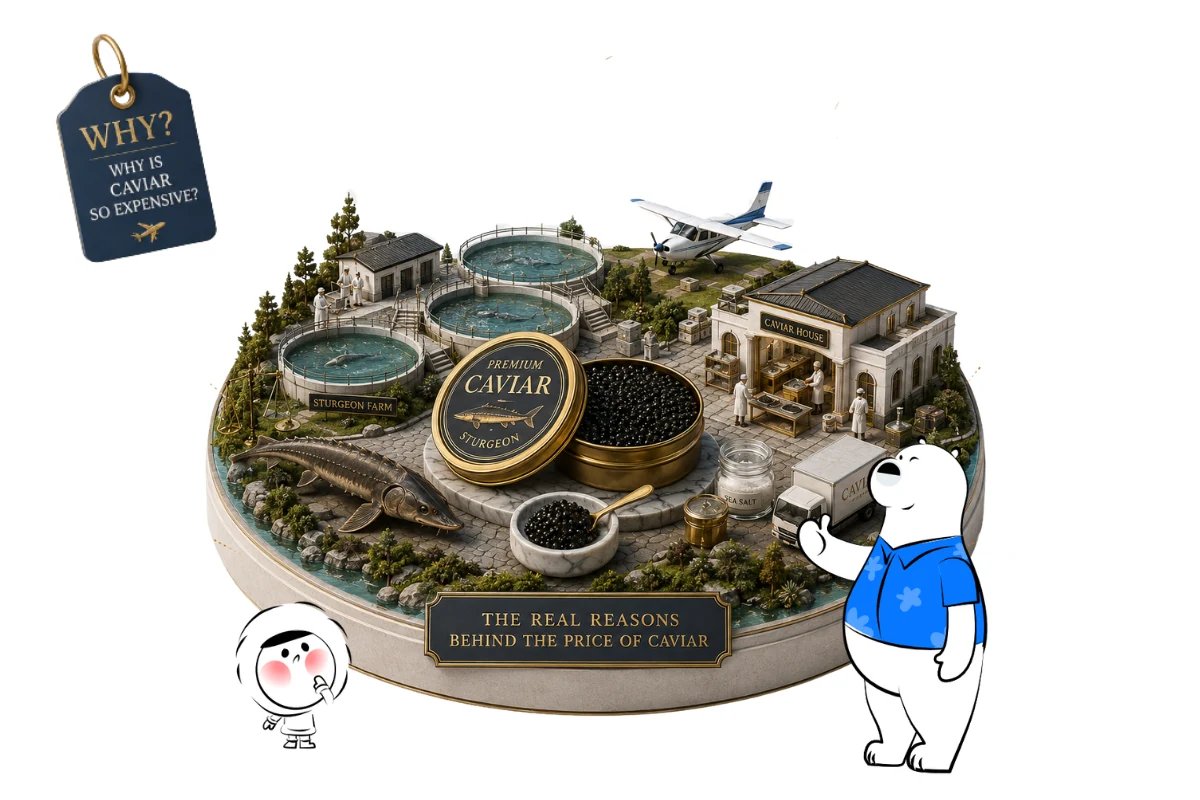
Caviar is expensive because producing genuine sturgeon caviar takes years, requires costly aquaculture and careful processing, and depends on a relatively limited supply of mature female fish. Rarity and luxury positioning affect the final price too, but the cost begins long before a tin reaches a restaurant table.
For travelers who encounter caviar at fine-dining restaurants, luxury hotels, or destination dining experiences, the price can look startling. A tiny serving may cost more than an entire meal. Like Wagyu beef and elaborate tasting menus, caviar sits at the premium end of food tourism, where production, rarity, craftsmanship, and experience can all influence what diners pay.
The Long Wait Behind Every Tin
Unlike many farmed foods, caviar cannot be produced quickly.
Female sturgeon must mature before they produce suitable roe. For Siberian sturgeon, the UN Food and Agriculture Organization notes that females may reach puberty at around seven years old under temperate farming conditions. Farmers therefore feed, monitor, house, and maintain fish for years before knowing what the eventual caviar yield and quality will be.
The FAO’s overview of Siberian sturgeon farming also describes the need to separate males and females and monitor maturity carefully.
That long production cycle ties up tanks, water systems, feed, labor, energy, and capital. If a fish fails to produce roe of the expected quality, years of investment cannot simply be restarted overnight.
This is one of the biggest reasons why caviar is so expensive.
Caviar Requires Careful Processing
Caviar is not simply fish eggs scooped into a jar.
The international Codex standard defines sturgeon caviar as eggs from fish in the Acipenseridae family treated with food-grade salt. Processing requires careful handling, sorting, salting, packaging, refrigeration, and hygiene controls to protect both quality and food safety.
The Codex standard for sturgeon caviar also specifies characteristics such as egg appearance and salt content.
The eggs are delicate. Producers must preserve their shape, texture, flavor, and freshness while keeping the product chilled throughout storage and transport.
Premium caviar therefore carries not only the cost of raising the fish, but also the cost of processing a highly perishable product with a demanding cold chain.
Scarcity, Regulation, And Traceability
Wild sturgeon populations have faced serious conservation pressure, making regulation another part of the caviar story.
International trade in sturgeon and caviar is governed through the Convention on International Trade in Endangered Species of Wild Fauna and Flora, or CITES. Its sturgeon program covers conservation measures, legal exporters, processing facilities, trade controls, and mechanisms designed to protect sturgeon populations and improve traceability.
These protections matter because caviar historically depended heavily on wild sturgeon fisheries. Modern legal production increasingly relies on controlled aquaculture, which can support conservation but does not make caviar cheap to produce.
Traceability, licensing, compliance, and controlled international trade all add complexity before premium caviar reaches diners.
Get Eskimo eSIM to stay connected globally
Need internet while travelling? Here's what we recommend:

Fixed data plans
- No speed reduction
- No expiry, keep your data forever
- Transfer data to anyone
- Personal hotspot


Not All Caviar Costs The Same
Caviar price varies widely. Species is only one factor.
Prices can also reflect:
- Egg size and appearance
- Texture and firmness
- Color
- Flavor
- Grade
- Farm and producer
- Origin
- Processing quality
- Packaging size
- Market availability
Beluga, Ossetra, Siberian sturgeon, and other caviar types can therefore sit at very different price points.
A premium label alone does not explain the cost. Two tins from different producers may come from different sturgeon species, require different maturation periods, receive different grades, and offer noticeably different sensory qualities.
Caviar is not the only food where provenance and production can create a substantial premium. Japan’s celebrated Wagyu beef is another example, and travelers interested in that side of food culture can find it among Eskimo’s traditional Japanese foods to try.
Caviar, Roe, And The Name On The Tin
Caviar is often used casually to describe many kinds of fish eggs, but labeling can be more precise.
In the United States, the Food and Drug Administration’s caviar labeling guidance says the unqualified term “caviar” should apply to salted sturgeon roe. Roe from another fish may use the word caviar when the fish is also identified, such as “whitefish caviar.”
That distinction explains why inexpensive jars of other fish roe may sit beside sturgeon caviar without carrying anything close to the same price.
The eggs may look similar at first glance, but the fish, production cycle, availability, and market value can be very different.
Luxury Adds A Premium, But It Is Not The Whole Story
Caviar has centuries of association with wealth, celebration, and fine dining. Elegant packaging, prestigious producers, luxury restaurants, and limited editions can push prices higher.
Still, calling caviar expensive simply because it is fashionable misses the bigger picture.
The underlying economics begin with years of raising sturgeon, followed by limited production, careful harvesting and processing, strict storage requirements, regulation, grading, distribution, and the risk that years of investment may not produce top-grade roe.
Luxury demand sits on top of those costs. It does not create them from nothing.
For travelers curious about how premium food becomes part of a destination itself, Eskimo’s look at iconic 3 Michelin star restaurants around the world explores restaurants where exceptional dining can become a reason to plan an entire journey.
Mobile Data For A Food-Focused Trip
A food-focused international trip often involves restaurant reservations, digital menus, translation, maps, ride-hailing, and last-minute train or flight updates between dining destinations. Reception is generally strongest in cities and populated areas, while underground transport, basements, remote roads, and dense indoor venues can weaken local signals.
An Eskimo Global eSIM plan can suit travelers building a food itinerary across several countries. Eskimo’s coverage across 175 countries and regions makes it practical for international stopovers and onward trips, while its universal eSIM lets travelers keep one reusable eSIM for multiple eligible destinations instead of installing a different one for every journey.
New users can also claim free 500MB of Global Data.
FAQs:
FAQs
Why is caviar so expensive compared with other fish roe?
Sturgeon generally take years to mature, making caviar production slower and more capital-intensive than many other forms of fish roe. Farming, processing, refrigeration, regulation, grading, and limited supply add further costs.
What is caviar made of?
Traditional sturgeon caviar is made from sturgeon eggs, or roe, that are carefully processed and salted. Other fish eggs can also be sold as named varieties of caviar in some markets, depending on local labeling rules.
Is Beluga caviar the most expensive type?
Beluga is among the best-known premium caviar types, but price depends on origin, legality, quality, grade, availability, egg characteristics, and producer. Rare specialty caviars can command even higher prices.
Does expensive caviar always taste better?
Not necessarily. Higher prices can reflect rarity, species, egg size, grading, production cost, or prestige. Personal preference also matters, especially for texture, saltiness, firmness, and flavor.