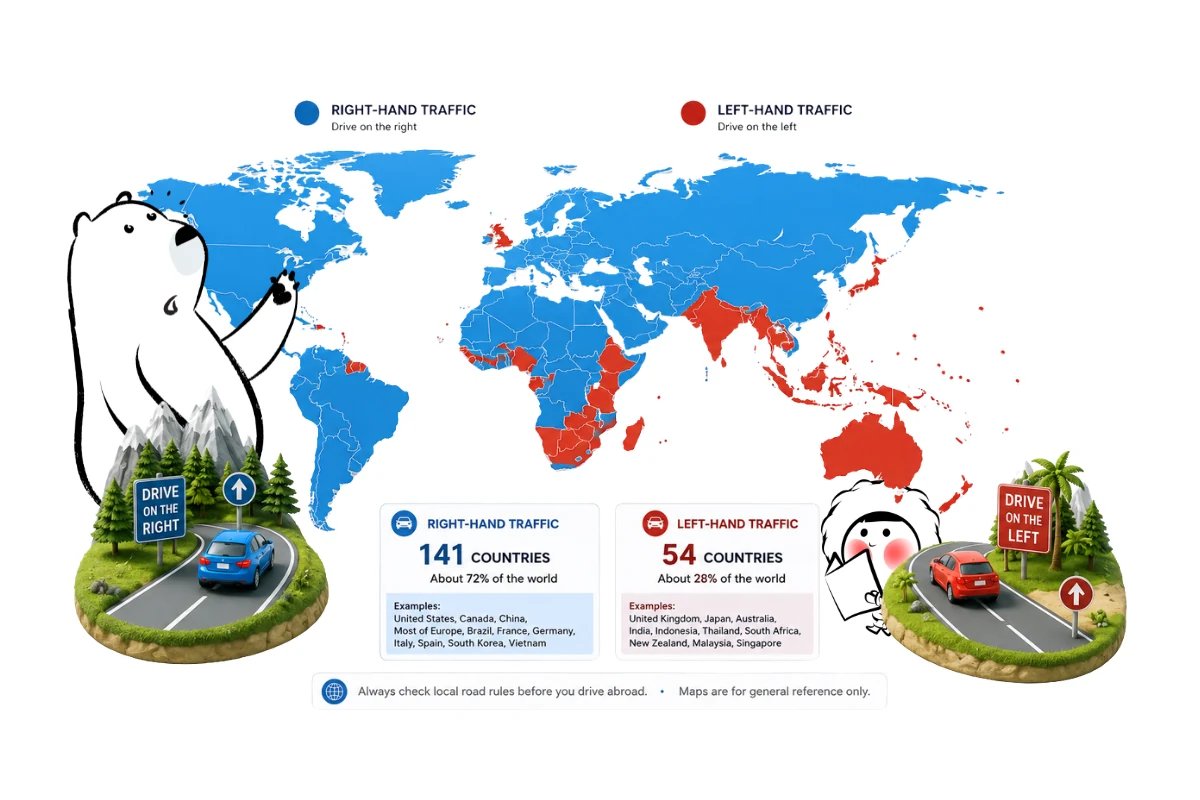
What countries drive on the right side of the road? Most countries worldwide use right-hand traffic, including the United States, Canada, China, most of Europe, and most of Latin America. A smaller group uses left-hand traffic, including the United Kingdom, Japan, Australia, India, Indonesia, Thailand, and South Africa.
For travelers, knowing the correct driving side matters before picking up a rental car, joining a road trip, or crossing an international border. The world driving side map gives you the quickest reference, while the country lists below cover sovereign states.
World Driving Side Map
There are two main traffic systems:
Left-hand traffic (LHT): vehicles normally travel on the left side of the road.
Right-hand traffic (RHT): vehicles normally travel on the right side of the road.
Right-hand traffic is considerably more common globally. Of the 195 sovereign states commonly counted internationally, 141 drive on the right and 54 drive on the left.
The split is far from random. Left-hand traffic remains particularly common in parts of South and Southeast Asia, southern and eastern Africa, Oceania, the Caribbean, and countries with historical links to Britain.
The map is especially useful before renting a vehicle because the traffic side can completely change familiar driving habits, including the direction you enter roundabouts, where you look first at intersections, and which lane you use after making a turn.
Countries That Drive on the Left Side of the Road
There are 54 sovereign countries that drive on the left side of the road.
Africa
- Botswana
- Eswatini
- Kenya
- Lesotho
- Malawi
- Mauritius
- Mozambique
- Namibia
- Seychelles
- South Africa
- Tanzania
- Uganda
- Zambia
- Zimbabwe
Asia
- Bangladesh
- Bhutan
- Brunei
- India
- Indonesia
- Japan
- Malaysia
- Maldives
- Nepal
- Pakistan
- Singapore
- Sri Lanka
- Thailand
- Timor-Leste
Europe
- Cyprus
- Ireland
- Malta
- United Kingdom
North America and the Caribbean
- Antigua and Barbuda
- Bahamas
- Barbados
- Dominica
- Grenada
- Jamaica S
- aint Kitts and Nevis
- Saint Lucia
- Saint Vincent and the Grenadines
- Trinidad and Tobago
South America
- Guyana
- Suriname
Oceania
- Australia
- Fiji
- Kiribati
- Nauru
- New Zealand
- Papua New Guinea
- Samoa
- Solomon Islands
- Tonga
- Tuvalu
Several territories also use left-hand traffic. These include Hong Kong, Macau, Bermuda, the Cayman Islands, the British Virgin Islands, and the US Virgin Islands.
Countries That Drive on the Right Side of the Road
The majority of sovereign countries use right-hand traffic.
A to C
- Afghanistan
- Albania
- Algeria
- Andorra
- Angola
- Argentina
- Armenia
- Austria
- Azerbaijan
- Bahrain
- Belarus
- Belgium
- Belize
- Benin
- Bolivia
- Bosnia and Herzegovina
- Brazil
- Bulgaria
- Burkina Faso
- Burundi
- Cabo Verde
- Cambodia
- Cameroon
- Canada
- Central African Republic
- Chad
- Chile
- China
- Colombia
- Comoros
- Costa Rica
- Côte d’Ivoire
- Croatia
- Cuba
- Czechia
D to H
- Democratic Republic of the Congo
- Denmark
- Djibouti
- Dominican Republic
- Ecuador
- Egypt
- El Salvador
- Equatorial Guinea
- Eritrea
- Estonia
- Ethiopia
- Finland
- France
- Gabon
- Gambia
- Georgia
- Germany
- Ghana
- Greece
- Guatemala
- Guinea
- Guinea-Bissau
- Haiti
- Honduras
- Hungary
Get Eskimo eSIM to stay connected globally
Need internet while travelling? Here's what we recommend:

Fixed data plans
- No speed reduction
- No expiry, keep your data forever
- Transfer data to anyone
- Personal hotspot


I to M
- Iceland
- Iran
- Iraq
- Israel
- Italy
- Jordan
- Kazakhstan
- Kuwait
- Kyrgyzstan
- Laos
- Latvia
- Lebanon
- Liberia
- Libya
- Liechtenstein
- Lithuania
- Luxembourg
- Madagascar
- Mali
- Marshall Islands
- Mauritania
- Mexico
- Micronesia
- Moldova
- Monaco
- Mongolia
- Montenegro
- Morocco
- Myanmar
N to S
- Netherlands
- Nicaragua
- Niger
- Nigeria
- North Korea
- North Macedonia
- Norway
- Oman
- Palau
- Palestine
- Panama
- Paraguay
- Peru
- Philippines
- Poland
- Portugal
- Qatar
- Republic of the Congo
- Romania
- Russia
- Rwanda
- San Marino
- São Tomé and Príncipe
- Saudi Arabia
- Senegal
- Serbia
- Sierra Leone
- Slovakia
- Slovenia
- Somalia
- South Korea
- South Sudan
- Spain
- Sudan
- Sweden
- Switzerland
- Syria
T to Z
- Tajikistan
- Togo
- Tunisia
- Turkey
- Turkmenistan
- Ukraine
- United Arab Emirates
- United States
- Uruguay
- Uzbekistan
- Vanuatu
- Vatican City
- Venezuela V
- ietnam
- Yemen
Territories do not always follow the same system as the country they are associated with. For example, the US Virgin Islands drive on the left, even though the mainland United States drives on the right.
Left-Hand Traffic vs Right-Hand Traffic
The side of the road and the position of a car’s steering wheel are related, but they describe different things.
Left-hand traffic means vehicles travel on the left side of the road. Cars in these countries usually have the steering wheel on the right side, known as right-hand drive.
Right-hand traffic means vehicles travel on the right. Cars are generally left-hand drive, placing the steering wheel on the left.
There are exceptions, especially where imported vehicles are common, so the steering-wheel position should never be used as your only clue about local traffic rules.
Road signs, lane markings, traffic flow, and instructions from your rental company are the safer references.
Why Some Countries Drive on the Left
Today’s map reflects centuries of transport history rather than a single global decision.
Britain formalized left-side travel, and left-hand traffic later became established across many territories connected to the British Empire. Countries including India, Australia, New Zealand, Kenya, Malaysia, and Singapore retained the system.
Other countries developed or adopted right-hand traffic. Today, virtually all of continental Europe drives on the right, along with the United States, Canada, China, most of Latin America, and much of the Middle East.
Some countries have changed sides over time, which is another reason modern driving rules should be checked rather than assumed from geography or history alone.
Driving on the Opposite Side While Traveling
Driving on an unfamiliar side can feel surprisingly natural after some practice, but the first part of the journey usually demands the most concentration.
If you are renting a vehicle abroad, check the driving side before arriving at the rental desk. Eskimo’s overview of whether to rent a car or motorbike when traveling can also help you decide whether self-driving suits the destination.
Once on the road:
- Take extra care when leaving the rental location. This may be your first time joining local traffic.
- Slow down at intersections. Habit can make you look toward the wrong direction first.
- Pay close attention at roundabouts. Traffic circulates clockwise in most left-driving countries and counterclockwise in most right-driving countries.
- Use lane markings after turning. Empty roads are where travelers can accidentally return to their habitual side.
- Be careful after stops. Petrol stations, restaurants, parking areas, and scenic viewpoints are common places to momentarily forget the local traffic side.
- Avoid unnecessary distractions. Set your navigation before moving and let a passenger handle route changes where possible.
Local laws go far beyond the side of the road. Speed limits, alcohol limits, compulsory equipment, toll systems, winter tyres, child restraints, and insurance requirements can all vary.
Check the relevant transport authority before driving. The UK government’s official driving-abroad guidance, for example, advises travelers to confirm licence, insurance, documentation, and destination-specific road rules before departure.
Depending on your destination and home licence, you may also need an International Driving Permit. Eskimo’s International Driving Permit overview explains when an IDP may be required and what to check before renting a vehicle.
Border Crossings Where the Driving Side Changes
Driving side becomes particularly important on international road trips because neighboring destinations do not always use the same system.
Thailand drives on the left, while neighboring Cambodia and Laos drive on the right.
Mainland China drives on the right, while Hong Kong and Macau use left-hand traffic.
Guyana and Suriname drive on the left, while neighboring Brazil drives on the right.
At formal crossings where the traffic system changes, road layouts, markings, bridges, ramps, or controlled lanes are generally designed to transfer vehicles safely to the other side.
Follow the signs and local traffic flow instead of trying to anticipate the crossover yourself.
Planning a Road Trip Across Different Driving Systems
Before setting off, save the driving side for every destination on your route rather than checking only your first country.
It also helps to confirm:
- Valid driving licence requirements
- International Driving Permit requirements
- Rental-car cross-border restrictions
- Insurance coverage
- Toll and vignette requirements
- Fuel availability or EV charging locations
- Emergency numbers
- Offline maps
- Local parking rules
Download your route before entering remote areas. Mobile coverage may be weaker on rural roads, in tunnels, across mountain passes, inside national parks, or far from populated areas.
Mobile Data for International Road Trips
Mobile data can help with GPS navigation, live road closures, parking apps, fuel or EV charging stations, accommodation changes, and roadside assistance during an international road trip. Reception is generally more reliable around cities and major transport corridors, while rural roads, mountain passes, tunnels, forests, and remote border areas may have weaker signal.
An Eskimo Global eSIM plan can support many multi-country itineraries, while Eskimo’s broader coverage across 175 countries and regions is useful for stopovers, onward journeys, and future destinations beyond the same road trip. Its universal eSIM lets travelers keep one reusable eSIM installed across eligible destinations instead of setting up a different eSIM every time they cross into another country.
New users can also claim free 500MB of Global Data.
FAQs:
What countries drive on the right side of the road?
Most countries drive on the right, including the United States, Canada, China, France, Germany, Spain, Italy, Brazil, Mexico, South Korea, Vietnam, and the United Arab Emirates. In total, 141 of the 195 sovereign states listed above use right-hand traffic.
What countries drive on the left?
There are 54 sovereign countries that drive on the left, including the United Kingdom, Ireland, Australia, New Zealand, Japan, India, Indonesia, Thailand, Malaysia, Singapore, South Africa, and Kenya.
Does Japan drive on the left or right?
Japan drives on the left side of the road. Most vehicles consequently have the steering wheel on the right side.
Does Europe drive on the left or right?
Almost all European countries drive on the right. The main sovereign exceptions are the United Kingdom, Ireland, Malta, and Cyprus, which drive on the left.
Is left-hand traffic the same as left-hand drive?
No. Left-hand traffic means vehicles travel on the left side of the road. Left-hand drive describes a vehicle with its steering wheel on the left side. Countries with left-hand traffic generally use right-hand-drive vehicles, and countries with right-hand traffic generally use left-hand-drive vehicles.