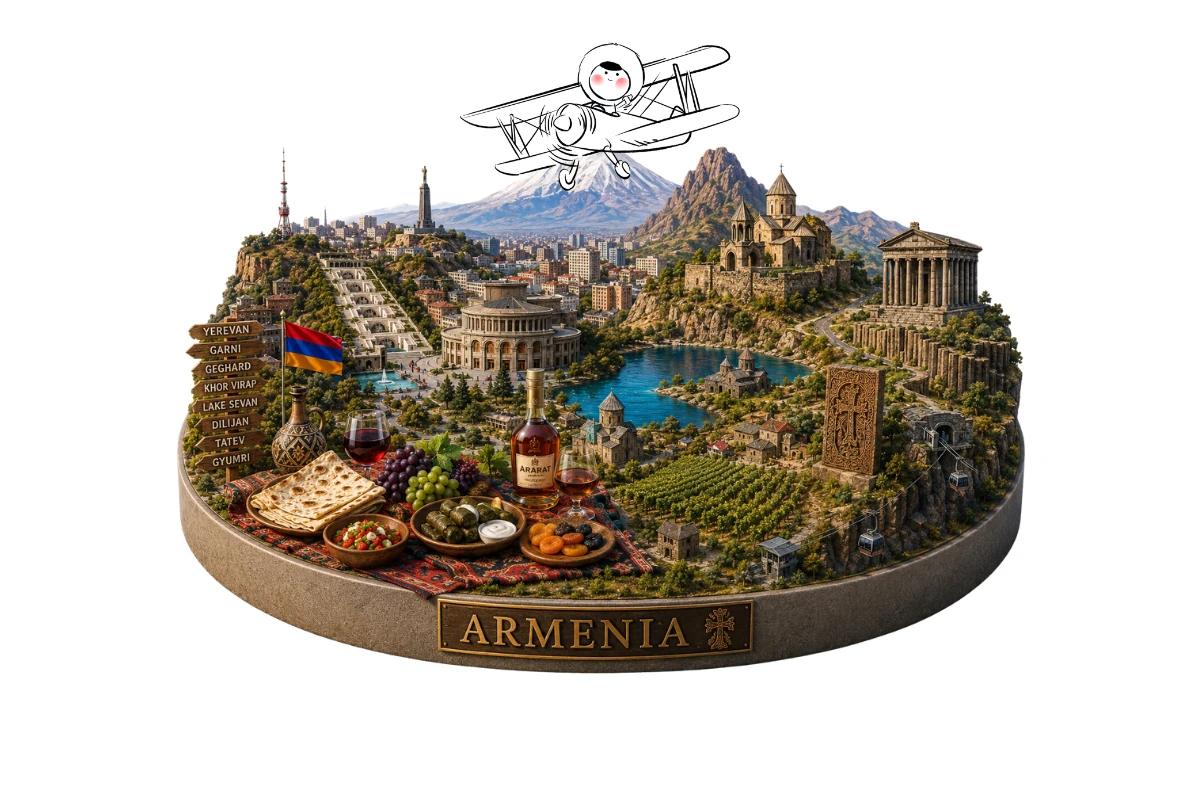
Armenia is worth visiting for ancient monasteries, mountain landscapes, distinctive food, wine culture, and a lively capital that is easy to explore. It suits travelers interested in history, road trips, hiking, architecture, and destinations that still feel less crowded than many established European routes.
A first Armenia trip usually needs five to seven days. That provides enough time for Yerevan, Garni and Geghard, Khor Virap, Lake Sevan, Dilijan, and at least one longer journey toward southern Armenia or Gyumri.
Armenia is compact, but roads through mountains and valleys can make travel slower than a map suggests. The strongest itinerary combines Yerevan with two or three regional bases instead of attempting to visit every monastery in one heroic sprint. The supplied validation report recommends this practical first-timer format, led by Yerevan, monasteries, landscapes, food, seasons, transport, and costs.
Where Armenia Is
Armenia is a landlocked country in the South Caucasus, bordered by Georgia, Azerbaijan, Iran, and Turkey.
It is often described as being at the crossroads of Europe and Asia. Geography places it in the South Caucasus, while its cultural, political, and historical connections extend in several directions. Treating Armenia as unambiguously European or Asian flattens a more complicated identity.
Yerevan is the capital and main arrival point for international visitors. Armenian is the official language, written in its own alphabet, while Russian and English are also used to varying degrees.
The Armenian dram is the national currency. Cards are common in Yerevan and larger towns, but cash remains useful for markets, rural guesthouses, small restaurants, and local transport.
Best Places To Visit In Armenia
Yerevan
Yerevan is the best starting point for an Armenia travel itinerary.
The city combines broad avenues, pink volcanic-stone buildings, museums, markets, parks, cafés, wine bars, and views toward Mount Ararat on clear days. Armenia’s official tourism platform presents Yerevan as a city where old architecture, contemporary culture, cafés, and seasonal events sit side by side.
Key Yerevan attractions include:
- Republic Square
- The Cascade
- Matenadaran
- Vernissage Market
- The Armenian Genocide Museum and Memorial
- Blue Mosque
- Kond
- GUM Market
- Ararat Brandy Factory
Two full days is a practical minimum. Add another day if you want museums, food tours, markets, or a slower café-heavy schedule.
Garni Temple
Garni is Armenia’s best-known Greco-Roman monument and one of the easiest day trips from Yerevan.
The temple stands above the Azat Gorge and is often combined with the Symphony of Stones, a natural formation of basalt columns below the village.
Garni works best as part of a wider route rather than a brief photo stop. Allow time for the gorge, local food, and nearby Geghard Monastery.
Geghard Monastery
Geghard is a UNESCO-listed medieval monastery partly carved into the surrounding rock.
Its chapels, stone chambers, acoustics, and dramatic valley setting make it one of Armenia’s most memorable religious sites. Armenia’s official tourism itinerary places Geghard and Garni together as a natural day trip from Yerevan.
Dress respectfully, keep voices low during services, and avoid treating active religious spaces as photography sets.
Khor Virap
Khor Virap is one of the country’s most photographed monasteries because of its position facing Mount Ararat.
The mountain lies across the border in modern Turkey, although it holds enormous cultural and symbolic importance in Armenia. Clear views are never guaranteed because cloud, haze, and seasonal conditions can obscure the peak.
Morning often provides the best chance of visibility, but weather matters more than the clock.
Lake Sevan
Lake Sevan is Armenia’s largest lake and one of its most popular summer escapes.
Visitors come for beaches, boat trips, lakeside meals, mountain views, and Sevanavank Monastery. The official tourism authority describes the wider Gegharkunik region as a destination for swimming, nature, ancient sites, and mountain scenery.
Summer is the busiest time. Outside the warmest months, wind and cold can make the shoreline feel much harsher than Yerevan.
Dilijan
Dilijan is a forested town surrounded by national park scenery, hiking routes, monasteries, and mountain villages.
It suits travelers who want a quieter base, cooler weather, and access to nature. Haghartsin and Goshavank monasteries are popular nearby excursions, while Parz Lake provides an easier outdoor stop.
Dilijan and Lake Sevan can be combined in one long day, but staying overnight gives the forests, trails, and cafés more room to breathe. Armenia’s tourism platform promotes Dilijan as a base for hiking, camping, and mountain recreation.
Tatev Monastery
Tatev is one of Armenia’s most dramatic monasteries, positioned above the Vorotan Gorge in the south.
Many visitors arrive using the Wings of Tatev cableway, although operating hours, weather restrictions, and maintenance schedules should be checked before departure.
The journey from Yerevan is long. Tatev works better as part of a southern Armenia itinerary with an overnight stay in Goris, Yeghegnadzor, or another regional base.
Gyumri
Gyumri is Armenia’s second-largest city and offers a different atmosphere from Yerevan.
Its historic center contains black tuff architecture, workshops, galleries, museums, cafés, and a strong local sense of humor and identity. Armenia’s official tourism platform highlights Gyumri’s historic streets, arts scene, and distinctive regional cuisine.
Gyumri can be visited by train or road from Yerevan. An overnight stay is worthwhile for travelers interested in architecture, crafts, and urban culture beyond the capital.
Areni And Noravank
The Areni region is associated with vineyards, wine production, caves, and the red cliffs surrounding Noravank Monastery.
A typical route combines wine tasting, Noravank, Areni Cave, and rural scenery. Book tastings in advance if visiting small producers, and arrange a driver if alcohol is part of the day.
Things To Do In Armenia
The best things to do in Armenia extend beyond checking monasteries off a list.
Explore Yerevan’s café and market culture
Yerevan is compact enough for long walks between markets, museums, wine bars, bakeries, and public squares.
Vernissage is useful for crafts and souvenirs, while GUM Market offers dried fruit, spices, sweets, and local produce. Ask before photographing vendors closely.
Visit medieval monasteries
Armenia’s monasteries are woven into mountain passes, forest valleys, cliffs, and villages.
Geghard, Khor Virap, Tatev, Noravank, Haghartsin, and Sevanavank each offer a different landscape and historical context. Avoid scheduling too many in one day, or the stone carvings begin melting into one long ecclesiastical blur.
Hike through mountains and gorges
Popular outdoor areas include Dilijan National Park, the Azat Gorge, the Vorotan Gorge, Mount Aragats, and trails near Lake Sevan.
Conditions vary sharply by altitude and season. Check weather, route difficulty, transport, and daylight before setting out.
Try Armenian wine and brandy
Armenia has a long history of grape cultivation and wine production.
Areni is the country’s best-known wine area, while Yerevan has tasting rooms and wine bars that are easier to visit without a car. Armenian brandy is also an established part of the country’s drinking culture.
Use a driver or tour for rural tastings. Mountain roads and generous pours are poor collaborators.
Learn the Armenian alphabet
The Armenian alphabet was created in the early fifth century and remains central to national identity.
Visitors will see its distinctive characters on signs, manuscripts, monuments, art, and souvenirs. Learning a few basic words is appreciated, even when pronunciation arrives wearing slightly crooked shoes.
Armenian Culture And Heritage
Armenian culture reflects a long history shaped by Christianity, trade routes, migration, language, music, craft traditions, and family life.
Armenia adopted Christianity as a state religion in the early fourth century, and churches and monasteries remain central to its cultural landscape. Many are active religious sites rather than historical displays.
Hospitality is an important social value. Guests may be offered food, fruit, coffee, wine, or brandy, especially in family-run accommodation and rural homes.
Respectful travel includes:
- Dressing modestly inside churches
- Keeping quiet during services
- Asking before photographing people
- Avoiding political assumptions
- Listening carefully when sensitive history is discussed
- Supporting local guides, producers, and guesthouses
The Armenian Genocide is a deeply significant part of Armenian history and identity. Visitors to the memorial and museum in Yerevan should approach the site with the same seriousness expected at any place of mass remembrance.
Armenian Food To Try
Armenian food is one of the strongest reasons to travel beyond Yerevan’s headline attractions.
The cuisine varies by region and family, combining grilled meat, herbs, grains, vegetables, dairy, fruit, bread, and slow-cooked dishes.
Lavash
Lavash is a thin traditional flatbread baked against the walls of a clay oven called a tonir.
It is eaten with cheese, herbs, meat, and other dishes. In some villages and restaurants, travelers can watch it being prepared.
Khorovats
Khorovats is Armenian barbecue, usually made with meat cooked over charcoal.
Recipes and cuts vary, and grilled vegetables often accompany the meal.
Dolma
Dolma commonly consists of grape leaves or vegetables filled with seasoned meat and rice.
Vegetarian versions also exist, particularly during fasting periods or in restaurants serving broader regional menus.
Gata
Gata is a sweet Armenian pastry that appears in several regional forms.
Some versions are bread-like, while others are flaky and filled with a buttery mixture. It pairs dangerously well with coffee.
Harissa
Harissa is a slow-cooked dish made from wheat and meat.
Its name and preparation differ from the North African chili paste that shares the same spelling.
Armenian wine and brandy
Wine regions such as Areni produce red, white, and sparkling wines, while Armenian brandy is widely available in Yerevan.
Tastings may include food pairings, cellar visits, and explanations of local grape varieties. Book ahead for smaller producers.
Get Eskimo eSIM to stay connected in Armenia
Need internet in Armenia? Here's what we recommend:

Fixed data plans
- No speed reduction
- No expiry, keep your data forever
- Transfer data to anyone
- Personal hotspot
Best Time To Visit Armenia
The best time to visit Armenia depends on whether the trip centers on cities, hiking, lakes, wine, or winter sports.
Spring
April to June is one of the best periods for sightseeing.
Temperatures are generally comfortable, hills begin turning green, and flowers appear across lower elevations. Rain is possible, and mountain routes may still hold snow early in the season.
Summer
July and August bring hot, dry conditions in Yerevan and cooler weather at higher elevations.
This is the best period for Lake Sevan, mountain travel, and high-altitude hiking. Yerevan can become very hot during the day, so plan outdoor sightseeing for morning and evening.
Armenia’s tourism authority describes summers as hot and sunny, with average temperatures around 30°C, while mountainous areas remain cooler.
Autumn
September and October offer harvest activity, vineyard visits, cooler days, and autumn colour.
This is an excellent season for wine routes, food-focused travel, and road trips. Rain and early cold can arrive in the mountains as the season progresses.
Winter
December to February suits travelers interested in snow, skiing, museums, and quieter city breaks.
Yerevan is colder but often less snowy than mountain destinations such as Tsaghkadzor, Dilijan, and Jermuk. Some rural attractions, roads, and outdoor activities may have limited access.
How Many Days To Spend In Armenia
Three days is enough for Yerevan plus Garni and Geghard.
Five days allows Yerevan, Khor Virap, Lake Sevan, Dilijan, and a wine-region excursion.
Seven days works well for a first Armenia itinerary combining the capital, central sights, northern landscapes, and one southern route.
Ten days or more allows time for Gyumri, Tatev, Goris, Areni, Jermuk, longer hikes, and slower regional stays.
Armenia’s official tourism board publishes a seven-day first-timer itinerary that connects Yerevan with Garni, Geghard, Lake Sevan, Dilijan, and other regional highlights.
A Seven-Day Armenia Itinerary
Day one
Explore Republic Square, the Cascade, central Yerevan, and local cafés.
Day two
Visit Matenadaran, Vernissage Market, the Armenian Genocide Memorial, and a food market.
Day three
Take a day trip to Garni Temple, the Symphony of Stones, and Geghard Monastery.
Day four
Visit Khor Virap, Areni, and Noravank, with an overnight stay farther south if continuing toward Tatev.
Day five
Travel to Tatev and Goris, or return toward Yerevan if avoiding a long southern route.
Day six
Visit Lake Sevan and continue to Dilijan.
Day seven
Walk around Dilijan, visit a nearby monastery or trail, then return to Yerevan.
Travelers prioritizing cities can replace the southern route with Gyumri. Those planning a wider regional journey can compare logistics with Eskimo’s first-timer’s guide to traveling Central Asia, while remembering that Armenia is in the South Caucasus rather than Central Asia.
Getting To Armenia
Most international visitors arrive through Zvartnots International Airport near Yerevan.
Flight availability depends on season and departure city. Connections commonly operate through regional and European hubs.
Land borders with Georgia and Iran can be used subject to current rules and conditions. The land borders with Azerbaijan and Turkey remain closed to ordinary travel, although direct flights operate between Armenia and Turkey.
Border arrangements can change. Check official information before planning a cross-border itinerary.
Armenia Visa And Entry Requirements
Visa rules depend on nationality, passport type, residence status, and travel purpose.
Armenia’s Ministry of Foreign Affairs provides a visa-checking tool and lists countries with visa-free access, eVisa eligibility, and invitation requirements. Visa-exempt travelers can generally stay for up to 180 days within one year unless another agreement sets a different limit.
A temporary exemption for certain residence-permit holders changed on July 1, 2026, with eligibility continuing for nationals of specified countries who hold qualifying residence permits valid for at least six months. Travelers should verify the latest conditions through the Armenian Ministry of Foreign Affairs visa portal because eligibility depends on citizenship and documents.
Carry accommodation details, proof of onward travel where required, and a passport valid for the intended stay.
Getting Around Armenia
Metro and buses in Yerevan
Yerevan has a metro, buses, minibuses, and taxis.
The metro is useful for selected central routes, but it does not cover the whole city. Ride-hailing apps are generally more straightforward than negotiating street taxis.
Trains
Rail services connect Yerevan with destinations including Gyumri and some seasonal or regional stops.
Trains can be comfortable for specific routes, but schedules are less comprehensive than bus or road transport.
Marshrutkas and buses
Shared minibuses and buses connect Yerevan with regional towns.
They are inexpensive but may have limited luggage space, flexible departure patterns, and less accessible booking information.
Rental cars
A rental car provides the most flexibility for monasteries, villages, wine regions, and mountain routes.
Road quality varies. Night driving can be difficult outside major cities because of lighting, road surfaces, animals, and limited services.
Tours and private drivers
Private drivers and small-group tours are practical for Garni, Geghard, Khor Virap, Noravank, Tatev, and wine regions.
Compare what is included, especially entrance fees, meals, guide services, hotel pickup, and waiting time.
Armenia Travel Costs
Armenia can offer good value compared with many Western European destinations, although prices vary sharply by location and travel style.
Yerevan has everything from hostels and family-run guesthouses to international hotels and premium restaurants. Rural areas may be cheaper, but limited supply can raise prices around festivals, weekends, and popular summer destinations.
Budget for:
- Airport transfers
- Day tours or car hire
- Attraction tickets
- Meals and café stops
- Regional accommodation
- Wine or brandy tastings
- Travel insurance
- Cash payments outside major towns
Booking ahead matters most for summer weekends, wine events, ski periods, and small guesthouses in southern Armenia.
Armenia Safety And Regional Travel
Most visitors travel through Yerevan and established tourist routes without serious problems, but regional conditions require careful planning.
As of late July 2026, the UK Foreign, Commonwealth and Development Office advises against all travel within five kilometers of Armenia’s eastern border with Azerbaijan and against travel on the M16/H26 road between Ijevan and Noyemberyan. The Armenia-Azerbaijan border remains closed.
Avoid border areas, follow official advice, and do not rely on an old map or a driver’s casual reassurance. Political demonstrations can occur in Yerevan and other cities, so keep away from large gatherings and monitor local information.
Petty crime levels are generally low, but keep valuables secure in crowded markets, transport hubs, and nightlife areas.
Road safety deserves particular attention. Use seat belts, avoid unlit rural roads after dark, and build extra time into mountain journeys.
Practical Armenia Travel Tips
Download offline maps before regional trips.
Carry cash outside Yerevan and larger towns.
Bring layers. Temperatures can change quickly between the capital, lake shores, valleys, and high-altitude sites.
Use sun protection at exposed monasteries and archaeological areas.
Check whether churches are holding services before entering.
Drink water regularly in summer, particularly during long drives and hikes.
Avoid assuming Mount Ararat is inside modern Armenia. It is visible from parts of Armenia but lies across the border in Turkey.
Confirm road conditions before traveling south or into mountain regions.
Leave room for meals. Armenian hospitality has a habit of turning a “quick lunch” into a small chapter of family history.
Mobile Data Around Armenia
Mobile data helps with ride-hailing in Yerevan, monastery directions, weather changes, restaurant bookings, and road navigation between regional towns. Coverage is generally stronger in Yerevan, larger settlements, and along major roads, while reception may weaken in mountain valleys, tunnels, remote trails, and sparsely populated southern areas.
An Eskimo Armenia eSIM plan can be prepared before arrival. Eskimo’s coverage across 175 countries and regions is useful for travelers continuing through Georgia, Europe, or other international stops, while no-expiry fixed data can remain available for a future journey if the full allowance is not used in Armenia.
New users can also claim free 500MB of Global Data.
FAQ
What is Armenia known for?
Armenia is known for ancient monasteries, Christian heritage, mountain scenery, Yerevan, Armenian food, wine, brandy, the Armenian alphabet, and views of Mount Ararat.
Is Armenia in Europe or Asia?
Armenia is in the South Caucasus and is often described as lying at the crossroads of Europe and Asia. Its geographic and cultural classification varies by context.
What is the best time to visit Armenia?
May to June and September to October generally offer comfortable sightseeing weather. July and August are better for Lake Sevan and high-altitude travel, while winter suits skiing and quieter city trips.
How many days are enough for Armenia?
Five to seven days is suitable for a first visit covering Yerevan, Garni, Geghard, Khor Virap, Lake Sevan, Dilijan, and one longer regional route.
Is Armenia safe for tourists?
Most established tourist areas are visited without serious problems, but travelers should avoid the Armenia-Azerbaijan border zone and check current official travel advice before regional journeys.