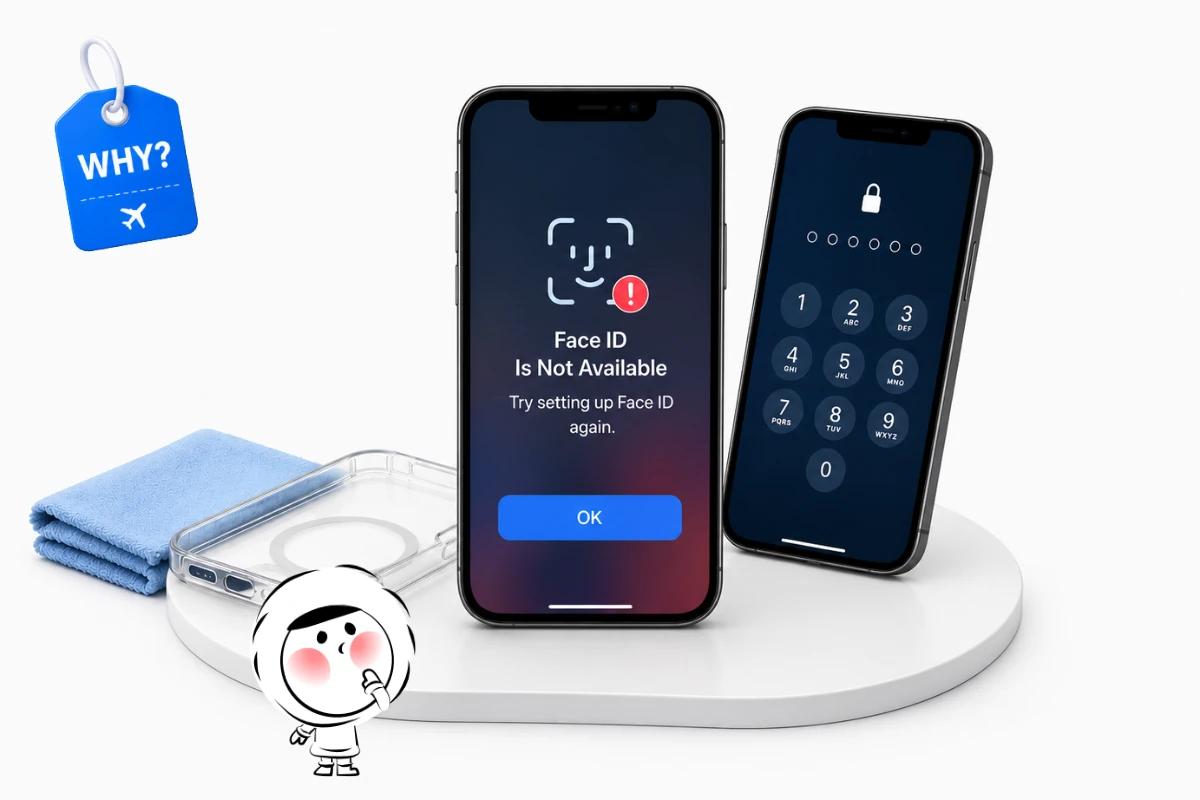
Your Face ID may not be working because the TrueDepth camera is covered, your face is partly obscured, Face ID settings have changed, iOS needs updating or the saved facial scan no longer recognises your appearance.
Start by uncovering and cleaning the camera area, checking that Face ID is enabled for the feature you are using, and restarting your iPhone. If recognition still fails, reset Face ID and set it up again before assuming the hardware is damaged.
Quick Checks Before Changing Anything
Try these simple checks first:
- Remove any case, screen protector or dirt covering the TrueDepth camera.
- Hold the iPhone at a comfortable viewing distance.
- Make sure your eyes, nose and mouth are visible.
- Remove sunglasses if they block the infrared light used by Face ID.
- Enter your passcode, lock the phone and try again.
- Restart the iPhone.
Face ID does not always activate immediately. Your iPhone may require the passcode after a restart, after several unsuccessful recognition attempts or in other security situations.
Clean And Uncover The TrueDepth Camera
Face ID relies on the TrueDepth camera system near the top of the display. A smudge, damaged screen protector, thick case edge or other obstruction can interfere with recognition.
Wipe the camera area gently with a clean, soft cloth. Then remove the case or screen protector temporarily and test Face ID again.
On an iPhone, Face ID generally works in portrait or landscape orientation on supported models. Face ID with a mask has additional device and orientation requirements. Apple states that mask recognition is available on iPhone 12 and later with supported software, but it does not work in landscape orientation. (Apple Support)
Check Your Face ID Settings
Open Settings > Face ID & Passcode and enter your passcode.
Confirm that Face ID is already set up and that the relevant option is enabled. Depending on how you use the phone, this may include:
- iPhone Unlock
- iTunes & App Store
- Wallet & Apple Pay
- Password AutoFill
- Other Apps
Face ID may work for unlocking the iPhone while remaining disabled for payments or a specific app.
You can also review Require Attention for Face ID. This security setting checks that your eyes are open and directed toward the device. Disabling it may help some accessibility needs, but it reduces the attention check used during authentication.
Update And Restart Your iPhone
Apple recommends updating an iPhone or iPad to the latest available version of iOS or iPadOS when Face ID is not working. (Apple Support)
Open Settings > General > Software Update and install any available update. Keep the device connected to power and Wi-Fi if the download is large.
After updating, restart the iPhone and test Face ID again.
Reset Face ID And Set It Up Again
If Face ID still does not recognise you, delete the saved scan and create a new one.
Go to:
Settings > Face ID & Passcode > Reset Face ID
Then select Set Up Face ID and follow the circular head-movement prompts.
Hold the phone in the position you normally use for unlocking. Remove anything that regularly changes the visible shape of your face during setup.
Face ID requires a device passcode, and its biometric data remains encrypted on the device rather than being stored in iCloud. (Apple Support)
Get Eskimo eSIM to stay connected globally
Need internet? Here's what we recommend:

Fixed data plans
- No speed reduction
- No expiry, keep your data forever
- Transfer data to anyone
- Personal hotspot


Face ID Not Recognising Your Appearance
Changes to glasses, facial hair, makeup, headwear or other features may occasionally affect recognition.
Face ID is designed to adapt gradually, but setting up an alternate appearance can help when you regularly look significantly different.
Open Settings > Face ID & Passcode > Set Up an Alternate Appearance.
Do not use this option to register another person. It is intended to improve recognition of your own appearance.
Face ID Not Working After An Update
Face ID problems after an update may come from temporary software behaviour, changed settings or an installation issue rather than a failed sensor.
Try these steps in order:
- Restart the iPhone.
- Check Face ID permissions.
- Install any newer software update.
- Reset Face ID and enrol your face again.
- Test Face ID without a case or screen protector.
Avoid erasing the entire iPhone as an early troubleshooting step. A full reset creates unnecessary work and may not fix a hardware-related problem.
Face ID Says It Is Unavailable
A persistent Face ID Is Not Available message can indicate that the TrueDepth camera cannot operate correctly.
Restart the device, install current software and try setting up Face ID again. If setup cannot begin or repeatedly stops, contact Apple Support or an Apple Authorised Service Provider.
Do not attempt to open or repair the TrueDepth camera yourself. Face ID components require specialised calibration, and unofficial repairs may create further problems.
Using Your iPhone While Face ID Is Unavailable
You can continue using your passcode to unlock the iPhone when Face ID fails.
Apps, payment services and password managers may also allow passcode, password or account-based authentication. The exact fallback depends on the app and its security settings.
Travellers should keep essential information accessible without relying entirely on biometric authentication. Useful precautions include:
- Memorising the device passcode
- Saving boarding passes to the Wallet app
- Keeping booking references available offline
- Carrying a physical payment card
- Knowing the password for the Apple Account
- Keeping a backup method for two-factor authentication
Mobile Access When Face ID Fails Abroad
Mobile data can help travellers open airline apps, retrieve boarding passes, contact Apple Support and complete account recovery when Face ID stops working overseas. Reception is generally stronger in cities, airports and along major transport routes, while indoor terminals, underground stations and remote areas may have weaker signals.
An Eskimo Global eSIM plan can support travellers moving between eligible destinations. Eskimo’s coverage across 175 countries and regions is practical for international trips and unexpected stopovers, while the universal eSIM allows one reusable Eskimo eSIM to support multiple eligible destinations without installing a different eSIM for each journey. Travellers unfamiliar with the technology can also review how an international eSIM works.
New users can also claim free 500MB of Global Data.
FAQs:
Why Is My Face ID Not Working Suddenly?
The camera may be obstructed, your appearance may be partly covered, Face ID permissions may have changed or the iPhone may need restarting or updating.
Why Is Face ID Not Recognising Me?
Check that your full face is visible, clean the TrueDepth camera and try without sunglasses, a case or a screen protector. Reset Face ID if recognition continues to fail.
How Do I Reset Face ID?
Open Settings > Face ID & Passcode, enter the passcode, select Reset Face ID, then choose Set Up Face ID and complete both facial scans.
Can Face ID Stop Working After A Screen Repair?
Yes. Face ID may fail if the TrueDepth camera system or related components were damaged, moved or not calibrated correctly. Contact Apple or an authorised provider for diagnosis.
Can I Use My iPhone Without Face ID?
Yes. You can unlock the device with its passcode and use alternative authentication methods offered by individual apps and services.