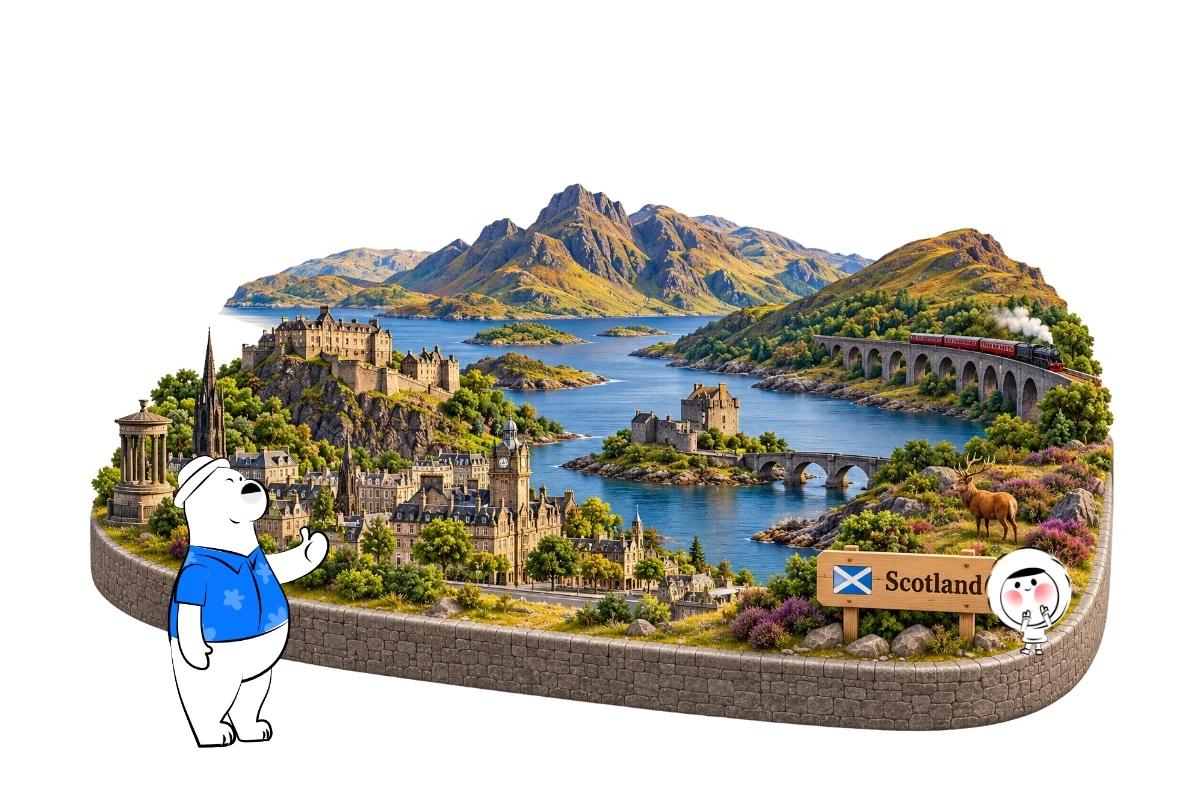
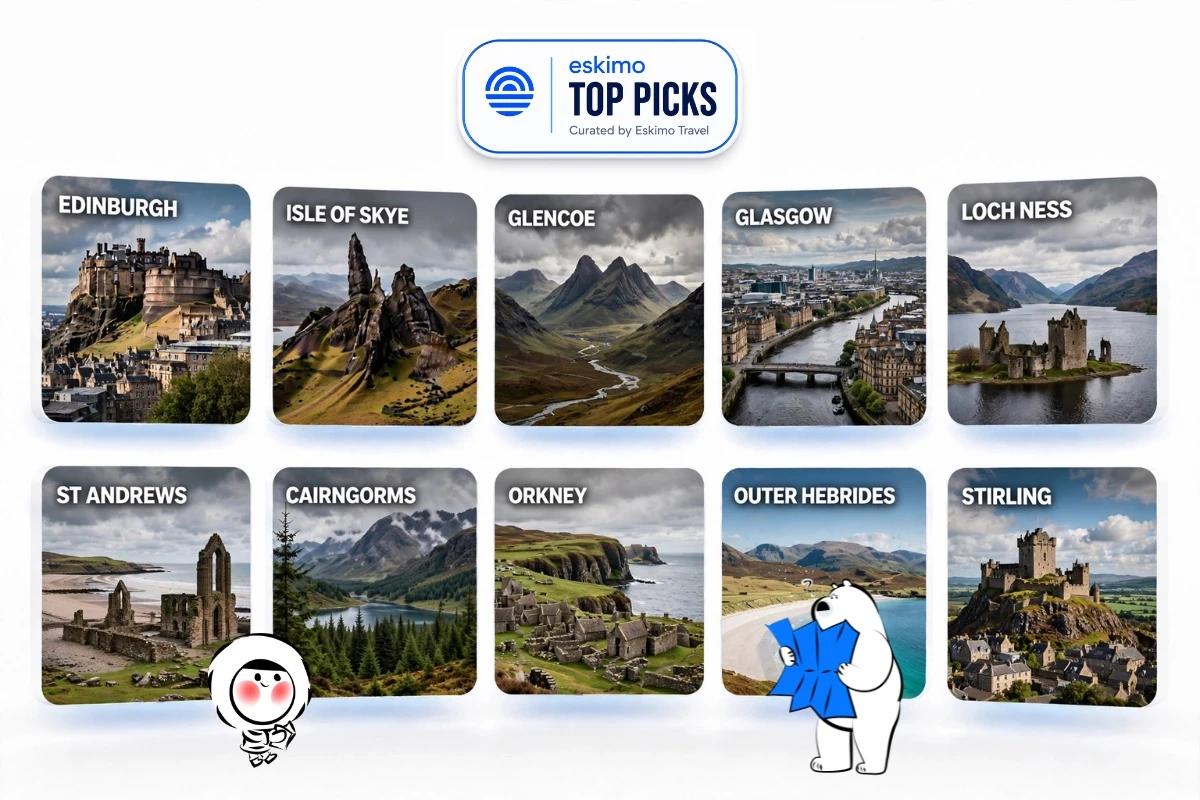
The best places to visit in Scotland are Edinburgh, the Isle of Skye, Glencoe, Glasgow, Loch Ness and Inverness, St Andrews and Fife, Cairngorms National Park, Orkney, the Outer Hebrides and Stirling. Together, these destinations offer a varied introduction to Scotland’s cities, castles, islands and Highland landscapes.
For a first trip with seven days, choose Edinburgh and one main Highland base rather than trying to visit everywhere. With 10 to 14 days, you can build a more comfortable route that includes several mainland destinations and time on an island.
These 10 destinations were selected for their scenery, cultural interest, range of experiences and suitability for different travel styles. The recommended stays are planning suggestions, not a checklist to complete in one holiday.
1. Edinburgh
Best for: History, architecture, festivals and first-time visits
Recommended stay: Two or three nights
Edinburgh is the best starting point for most first visits to Scotland. Its medieval Old Town, elegant New Town and hilltop castle bring contrasting periods of Scottish history into a compact city centre. The smaller closes and courtyards around the Royal Mile are as much a part of the experience as the headline attractions.
Begin with Edinburgh Castle, then leave time to explore the Royal Mile and surrounding streets rather than moving straight to your next booking. Calton Hill provides another perspective on the skyline, while the New Town offers a change from the Old Town’s narrow lanes.
Reserve Edinburgh Castle tickets ahead of your visit. Tickets can sell out well in advance, and an online sell-out means no additional admission tickets will be available at the castle. The National Museum of Scotland is a useful indoor alternative, with free general admission.
August’s Edinburgh Festival Fringe adds a packed programme of performances. Choose festival dates deliberately, reserve accommodation early and avoid scheduling sightseeing so tightly that there is no room for a show.
Planning tip: Explore Edinburgh without a car, then collect a rental vehicle when you are ready to leave for the Highlands.
2. Isle of Skye
Best for: Mountain scenery, photography and a scenery-focused road trip
Recommended stay: Three nights
The Isle of Skye is a leading choice for dramatic landscapes, with mountain ridges, rugged coastline and distinctive rock formations. It rewards a slower visit more than a quick circuit of famous viewpoints.
Give the Old Man of Storr and the Quiraing enough time for walking, rather than treating them as brief roadside stops. A useful approach is to group northern sights into one day and reserve another for western destinations such as Dunvegan Castle or Neist Point. Walking routes vary in difficulty, so choose according to the conditions and your experience.
You do not need a ferry to reach Skye. The Skye Bridge connects the island with the mainland at Kyle of Lochalsh. The Mallaig–Armadale ferry provides another approach, which can suit a west-coast itinerary.
A car offers the greatest flexibility, but a car-free trip is possible using mainland coaches, local buses and organised excursions. Use the VisitScotland Skye guide to compare transport options before choosing your accommodation.
Planning tip: Keep one day flexible. There is little advantage in fixing every outdoor stop before knowing which day has the most suitable weather.
3. Glencoe
Best for: Highland scenery, walking and mainland road trips
Recommended stay: Two nights
Glencoe is an excellent choice when you want a Highland stay without adding an island crossing. Its location beside the A82 makes it straightforward to include in a west-coast route, while the Glencoe Visitor Centre provides a useful starting point for exploring the area.
The Three Sisters are the classic mountain backdrop, but a rewarding visit does not require a demanding hike. At Glencoe Lochan, the gentle Lochan Trail follows an approximately 1.6-kilometre circuit. Check the official Glencoe Lochan trail descriptions to choose between the available routes.
Glencoe also works without a car when accommodation and walking plans are arranged carefully. Daily coaches between Glasgow and Fort William stop at the visitor-centre junction, although reaching individual viewpoints and trailheads requires additional planning.
Planning tip: Stay overnight rather than making Glencoe only a photo stop between destinations. Two nights provide a full day without packing, checking out and driving onward.
4. Glasgow
Best for: Museums, live music, neighbourhood exploring and city breaks
Recommended stay: Two nights
Glasgow is the strongest choice on this list for travellers who want live music to be a central part of their trip. Its scene stretches from traditional music and smaller venues to orchestral performances and major concerts. Check what is on before finalising your dates.
During the day, begin with Kelvingrove Art Gallery and Museum or the Riverside Museum. Several attractions in the Glasgow Life museum network offer free general admission, making Glasgow useful for a culture-focused visit without paying for every stop. Special exhibitions and events may have separate charges.
For another side of the city, explore the Cathedral Precinct. Glasgow Cathedral, the Necropolis, Provand’s Lordship and St Mungo Museum introduce a different chapter of Glasgow’s history from its better-known music and industrial heritage.
Planning tip: Give Glasgow an evening as well as a museum day. A concert, theatre performance or relaxed dinner helps make the visit more than a quick excursion from Edinburgh.
5. Loch Ness and Inverness
Best for: Loch scenery, castle visits and a practical Highland base
Recommended stay: Two nights
Loch Ness is worth visiting for its landscape and historic attractions, with the monster legend adding an entertaining extra. Inverness is a useful base for combining the loch with nearby places such as Culloden Battlefield and Clava Cairns.
Urquhart Castle is the main historic stop beside Loch Ness. Book admission early, particularly for summer dates. Drivers also need to reserve parking online, which can be added during the ticket-booking process. Check the Urquhart Castle visitor information before building your day around the visit.
In Inverness itself, the Inverness Castle Experience is now open. Its interactive installations and exhibitions focus on Highland landscapes, people and heritage, so expect a modern visitor experience rather than a conventional tour of preserved royal rooms.
Planning tip: Choose one main excursion each day. Trying to fit Loch Ness, Urquhart Castle, Culloden, Clava Cairns and the castle experience into a single day leaves little time to appreciate any of them.
6. St Andrews and Fife
Best for: Coastal history, golf and a smaller-town addition to an Edinburgh trip
Recommended stay: A day trip or one night
St Andrews combines coastal castle ruins with the heritage of the Old Course. Golf enthusiasts can join an official Old Course guided walk without booking a round, while the castle occupies a seaside position between the university and cathedral.
Current access restrictions are worth checking. At St Andrews Cathedral, the grounds are free to visit when open, but the museum and shop are closed and sections of the graveyard are fenced off. At St Andrews Castle, the mine, countermine and Bishop’s Apartments are currently closed. Consult the cathedral visitor information and castle access updates shortly before travelling.
St Andrews has no railway station. The usual rail approach is to Leuchars, followed by a bus or taxi into town. This makes a car-free visit manageable with a little connection planning.
Planning tip: Choose a day trip when St Andrews itself is the priority. Stay overnight when you also want time to explore the wider Fife coast.
7. Cairngorms National Park
Best for: Woodland walks, outdoor activities and a Highland stay with fewer long drives
Recommended stay: Two or three nights
Cairngorms National Park is a good alternative to a west-coast road trip. Aviemore provides a practical base with rail access, while local buses make some outdoor attractions reachable without a car. The park’s railway stations also include Kingussie, Newtonmore, Blair Atholl and Carrbridge.
Begin with lower-level landscapes rather than assuming every rewarding outing requires a summit. Loch Morlich combines a sandy shore, pine forest and mountain views, with walking and cycling opportunities nearby. It is also served by the Aviemore Adventurer bus.
Use the Cairngorms public transport guide to plan around available connections. Check the return journey before setting out, particularly when a walk finishes somewhere different from where it starts.
For mountain routes, consult the Mountain Weather Information Service, which publishes a forecast covering the Cairngorms.
Planning tip: Keep both a woodland option and a mountain option in your itinerary, then choose according to the forecast.
8. Orkney
Best for: Archaeology, prehistoric landscapes and a history-focused island trip
Recommended stay: Three or four nights
Orkney is one of the best places to visit in Scotland for archaeology. The UNESCO-listed Heart of Neolithic Orkney includes Skara Brae, Maeshowe, the Ring of Brodgar and the Stones of Stenness, offering an extraordinary introduction to life around 5,000 years ago.
These sites provide different experiences. Skara Brae preserves a settlement with surviving stone furnishings, while Maeshowe is a chambered tomb and the stone circles form part of a wider ceremonial landscape. Give them separate time rather than treating each as another quick stop.
Book Maeshowe tours early. Entry is by guided tour only, beginning at the visitor centre in Stenness. Access to the cairn includes a walk and a low, narrow entrance passage; the cairn itself is not wheelchair accessible.
Flights and ferry services connect Orkney with the Scottish mainland. Compare the options in the official guide to getting to Orkney before booking accommodation.
Planning tip: Give Orkney its own section of the holiday rather than treating it as a brief detour from a mainland road trip.
9. Outer Hebrides
Best for: Beaches, Gaelic culture and a slower island journey
Recommended stay: Four or five nights for Lewis and Harris
The Outer Hebrides suit travellers who want open landscapes, beaches and island culture rather than a tightly packed sightseeing schedule. For a first visit, concentrate on Lewis and Harris, which form one island despite their separate names.
Build your days around the beaches and mountain landscapes of Harris, then make time for Lewis’s historic sites and Stornoway. The VisitScotland Lewis and Harris guide is a useful starting point for choosing where to stay and how to divide your time.
Check the latest Calanais Standing Stones visitor information before arriving. The visitor centre now advertises combined admission to the stones and its immersive exhibition, so older advice about visitor arrangements may no longer apply.
A car makes scattered attractions easier to combine, although local buses connect Stornoway with other settlements from Monday to Saturday. Check Sunday transport and individual business opening hours before finalising your plans.
Planning tip: Four or five nights is a starting point for Lewis and Harris, not a recommendation for covering the entire Outer Hebrides.
Get Eskimo eSIM to stay connected globally
Need internet while travelling? Here's what we recommend:

Fixed data plans
- No speed reduction
- No expiry, keep your data forever
- Transfer data to anyone
- Personal hotspot


10. Stirling
Best for: Castle sightseeing, Scottish history and a car-free day trip
Recommended stay: A day trip or one night
Stirling is a practical choice for a trip centred on a major historic attraction. Stirling Castle stands above the Old Town, approximately half a mile uphill from the railway and bus stations. Allow time for the ascent rather than booking admission immediately after your train arrives.
Drivers should check the latest Stirling Castle visitor information. The castle currently lists its car park as closed to vehicles other than coaches and those requiring accessible parking, with alternatives available elsewhere in Stirling.
The National Wallace Monument makes a worthwhile second stop. A shuttle can help with the approach up Abbey Craig, but reaching the upper galleries and viewing crown involves a narrow spiral staircase with 246 steps.
Planning tip: For a day visit, focus on the castle and one other major attraction. Check gradients and accessibility as carefully as opening hours.
Which Scotland Destinations Should You Choose?
For a first visit, start with Edinburgh and either Glencoe or the Cairngorms. Add Skye when the itinerary allows a dedicated island stay.
For a city-focused holiday, choose Edinburgh and Glasgow, with Stirling as an optional day trip.
For history and archaeology, prioritise Edinburgh, Stirling, St Andrews and Orkney, choosing between them according to your time rather than attempting all four in a short break.
For outdoor scenery, choose Glencoe or Skye for a west-coast trip, the Cairngorms for a woodland-and-mountain stay, or the Outer Hebrides when beaches and island landscapes are the main attraction.
How Long Should You Spend in Scotland?
Four Days: Edinburgh and One Nearby Destination
Spend three nights in Edinburgh and give the city most of your time. Add a day trip to Stirling or Glasgow only when it fits your interests.
For a first short break, one additional destination is enough. Avoid using a large share of the trip to travel to and from a distant Highland attraction.
Seven Days: One City and One Highland Base
A manageable seven-day road trip could include two nights in Edinburgh, three nights around Glencoe and a final night near your departure airport or station.
For a car-free alternative, consider Edinburgh followed by an Aviemore-based stay. Rail access and local buses make this a workable combination, provided your chosen activities fit the connections.
Ten Days: Edinburgh, Glencoe and Skye
A balanced starting point is three nights in Edinburgh, two around Glencoe, three on Skye and one near your departure point.
Treat the longer transfers as travel days. Do not schedule a substantial hike or several timed attractions simply because the map suggests you will pass nearby.
Fourteen Days: Mainland Highlights and One Island Region
Two weeks gives you more freedom to combine a city stay, selected Highland destinations and either Orkney or the Outer Hebrides.
Choose one island region rather than trying to include both. Build a buffer before an important onward connection instead of relying on a tightly timed island departure.
For a longer UK holiday, give England its own allocation of days. Our guide to things to do in Liverpool can help you plan a separate city stay rather than adding another rushed stop.
Getting Around Scotland
Trains and Coaches
Trains are useful for journeys between Edinburgh, Glasgow, Stirling, Inverness and Aviemore. Check ScotRail timetables and journey information for your actual travel date, including any service changes.
Coaches extend the public transport network into places such as Glencoe and Skye. However, reaching the destination does not necessarily mean you can easily reach every attraction nearby. Choose your accommodation around the journeys you intend to make.
Driving
A car is most useful when your plans involve scattered rural attractions. Skye and Lewis and Harris both have single-track roads, so allow more time than the distance alone suggests.
Use passing places responsibly, let faster traffic behind you pass when safe and never use a passing place as a parking space.
Keep driving days realistic. Several short walks, meals and photo stops can turn an apparently simple transfer into a full day.
Ferries
For west-coast island journeys, check CalMac service status as well as the published timetable. The timetable tells you what is scheduled; live updates tell you whether disruption may affect your sailing.
Reserve ahead on bookable routes. CalMac also strongly advises foot passengers to make reservations before travel where applicable. Follow the check-in deadline on your ticket, since it varies between services.
Orkney uses different operators, including NorthLink Ferries and Pentland Ferries, so do not look to CalMac for those crossings.
Best Time to Visit Scotland
May, June and September are useful starting points for a sightseeing-focused trip, but choose dates around your route and interests rather than assuming one month is best everywhere.
Spring brings lengthening days and seasonal attractions reopening. Summer suits outdoor activities, festivals and island travel. Autumn adds woodland colour, while winter can work well for a more city-focused holiday with flexible outdoor plans. The VisitScotland seasonal guide provides ideas for each part of the year.
For Edinburgh’s festival atmosphere, choose August deliberately. For a trip less centred on major events, compare dates outside the Fringe period. Our guide to shoulder-season travel explains the trade-offs to consider when travelling outside the busiest periods.
Midges are another consideration for rural trips, especially in western areas and damp conditions. Pack suitable repellent and lightweight covering layers, and read the VisitScotland midge guidance before an outdoor-focused holiday.
Whatever your dates, keep an alternative to your most weather-dependent activity.
Booking and Budget Details to Check
Start with the parts of your itinerary that have limited availability: island accommodation, transport and timed attractions. Edinburgh Castle, Urquhart Castle and Maeshowe all warrant advance planning rather than an assumption that tickets will be available on arrival.
Edinburgh now has a visitor levy on eligible paid overnight accommodation. The charge is 5% of the accommodation cost before VAT, excluding extras such as meals and parking, and applies to a maximum of five consecutive nights. It covers eligible stays from 24 July 2026; qualifying bookings paid for at least in part before 1 October 2025 are exempt. Check the Edinburgh visitor levy guidance and how the charge appears in your accommodation quote.
Compare the total cost of your route, not only room prices. Another overnight base may also mean another transport fare, parking charge, ferry booking or day spent moving.
Mobile Data for a Scotland Trip
Mobile data helps with rail tickets, ferry updates, weather forecasts and directions to your accommodation. Coverage depends on your location and network, so check Ofcom’s mobile coverage tool before travelling into remote areas. Its predictions are a guide, not a guarantee of reception.
Download maps, booking confirmations and essential travel information before leaving a reliable connection. Do not make live mobile reception your only navigation plan for a remote walk.
An Eskimo United Kingdom eSIM can be prepared before arrival on a compatible, unlocked device. Eskimo’s fixed data plans have no expiry, allowing unused data to remain available for a later trip within the purchased plan’s coverage.
For onward travel to the Republic of Ireland or mainland Europe, compare an Eskimo Europe eSIM and check the included destinations. Do not assume a UK-only plan covers another country.
Eligible new users can also claim free 500MB of Global Data using FREE500MB, subject to the current offer terms.
FAQs
What Are the Best Places to Visit in Scotland for a First Trip?
Edinburgh and Glencoe make a strong starting combination. Add Skye when you have time for a dedicated island stay, or choose an Aviemore-based Cairngorms visit for an alternative Highland experience.
How Many Days Do You Need in Scotland?
Seven days is a useful starting point for a city and one main Highland base. Around 10 days gives more flexibility for Edinburgh, Glencoe and Skye. Allow closer to two weeks when combining mainland sightseeing with a substantial Orkney or Outer Hebrides stay.
Can You Visit Scotland Without a Car?
Yes. Edinburgh, Glasgow, Stirling, Inverness and Aviemore are accessible by rail, while coaches and local buses reach additional destinations. The main challenge is often travelling from your accommodation to a rural attraction, rather than getting between larger towns.
Which Scottish Island Is Best for First-Time Visitors?
Skye is a practical choice for a mainland road trip because it can be reached by bridge. Choose Orkney when archaeology is your priority, or Lewis and Harris for a slower trip centred on beaches and island culture.
Which Part of Scotland Has the Best Scenery?
Choose Glencoe or Skye for a mountain-focused trip, the Cairngorms for woodland and mountain outings, or the Outer Hebrides for coastal landscapes. The best choice is the place where you will have enough time to explore, not simply the one with the longest list of famous viewpoints.