
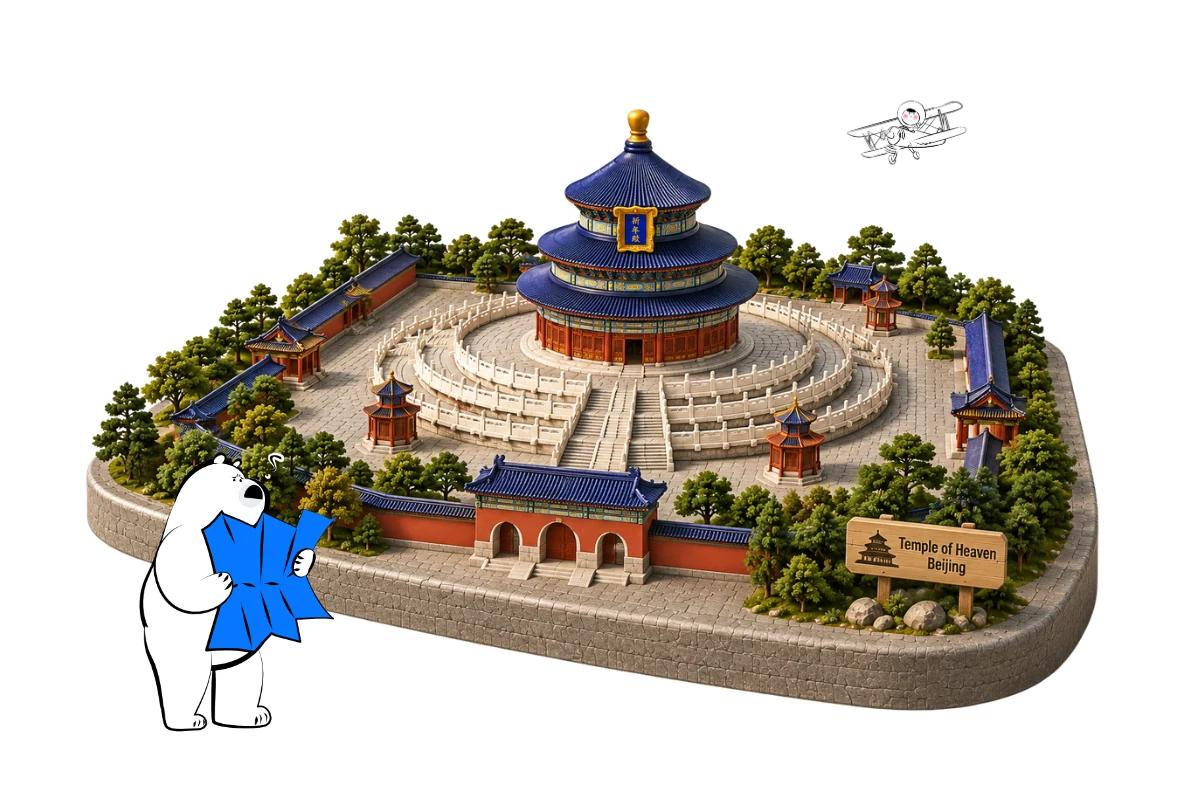
The Temple of Heaven in Beijing is a UNESCO World Heritage Site where Chinese emperors once performed ceremonies to honor heaven and pray for good harvests. Established in 1420, the complex is famous for its blue-roofed Hall of Prayer for Good Harvests, Echo Wall and Circular Mound Altar.
Allow two to three hours for a visit. Standard park admission costs CNY 10 to CNY 15, while combined tickets covering the three main historic attractions cost CNY 28 to CNY 34, depending on the season. These prices are published by the Beijing Municipal Government.
For first-time visitors, the combined ticket is the better choice. Arrive early, ideally on a weekday, and use Beijing Subway Line 5 to reach the East Gate.
Temple of Heaven Beijing at a Glance
- Location: Dongcheng District, Beijing, China
- Chinese name: 天坛 (Tiāntán)
- Established: 1420, during the Ming dynasty
- UNESCO status: World Heritage Site since 1998
- Park admission: CNY 10 to CNY 15
- Combined ticket: CNY 28 to CNY 34
- Park opening: 6:00 AM in peak season, 6:30 AM in low season
- Main attractions: Open from 8:00 AM, generally Tuesday to Sunday
- Recommended visit: Two to three hours
- Nearest subway: Tiantandongmen Station, Line 5
- Best arrival: Early morning
The prices and operating hours above are published in the Beijing Municipal Government’s Temple of Heaven visitor information.
Special opening arrangements may apply during public holidays.
Temple of Heaven Location in Beijing
The Temple of Heaven is located in southern Dongcheng District, approximately four kilometers south of Tiananmen Square.
Its address is No. 7 Tiantan Neidongli, Dongcheng District, Beijing, China.
The complex covers approximately 273 hectares, making it considerably larger than its famous central buildings suggest.
Despite its name, the Temple of Heaven is not a single temple. It is an extensive ceremonial complex containing historic altars, imperial buildings, landscaped gardens and centuries-old trees.
The principal attractions follow a north-south axis:
- Hall of Prayer for Good Harvests in the north
- Imperial Vault of Heaven and Echo Wall in the center
- Circular Mound Altar in the south
This arrangement reflects traditional Chinese beliefs about heaven, earth and imperial authority.
The location makes the Temple of Heaven convenient to combine with other historic Beijing attractions, including Tiananmen Square, the Forbidden City and Qianmen.
Travelers exploring beyond Beijing can also consider Eskimo’s one-month China travel itinerary, which includes the capital alongside destinations such as Chengdu, Zhangjiajie and Yunnan.
Temple of Heaven Tickets and Entry Fees
Temple of Heaven tickets are available as ordinary park admission or combined tickets that include the main ceremonial attractions.
The combined ticket covers the Hall of Prayer for Good Harvests, Echo Wall and Circular Mound Altar.
Ordinary admission allows visitors to explore the park grounds but does not include entry to these three historic attractions.
The following prices are published in the Beijing Municipal Government’s official Temple of Heaven ticket information.
Peak season ticket prices
April 1 to October 31
- Standard park admission: CNY 15
- Discounted park admission: CNY 7.50
- Standard combined ticket: CNY 34
- Discounted combined ticket: CNY 17
Low season ticket prices
November 1 to March 31
- Standard park admission: CNY 10
- Discounted park admission: CNY 5
- Standard combined ticket: CNY 28
- Discounted combined ticket: CNY 14
Separate attraction tickets
Visitors who have already purchased ordinary park admission can purchase an additional ticket covering the three principal historic attractions.
The published prices are:
- Standard separate attraction ticket: CNY 20
- Discounted separate attraction ticket: CNY 10
These tickets cover the Hall of Prayer for Good Harvests, Echo Wall and Circular Mound Altar.
For travelers planning to visit all three landmarks, purchasing the combined ticket from the beginning is generally simpler.
Discount eligibility depends on age, student status and other applicable admission policies. Visitors claiming discounted admission should carry supporting identification.
Children, students and other eligible visitors may qualify for free or discounted admission under the park’s concession rules.
Eligibility can depend on age, education level and identification documents. Check the conditions shown by the official ticketing platform before selecting a discounted ticket.
How to book Temple of Heaven tickets
Foreign visitors can purchase Temple of Heaven tickets through Beijing’s official municipal park ticketing system.
The Beijing Municipal Government’s ticket-booking guide for foreign visitors explains the process.
Online tickets are available through the official Visiting Beijing Parks platform and associated WeChat ticketing services.
Visitors can generally make reservations between one and seven days before their visit.
Foreign travelers should prepare:
- A valid passport or foreign permanent resident identification document
- The identification details required by the booking platform
- An accepted payment method
- Their electronic ticket or booking confirmation
The official booking process involves selecting the park, choosing a visiting date, entering visitor information and completing payment.
Visitors can retrieve their electronic tickets through the booking platform.
The government’s electronic ticket instructions explain that visitors can enter by scanning the ticket’s QR code and presenting valid identification when required.
Bring the same identification document used during booking.
Buying tickets at the park
Tickets are also available through designated ticketing services at Beijing’s municipal parks.
The Beijing Municipal Government’s Temple of Heaven ticketing information identifies ticket-office services as an admission option.
This is useful for international travelers who cannot complete the online booking process.
However, advance booking remains convenient during weekends, Chinese public holidays and peak travel seasons.
Use official booking channels rather than assuming that third-party ticket sellers are authorized.
Temple of Heaven Opening Hours
Temple of Heaven opening hours vary by season, and the park grounds operate on a different schedule from the main historic attractions.
The following schedules are published in the Beijing Municipal Government’s official opening-hours information.
Park opening hours
April 1 to October 31
- Opens: 6:00 AM
- Last admission: 9:00 PM
- Closes: 10:00 PM
November 1 to March 31
- Opens: 6:30 AM
- Last admission: 9:00 PM
- Closes: 10:00 PM
These times apply to the park grounds.
Main attraction opening hours
The Hall of Prayer for Good Harvests, Echo Wall and Circular Mound Altar follow shorter operating hours.
April 1 to October 31
- Opens: 8:00 AM
- Last admission: 5:30 PM
- Closes: 6:00 PM
November 1 to March 31
- Opens: 8:00 AM
- Last admission: 4:30 PM
- Closes: 5:00 PM
The three principal historic attractions generally operate from Tuesday to Sunday.
They are normally closed on Mondays, except during designated statutory holidays.
The park grounds remain accessible on Mondays during their normal operating hours.
A September 2026 Beijing Municipal Government announcement confirmed that Monday closures resumed on September 1, 2026, for the Temple of Heaven’s historic architectural complexes.
This includes the Hall of Prayer for Good Harvests, Echo Wall and Circular Mound Altar.
For visitors interested in the main buildings, Tuesday through Sunday is therefore the safer choice.
Temporary closures and holiday arrangements may affect individual attractions.
Best Time to Visit the Temple of Heaven
Early morning is generally the best time to visit the Temple of Heaven, especially for photography, cooler temperatures and observing local park activities.
The most suitable season depends on your preference for weather and crowd levels.
Early morning for local park life
Arriving between approximately 7:00 AM and 9:00 AM allows visitors to experience the park before the busiest sightseeing period.
Local residents often gather for activities including:
- Tai chi
- Group exercise
- Traditional dancing
- Singing
- Social gatherings
These activities are part of the park’s everyday character.
Visitors arriving before 8:00 AM can explore the gardens before the main ceremonial attractions open.
For travelers primarily interested in the historic buildings, arriving around 8:00 AM is more efficient.
Spring and autumn for comfortable weather
April, May, September and October generally offer pleasant conditions for walking around Beijing.
Spring brings milder temperatures and fresh greenery.
Autumn often offers cooler weather and comfortable sightseeing conditions.
Summer can be hot and humid, particularly on the exposed marble terraces.
Winter temperatures can fall below freezing, although the park may be quieter outside major holidays.
Weekdays for lighter crowds
Tuesday through Friday generally provide a better balance between attraction access and crowd levels.
Weekends can be busier because the park is popular with both tourists and Beijing residents.
Major Chinese holidays, particularly the National Day holiday period in early October, can bring significantly larger visitor numbers.
Temple of Heaven Entrances and Transport
The Temple of Heaven has four main entrances: East, West, North and South.
Choosing the right entrance matters because the park covers a large area, and walking between gates can take considerable time.
The main ceremonial buildings are connected by a central north-south route.
For most first-time visitors, the East Gate provides convenient subway access. Travelers planning a north-to-south sightseeing route can also consider the North Gate.
East Gate
Best for: Subway access and first-time visitors
The East Gate is one of the most convenient entrances for travelers using public transport.
Take Beijing Subway Line 5 to Tiantandongmen Station.
Exit A is commonly recommended for reaching the East Gate.
From the station, follow signs toward the park entrance.
The station provides convenient access to the eastern side of the park.
From the gate, follow signs toward the Hall of Prayer for Good Harvests.
This entrance works particularly well for visitors planning to see the three main landmarks.
West Gate
Best for: Travelers using Subway Line 8
Take Subway Line 8 to Tianqiao Station.
Exit C is commonly recommended for reaching the Temple of Heaven’s West Gate.
Follow directions toward the park after leaving the station.
This entrance is useful for travelers approaching from the Tianqiao area or combining their visit with nearby neighborhoods.
North Gate
Best for: Starting at the Hall of Prayer for Good Harvests
The North Gate provides a logical starting point for a north-to-south sightseeing route.
Begin with the Hall of Prayer for Good Harvests, continue toward the Imperial Vault of Heaven and finish at the Circular Mound Altar.
This route follows the main ceremonial axis.
South Gate
Best for: Starting at the Circular Mound Altar
The South Gate is convenient for visitors who prefer to explore the complex from south to north.
Begin with the Circular Mound Altar before continuing toward the Echo Wall and Hall of Prayer for Good Harvests.
This route is also useful for visitors who want to finish their sightseeing near the northern ceremonial buildings.
Get Eskimo eSIM to stay connected globally
Need internet while travelling? Here's what we recommend:

Fixed data plans
- No speed reduction
- No expiry, keep your data forever
- Transfer data to anyone
- Personal hotspot


Getting there by subway
Beijing’s subway system is generally the most convenient way to reach the Temple of Heaven.
The two most useful stations are:
- Tiantandongmen Station: Line 5, Exit A, convenient for the East Gate
- Tianqiao Station: Line 8, Exit C, convenient for the West Gate
Follow current station signage when choosing your exit.
Subway fares depend on travel distance.
For help with subway payments, transport apps and intercity connections, Eskimo’s transportation guide to China explains the main options for international visitors.
Getting there by taxi
Taxis and ride-hailing services are widely available in Beijing.
Journey times depend on traffic and your starting location.
Show the driver the park’s Chinese name:
天坛公园 (Tiāntán Gōngyuán)
Specify your preferred entrance because the four gates are separated by considerable walking distances.
What to See at the Temple of Heaven
Three historic attractions form the main sightseeing route, but the surrounding park and additional ceremonial buildings are also worth exploring.
Hall of Prayer for Good Harvests
Location: Northern ceremonial complex Type: Imperial prayer hall Best for: Architecture and photography Entry: Combined ticket or separate attraction ticket Main highlight: Circular hall with a three-tiered blue roof
The Hall of Prayer for Good Harvests is the most recognizable building at the Temple of Heaven.
Its circular structure rises above three levels of white marble terraces, creating one of Beijing’s most distinctive architectural compositions.
The hall was used for imperial ceremonies seeking favorable harvests.
Its design incorporates traditional Chinese symbolism associated with heaven, the seasons and the passage of time.
The building’s wooden framework demonstrates sophisticated traditional construction techniques.
For photography, the broad marble staircases provide a recognizable foreground beneath the blue-tiled roof.
Arriving shortly after opening can make it easier to appreciate the architecture before the courtyard becomes crowded.
Imperial Vault of Heaven and Echo Wall
Location: Central ceremonial complex Type: Historic ceremonial building Best for: Architecture and acoustic features Entry: Combined ticket or separate attraction ticket Main highlight: Circular Echo Wall
The Imperial Vault of Heaven stands south of the Hall of Prayer for Good Harvests.
This smaller circular building was associated with the storage of ceremonial tablets used during imperial worship.
It is surrounded by the Echo Wall, a circular enclosure known for its acoustic properties.
Under suitable conditions, sound can travel along the curved wall between distant points.
However, background noise, crowds and visitor restrictions may make the effect difficult to experience.
The surrounding courtyard is also valuable for understanding the symmetry and symbolism of the complex.
Circular Mound Altar
Location: Southern ceremonial complex Type: Open-air imperial altar Best for: History and architectural symbolism Entry: Combined ticket or separate attraction ticket Main highlight: Three-tiered circular marble altar
The Circular Mound Altar was used for important imperial ceremonies honoring heaven, particularly during the winter solstice.
Unlike the Hall of Prayer for Good Harvests, it is an open-air structure.
The altar consists of three circular marble platforms connected by staircases.
Its design incorporates numerical symbolism, particularly the number nine and its multiples.
In traditional Chinese cosmology, nine was associated with imperial authority and the highest single-digit yang number.
The central stone on the upper terrace is also associated with unusual acoustic effects.
The altar offers a different perspective on the Temple of Heaven because its significance comes primarily from its ceremonial layout rather than a large enclosed building.
Hall of Abstinence
Location: Western section of the inner complex Type: Imperial ceremonial residence Best for: Understanding imperial rituals Entry: Subject to current access arrangements Main highlight: Buildings associated with ceremonial preparation
The Hall of Abstinence was used by emperors preparing for important ceremonies.
Imperial rituals required prescribed periods of fasting and preparation before certain sacrifices.
The buildings provide insight into the formal procedures surrounding worship at the Temple of Heaven.
Access may vary, so confirm whether the area is open before planning a visit.
Temple of Heaven Park
Location: Surrounding the ceremonial complex Type: Historic parkland Best for: Walking and local culture Entry: Ordinary park admission Main highlight: Ancient trees, landscaped paths and community activities
The surrounding park is an important part of the Temple of Heaven experience.
Its extensive grounds contain mature trees, long pathways and open spaces used by local residents.
The park provides a quieter contrast to the main ceremonial courtyards.
Visitors interested in photography or local daily life may want to spend additional time here rather than rushing between historic buildings.
Temple of Heaven History and Significance
The Temple of Heaven was established in 1420 during the reign of the Yongle Emperor of the Ming dynasty.
It became one of the most important ceremonial complexes in imperial China.
During the Ming and Qing dynasties, emperors performed rituals here to honor heaven and seek favorable agricultural conditions.
The emperor was traditionally regarded as the Son of Heaven, responsible for maintaining harmony between human society and the celestial order.
Because agriculture supported much of China’s population and economy, ceremonies for successful harvests carried enormous political and symbolic importance.
The Temple of Heaven therefore represented both religious tradition and imperial authority.
Why the architecture uses circular forms
Traditional Chinese cosmology associated heaven with circular forms and earth with square forms.
These ideas influenced the layout and architecture of the Temple of Heaven.
Circular altars, symmetrical courtyards and carefully aligned buildings reinforced the relationship between the emperor and heaven.
The complex’s geometry was part of its ceremonial meaning rather than simply a decorative choice.
The symbolism of the number nine
The number nine appears repeatedly in the Circular Mound Altar.
Its multiples are incorporated into the arrangement of paving stones, staircases and other architectural elements.
This numerical symbolism reflected traditional beliefs about heaven and imperial power.
UNESCO World Heritage recognition
The Temple of Heaven became a UNESCO World Heritage Site in 1998.
UNESCO recognizes its architectural significance and its representation of traditional Chinese cosmological beliefs.
The complex is also an important surviving example of imperial ceremonial architecture.
The UNESCO Temple of Heaven World Heritage listing explains the site’s historical importance and protected cultural features.
Temple of Heaven Architecture and Interesting Facts
The Temple of Heaven contains several architectural features that distinguish it from Beijing’s other imperial landmarks.
It was primarily a ceremonial complex.
Unlike temples used for regular public religious worship, the Temple of Heaven was designed for important imperial state rituals.
Its famous blue roofs symbolize heaven.
The Hall of Prayer for Good Harvests uses distinctive blue-glazed roof tiles that reinforce the complex’s celestial symbolism.
The Hall of Prayer for Good Harvests has an elaborate wooden structure.
Its columns and beams demonstrate traditional Chinese timber construction.
The ceremonial buildings follow a north-south axis.
Their alignment reflects the importance of order and symmetry in imperial architecture.
The surrounding landscape is historically significant.
Ancient trees and landscaped grounds form part of the complex’s original ceremonial setting.
The park opened to the public in 1918.
After centuries of imperial use, the grounds became accessible to ordinary visitors.
Today, the Temple of Heaven serves both as a protected historic monument and a public recreational park.
A Practical Two-Hour Temple of Heaven Route
Visitors with limited time can explore the three principal attractions in approximately two hours.
A north-to-south route provides a straightforward way to experience the ceremonial complex.
First 40 minutes: Hall of Prayer for Good Harvests
Begin at the northern ceremonial area.
Explore the courtyard, photograph the blue-roofed hall and examine the surrounding marble terraces.
Allow enough time to appreciate the building from different viewpoints.
Next 30 minutes: Central ceremonial walkway
Continue south along the main axis.
The connecting pathways reveal the scale and symmetry of the complex.
Use this part of the visit to appreciate the surrounding landscape and architectural arrangement.
Next 25 minutes: Imperial Vault of Heaven and Echo Wall
Explore the circular courtyard surrounding the Imperial Vault of Heaven.
Examine the Echo Wall and its architectural design.
Avoid relying on an acoustic demonstration, as crowds and restrictions may prevent it.
Final 25 minutes: Circular Mound Altar
Finish at the southern ceremonial altar.
Explore the marble terraces and observe the geometric layout.
Continue toward the South Gate or spend additional time walking through the park.
Allow three hours if you prefer a relaxed pace.
Walking distances vary depending on your entrance, exit and the number of additional attractions you visit.
Travelers entering through the East Gate can adapt the route by walking toward the Hall of Prayer for Good Harvests before continuing south.
Temple of Heaven Visiting Tips
A few preparations can make sightseeing easier, especially for international visitors.
Bring the correct identification
Foreign visitors should carry the passport or identification document used for their ticket purchase.
Beijing’s official ticketing guidance states that visitors may need to present their identification document when entering the park.
Wear comfortable walking shoes
The Temple of Heaven covers approximately 273 hectares.
Although the main attractions occupy a smaller area, visitors should expect substantial walking.
Prepare for seasonal weather
The marble terraces provide limited shade.
Summer visitors should carry water and sun protection.
Winter visitors should prepare for cold temperatures and potentially windy conditions.
Download useful apps before arriving
China’s digital services operate differently from those in many other countries.
Alipay and WeChat Pay are commonly used for payments, while Amap can help with navigation and DiDi is useful for ride-hailing.
Some international websites and apps may be restricted or function differently in mainland China.
Mobile data access does not guarantee that every international service will work.
Set up essential apps, payment methods and translation tools before arriving.
Eskimo’s apps to download before traveling to China explains the main options.
Plan for accessibility
The park contains broad walking paths, but some historic areas include stairs, raised platforms and uneven surfaces.
Visitors using wheelchairs or mobility aids should confirm accessible routes and entrance arrangements before arrival.
The Temple of Heaven’s official visitor information lists the park’s service telephone number as +86 10 67028866.
Contact the park for current accessibility arrangements and assistance.
Respect local park activities
The Temple of Heaven is also a community space.
Avoid interrupting exercise groups or photographing individuals without consideration.
Follow posted restrictions around historic buildings and ceremonial structures.
Combining the Temple of Heaven With Other Beijing Attractions
The Temple of Heaven can be combined with other central Beijing landmarks, although attempting to visit too many major sites in one day may feel rushed.
Tiananmen Square
Tiananmen Square lies north of the Temple of Heaven.
It is one of Beijing’s most recognizable public spaces and is closely connected to the city’s modern political history.
Security procedures and reservation requirements may apply.
Check official access arrangements before visiting.
Forbidden City
The Forbidden City, now the Palace Museum, was the imperial residence of the Ming and Qing dynasties.
It provides an interesting contrast with the Temple of Heaven.
The Forbidden City represents imperial residential and administrative life, while the Temple of Heaven reflects ceremonial responsibilities.
Both attractions are extensive, so allow sufficient time if visiting them on the same day.
Palace Museum tickets should be arranged according to its official reservation requirements.
Qianmen
Qianmen is a historic commercial district south of Tiananmen Square.
Its pedestrian streets contain shops, restaurants and traditional architectural features.
It is a convenient option for lunch or an afternoon walk after visiting the Temple of Heaven.
For a manageable sightseeing day, visit the Temple of Heaven in the morning and explore Qianmen afterward.
Mobile Data for Visiting Beijing
Mobile data helps with Temple of Heaven ticket confirmations, Beijing subway directions, ride-hailing bookings and translating Chinese signs. Reception is generally stronger across central Beijing and major transport routes, although it can weaken in underground stations, enclosed buildings and crowded areas. Save your ticket confirmation and the park’s Chinese address before traveling.
An Eskimo China eSIM plan is suitable for travelers visiting Beijing and other destinations within China. Eskimo offers eSIM data plans for more than 175 countries and regions overall, although coverage varies by plan. With no-expiry fixed data, unused data can remain available for future travel instead of needing to be used during one holiday.
New users can also claim a free 250MB Global eSIM.
FAQs
How much are Temple of Heaven Beijing tickets?
Temple of Heaven Beijing park admission costs CNY 15 from April to October and CNY 10 from November to March. Combined tickets covering the three main historic attractions cost CNY 34 and CNY 28 respectively, according to the published Beijing Municipal Government ticket information.
How long does it take to visit the Temple of Heaven?
Allow two to three hours to explore the Hall of Prayer for Good Harvests, Echo Wall, Circular Mound Altar and surrounding park. Visitors interested in photography or additional historic buildings may need longer.
Is the Temple of Heaven open on Mondays?
The park grounds are generally open on Mondays, but the three main historic attractions are normally closed. Exceptions apply during designated Chinese statutory holidays. Beijing’s municipal government confirmed the resumption of Monday closures in September 2026.
Which subway station is closest to the Temple of Heaven?
Tiantandongmen Station on Beijing Subway Line 5 is one of the most convenient options for the East Gate. Exit A is commonly recommended. Tianqiao Station on Line 8 provides access to the West Gate, with Exit C commonly recommended.
Can you visit the Temple of Heaven without a combined ticket?
Yes. Ordinary admission allows visitors to explore the park grounds. However, entering the Hall of Prayer for Good Harvests, Echo Wall and Circular Mound Altar requires a combined ticket or the appropriate separate attraction ticket.