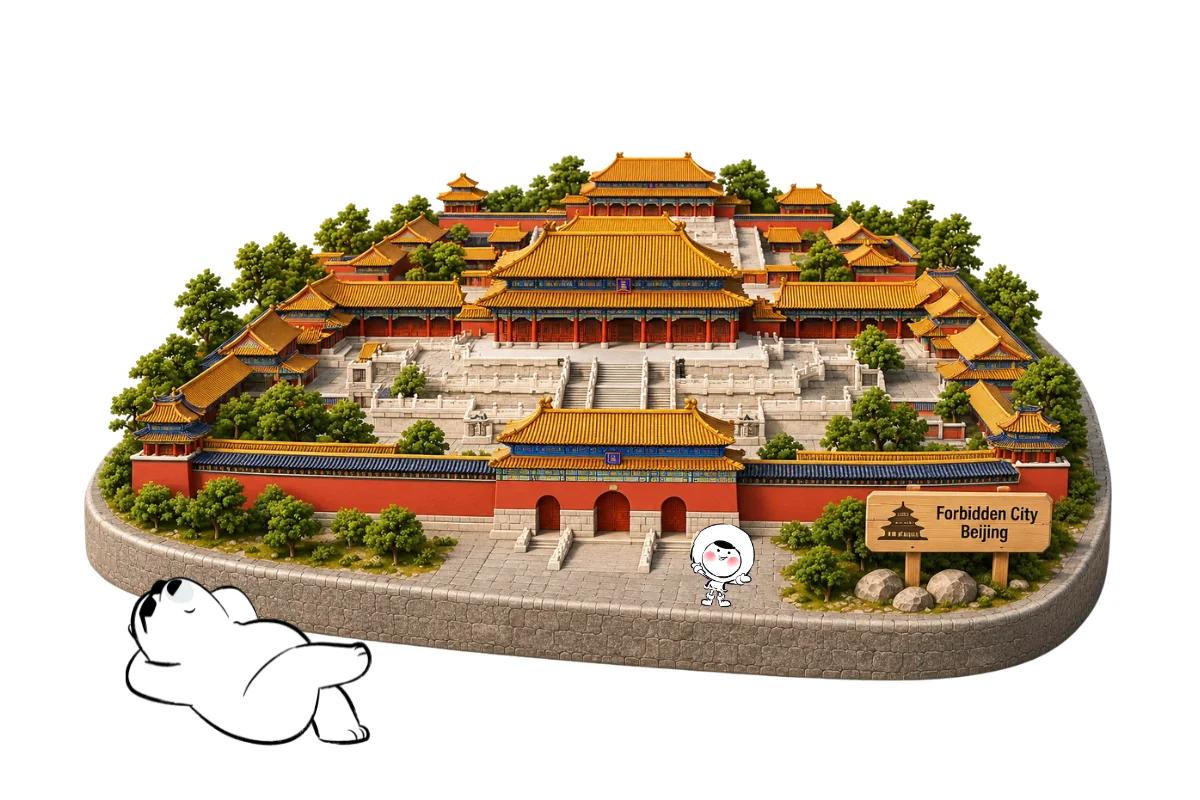
The Forbidden City in Beijing, China, is a former imperial palace that served as the home and ceremonial center of Chinese emperors for nearly 500 years. Today, it houses the Palace Museum, one of Beijing’s most important historical attractions and a UNESCO World Heritage Site.
Visitors should allow three to four hours to explore the main palace halls, courtyards and Imperial Garden. Standard admission is listed at CNY 60 from April to October and CNY 40 from November to March. Tickets should be reserved in advance through the Palace Museum’s official booking channels.
For first-time visitors, the most practical route is to enter through the Meridian Gate on the southern side, walk north through the main ceremonial halls and finish at the Gate of Divine Prowess near Jingshan Park.
Forbidden City Beijing at a Glance
- Location: Dongcheng District, central Beijing, China
- Chinese name: 故宫 (Gùgōng)
- Official museum: Palace Museum
- Construction: 1406–1420
- Imperial dynasties: Ming and Qing
- UNESCO status: World Heritage Site since 1987
- Peak-season admission: CNY 60
- Low-season admission: CNY 40
- Opening time: 8:30 AM
- Closing day: Generally Monday, except designated holidays
- Recommended visit: Three to four hours
- Main entrance: Meridian Gate, also called the South Gate
- Main exit: Gate of Divine Prowess, also called the North Gate
- Best time to visit: Weekday mornings in spring or autumn
The Palace Museum’s official visitor information is the reference for current admission prices, opening hours, ticket reservations and visitor arrangements.
Where the Forbidden City Is Located
The Forbidden City is located in central Beijing, immediately north of Tiananmen Square.
Its official address is:
4 Jingshanqian Street, Dongcheng District, Beijing, China.
The palace complex occupies approximately 72 hectares, surrounded by imposing red walls and a defensive moat.
Its location places it at the center of Beijing’s historic imperial city.
The Forbidden City is bordered by several important landmarks:
- South: Tiananmen Square and Tiananmen Gate
- North: Jingshan Park
- West: Zhongnanhai area and surrounding historic neighborhoods
- East: Central Beijing streets and traditional residential districts
The complex is arranged along a north-south axis, with its most important ceremonial buildings positioned in the central section.
Visitors generally move from south to north, following the same broad architectural sequence that once connected the imperial court’s principal spaces.
For travelers planning to explore more of the country, Eskimo’s one-month China travel itinerary provides ideas for combining Beijing with other destinations.
Forbidden City Tickets and Admission Prices
Forbidden City tickets are available through the Palace Museum’s official reservation channels.
Advance booking is strongly recommended. The museum’s normal ticketing arrangements require visitors to reserve admission before arriving, and travelers should not rely on purchasing tickets at the entrance.
Admission prices vary by season, and some galleries require additional tickets.
Peak-season ticket prices
April 1 to October 31
- Standard admission: CNY 60
- Treasure Gallery: Additional CNY 10
- Gallery of Clocks: Additional CNY 10
Low-season ticket prices
November 1 to March 31
- Standard admission: CNY 40
- Treasure Gallery: Additional CNY 10
- Gallery of Clocks: Additional CNY 10
These are the published standard admission prices. Check the official Palace Museum visitor information when selecting your visiting date, as prices, special exhibitions and access arrangements may change.
Discounted admission may be available for eligible students, children, seniors and other qualifying visitors.
Eligibility and documentation requirements depend on the applicable ticket policy.
Visitors should confirm their category before booking rather than assuming that a foreign student card or other document automatically qualifies for a discount.
Treasure Gallery and Gallery of Clocks
General admission covers the main palace complex, but two specialist exhibition areas normally require separate tickets.
The Treasure Gallery displays objects associated with imperial wealth and court life, including jewelry, decorative arts and ceremonial objects.
The Gallery of Clocks features historic timepieces, including elaborate mechanical clocks collected by the imperial court.
The published additional admission price is CNY 10 for each gallery.
Visitors interested in imperial craftsmanship may find these additions worthwhile, but they should allow extra time beyond the main sightseeing route.
Gallery access can be affected by exhibitions, conservation work or temporary closures.
How to book Forbidden City tickets
International visitors can arrange admission through the official Palace Museum international visitor website.
The Palace Museum also operates an official Chinese-language ticketing platform.
The usual reservation process involves:
- Opening an official Palace Museum booking channel.
- Selecting the intended visiting date.
- Choosing the appropriate admission category.
- Entering the required visitor information.
- Providing passport details where requested.
- Completing payment through an accepted method.
- Saving the reservation confirmation.
The exact interface, available payment methods and booking window can vary by channel.
Visitors should follow the instructions displayed by the official booking system rather than relying on a fixed reservation period.
Tickets may become difficult to obtain during weekends, Chinese public holidays and busy travel periods.
Booking as soon as your preferred date becomes available is advisable.
Passport and identification requirements
Foreign visitors should use their passport information when making a reservation if required by the booking platform.
Bring the original passport used for the booking on the day of your visit.
Beijing’s municipal government explains that international visitors can use the Palace Museum’s English-language booking service and may need to complete manual identification checks at the Meridian Gate.
The Beijing Municipal Government’s foreign-visitor ticketing guidance provides additional information about passport reservations and entry procedures.
Keep your electronic booking confirmation accessible, but do not assume that a screenshot can replace the identification document required for admission.
Forbidden City Opening Hours and Closing Days
The Forbidden City operates different schedules during the peak and low seasons.
The Palace Museum generally opens at 8:30 AM, while closing times vary by season.
Peak-season opening hours
April 1 to October 31
- Opens: 8:30 AM
- Last admission: 4:00 PM
- Closes: 5:00 PM
Low-season opening hours
November 1 to March 31
- Opens: 8:30 AM
- Last admission: 3:30 PM
- Closes: 4:30 PM
These are the museum’s published seasonal schedules.
Check the Palace Museum’s current visitor information for the date of your visit, particularly during national holidays or special events.
Visitors should enter well before the final admission time because the complex is extensive.
Arriving near closing time leaves insufficient time to explore the principal halls and gardens.
Monday closures
The Forbidden City is generally open from Tuesday to Sunday.
The Palace Museum normally closes on Mondays, although exceptions may apply during designated national holidays.
Temporary closures, special events and adjusted opening arrangements can also affect individual visiting dates.
For a standard Beijing itinerary, Tuesday through Sunday is the more reliable planning choice.
Best Time to Visit the Forbidden City
Spring and autumn generally offer the most comfortable conditions for exploring the Forbidden City.
Much of the sightseeing route passes through large outdoor courtyards with limited shade.
Spring for comfortable sightseeing
April and May usually bring milder temperatures and improving weather conditions.
These months are suitable for walking between the palace halls and photographing the complex.
However, popular attractions can become crowded during public holidays.
Autumn for clear skies and cooler weather
September and October are also popular months for visiting Beijing.
Autumn generally brings cooler temperatures and comfortable walking conditions.
The golden palace rooftops can look particularly striking against clear skies.
The National Day holiday period in early October is a major exception because visitor numbers can rise substantially.
Summer and winter conditions
Summer can be hot and humid, especially in the exposed ceremonial courtyards.
Carry water, use sun protection and allow time for breaks.
Winter is considerably colder, with temperatures frequently dropping below freezing.
Visitor numbers may be lower outside holiday periods, but shorter opening hours reduce available sightseeing time.
Weekdays and arrival times
Tuesday through Friday generally offer a better chance of avoiding the busiest weekend crowds.
Arriving close to the 8:30 AM opening time allows more flexibility for exploring the main halls.
However, even early visitors should expect security procedures and queues.
For photography, morning light can work well around the central courtyards, while quieter side passages may offer alternative perspectives later in the visit.
Forbidden City Map, Entrances and Exits
The Forbidden City’s normal visitor route runs from south to north.
This is one of the most important details to understand before arriving.
Visitors enter through the Meridian Gate on the southern side and leave through designated exits.
The Palace Museum’s official ticketing platform identifies the standard entrance and exit arrangements.
- Entrance: Meridian Gate, South Gate
- Exit: Gate of Divine Prowess, North Gate
- Alternative exit: East Prosperity Gate, East Gate
Visitors should follow the current museum signs and staff instructions, as security procedures or temporary restrictions can affect pedestrian routes.
Meridian Gate: Main entrance
The Meridian Gate, known as Wumen in Chinese, is the principal visitor entrance.
It stands at the southern end of the palace complex.
Visitors approach this entrance after passing through the surrounding public access and security areas.
The normal one-way visitor system means that arriving at the northern gate does not provide the standard route into the Forbidden City.
Gate of Divine Prowess: Main exit
The Gate of Divine Prowess, known as Shenwumen, is located at the northern end of the complex.
It is a convenient exit for travelers planning to visit Jingshan Park afterward.
Jingshan Park sits immediately north of the Forbidden City and offers elevated views across its rooftops.
East Prosperity Gate: Alternative exit
The East Prosperity Gate, known as Donghuamen, provides another designated exit under normal visitor arrangements.
It can be useful for travelers continuing toward streets and neighborhoods east of the palace complex.
Choose your exit according to your next destination and any instructions in effect on your visiting date.
Getting to the Forbidden City by subway
Beijing’s subway network is a convenient way to reach the surrounding Tiananmen area.
Useful stations include:
- Tiananmen East: Line 1
- Tiananmen West: Line 1
Both stations provide access to the wider Tiananmen area, from which visitors can continue toward the southern palace entrance.
The precise walking route may depend on current pedestrian access restrictions, station arrangements and security controls.
Follow official signs and directions rather than assuming that every approach to Tiananmen Square is open.
Allow additional time for security checks.
For subway payments, train travel and other transport options, Eskimo’s transportation guide to China covers practical arrangements for international travelers.
Getting there by taxi
Taxis and ride-hailing services are available throughout Beijing.
However, vehicles cannot necessarily stop directly outside the Meridian Gate because of pedestrian restrictions and security controls.
Ask to be dropped at an accessible point near the southern approach and continue on foot.
Show the driver the Chinese name:
故宫博物院 (Gùgōng Bówùyuàn)
Confirm the drop-off location in your navigation app before starting the journey.
What to See Inside the Forbidden City
The Forbidden City contains ceremonial halls, residential palaces, courtyards, gardens and museum collections.
The central route covers the most recognizable imperial buildings.
Visitors with additional time can explore selected side palaces and specialist galleries.
Hall of Supreme Harmony
Location: Central Outer Court Type: Imperial ceremonial hall Best for: Architecture and imperial history Entry: General admission Main highlight: The largest and most prominent ceremonial hall in the Forbidden City
The Hall of Supreme Harmony is one of the most recognizable structures in the Forbidden City.
It stands on an elevated white marble terrace overlooking an expansive courtyard.
The hall was used for major imperial ceremonies, including important events associated with the emperor’s authority.
Its scale reflects the central role of imperial power in traditional Chinese political life.
The building features elaborate wooden architecture, a golden-tiled roof and decorative details associated with imperial symbolism.
Visitors can appreciate the hall from the surrounding courtyard, although interior access is restricted.
The marble terraces and surrounding architecture provide some of the palace complex’s most recognizable photography opportunities.
Hall of Central Harmony
Location: Central Outer Court Type: Imperial ceremonial building Best for: Understanding palace rituals Entry: General admission Main highlight: Smaller ceremonial hall between the two major outer-court buildings
The Hall of Central Harmony stands between the Hall of Supreme Harmony and the Hall of Preserving Harmony.
It was associated with preparations for important imperial ceremonies.
Compared with the larger halls nearby, its smaller scale helps illustrate the different functions of buildings within the ceremonial complex.
The hall also contributes to the architectural symmetry of the central axis.
Hall of Preserving Harmony
Location: Northern Outer Court Type: Imperial ceremonial hall Best for: Architecture and historical context Entry: General admission Main highlight: Historic ceremonial building and carved marble ramp
The Hall of Preserving Harmony is the northernmost of the three principal halls in the Outer Court.
It served several ceremonial purposes during the Ming and Qing dynasties.
During the Qing dynasty, it was also associated with the final stage of the imperial civil service examinations.
Behind the hall, visitors can see an elaborate carved marble ramp featuring traditional imperial motifs.
This is one of the most impressive examples of stone carving within the Forbidden City.
Get Eskimo eSIM to stay connected globally
Need internet while travelling? Here's what we recommend:

Fixed data plans
- No speed reduction
- No expiry, keep your data forever
- Transfer data to anyone
- Personal hotspot


Palace of Heavenly Purity
Location: Inner Court Type: Imperial residential and administrative palace Best for: Understanding daily imperial life Entry: General admission Main highlight: Historic residence associated with Ming and Qing emperors
The Palace of Heavenly Purity stands within the Inner Court, where the imperial household conducted much of its private and administrative life.
It served as an imperial residence during the Ming dynasty and early Qing period.
Its role later changed as Qing emperors adopted different residential arrangements.
The palace helps visitors understand the distinction between the public ceremonial functions of the Outer Court and the more private activities of the Inner Court.
Hall of Union
Location: Central Inner Court Type: Imperial ceremonial building Best for: Court traditions and palace symbolism Entry: General admission Main highlight: Building associated with imperial authority and ceremonial objects
The Hall of Union lies between the Palace of Heavenly Purity and the Palace of Earthly Tranquility.
Its position reinforces the symmetry of the Inner Court.
The hall was associated with important imperial objects and court traditions.
It provides another example of how architecture and ceremonial meaning were closely connected in the palace complex.
Palace of Earthly Tranquility
Location: Northern Inner Court Type: Imperial residential and ceremonial building Best for: Qing dynasty court history Entry: General admission Main highlight: Imperial household traditions and ceremonial spaces
The Palace of Earthly Tranquility originally served as the empress’s residence during the Ming dynasty.
During the Qing dynasty, parts of the building were adapted for Manchu religious ceremonies and imperial wedding traditions.
Its changing functions reflect differences between Ming and Qing court practices.
The building forms the northern section of the Inner Court’s central palace sequence.
Imperial Garden
Location: Northern end of the Inner Court Type: Historic imperial garden Best for: Landscaping and a quieter sightseeing stop Entry: General admission Main highlight: Traditional pavilions, ancient trees and ornamental rock formations
The Imperial Garden offers a change of atmosphere after the formal ceremonial courtyards.
It contains landscaped paths, decorative rock formations, pavilions and mature trees.
The garden was designed for members of the imperial household rather than public recreation.
Its smaller spaces and intricate details contrast with the monumental architecture of the Outer Court.
Visitors following the main northbound route will encounter the garden shortly before reaching the northern exit.
Treasure Gallery
Location: Eastern palace complex Type: Specialist museum gallery Best for: Imperial jewelry and decorative arts Entry: Additional CNY 10 ticket Main highlight: Objects associated with imperial wealth and craftsmanship
The Treasure Gallery contains selected objects from the imperial collections.
Exhibits may include jewelry, precious materials and ceremonial objects.
The gallery occupies part of the Palace of Tranquil Longevity area.
It is a worthwhile addition for visitors particularly interested in Qing dynasty decorative arts.
Exhibition arrangements can change, so check which spaces are open on your visiting date.
Gallery of Clocks
Location: Eastern palace complex Type: Specialist museum gallery Best for: Historic technology and craftsmanship Entry: Additional CNY 10 ticket Main highlight: Elaborate mechanical clocks from the imperial collections
The Gallery of Clocks displays historic timepieces associated with the Qing imperial court.
Its collections include clocks made in China and abroad.
Many examples combine intricate mechanical engineering with decorative craftsmanship.
Visitors interested in the relationship between technology, trade and imperial collecting may find this gallery especially rewarding.
Allow additional time if including both specialist galleries in your itinerary.
A Practical Three-Hour Forbidden City Route
A three-hour visit provides enough time to see the main ceremonial halls and central Inner Court without exploring every side palace.
The route below follows the museum’s south-to-north visitor arrangement.
First 30 minutes: Meridian Gate and the opening courtyards
Enter through the Meridian Gate.
Continue into the large southern courtyards and observe the scale of the palace complex.
The broad stone pathways and surrounding architecture establish the formal layout of the imperial city.
Allow time for photographs before moving toward the central halls.
Next 45 minutes: Three major halls of the Outer Court
Visit the Hall of Supreme Harmony, Hall of Central Harmony and Hall of Preserving Harmony.
These buildings formed the ceremonial center of imperial government.
Spend time examining their rooftops, marble terraces and architectural details.
The central courtyards are often among the busiest parts of the museum.
Next 40 minutes: Inner Court palaces
Continue north toward the Palace of Heavenly Purity.
Explore the Hall of Union and Palace of Earthly Tranquility.
This section reveals how the palace complex transitioned from ceremonial spaces to the imperial household’s residential and administrative areas.
Next 35 minutes: Imperial Garden
Walk through the Imperial Garden.
Explore its pavilions, ornamental stones and historic trees.
The garden provides a more intimate setting than the large ceremonial courtyards.
Final 30 minutes: Northern exit and surrounding views
Continue toward the Gate of Divine Prowess.
Visitors can leave the museum and proceed toward Jingshan Park if time and energy allow.
The park’s elevated viewpoint offers a broad perspective over the Forbidden City’s symmetrical rooftops.
Allow four to five hours if you intend to visit the Treasure Gallery, Gallery of Clocks or additional side palaces.
Forbidden City History and Imperial Significance
Construction of the Forbidden City began in 1406 during the reign of the Yongle Emperor.
The principal palace complex was completed in 1420.
It became the imperial residence and political center of the Ming dynasty after the imperial capital was established in Beijing.
The Forbidden City subsequently served the Qing dynasty until the end of imperial rule in 1912.
The meaning behind the name
The name Forbidden City reflects the strict access restrictions that historically surrounded the imperial palace.
Ordinary residents could not enter freely.
Access was controlled according to court hierarchy, official responsibilities and imperial permission.
The complex functioned as both the emperor’s residence and the center of imperial government.
The Ming and Qing dynasties
The Forbidden City housed 24 emperors across the Ming and Qing dynasties.
During these centuries, the palace complex witnessed major political ceremonies, court administration and changes in imperial leadership.
The final Qing emperor, Puyi, abdicated in 1912.
Although imperial rule ended, the palace continued to hold enormous historical and cultural significance.
The establishment of the Palace Museum
The Palace Museum was established in 1925.
Its creation transformed the former imperial residence into a public cultural institution.
Today, the museum preserves historic architecture and extensive collections associated with China’s imperial past.
The complex became a UNESCO World Heritage Site in 1987 as part of the Imperial Palaces of the Ming and Qing Dynasties designation.
UNESCO’s World Heritage listing recognizes the exceptional cultural and architectural importance of these imperial palaces.
Forbidden City Architecture and Interesting Facts
The Forbidden City is one of the most important surviving examples of traditional Chinese imperial palace architecture.
Its design reflects political hierarchy, cosmological beliefs and the ceremonial requirements of imperial government.
The significance of the central axis
The palace buildings follow a carefully organized north-south axis.
Major ceremonial halls occupy prominent positions along this route.
The arrangement emphasizes symmetry, order and imperial authority.
The Forbidden City’s central alignment also forms part of Beijing’s wider historic urban layout.
Red walls and golden rooftops
Red walls and yellow-glazed roof tiles are among the Forbidden City’s most recognizable features.
Yellow was closely associated with imperial authority.
The extensive use of these colors helped distinguish the palace from ordinary residential architecture.
Decorative roof figures, painted beams and carved stone details further reinforce the complex’s imperial character.
The importance of courtyards
Large courtyards separate many of the principal palace halls.
These spaces provided room for ceremonies, processions and the movement of officials.
They also create dramatic views of the surrounding buildings.
The scale of the courtyards is a reminder that the Forbidden City functioned as a major administrative and ceremonial complex, not simply a royal residence.
The palace’s defensive features
The Forbidden City is surrounded by high walls and a moat.
Corner towers stand at the four corners of the enclosure.
These structures formed part of the palace’s controlled boundaries.
They also contribute to the complex’s distinctive appearance.
The palace contains far more than its central halls
The main visitor route covers only part of the Forbidden City.
Beyond the central axis are residential courtyards, specialist exhibition spaces and historic buildings associated with different members of the imperial household.
Some areas may be closed for conservation or exhibition preparation.
Visitors interested in architecture or museum collections can spend considerably longer than the standard three-hour itinerary.
Forbidden City Visiting Tips
A few practical preparations can make a significant difference to your visit.
Reserve tickets before arriving
Reserve admission through an official Palace Museum channel before traveling to the entrance.
Do not assume that same-day admission will be available.
The museum’s reservation rules and ticket-release arrangements should be checked for your intended visiting date.
Carry your original passport
International visitors should bring the original identification document used during their reservation.
A photograph or digital copy may not be accepted as a substitute during identity checks.
Allow time for security procedures
Security checks are common around major attractions in central Beijing.
Arrive with enough time to complete the necessary checks before entering the museum.
Avoid bringing prohibited items.
Wear comfortable walking shoes
The Forbidden City covers a large area.
Visitors should expect extensive walking across stone pathways, courtyards and historic surfaces.
Comfortable footwear is particularly useful during summer and winter.
Prepare for the weather
Many palace courtyards have limited shade.
During summer, bring water, sunscreen and suitable clothing.
In winter, wear warm layers and prepare for cold winds across the open courtyards.
Download useful travel apps
Mobile payment, navigation and translation apps can be particularly helpful in Beijing.
Amap is widely used for local navigation.
Alipay and WeChat Pay support many everyday payments, while DiDi is useful for arranging transport.
Set up essential services before traveling.
Eskimo’s apps to download before traveling to China covers useful tools for navigation, transport and payments.
Plan for accessibility
The Forbidden City contains broad courtyards, but some historic buildings have raised platforms, steps and uneven surfaces.
Accessibility arrangements vary between different parts of the complex.
Visitors using wheelchairs or mobility aids should consult the Palace Museum’s official visitor services before arrival.
Respect preservation restrictions
The Forbidden City is a protected historic site.
Follow museum instructions regarding restricted areas, photography and access to historic buildings.
Do not climb barriers or touch protected objects.
Some galleries may have additional photography restrictions.
Nearby Beijing Attractions
The Forbidden City’s central location makes it convenient to combine with other historic attractions.
However, travelers should allow enough time for security procedures, walking distances and separate admission requirements.
Tiananmen Square
Tiananmen Square is located immediately south of the Forbidden City.
It is one of Beijing’s most recognizable public spaces.
The square is associated with major events in China’s modern history and contains several important national landmarks.
Access procedures and reservation requirements can change.
Check official visitor information before planning a combined visit.
Jingshan Park
Jingshan Park lies immediately north of the Forbidden City.
Its elevated central hill provides one of the best-known panoramic views of the palace complex.
From the viewpoint, visitors can appreciate the symmetry of the Forbidden City’s rooftops and courtyards.
Jingshan Park is particularly convenient after leaving through the Gate of Divine Prowess.
Separate park admission may apply.
Temple of Heaven
The Temple of Heaven is another major imperial ceremonial complex in Beijing.
Located south of the Forbidden City, it was used by emperors for ceremonies associated with heaven and agricultural prosperity.
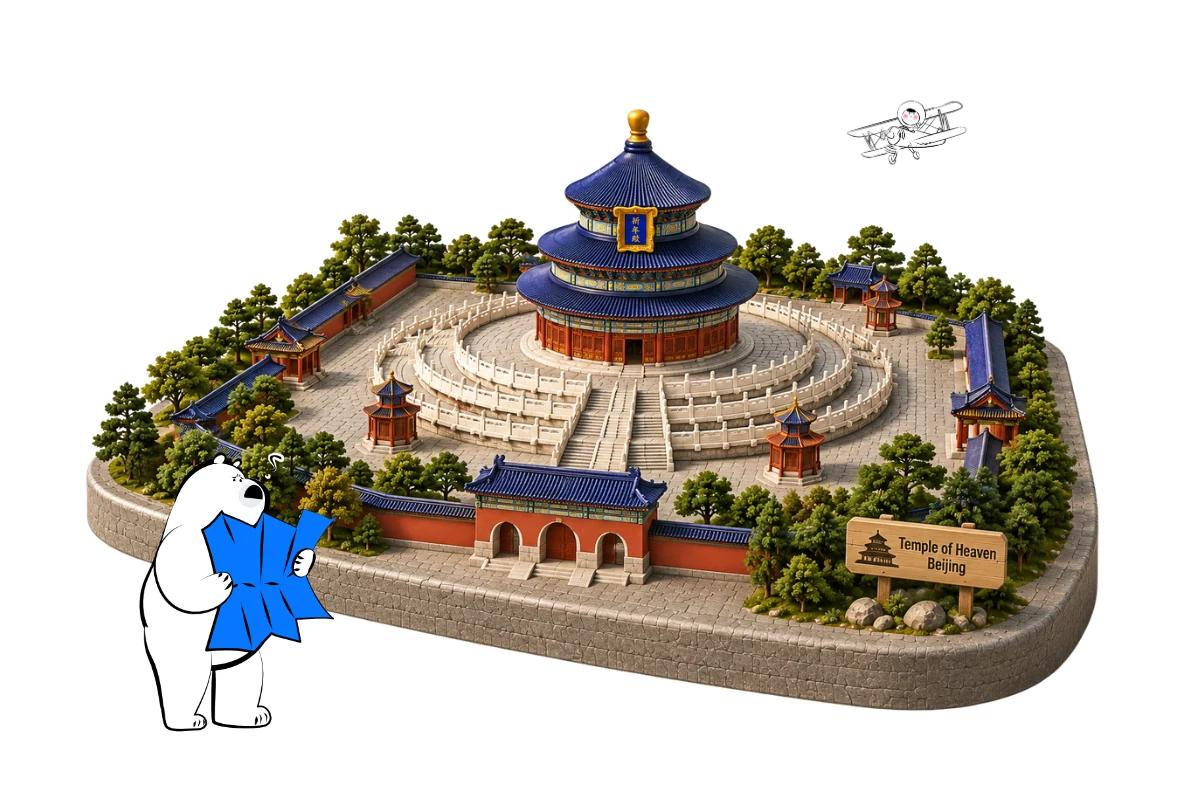
Its blue-roofed Hall of Prayer for Good Harvests provides a striking architectural contrast with the Forbidden City’s golden rooftops.
Allow approximately two to three hours for a visit.
Beihai Park
Beihai Park lies northwest of the Forbidden City.
It features a large lake, landscaped gardens, historic structures and the distinctive White Dagoba.
The park offers a quieter alternative to Beijing’s major palace attractions.
It can be a pleasant addition to a longer stay in the capital.
Mobile Data for Visiting Beijing
Mobile data is useful when visiting the Forbidden City because travelers may need to retrieve Palace Museum reservations, navigate the Tiananmen area, arrange ride-hailing pickups and translate Chinese signs. Coverage is generally stronger across central Beijing and major transport routes, although reception may weaken in underground stations, enclosed buildings and crowded indoor spaces. Save your booking confirmation and the museum’s Chinese name before leaving your hotel.
An Eskimo China eSIM plan provides a mobile-data option for travelers exploring Beijing and other Chinese cities. Eskimo’s overall coverage extends across 175 countries and regions, which is useful for international travelers planning stopovers or future trips to other eligible destinations. With no-expiry fixed data, unused data can remain available for a later journey instead of needing to be consumed during a short Beijing visit.
New users can also claim a free 250MB Global eSIM.
FAQs:
How much does it cost to visit the Forbidden City in Beijing?
The Palace Museum’s published standard admission is CNY 60 from April to October and CNY 40 from November to March. The Treasure Gallery and Gallery of Clocks normally require an additional CNY 10 ticket each. Confirm current prices and gallery availability through the official booking system.
How long does it take to visit the Forbidden City?
Allow three to four hours for the main palace halls, courtyards and Imperial Garden. A shorter visit of approximately two hours is possible, while travelers exploring additional galleries and side palaces may need four to five hours or longer.
Can foreigners buy Forbidden City tickets online?
Yes. Foreign visitors can normally reserve admission through the Palace Museum’s official international booking service using their passport information. Bring the original passport used for the reservation and follow the designated identification procedures at the Meridian Gate.
Is the Forbidden City open on Mondays?
The Palace Museum is generally closed on Mondays, except during designated national holidays or special opening arrangements. Check the museum’s current calendar before choosing your visiting date.
Which entrance should visitors use for the Forbidden City?
Visitors normally enter through the Meridian Gate on the southern side of the Forbidden City. The standard sightseeing route runs from south to north, with exits at the Gate of Divine Prowess or East Prosperity Gate, subject to current museum arrangements.