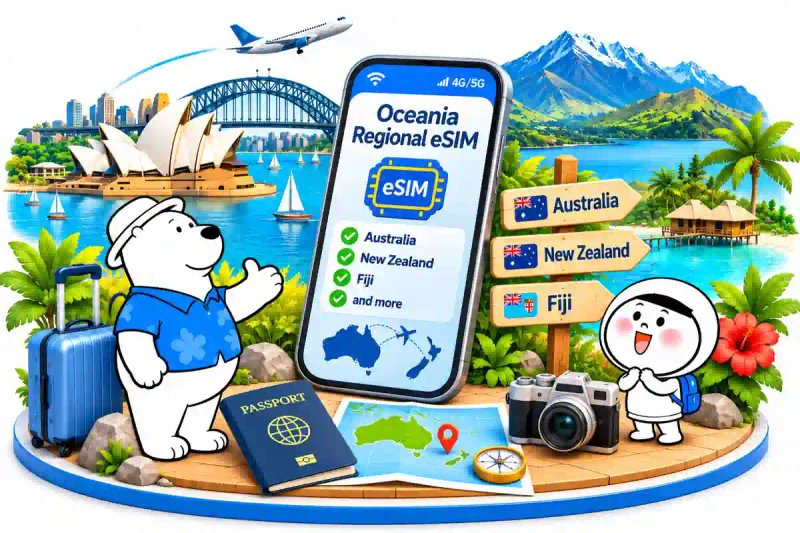
The best regional eSIM for Oceania is one that explicitly includes every destination on your itinerary, not simply a plan advertised as Pacific-wide. For Australia, New Zealand and Fiji, compare the coverage list, data allowance and device requirements before buying. Remote islands and open-water crossings may have limited reception.

Best Regional eSIM for Oceania: What to Check
A regional eSIM can be convenient for a multi-country trip, but the word "Oceania" does not guarantee service throughout the South Pacific. The destination list of the specific plan is more important than its regional name. A South Pacific eSIM may cover several islands or only selected stops.
Before paying, check:
- Included destinations: Confirm Australia, New Zealand, Fiji and every additional country or territory on your route individually.
- Local reception: Examine partner-network coverage for the places you will actually visit, including rural roads and outer islands.
- Phone compatibility: Your exact handset model must support eSIM and be carrier-unlocked.
- Plan allowance: Compare fixed data, any fair-use threshold and what happens when your allowance runs out.
- Activation rules: Check whether validity begins at purchase, installation, first connection or another specified event.
- Hotspot and calls: Verify tethering rules and whether the plan is data-only or includes voice and SMS.
A guide to eSIM device compatibility can help you check regional handset differences before buying a travel plan.
Comparing Mobile Data Options Across Oceania
A multi-country eSIM reduces the need to purchase separate plans after every flight, but it is not automatically the cheapest option. For longer stays in one destination, local prepaid service or an existing carrier roaming package may offer better value.
| Option | Best Fit | Main Advantage | What to verify |
| Regional travel eSIM | Two or more included destinations | One digital profile for eligible countries | Exact country list, data allowance and partner coverage |
| Country-specific eSIM or SIM | Longer stay in one country | Potentially better local pricing or allowance | Registration, compatibility and local terms |
| Home-carrier roaming | Short visits with a suitable home plan | Keeps existing service arrangements | Daily fees, included destinations and limits |
| Pocket Wi-Fi | Groups sharing a connection | Multiple devices can connect | Rental, charging, pickup and route coverage |
A regional eSIM can be a strong fit for a trans-Tasman holiday followed by Fiji, while a country plan may be simpler for two weeks entirely in Australia. Compare the total trip cost, not only the advertised price per gigabyte.
Australia, New Zealand and Fiji: Coverage Differences
An Australia, New Zealand and Fiji eSIM itinerary combines three distinct mobile markets. Even if one regional package lists all three countries, network availability can change sharply between a city, a mountain valley and a small island.
Australia: Cities, highways and the Outback
Coverage is generally more accessible in major cities and populated areas than in remote inland regions. Before a long drive, compare provider maps and download navigation data; the Australian government's mobile coverage guidance explains why national population coverage does not equal blanket geographic coverage.
New Zealand: Mountain routes and rural stops
Auckland and Wellington are different connectivity environments from remote South Island valleys and hiking areas. Download offline maps for remote routes, and check accommodation contact details in advance if you are heading into the mountains.
Fiji: Main islands and boat transfers
Check service separately for Viti Levu, Vanua Levu and any smaller islands in your itinerary. A plan that works in Nadi or Suva may not provide usable data throughout the Mamanuca or Yasawa islands, and mobile coverage should not be assumed while at sea.
If your trip continues to Samoa, Tonga, Vanuatu or other Pacific destinations, do not treat them as included simply because a plan covers Fiji. Check each destination against the current regional-plan list before checkout.
How to Find the Best-Value Oceania eSIM in 2026
The cheapest prepaid eSIM for Oceania depends on the countries included, the amount of usable data and the length of your journey. A low price is poor value if the plan excludes your final island or if your regular home line generates unexpected charges.
Compare costs in this order:
- Map your route. List every destination, including transit stops where you need mobile data.
- Compare full prices. Add the cost of any separate country plans, roaming passes or Wi-Fi rentals.
- Calculate usable value. Divide the total plan price by the data allowance you realistically expect to use, not by an unlimited headline that has a speed threshold.
- Check conditions. Review plan expiry, refill options, hotspot rules and any applicable taxes or fees.
- Keep a fallback. Save flight bookings and the address of your next accommodation offline before moving between islands.
For light use, a smaller prepaid allowance may cover messaging, navigation and booking checks. Video calls, streaming, large uploads and repeated hotspot use require more data. Do not rely on a claimed 5G speed unless the selected plan and local network explicitly support it in your destination.
Get Eskimo eSIM to stay connected globally
Need internet while travelling? Here's what we recommend:

Fixed data plans
- No speed reduction
- No expiry, keep your data forever
- Transfer data to anyone
- Personal hotspot


How to Activate a Regional eSIM for South Pacific Travel
Install the eSIM using a reliable internet connection before departure when the provider permits it. Regional eSIM activation involves separate profile-installation and network-connection stages, and timing rules vary between plans.
Step 1: Check and install the eSIM
Confirm that your device supports eSIM and is not locked to your home carrier. Follow the provider's app instructions, scan its QR code or enter the supplied activation information over Wi-Fi. Avoid deleting the profile if installation appears incomplete.
Step 2: Select the correct data line
Set the travel eSIM as the mobile-data line when you want to use it abroad. If you keep your home SIM active for calls or verification messages, review its roaming fees and disable automatic data switching where appropriate.
Step 3: Follow the travel plan's roaming instructions
Some travel eSIMs need data roaming enabled on the travel eSIM line to connect to partner networks. This is different from enabling roaming on your home SIM, which may incur charges. Apple's international travel eSIM instructions explain the dual-SIM distinction.
Step 4: Test service at each destination
After landing, confirm that the eSIM is active, selected for mobile data and connected to a supported network. If there is no service, briefly toggle airplane mode and check the plan's destination list before changing network settings.
For device-specific menus, follow Eskimo's Android eSIM installation instructions or iPhone eSIM setup guidance.
Oceania eSIM Tips for Island-Hopping Trips
Island-hopping requires more preparation than moving between cities because reception may disappear on ferries and in sparsely populated coastal areas. A mobile plan is a useful tool, not a substitute for offline travel documents or local safety arrangements.
- Download routes before departure: Save driving maps, ferry meeting points and hotel addresses while you have reliable Wi-Fi.
- Confirm boat operators directly: Departure points and times may change with weather, and your phone may have no usable signal at sea.
- Restrict background usage: Pause automatic photo backups and app updates if you have a limited allowance.
- Keep bank verification accessible: A data-only eSIM does not automatically give you a local phone number or SMS service.
- Prepare for emergencies: Do not count on a travel data eSIM as your only means of contacting emergency services in remote areas.
Choosing an Eskimo eSIM for Oceania
Mobile data helps with airport transfers in Sydney, campervan navigation in New Zealand, and ferry confirmations in Fiji. Reception is generally stronger near towns and main transport corridors, but it can weaken in the Australian Outback, remote mountain valleys and smaller Pacific islands. Save critical documents offline before longer journeys.
An Eskimo Asia Pacific eSIM plan is an option for eligible multi-country itineraries. Eskimo's overall network footprint extends across 175 countries and regions, useful for travelers continuing through Asia or other supported destinations, although each individual plan has its own coverage list. No-expiry fixed data lets unused allowance remain available for a later eligible trip instead of forcing travelers to use it during one holiday.
New users can also claim a free 500MB Global eSIM.
Frequently Asked Questions
Does one regional eSIM work in Australia, New Zealand and Fiji?
It can, if the exact plan includes all three. Eskimo currently displays an Asia Pacific option on its Australia, New Zealand and Fiji plan pages, but check the selected plan's latest destination list before purchasing.
Does an Oceania eSIM cover every Pacific island?
No. Oceania is a geographic region, not a standard coverage list. Samoa, Tonga, Vanuatu and other destinations must each be verified against the chosen plan.
Can I keep receiving bank verification texts on my home number?
Usually, if your phone supports the required dual-SIM configuration and your home carrier permits service abroad. The home carrier may still charge for some activities, so review its roaming terms.
Will my regional eSIM connect automatically after landing?
It may register with a partner network when the line is enabled and the destination is covered. Automatic connection is not guaranteed, and the first connection may require the provider's roaming settings.
Can I use a travel eSIM while island hopping by boat?
Only where a supported mobile network has usable reception. Connectivity can be weak or unavailable offshore, so download tickets and essential maps before boarding.
Conclusion
The best regional eSIM for Oceania is the one that covers your actual stops, not the one with the broadest regional label. For an Australia, New Zealand and Fiji itinerary, check each destination, compare the total cost against local SIMs and home roaming, and confirm your phone supports the chosen plan.
Install the eSIM before departure when allowed, use the correct data-line settings, and save transport details offline. For more remote Pacific islands, treat mobile coverage as uncertain and prepare an alternative communication plan.