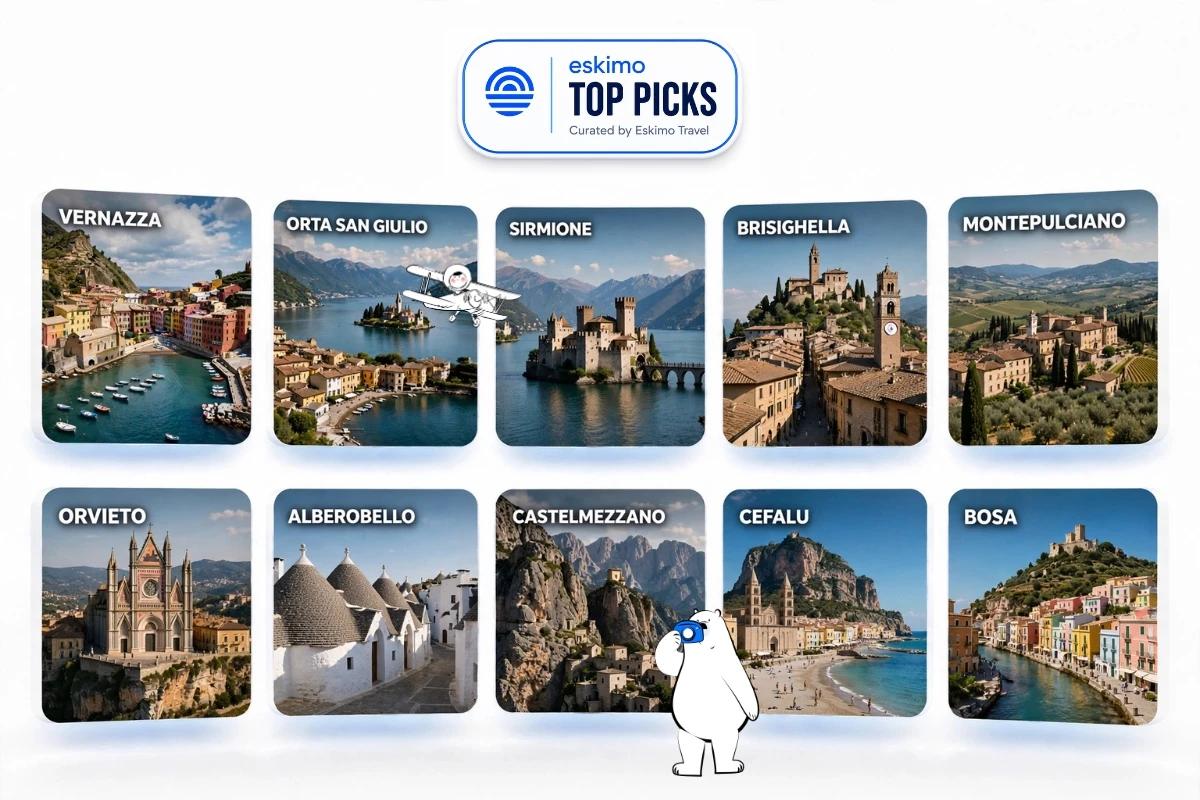
The best small towns in Italy reveal a quieter side of the country, with medieval lanes, lakeside promenades, mountain scenery, regional food, and historic centres that can often be explored on foot. Vernazza, Orta San Giulio, Brisighella, Montepulciano, Orvieto, Sirmione, Alberobello, Castelmezzano, Cefalù, and Bosa offer an especially varied introduction.
Some work well as day trips from major cities, while others deserve an overnight stay. Transport is the main practical consideration because several hill towns and rural villages require a regional train followed by a bus, funicular, ferry, or short drive.
Vernazza, Liguria
Vernazza is one of the five Cinque Terre villages, with pastel houses clustered around a compact harbour. The steep lanes, sea views, and surrounding vineyard terraces make it one of the most recognisable coastal towns in Italy.
The village suits travelers who enjoy walking, photography, and coastal scenery. Arriving by train is generally easier than driving because parking is limited and the historic centre is largely pedestrianised.
Trenitalia’s seasonal Cinque Terre Express serves Vernazza and the other Cinque Terre villages between La Spezia and Levanto. Service frequency and operating periods can change, so check the latest timetable before traveling.
Best for: Coastal walks and harbour views Best time: Late spring or early autumn Suggested stay: One night or a full-day visit
Orta San Giulio, Piedmont
Orta San Giulio sits beside Lake Orta in northern Italy, centred on the elegant Piazza Motta. Boats connect the waterfront with Isola San Giulio, a tiny island dominated by its basilica and historic buildings.
The town feels more intimate than the busiest Lake Como destinations. Its arcaded square, narrow lanes, and wooded surroundings make it a strong choice for couples and travelers looking for a slower lakeside stop.
Public transport usually involves a train to Orta-Miasino followed by a local connection or walk, depending on luggage and mobility.
Best for: Lakeside scenery and quiet evenings Best time: May to June or September Suggested stay: One or two nights
Sirmione, Lombardy
Sirmione occupies a narrow peninsula extending into Lake Garda. Visitors enter its historic centre through the fortified Scaligero Castle before reaching stone lanes, waterfront viewpoints, thermal spas, and the archaeological site known as the Grotte di Catullo.
It is one of the most popular small towns in northern Italy, so timing matters. Early mornings and evenings are calmer than the middle of the day, especially during summer.
Sirmione does not have its own railway station. Most travelers arrive by bus, ferry, or taxi from nearby stations such as Desenzano del Garda-Sirmione or Peschiera del Garda.
Best for: Lake views, history, and thermal spas Best time: April to June or September Suggested stay: One night or a day trip
Brisighella, Emilia-Romagna
Brisighella is a medieval town below three prominent hills crowned by a clock tower, fortress, and sanctuary. Its most distinctive street is the covered Via degli Asini, once used by merchants transporting gypsum by donkey.
The surrounding landscape contains vineyards and olive groves, giving the town a strong connection to Emilia-Romagna’s food culture. It is compact enough for a relaxed day visit but rewards an overnight stay after day-trippers leave.
Brisighella has a railway station on the route between Faenza and Florence, although engineering works or timetable changes may affect individual journeys.
Best for: Medieval architecture and regional food Best time: Spring or early autumn Suggested stay: One night
Montepulciano, Tuscany
Montepulciano rises above the Tuscan countryside near the Val d’Orcia. Renaissance palaces, wine cellars, steep stone streets, and views across vineyards give it the classic character associated with Italian hill towns.
Piazza Grande forms the historic centre’s focal point. The town is also closely associated with Vino Nobile di Montepulciano, which can be sampled at local cellars and enotecas.
The railway station named Montepulciano lies outside the hill town, so visitors generally need a bus, taxi, or car for the final part of the journey. Drivers should check parking locations and restricted-traffic zones before entering the centre.
Best for: Tuscan scenery, wine, and architecture Best time: May, June, September, or October Suggested stay: Two nights
Orvieto, Umbria
Orvieto stands on a volcanic tuff plateau above the Umbrian countryside. Its striped Gothic cathedral is the main landmark, but underground caves, medieval streets, wells, and panoramic viewpoints add enough depth for a full day or overnight visit.
The town is one of the most accessible countryside stops from Rome. Regional trains reach the lower station, where a funicular continues toward the historic centre. Trenitalia lists Orvieto among its combined rail connections for Italian historic towns.
Its compact centre and direct rail access make Orvieto a practical introduction to Italy off the beaten path without requiring a car.
Best for: Architecture, history, and an easy rail trip Best time: April to June or September to October Suggested stay: One night or a day trip from Rome
Alberobello, Puglia
Alberobello is known for its trulli, whitewashed dry-stone buildings topped with conical roofs. More than 1,500 stand across the town, and the trulli district has been recognised by UNESCO since 1996.
Rione Monti contains the largest concentration, while Aia Piccola retains a quieter residential feel. The historic centre is compact and easy to explore on foot, although its most famous streets can become crowded during summer afternoons.
The official Italia.it Alberobello overview provides useful background on the town’s districts, architecture, and local food.
Best for: Unusual architecture and Puglian culture Best time: April to June or September Suggested stay: One night
Get Eskimo eSIM to stay connected in Italy
Need internet in Italy? Here's what we recommend:

Fixed data plans
- No speed reduction
- No expiry, keep your data forever
- Transfer data to anyone
- Personal hotspot
Unlimited data plans
- Unlimited day pass
- Daily 3GB high-speed + 1Mbps unlimited after
- Personal hotspot


Castelmezzano, Basilicata
Castelmezzano is built beneath the jagged peaks of the Lucanian Dolomites in southern Italy. Stone houses appear to climb into the mountains, while narrow lanes lead to viewpoints over the Basento Valley.
The town suits active travelers and anyone looking for dramatic scenery away from Italy’s established city routes. Hiking trails connect the surrounding landscape, while seasonal adventure activities may operate under weather-dependent schedules.
Public transport is limited compared with larger destinations. A car is usually the most practical option, but mountain roads require additional time and careful driving.
Best for: Mountain landscapes and outdoor activities Best time: May to June or September Suggested stay: One or two nights
Cefalù, Sicily
Cefalù combines a sandy beach with a dense medieval centre on Sicily’s northern coast. Its Norman cathedral dominates the main square, while La Rocca rises behind the town and offers elevated views for travelers prepared for the climb.
The beach and historic centre sit close together, making Cefalù easy to explore without a car. Direct rail services from Palermo make it one of the more accessible best towns in southern Italy.
Trenitalia includes Cefalù among the historic towns promoted through its regional rail network.
Best for: Beach time, architecture, and Sicilian food Best time: May to June or September Suggested stay: Two nights
Bosa, Sardinia
Bosa lies beside the Temo River on Sardinia’s western side. Colourful houses climb toward the hilltop Malaspina Castle, while palm-lined riverbanks and stone streets give the town a character unlike Sardinia’s better-known resort areas.
The historic centre is compact, but reaching Bosa generally requires a bus or car because the town is not connected to Sardinia’s main passenger rail network. The coastal road from Alghero is scenic but winding.
Bosa is a good match for travelers building a slower western Sardinia itinerary around local food, beaches, and small communities.
Best for: Colourful streets and a quieter Sardinian base Best time: May, June, or September Suggested stay: Two nights
Planning A Small-Town Italy Trip
A balanced route should combine towns that fit naturally into the same region rather than attempting to cover all ten in one holiday.
Useful combinations include:
- Northern Italy: Orta San Giulio, Sirmione, and Vernazza
- Central Italy: Brisighella, Montepulciano, and Orvieto
- Southern Italy: Alberobello and Castelmezzano
- Island extension: Cefalù in Sicily or Bosa in Sardinia
Regional trains serve many Italian towns, while Trenitalia also operates integrated train, bus, ferry, and funicular connections to places beyond the main rail network. Check the Trenitalia regional connections before finalising each journey.
Travelers combining smaller destinations with Rome, Florence, Venice, or Milan can use a 10-day Italy itinerary as a starting point. It is also worth checking Italy’s public holidays, when transport, shops, attractions, and accommodation demand may differ from normal schedules.
Mobile Data Around Italy’s Small Towns
Mobile data helps with regional train tickets, bus timetables, restricted-traffic zones, restaurant reservations, and navigation through historic centres. Coverage is generally stronger within towns and along main roads, while reception may weaken on mountain routes, rural roads, coastal trails, and inside thick stone buildings.
An Eskimo Italy eSIM plan can be installed before arrival. Eskimo’s coverage across 175 countries and regions is useful for travelers continuing into Switzerland, France, Slovenia, or another European destination, while no-expiry fixed data can remain available for a later trip if the full allowance is not used in Italy.
New users can also claim free 500MB of Global Data.
FAQs
What are the best small towns in Italy for a first visit?
Orvieto, Alberobello, Cefalù, Sirmione, and Vernazza are strong first choices because they combine distinctive scenery with established visitor services and relatively practical transport.
Which small towns in Italy are easiest to reach by train?
Vernazza, Brisighella, Orvieto, and Cefalù have useful rail connections. Sirmione, Montepulciano, Castelmezzano, and Bosa usually require an additional bus, taxi, ferry, funicular, or car journey.
What is the best time to visit small towns in Italy?
Late spring and early autumn generally offer comfortable weather and fewer crowds than July and August. Mountain destinations may be cooler, while coastal towns can remain busy into September.
Can you visit Italy’s small towns without a car?
Yes, especially along major rail routes. A car becomes more useful for rural Tuscany, Basilicata, inland Sardinia, and itineraries involving several villages with limited public transport.
How many days should you spend in a small Italian town?
One night is enough for compact towns such as Orvieto or Brisighella. Two nights are better for coastal, lakeside, or countryside destinations where the surrounding area is part of the appeal.