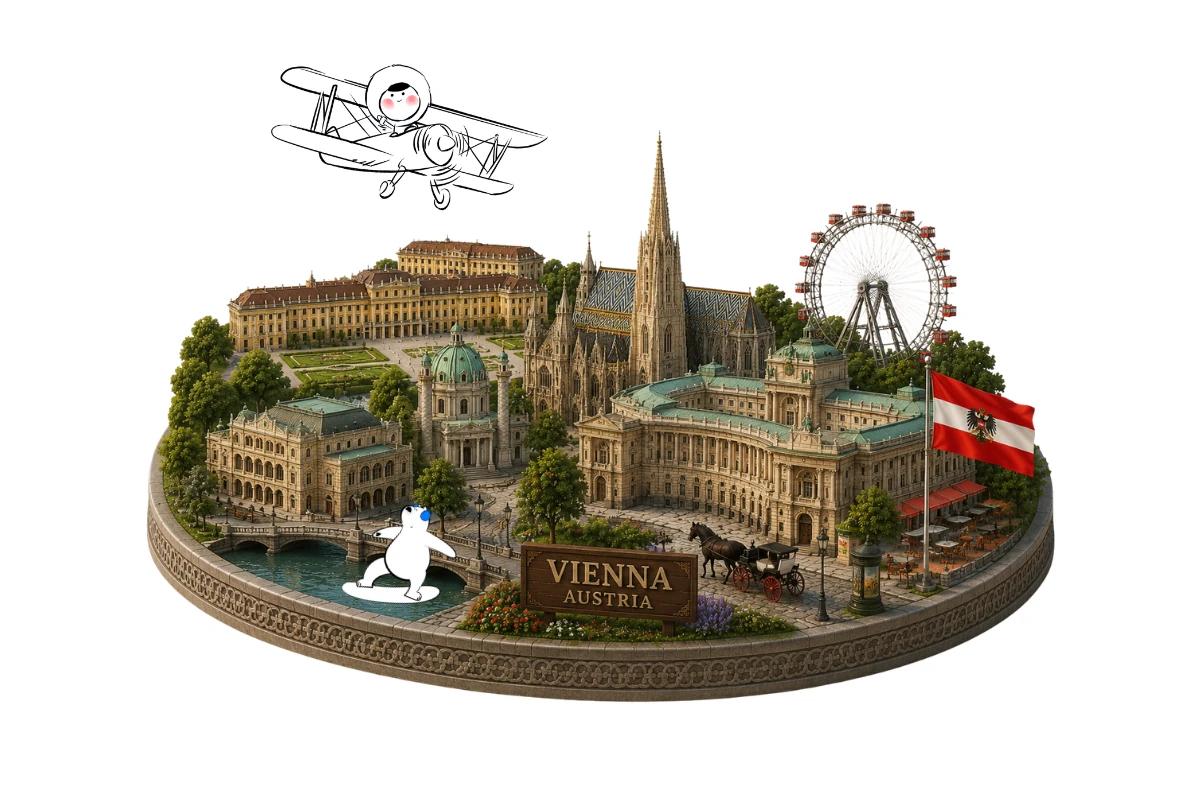
The best things to do in Vienna include exploring Schönbrunn Palace, walking through the historic centre, seeing Gustav Klimt’s art at the Belvedere, visiting the Hofburg, relaxing in a traditional coffeehouse, and riding the Giant Ferris Wheel at Prater.
Vienna is especially rewarding for first-time visitors because many of its main attractions are connected by an efficient public transport network. Its imperial landmarks, museums, markets, parks, and café culture can comfortably fill three or four days without making the trip feel rushed.
Whether you are deciding what to do in Vienna for a weekend or planning a longer Austria itinerary, these are the experiences most worth prioritising.
Best Things to Do in Vienna
Explore Schönbrunn Palace and its gardens
Schönbrunn Palace is one of the most important Vienna attractions and the best place to understand the scale of the Habsburg monarchy.
Visitors can tour richly decorated state rooms, walk through formal gardens, and climb towards the Gloriette for a broad view over the palace grounds and city. The wider estate also includes fountains, woodland paths, a maze, and Vienna Zoo.
Allow at least half a day if you want to explore both the palace interior and gardens. Interior visits use timed admission, so reserving a ticket ahead is sensible during weekends and peak travel periods.
The palace is easily reached on the U4 subway line, making it convenient to visit without joining an organised tour. Vienna’s official tourism board lists Schönbrunn among the city’s essential sights. (vienna.info)
Walk through Vienna’s historic centre
Vienna’s historic centre, known as the Innere Stadt or First District, contains many of the city’s most recognisable streets and landmarks.
Start around Stephansplatz before walking towards Graben, Kohlmarkt, Michaelerplatz, and the Hofburg. Along the way, you will pass ornate façades, historic churches, shopping streets, monuments, and cafés tucked inside centuries-old buildings.
This is one of the best free things to do in Vienna. The compact centre is easy to explore on foot, although comfortable shoes are helpful because several streets are paved with stone.
Visit early in the morning for quieter streets, then return in the evening when the buildings and shopfronts are illuminated.
Visit St. Stephen’s Cathedral
St. Stephen’s Cathedral rises above the centre of Vienna with its Gothic tower and colourful tiled roof.
Entry to the main worship area is possible, while separate tickets may be required for tower access, guided areas, catacombs, or special sections. Climbing the South Tower rewards visitors with elevated views across the rooftops of central Vienna.
The cathedral’s position beside Stephansplatz makes it easy to combine with the historic centre, the Hofburg, or a walk along the Ringstrasse.
It remains one of the most important Vienna landmarks and a natural starting point for first-time sightseeing. (vienna.info)
See Klimt’s The Kiss at the Belvedere
The Belvedere combines Baroque architecture, formal gardens, and one of Vienna’s most famous art collections.
Upper Belvedere is best known for its collection of works by Gustav Klimt, including The Kiss. The museum also displays Austrian and European art across several periods.
Even visitors who are not planning to enter the galleries can walk through parts of the palace gardens and admire the symmetrical view between Upper and Lower Belvedere.
Book a timed ticket if seeing Klimt’s work is a priority. The galleries can become busy, particularly from late morning onwards.
Discover the Hofburg Palace complex
The Hofburg was the centre of Habsburg power for centuries and now houses several museums, institutions, historic rooms, and ceremonial spaces.
Popular areas include the Imperial Apartments, the Sisi Museum, the Imperial Treasury, and the Spanish Riding School. Trying to see everything in one visit can be exhausting, so choose one or two sections based on your interests.
The palace sits beside Michaelerplatz and connects naturally with a walk through central Vienna. Nearby attractions include the Austrian National Library, Volksgarten, and the grand buildings of the Ringstrasse.
For visitors wondering what to see in Vienna beyond Schönbrunn, the Hofburg offers another side of the city’s imperial history. (vienna.info)
Attend a classical concert or opera
Vienna’s musical heritage is woven into concert halls, churches, palaces, and opera houses across the city.
The Vienna State Opera is the most famous venue, but performances also take place at the Musikverein, Konzerthaus, churches, and smaller halls. Programmes range from full operas and orchestral concerts to chamber music and shorter visitor-focused performances.
Check the venue, programme, seating plan, and dress expectations before booking. Some heavily promoted tourist concerts prioritise atmosphere and accessibility, while established venues may offer a more traditional performance experience.
Travellers on a tighter budget can look for standing-room tickets or lower-priced seats with limited views.
Explore the Kunsthistorisches Museum
The Kunsthistorisches Museum is one of Vienna’s leading museums and an essential stop for visitors interested in European art, decorative objects, and imperial collections.
Its galleries include works by artists such as Bruegel, Raphael, Titian, Velázquez, and Caravaggio. The building itself is part of the attraction, with an imposing staircase, domed hall, and richly decorated interiors.
Set aside at least two hours, although art enthusiasts could easily spend half a day inside. The museum faces the Natural History Museum across Maria-Theresien-Platz, so the area works well for a museum-focused afternoon.
Ride the Giant Ferris Wheel at Prater
Prater combines a large public green space with the Wurstelprater amusement park and Vienna’s historic Giant Ferris Wheel.
The wheel, erected in 1897, has become one of the city’s best-known symbols. A ride provides wide views over Vienna, particularly around sunset or after dark.
Entry to the amusement park area is generally open, with individual attractions charging separately. That allows visitors to walk around, enjoy the atmosphere, and decide which rides they want to try.
Beyond the rides, the larger Prater park has long paths and open spaces that provide a change from Vienna’s palaces and museums. (vienna.info)
Browse Naschmarkt
Naschmarkt is one of Vienna’s best-known food markets, with stalls, small shops, restaurants, produce, spices, baked goods, and international ingredients.
It is a convenient stop between central Vienna and the MuseumsQuartier area. Come for a casual breakfast, lunch, or snack rather than expecting a purely traditional Austrian market.
Prices and quality vary, so look around before choosing where to eat. The surrounding neighbourhood also contains independent cafés, small galleries, and striking examples of Jugendstil architecture.
Saturday brings additional market activity, but it can also be the busiest time to visit.
Experience a traditional Viennese coffeehouse
Vienna’s coffeehouses are places to slow down rather than grab a drink and leave.
Menus commonly include coffee, cakes, pastries, breakfast dishes, and light meals. Classic choices include melange coffee, apple strudel, and slices of rich chocolate cake.
Well-known historic cafés can attract long queues, especially around midday and on weekends. A less famous neighbourhood coffeehouse may offer a calmer atmosphere while preserving the leisurely rhythm that makes the experience special.
Do not rush the visit. Reading, talking, and lingering at the table are part of the tradition.
Walk or ride along the Ringstrasse
The Ringstrasse circles Vienna’s historic centre and passes several monumental buildings, including the State Opera, Parliament, City Hall, the Hofburg, and major museums.
Walking the entire boulevard takes time, so many visitors explore it in sections. Tram routes 1, 2, D, and 71 pass notable parts of central Vienna, although they are regular public transport services rather than guided sightseeing tours.
Routes 1 and 2 provide views of several Ringstrasse landmarks, while Route D connects the central area with Belvedere Palace. (vienna.info)
A tram ride is an affordable way to rest your feet while continuing your Vienna sightseeing.
Get Eskimo eSIM to stay connected in Austria
Need internet in Austria? Here's what we recommend:

Fixed data plans
- No speed reduction
- No expiry, keep your data forever
- Transfer data to anyone
- Personal hotspot



Unlimited data plans
- Unlimited day pass
- Daily 3GB high-speed + 1Mbps unlimited after
- Personal hotspot
Visit Hundertwasserhaus and the Kunst Haus Wien
Hundertwasserhaus presents a very different side of Vienna from its symmetrical palaces and formal boulevards.
Designed around the ideas of Austrian artist Friedensreich Hundertwasser, the residential building uses irregular shapes, bright colours, planted terraces, and uneven surfaces. The apartments are private, so visitors view the exterior rather than enter the building.
Nearby, Kunst Haus Wien explores Hundertwasser’s work and environmental ideas through exhibitions in another distinctive building.
The area is worth visiting for architecture, photography, and a break from Vienna’s imperial aesthetic.
Vienna Attractions for First-Time Visitors
First-time visitors should prioritise Schönbrunn Palace, the historic centre, St. Stephen’s Cathedral, the Hofburg, and the Belvedere. Together, these Vienna top attractions provide the clearest introduction to the city’s imperial history, architecture, art, and public spaces.
With additional time, add the Kunsthistorisches Museum, Prater, Naschmarkt, and a classical performance.
A practical three-day outline could look like this:
- Day one: Historic centre, St. Stephen’s Cathedral, Hofburg, and Ringstrasse
- Day two: Schönbrunn Palace and a classical concert or opera
- Day three: Belvedere, Naschmarkt, a museum, and Prater
Avoid scheduling several large museums on the same day. Vienna’s collections are extensive, and palace interiors can begin to blur together when packed into one hurried itinerary.
Vienna Landmarks and Historic Areas
Many of the most recognisable Vienna landmarks sit inside or close to the Innere Stadt.
Beyond the main attractions, look for the Austrian Parliament Building, Vienna City Hall, Karlskirche, the Secession Building, and the grand façades surrounding Heldenplatz.
The MuseumsQuartier combines historic architecture with modern cultural venues, courtyards, restaurants, and public seating. It is especially pleasant in warmer weather when the courtyards become informal gathering spaces.
For a more residential atmosphere, explore Spittelberg, Neubau, or the streets around the Servitenviertel. These areas offer cafés, shops, and local architecture without the constant flow of major sightseeing groups.
Food, Coffeehouses and Local Experiences
Vienna’s food culture reaches beyond schnitzel and cake, although both are worth trying.
Traditional dishes and snacks to look for include:
- Wiener schnitzel, usually made with veal
- Tafelspitz, boiled beef served with accompaniments
- Goulash
- Käsekrainer sausage
- Apfelstrudel
- Kaiserschmarrn
- Sachertorte
- Seasonal pastries and Christmas-market food
Reservations are useful for popular restaurants, particularly on Friday and Saturday evenings.
Vienna also has an established wine culture. The city’s heuriger wine taverns serve local wine and simple food, particularly in outer districts such as Grinzing, Nussdorf, and Neustift am Walde.
A visit to a heuriger can be one of the best local experiences in Vienna, especially during mild weather when garden seating is available.
Practical Tips for Visiting Vienna
Use public transport
Vienna has an extensive network of subway trains, trams, buses, night buses, and suburban trains. Tickets within the Vienna core zone can generally be used across these services, making it straightforward to switch between transport types. (vienna.info)
The U1 and U3 lines serve Stephansplatz, while the U4 is useful for reaching Schönbrunn. Prater is connected by the U1 and U2 at Praterstern.
Always check whether a paper ticket needs validation before travelling.
Walk between central attractions
The historic centre is compact enough to explore on foot. St. Stephen’s Cathedral, the Hofburg, Graben, the State Opera, and several museums are within a manageable central area.
Public transport becomes more useful for Schönbrunn, Prater, outer neighbourhoods, and trips to wine-tavern districts.
Reserve major attractions
Advance reservations are worthwhile for palace interiors, popular museums, opera performances, and major concerts.
Opening hours, exhibitions, restoration work, and admission arrangements can change. Confirm details through the official Vienna tourism website and the attraction’s own website shortly before visiting.
Plan around Sundays and public holidays
Many shops and supermarkets close on Sundays and Austrian public holidays, although restaurants, museums, transport services, and tourist facilities may continue with adjusted schedules.
Check the Austria public holidays 2026 calendar before finalising your itinerary, particularly around Easter, Christmas, and National Day.
Choose the right season
Spring and early autumn generally provide comfortable conditions for sightseeing, parks, and outdoor dining. Summer brings long days and events but can also produce hot afternoons and larger crowds.
Late November and December attract visitors for Christmas markets and seasonal decorations. Winter outside the festive period is colder and darker, but museums, concerts, and coffeehouses remain appealing.
Stay Connected in Vienna With an eSIM
Mobile data is useful in Vienna for checking U-Bahn routes, validating opening hours, storing digital tickets, navigating between attractions, translating menus, and making restaurant reservations. Coverage is generally stronger across the city and established transport routes, although signal quality can weaken inside underground stations, thick historic buildings, tunnels, or crowded venues.
Travellers visiting Austria and nearby European countries can use an Eskimo Europe eSIM, while Eskimo’s wider network covers more than 175 countries and regions. Fixed data plans do not expire, so remaining data can be kept for a later European trip instead of disappearing at the end of the holiday. (Eskimo Travel)
New users can also claim free 500MB of Global Data.
FAQs
Is Vienna worth visiting?
Yes. Vienna is worth visiting for its imperial palaces, major art collections, classical music, historic architecture, coffeehouse culture, parks, and reliable public transport. Three or four days is enough for the principal sights without rushing.
What country is Vienna in?
Vienna is the capital of Austria, a Central European country bordering Germany, the Czech Republic, Slovakia, Hungary, Slovenia, Italy, Switzerland, and Liechtenstein.
How many days do you need in Vienna?
Three days is a good minimum for first-time visitors. Four or five days provide more time for museums, neighbourhoods, performances, wine taverns, and a possible day trip.
What are the best free things to do in Vienna?
Free activities include walking through the historic centre, exploring the Ringstrasse, visiting palace gardens, browsing Naschmarkt, relaxing in Prater’s public park, and viewing Hundertwasserhaus from outside.
Is Vienna easy to explore without a car?
Yes. Vienna’s central attractions are walkable, while the subway, trams, buses, and suburban trains connect the wider city. A car is generally unnecessary for a city-focused visit.