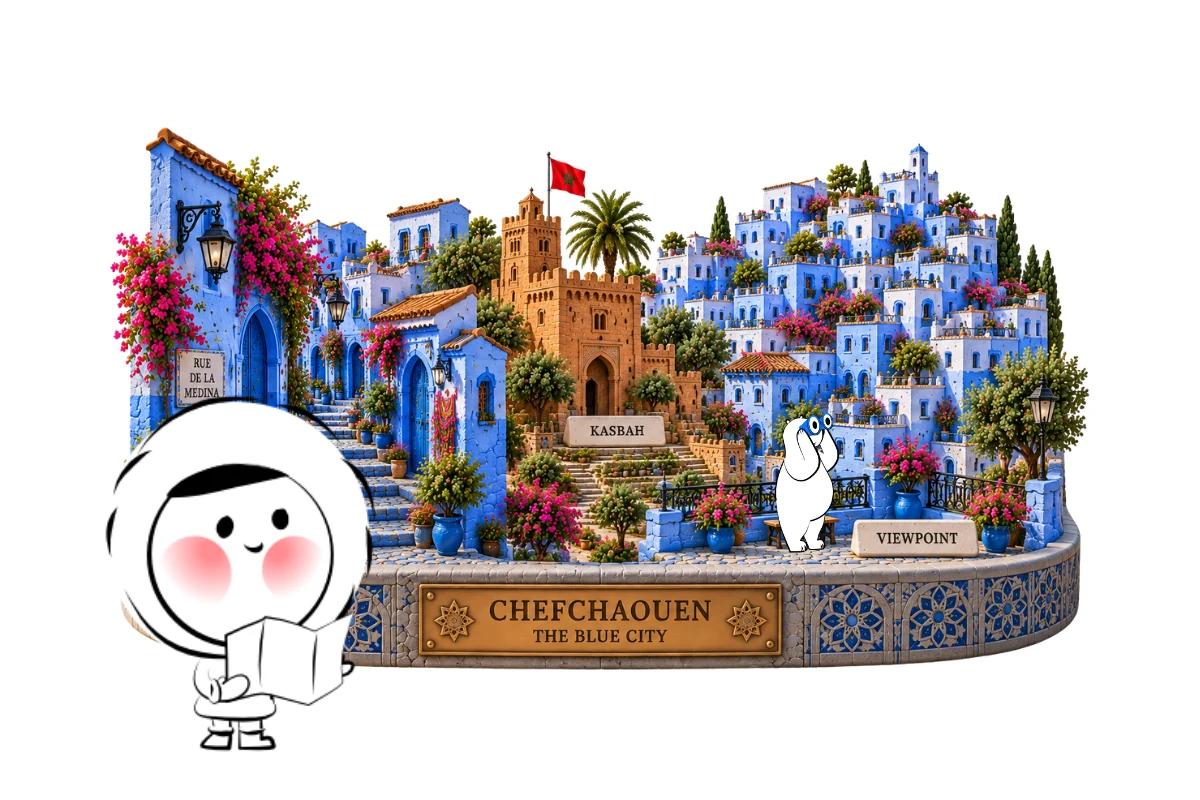
Chefchaouen is Morocco’s famous Blue City, known for the blue-painted lanes and houses that cover much of its hillside medina. Located in northern Morocco in the Rif Mountains, Chefchaouen combines a compact historic center, mountain scenery, local crafts, and easy access to nature.
The city works especially well for travelers who enjoy walking, photography, historic medinas, and slower-paced stops between larger Moroccan cities. One detail is less certain than the photographs suggest: there is no single definitively established explanation for why Chefchaouen became blue.
A full day covers the main sights, but staying one or two nights gives you more time to experience the medina before day visitors arrive and after the streets quiet down in the evening.
Chefchaouen, Morocco’s Blue City
Chefchaouen lies on the slopes of the Rif Mountains in northern Morocco. Its old medina is a maze of steep lanes, staircases, small squares, workshops, homes, and doorways painted in shades ranging from pale powder blue to deep indigo.
The Moroccan National Tourist Office highlights the old medina, Akchour Waterfalls, Grand Mosque, traditional crafts, Ras El Maa, and surrounding mountain landscapes among the destination’s attractions.
Chefchaouen is sometimes called the Blue Pearl of Morocco, but the city is more than a backdrop for photographs. Its smaller scale makes it easier to explore on foot than the medinas of Marrakech or Fes, while its mountain setting gives it a noticeably different character.
Travelers building a longer route can compare Chefchaouen with Marrakech, Fes, the Sahara, and Morocco’s Atlantic coast in Eskimo’s overview of travel around Morocco.
Why Chefchaouen Is Blue
The exact origin of Chefchaouen’s blue walls is not definitively established. MoroccoMuseum’s historical overview of Chefchaouen describes several explanations rather than one proven account.
One widely repeated theory connects the color with Jewish communities that lived in Chefchaouen and with the religious symbolism sometimes associated with blue. Local accounts also connect the city’s former Jewish quarter with the introduction of blue dyes.
Other interpretations point to local decorative traditions or the feeling of freshness created by the color. Popular explanations also claim that blue was intended to discourage insects.
None of these theories alone has been established as the definitive explanation for how blue became so widespread across the medina. It is more accurate to treat them as historical hypotheses and local traditions rather than settled fact.
The appearance travelers recognize today also developed gradually. Historical photographs indicate that Chefchaouen’s buildings were not always painted blue with the intensity and consistency seen across parts of the medina today.
What is certain is that blue has become one of the defining features of Chefchaouen’s modern visual identity. The color also varies considerably from street to street, from pale blue walls and indigo doors to whitewashed or stone-colored surfaces.
A Short History Of Chefchaouen
Chefchaouen was founded in 1471 in a period when Iberian powers were expanding along the northern Moroccan coast. Its location in the Rif Mountains gave the settlement strategic value and helped shape its early defensive role.
The city later received Muslim and Jewish populations arriving from Al-Andalus. Their presence contributed to the development of Chefchaouen’s architecture, crafts, traditions, and wider cultural identity.
These influences remain visible beyond the famous wall color. Look for tiled doorways, courtyards, fountains, covered passages, workshops, woven goods, and the compact street pattern of the old medina.
Chefchaouen therefore feels quite different from Morocco’s larger imperial cities. It is less monumental than Fes or Marrakech, but the combination of medina life, Andalusian heritage, and Rif Mountain geography gives the city a distinct character.
Best Things To Do In Chefchaouen
Most of Chefchaouen’s essential sights are close together, making the city particularly suited to exploring on foot.
Walk through the blue medina
The medina is the main reason most travelers come to Chefchaouen. Wander through its lanes and you will encounter painted staircases, arches, small shops, fountains, workshops, and residential courtyards.
Early morning is generally the easiest time for quieter streets and photography. Later in the day, the most recognizable lanes can become noticeably busier.
Many of the famous blue doorways belong to private homes. Avoid blocking entrances, entering courtyards without permission, or treating residential properties as photography sets.
Visit the Kasbah
Chefchaouen’s Kasbah stands beside the central Plaza Outa el-Hammam.
Its ochre walls contrast sharply with the blue and white buildings around it. Inside are gardens and museum collections connected with the history and culture of Chefchaouen and the surrounding region.
The Moroccan National Tourist Office’s Chefchaouen information highlights the museum’s collection of old weapons, historical photographs, and textiles.
Opening arrangements and admission details can change, so check current information locally before planning your day around a specific time.
Spend time in Plaza Outa el-Hammam
Plaza Outa el-Hammam is the social center of the medina. Cafés and restaurants surround the square, with the Kasbah and Grand Mosque shaping much of the view.
It is a convenient place to stop between walks through the steeper parts of the old city, especially in the afternoon or evening.
Walk to Ras El Maa
Ras El Maa sits near the edge of the medina, where mountain water reaches the town.
The area provides a change from the enclosed lanes and makes Chefchaouen’s proximity to the Rif landscape much clearer. Walking routes continue uphill from around Ras El Maa toward viewpoints over the city.
See Chefchaouen from above
One of the best ways to understand Chefchaouen’s setting is to look back at the medina from the surrounding hillside.
Paths above Ras El Maa lead toward viewpoints overlooking the blue city and mountains. Late afternoon is popular because the changing light emphasizes the contrast between the medina and surrounding slopes.
Wear shoes with reasonable grip. Paths, cobbled lanes, and medina steps can be uneven, particularly after rain.
Get Eskimo eSIM to stay connected in Morocco
Need internet in Morocco? Here's what we recommend:

Fixed data plans
- No speed reduction
- No expiry, keep your data forever
- Transfer data to anyone
- Personal hotspot



Browse local crafts
Chefchaouen has longstanding traditions of weaving, woodworking, leatherwork, and other crafts.
Shopping can feel less overwhelming here than in Morocco’s larger medinas. Prices in tourist-heavy streets can still vary, so compare similar items and agree on the price before buying.
Take a trip to Akchour
Akchour is a popular nature excursion from Chefchaouen, known for Rif Mountain scenery, waterfalls, and hiking.
Conditions can vary with rainfall, weather, and trail conditions. Check locally before setting out, particularly after periods of heavy rain.
Akchour makes more sense if you have at least two nights in Chefchaouen rather than trying to squeeze it into a short day visit.
Best Time To Visit Chefchaouen
Spring and autumn are generally the easiest seasons for sightseeing, with milder conditions for walking through the medina and exploring the surrounding hills.
Summer can bring hotter afternoons, although Chefchaouen’s mountain setting differs from Morocco’s hotter inland and desert destinations. Starting early is useful if you plan to spend much of the day walking.
Winter is cooler and can bring more rain to northern Morocco. Streets may be quieter, but wet stone, stairways, and hiking paths require more care.
For photography, morning and late afternoon usually provide softer light. Early morning also gives you a better chance of exploring popular blue lanes before more day visitors arrive.
Getting To Chefchaouen
Chefchaouen does not have a major passenger airport or railway station, so most visitors arrive by road.
Tangier and Tetouan are convenient gateways from northern Morocco, while Fes is another common starting point for travelers combining Chefchaouen with Morocco’s historic imperial cities.
According to the Moroccan National Tourist Office, Chefchaouen is approximately 112 km from Tangier, 65 km from Tetouan, and 194 km from Fes by road. The tourism office currently lists indicative journey times of around 2 hours 11 minutes from Tangier, 1 hour 26 minutes from Tetouan, and 3 hours 24 minutes from Fes. Actual travel time depends on traffic, road conditions, stops, and your exact starting point.
Intercity buses, shared or private taxis, private transfers, tours, and rental cars are common ways to reach Chefchaouen. Check current schedules with the relevant operator shortly before traveling rather than relying on an old timetable.
For a wider route, Eskimo’s Morocco travel overview places Chefchaouen alongside destinations including Fes, Marrakech, Casablanca, the Sahara, and Morocco’s Atlantic coast.
Recommended Stay Length
A full day is enough for Chefchaouen’s central highlights, including the medina, Kasbah area, Ras El Maa, and a hillside viewpoint.
One night is better if you want to experience the city after many day visitors have left and again early the following morning.
Two nights provide a more relaxed schedule and leave room for Akchour, longer walks, shopping, or photography at different times of day.
Chefchaouen works best as one northern stop within a wider Morocco route, particularly when combined with Tangier, Tetouan, or Fes. If your itinerary is concentrated farther south, consider the additional road time before adding a short detour to Chefchaouen.
Practical Tips For Visiting Chefchaouen
Chefchaouen rewards comfortable footwear. The medina is compact but steep, with stairs, slopes, cobbled surfaces, and uneven lanes.
Carry some Moroccan dirhams for small cafés, shops, taxis, and purchases where card payment may not be practical.
Dress with reasonable respect for local norms, particularly away from tourist-focused areas. Chefchaouen receives international visitors, but the medina remains a residential neighborhood as well as a visitor destination.
Ask before photographing people. The city’s visual appeal can make it easy to forget that many of its most photographed streets and doorways are part of people’s everyday homes.
Download an offline map before exploring. Navigation apps can help, but GPS positioning may be less precise among narrow medina lanes.
If you arrive late in the day, save the longer medina walk and viewpoints for the following morning. This avoids rushing through steep lanes after dark and gives you a quieter start before daytime visitor traffic increases.
Mobile Data In Chefchaouen
Mobile data can help with navigating the medina, checking bus or transfer information, translating menus and signs, and messaging accommodation hosts when arriving in Chefchaouen. Reception is generally more dependable in populated areas and along major roads, while signal can vary in the Rif Mountains, valleys, remote hiking areas, and stretches outside towns.
An Eskimo Morocco eSIM plan is available for travelers using data within Morocco. Eskimo’s coverage across 175 countries and regions overall can also be useful for stopovers or future international trips without starting from scratch each time. No-expiry fixed data means any unused fixed-plan allowance can remain available instead of needing to be used during a short Chefchaouen stay.
New users can also claim a free 250MB Global eSIM.
FAQs:
Is Chefchaouen the Blue City of Morocco?
Yes. Chefchaouen in northern Morocco is widely known as the Blue City because large parts of its historic medina are painted in different shades of blue.
Is all of Chefchaouen painted blue?
No. The strongest concentration of blue-painted buildings is in the old medina. Other areas include white, stone-colored, neutral, and more conventional buildings.
Does Chefchaouen have a train station?
No. Chefchaouen does not have a railway station, so travelers generally complete the journey by road using a bus, taxi, private transfer, tour, or rental car.
Can you visit Chefchaouen from Tangier in one day?
Yes. The Moroccan National Tourist Office lists Chefchaouen at about 112 km from Tangier, making a day trip possible. Staying overnight gives you more time to experience the medina outside the busiest daytime period.
Why is Chefchaouen called the Blue Pearl?
The nickname refers to the blue-painted buildings that dominate much of Chefchaouen’s historic medina and have become the city’s defining visual feature