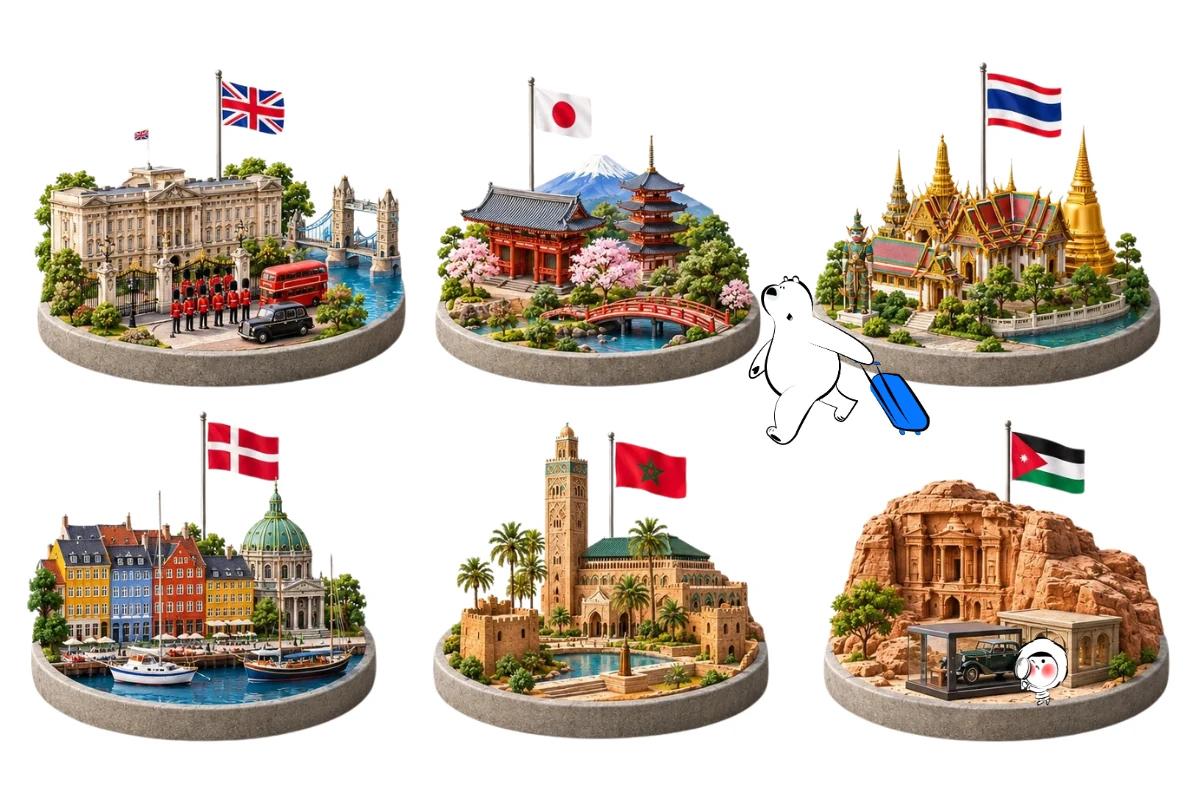
There are 43 sovereign monarchy countries in the world as of 2026, from Denmark and Spain to Japan, Thailand, Morocco, Jordan, Tonga, and the Gulf monarchies. King Charles III is sovereign of the United Kingdom and 14 other Commonwealth realms, according to the Royal Family.
For travelers, the useful question is not only which countries have monarchies, but where royal heritage becomes part of the trip. That can mean touring a working castle, watching a changing-of-the-guard ceremony, walking through imperial gardens, visiting a royal museum, or following stricter etiquette around a palace or royal symbol.
Access varies considerably. Some royal properties welcome visitors throughout much of the year, while others remain working or private residences with only gardens, museums, ceremonial spaces, or exterior areas open to the public.
Monarchy In 60 Seconds For Travelers
A monarchy is a country whose head of state is a monarch, usually a king, queen, emperor, sultan, emir, prince, or similar royal figure.
Modern monarchies do not all operate in the same way. In countries such as the United Kingdom, Japan, Denmark, Norway, Sweden, and the Netherlands, the monarch’s role is largely constitutional or ceremonial. In some other monarchies, the ruler holds substantially greater executive authority.
Travelers rarely need a political-science lesson before visiting. More practical questions are whether a royal site is open, when ceremonies take place, what clothing or photography rules apply, and which parts of a palace complex remain restricted.
Monarchy Countries Around The World Today
The world’s current sovereign monarchies are spread across every inhabited region except South America. They include conventional hereditary kingdoms as well as less common systems such as Andorra’s co-principality and Vatican City’s elective papal monarchy.
Europe
- Andorra
- Belgium
- Denmark
- Liechtenstein
- Luxembourg
- Monaco
- Netherlands
- Norway
- Spain
- Sweden
- United Kingdom
- Vatican City
Asia and the Middle East
- Bahrain
- Bhutan
- Brunei
- Cambodia
- Japan
- Jordan
- Kuwait
- Malaysia
- Oman
- Qatar
- Saudi Arabia
- Thailand
- United Arab Emirates
Africa
- Eswatini
- Lesotho
- Morocco
Americas and the Caribbean
- Antigua and Barbuda
- Bahamas
- Belize
- Canada
- Grenada
- Jamaica
- Saint Kitts and Nevis
- Saint Lucia
- Saint Vincent and the Grenadines
Oceania
- Australia
- New Zealand
- Papua New Guinea
- Solomon Islands
- Tonga
- Tuvalu
Several of these countries share the same monarch while remaining independent states. Others have their own royal houses, traditions, titles, and ceremonial customs.
For travelers, the most rewarding monarchy destinations are usually places where royal heritage is visible through accessible palaces, museums, ceremonies, architecture, gardens, or public spaces.
Royal Destinations Worth Traveling For
United Kingdom: London and Windsor
Britain offers one of the easiest royal experiences to add to a conventional city trip.
Buckingham Palace remains a working royal residence, and visitor access to the State Rooms is seasonal rather than year-round. Opening arrangements can also change for official use, maintenance, or royal events.
Windsor Castle is a stronger choice if visiting a working royal residence is a priority. The castle welcomes visitors throughout the year, although individual areas can close. Standard visits can include the State Apartments, St George’s Chapel, parts of the Royal Collection, and the castle precincts.
Advance booking is worthwhile. The Royal Collection Trust currently lists 2026 standard adult admission at £32 in advance and £36 when purchased on the day.
Changing the Guard also takes place at Buckingham Palace and Windsor Castle, but schedules vary. Check the official Royal Family Changing the Guard information shortly before visiting rather than assuming a ceremony will take place every day.
For more sightseeing ideas around the capital, Eskimo’s London photography spots and landmarks can help connect the royal sights with Westminster, Tower Bridge, St Paul’s Cathedral, and other parts of the city.
Get Eskimo eSIM to stay connected globally
Need internet? Here's what we recommend:

Fixed data plans
- No speed reduction
- No expiry, keep your data forever
- Transfer data to anyone
- Personal hotspot


Japan: Tokyo and Kyoto
Japan’s monarchy offers a very different visitor experience from Europe’s palace-centered royal tourism.
In Tokyo, the Imperial Palace remains an active imperial residence, so most visitors experience the complex through designated tours, public areas, and the East Gardens rather than wandering through the main palace buildings.
The Imperial Household Agency manages public access information for the Imperial Palace and other imperial properties.
The East Gardens are open to the public during published opening periods, while some other imperial sites use designated routes, guided visits, or advance procedures. The agency also provides multilingual audio guidance for several imperial properties.
Kyoto adds another layer through imperial gardens, former court architecture, and carefully managed historic properties. At Kyoto Imperial Palace, visitors can follow the public route through the grounds, but the palace buildings are not generally open for interior tours.
For broader trip planning, Eskimo’s Japan travel tips for first-time visitors covers transport, payments, mobile data, and other practical details.
Thailand: Bangkok
Bangkok’s Grand Palace is one of the clearest examples of royal heritage forming part of a major modern visitor attraction.
The palace complex has a strict dress code. Current official rules prohibit clothing including sleeveless shirts, short tops, short shorts, torn trousers, tight trousers, and mini skirts. Drones are also prohibited over the Grand Palace area.
The Grand Palace’s official visitor information currently lists foreign admission at 500 baht. Tickets are sold from 8:30 AM to 3:30 PM, while general opening hours are listed until 4:30 PM.
Opening arrangements can change for ceremonies or official functions, so check the live information before crossing Bangkok for your visit.
Heat also affects the experience because much of a palace-and-temple day involves walking outdoors. Eskimo’s best time to visit Bangkok and Northern Thailand can help with seasonal planning.
Denmark: Copenhagen
Copenhagen offers a compact royal experience that fits easily into a city break.
Amalienborg is the Danish royal family’s Copenhagen residence. The complex consists of four palaces surrounding an octagonal courtyard, with different buildings serving private, ceremonial, administrative, and representative functions.
Its central location makes it easy to combine Amalienborg with Frederiksstaden, the Marble Church, the waterfront, and other central Copenhagen sights without dedicating a full day to royal tourism.
Copenhagen is also a practical starting point for a Scandinavian itinerary linking several monarchy countries, especially Denmark, Norway, and Sweden.
Morocco: Rabat
Morocco is a useful reminder that a famous royal palace is not necessarily a palace tourists can enter.
The Royal Palace in Rabat, or Dar El Makhzen, is the King’s official residence. Its interior is not open to the public, although visitors can access the Esplanade du Méchouar outside the palace.
The Mohammed V Mausoleum offers more direct visitor access. It contains the tombs of King Mohammed V, King Hassan II, and Prince Moulay Abdallah and can be combined with the nearby Hassan Tower.
Rabat therefore works better as a wider cultural and architectural destination than as a conventional palace-interior tour.
Jordan: Amman
Jordan’s most accessible royal-themed attraction is a museum rather than an active palace.
The Royal Automobile Museum in Amman traces Hashemite and Jordanian history through cars and motorcycles associated with the royal family. Current official information lists the museum as open Saturday to Thursday from 10:00 AM to 7:00 PM and Friday from 11:00 AM to 7:00 PM, with Tuesday closed.
The museum is also listed as accessible for visitors with disabilities.
For travelers who prefer museums to palace tours, Amman provides a distinctive way to experience royal history through vehicles, personal collections, and Jordan’s modern history.
Palaces, Castles And Royal Ceremonies Travelers Can Experience
Royal attractions differ widely, so choosing the type of experience can be more useful than choosing a monarchy country first.
For working royal interiors, Windsor Castle is one of the strongest options. It combines historic State Apartments and royal collections with spaces that continue to serve an official royal function.
For public ceremony, Britain’s Changing the Guard is among the most recognizable royal traditions. Schedules can change, so check the official calendar before planning a morning around it.
For imperial gardens and controlled palace access, Tokyo and Kyoto offer a more structured experience. Some imperial properties use designated routes, guided visits, applications, or restricted access rather than fully open palace interiors.
For royal and religious architecture, Bangkok’s Grand Palace and Wat Phra Kaew combine a major palace complex with one of Thailand’s most important sacred spaces. Dress and conduct rules are therefore stricter than at many European royal attractions.
For royal history through collections, Amman’s Royal Automobile Museum provides a focused museum visit without requiring access to an active royal residence.
Constitutional And Absolute Monarchies In Travel Context
Constitutional monarchy and absolute monarchy describe how political authority is distributed. They do not indicate whether a destination is easier, harder, more interesting, or less interesting to visit.
Japan, Denmark, Sweden, Norway, Spain, Belgium, the Netherlands, and the United Kingdom are examples of constitutional monarchies where elected institutions handle day-to-day government.
Brunei, Oman, Saudi Arabia, and Eswatini are examples where monarchs hold substantially greater authority, although individual systems differ and several monarchies do not fit neatly into a simple two-category model.
For travelers, the practical takeaway is cultural. Expectations around royal symbols, photography, public conduct, palace access, and discussion of the monarchy can vary considerably between countries. Follow local laws and official visitor instructions rather than applying assumptions from one monarchy to another.
Royal Etiquette, Photography And Cultural Sensitivities
Royal sites can function as residences, religious spaces, government facilities, museums, ceremonial venues, or several of these at once.
A few practical habits help avoid problems:
- Check clothing rules before leaving your hotel. Bangkok’s Grand Palace is one example where dress requirements are actively enforced.
- Do not assume photography is permitted indoors. Rules can change between rooms and may be stricter in active royal or religious spaces.
- Respect barriers and restricted areas. A public courtyard can sit immediately beside private or ceremonial sections.
- Check the day’s opening arrangements. Royal residences can alter access for state events, ceremonies, maintenance, or security.
- Check drone rules separately. Bangkok’s Grand Palace explicitly prohibits drone flights over the complex.
- Treat royal symbols according to local norms. Expectations can differ sharply between countries.
Checking the official attraction website on the day of your visit is safer than relying on an old screenshot, social-media post, or third-party ticket listing.
Building A Multi-Country Monarchy Trip
Europe offers the simplest options for combining several monarchy countries without excessive travel time.
A United Kingdom, Belgium, Netherlands, and Luxembourg route works well for travelers who want to combine Britain’s highly visible royal tourism with compact continental capitals. Rail is particularly useful between Belgium, the Netherlands, and Luxembourg, while reaching or leaving the UK requires a Channel crossing or flight.
A Denmark, Norway, and Sweden itinerary combines three Scandinavian monarchies with Copenhagen, Oslo, and Stockholm. It works well for travelers interested in royal residences, waterfront cities, museums, rail journeys, and Nordic design, although distances are greater than they can appear on a map.
A Spain and Morocco itinerary creates a stronger cultural contrast. Flights are usually the simplest connection, while some routes can also incorporate ferry travel between southern Spain and northern Morocco.
In Asia, Japan and Thailand pair two very different monarchy traditions with two major travel destinations. The distance makes the combination better suited to a longer holiday than a short city break.
The best itinerary should still be built around geography, transport time, season, entry requirements, and the places you genuinely want to visit. Sharing a form of government is not enough reason to force two destinations into the same trip.
Travel Technology For Royal Destinations
Royal travel increasingly involves the same digital tools used throughout a modern international trip.
Official booking sites and mobile tickets are useful for attractions with timed entry, seasonal openings, or limited capacity. Save important confirmations offline before leaving your accommodation in case reception becomes weaker inside historic buildings.
Maps are particularly helpful around large palace districts, gardens, castle complexes, and old city centers where the visitor entrance may be some distance from the most obvious map marker.
Translation tools can help with signs, museum information, transport updates, and visitor instructions once you move beyond heavily visited international attractions.
Transit apps become especially useful for trips such as London to Windsor or for journeys between European royal capitals.
Official attraction technology can add useful context too. Japan’s Imperial Household Agency provides multilingual audio guidance for imperial properties, while museum apps and digital guides can help visitors navigate collections without carrying printed material.
Mobile Data Across Monarchy Countries
A multi-country royal itinerary can involve digital attraction tickets, rail changes, palace opening updates, translation, historic-district navigation, and accommodation messages across several borders. Reception is generally stronger in cities and along major transport routes, while underground stations, thick historic buildings, rural roads, mountains, and remote areas can have weaker signals.
An Eskimo Global eSIM plan currently covers 126 countries, making it relevant for an itinerary spanning several regions. Eskimo also offers country and regional plans across 160+ countries, which can be useful for onward travel beyond the countries included in the Global plan. Its universal eSIM can support multiple eligible destinations through one reusable eSIM, reducing the need to install a different eSIM for every international trip.
New users can also claim a free 250MB Global eSIM.
FAQs:
How many monarchy countries are there in the world?
There are 43 sovereign monarchy countries as of 2026. They include kingdoms, principalities, sultanates, emirates, Commonwealth realms, Japan’s imperial monarchy, and Vatican City’s elective papal monarchy.
Which monarchy countries are best for royal tourism?
The United Kingdom, Japan, Thailand, Denmark, Morocco, and Jordan offer very different royal travel experiences, ranging from working castles and imperial gardens to palace complexes, ceremonies, museums, and royal architecture.
Which countries have constitutional monarchies?
Examples include the United Kingdom, Japan, Denmark, Norway, Sweden, Spain, Belgium, the Netherlands, Cambodia, and several Commonwealth realms. The monarch’s exact constitutional role differs between countries.
Can tourists visit royal palaces?
Yes, but access varies. Windsor Castle welcomes visitors throughout the year, Japan provides controlled public access to selected imperial properties, and Bangkok’s Grand Palace has visitor areas. Other royal residences, including Rabat’s Royal Palace, are not open for ordinary interior tours.
Are palace opening hours fixed throughout the year?
Not always. Working royal residences may change access for ceremonies, state events, security, maintenance, or seasonal schedules. Check the official palace, royal-house, or attraction website shortly before visiting.