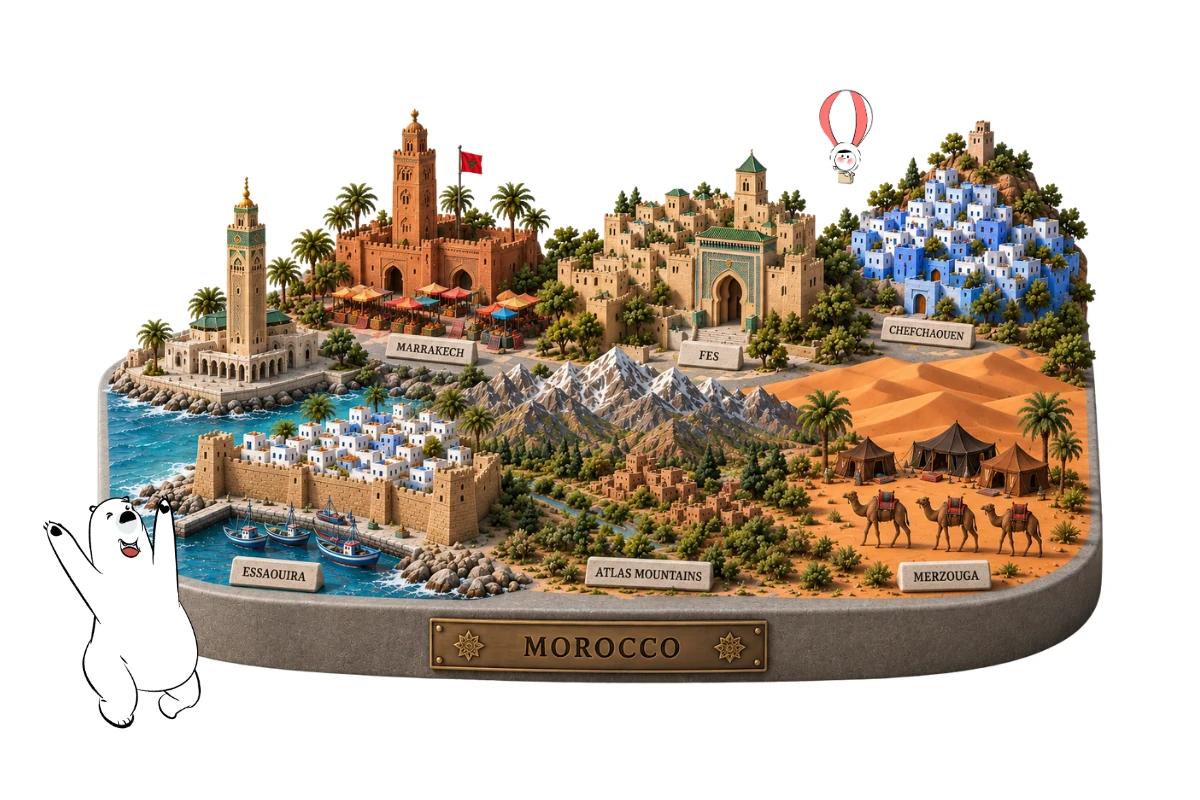
The best things to do in Morocco are exploring Marrakech and Fes, walking through Chefchaouen, visiting the Sahara near Merzouga, spending time in the Atlas Mountains, discovering the Atlantic coast, and experiencing Morocco’s food, crafts, architecture, and medinas.
For a first trip, it is usually better to choose two or three regions rather than trying to cross the entire country. Morocco packs imperial cities, mountains, desert, beaches, and historic towns into one destination, but the distances between them can turn an ambitious itinerary into a succession of long travel days.
Spring and autumn generally work particularly well for trips that combine cities with the desert or mountains. Morocco’s official tourism board recommends spring and autumn for Sahara travel, while coastal destinations tend to have milder conditions.
Best Places And Experiences At A Glance
Morocco suits several very different travel styles. A useful first shortlist is:
- Marrakech for souks, gardens, riads, architecture, food, and an energetic medina.
- Fes for traditional craftsmanship, historic streets, religious architecture, and one of Morocco’s most immersive medinas.
- Chefchaouen for a slower mountain-town experience and access to the Rif.
- Merzouga and the Sahara for dunes, desert camps, camel excursions, and long overland journeys through southern Morocco.
- Essaouira for Atlantic air, ramparts, seafood, art, and a calmer pace after Marrakech.
- Rabat for history, architecture, and a quieter capital-city experience.
- Casablanca for modern Morocco, the Atlantic waterfront, and major urban architecture.
- The Atlas Mountains for trekking, mountain villages, valleys, and a sharp contrast with Morocco’s cities.
The Moroccan National Tourist Office organizes Morocco around experiences including medinas, mountains, coast, culture, sport, gastronomy, and wellness, which reflects how varied a single trip can become.
Marrakech
Marrakech is one of the easiest places to begin if you want an intense introduction to Morocco.
The medina concentrates souks, historic architecture, riads, food stalls, courtyards, and workshops into a dense area that rewards walking. Jemaa el-Fna changes character throughout the day, while the surrounding souks are better approached as neighborhoods to explore rather than a checklist of shops.
Give yourself time away from the busiest parts of the medina too. Gardens, hammams, cooking experiences, quieter residential streets, and rooftop cafés can make Marrakech feel much less frantic.
If your Morocco trip is short, Marrakech also works as a base for excursions toward the Atlas Mountains or the desert-facing south. A true Sahara trip, however, requires substantially more travel time than a simple day excursion.
Fes
Fes is the stronger choice if your priority is historic urban Morocco and traditional craft.
Fes el-Bali is a web of narrow lanes containing workshops, markets, fountains, religious buildings, food stalls, and centuries-old architecture.
Marrakech and Fes should not be treated as interchangeable. Marrakech offers a busier mix of markets, gardens, restaurants, and excursions. Fes often feels more focused on traditional craft, historic urban fabric, and navigating the medina itself.
If you enjoy ceramics, leatherwork, wood carving, textiles, or Moroccan food, Fes deserves more than a rushed overnight stop.
Chefchaouen And Northern Morocco
Chefchaouen works best for travelers who want a smaller city surrounded by mountains rather than another major urban stop.
Its blue-painted old streets are the obvious visual draw, but the town also has a medina, kasbah, local food, traditional crafts, and access to the Rif Mountains. Nearby options include Akchour Waterfalls and Talassemtane National Park.
The catch is routing. Chefchaouen sits in northern Morocco, so adding it to a trip focused on Marrakech and the Sahara can mean significant additional travel.
It makes more sense when paired with Tangier, Tetouan, Fes, or a broader northern itinerary. Morocco’s tourism board lists Fes to Chefchaouen at about 194 km by road, which illustrates why the town should be treated as a proper journey rather than a casual extension of a southern itinerary.
Casablanca And Rabat
Casablanca and Rabat suit different types of travelers.
Casablanca is the stronger choice for travelers interested in modern city life, architecture, the Atlantic waterfront, and landmarks such as the Hassan II Mosque rather than a medina-centered stay.
Rabat is smaller and generally easier to fold into a cultural itinerary. The Kasbah of the Oudayas, Chellah, historic quarters, gardens, and Atlantic setting give the capital a different pace from Marrakech or Fes.
If time is limited, choose based on trip style rather than visiting both automatically. Casablanca works better as a modern-city stop, while Rabat provides a more concentrated mix of heritage, architecture, and public spaces.
Sahara And Desert Experiences
A Sahara experience is one of Morocco’s biggest geographical contrasts, but it requires realistic planning.
Merzouga is the best-known gateway to the Erg Chebbi dunes. Desert trips often combine dune scenery with camel excursions, camps, oases, kasbahs, and long drives through eastern or southern Morocco.
Do not plan the Sahara as if it were just outside Marrakech. Reaching the main dune areas often involves long overland journeys through mountain passes, valleys, towns, and desert-edge landscapes.
That travel time can be part of the appeal if you enjoy road trips. If you dislike long drives or have only a few days, prioritizing the cities, mountains, or coast may produce a better trip.
The Atlantic And Mediterranean Coast
Morocco’s coast can completely change the rhythm of a city-heavy itinerary.
Essaouira is one of the easiest coastal additions from Marrakech. Its fortified medina, port, ramparts, galleries, seafood, and Atlantic setting make it more cultural than resort-focused.
Agadir and nearby Taghazout suit travelers who want beaches, surf culture, and a more relaxed coastal stay.
Further north, Tangier combines Mediterranean and Atlantic influences with cafés, architecture, maritime history, and convenient access to northern Morocco.
The coast is especially useful when you want a slower few days between medinas or long overland journeys.
Get Eskimo eSIM to stay connected in Morocco
Need internet in Morocco? Here's what we recommend:

Fixed data plans
- No speed reduction
- No expiry, keep your data forever
- Transfer data to anyone
- Personal hotspot
Atlas Mountains And Outdoor Experiences
The Atlas Mountains provide one of Morocco’s strongest contrasts with the imperial cities.
The High Atlas contains Jbel Toubkal, North Africa’s highest peak, along with valleys, villages, trekking routes, high passes, and landscapes that change sharply with altitude and season.
You do not need to climb Toubkal to include the mountains. Day walks, village stays, valley drives, and guided hikes can all work depending on your fitness, season, and available time.
Conditions matter more here than they do in the major cities. Snow, heat, altitude, road conditions, and trail difficulty can affect plans, so check local information shortly before departure.
For travelers interested in outdoor experiences, the Atlas can add more variety than simply adding another famous city.
Cultural Experiences Worth Prioritizing
Some of Morocco’s strongest travel experiences are not individual landmarks.
Explore a medina slowly
Medinas in Marrakech, Fes, Essaouira, Rabat, and other cities work best when you allow time to wander rather than rushing between pins on a map.
Fes is particularly strong for workshops and traditional craft. Marrakech combines historic streets with markets, food, riads, and a busier visitor scene. Essaouira offers a smaller coastal version.
Eat beyond the most famous dishes
Tagine and couscous are obvious starting points, but regional cooking, breads, pastries, olives, preserved ingredients, tea, grilled meats, seafood, and market food vary considerably by location.
A cooking class can be useful early in a trip because it makes menus, spices, and market ingredients easier to understand afterward.
Visit workshops and artisan areas
Ceramics, leather, woodwork, metalwork, carpets, textiles, and zellige tile work remain important parts of Morocco’s craft traditions.
Look for places where you can actually see production rather than only shopping for finished products.
Try a hammam
A hammam can range from a simple neighborhood bathing experience to a polished spa treatment.
Check the format before booking. Expectations around privacy, clothing, scrubbing, facilities, and service vary considerably between traditional hammams and hotel spas.
Spend a night in a riad
A riad stay adds architectural context that a conventional hotel often cannot provide. Interior courtyards, tilework, carved plaster, fountains, and rooftop spaces can make the accommodation itself part of the experience.
Combining Morocco’s Highlights
A good Morocco route should minimize unnecessary backtracking.
For five days, focus on one region. Marrakech with the Atlas Mountains or Essaouira works better than trying to include Fes and the Sahara.
For seven days, combine two major areas, such as Marrakech and Essaouira, Marrakech and the south, or Fes with Chefchaouen and northern Morocco.
For 10 days, it becomes more realistic to connect major regions. Marrakech, Fes, and a desert journey can work, but expect substantial overland travel. Another option is Casablanca or Rabat, Fes, Chefchaouen, and Tangier for a city-and-north itinerary.
If Morocco will be your first trip on the continent, Eskimo’s best African countries for first-time visitors provides broader regional context. Morocco also appears among Eskimo’s most visited countries in Africa, alongside other major African destinations.
Getting Around Morocco
Trains are useful for several major city combinations, including Casablanca, Rabat, Tangier, Fes, and Marrakech.
Morocco’s Al Boraq high-speed service currently connects Tangier, Kenitra, Rabat, and Casablanca. Conventional rail serves a wider network, while coaches help cover destinations beyond the railway. The Moroccan National Tourist Office’s transport information also directs travelers to ONCF for rail planning and tickets.
Private transfers can be useful for mountain and desert itineraries, while rental cars provide more flexibility for travelers comfortable with longer road journeys.
Inside old medinas, walking is usually the practical option. Cars often cannot reach the narrowest historic streets, which is worth considering when choosing accommodation and packing luggage.
Travel Technology For Morocco
Digital tools are especially useful in Morocco because one trip can involve dense medinas, intercity transport, mountain roads, and long overland transfers.
Offline maps are worth downloading before exploring a medina. GPS can still be imperfect inside narrow lanes, but saved maps make it easier to regain orientation.
Rail and coach information helps when connecting major cities. Keep tickets or confirmations available offline in case mobile reception is weak at the wrong moment.
Translation tools can help with menus, transport information, accommodation messages, and basic conversations.
Accommodation messaging is particularly useful for riads inside medinas. Some properties arrange meeting points because the final approach may involve pedestrian streets that taxis cannot reach directly.
Navigation apps matter most on road trips toward the Atlas, southern valleys, and desert regions. Downloading offline sections before leaving major towns adds useful backup.
Using Mobile Data Around Morocco
Mobile data helps with navigating medina lanes, checking train and coach information, confirming desert pickup points, translating menus, and messaging riads before arrival. Coverage is generally stronger in cities and along major transport corridors, while reception can weaken on mountain roads, in remote valleys, and across desert stretches.
An Eskimo Morocco eSIM plan is the most relevant option for a single-country trip. Eskimo currently offers plans across 160+ countries, which is useful if the journey continues to Spain, France, or another destination after Morocco. No-expiry fixed data means unused fixed data can remain available for a future trip instead of needing to be consumed during one holiday.
New users can also claim a free 250MB Global eSIM.
FAQs:
What are the best things to do in Morocco for a first trip?
For a first visit, prioritize Marrakech or Fes, one contrasting region such as the Sahara, Atlas Mountains, or Atlantic coast, and enough time to experience medinas, Moroccan food, architecture, and local crafts without rushing.
How many days do you need in Morocco?
Around seven to 10 days gives most travelers enough time to combine two or three major areas. Five days works better when focused on one region, while two weeks allows a broader route across cities, mountains, coast, and desert.
Is Marrakech or Fes better for first-time visitors?
Marrakech is better for travelers who want a lively mix of markets, gardens, restaurants, riads, and excursions. Fes is stronger for traditional craft, historic urban architecture, and a more immersive medina experience.
Is the Sahara worth adding to a Morocco trip?
Yes, if you enjoy long scenic road journeys and can dedicate several days to the route. The desert is less suitable for a very short trip because reaching the major dune areas requires substantial travel from Marrakech or Fes.
What is the best time for sightseeing in Morocco?
Spring and autumn generally offer comfortable conditions for trips combining cities, mountains, and the desert. Summer can be very hot inland, while winter brings cooler nights and colder conditions at higher elevations.