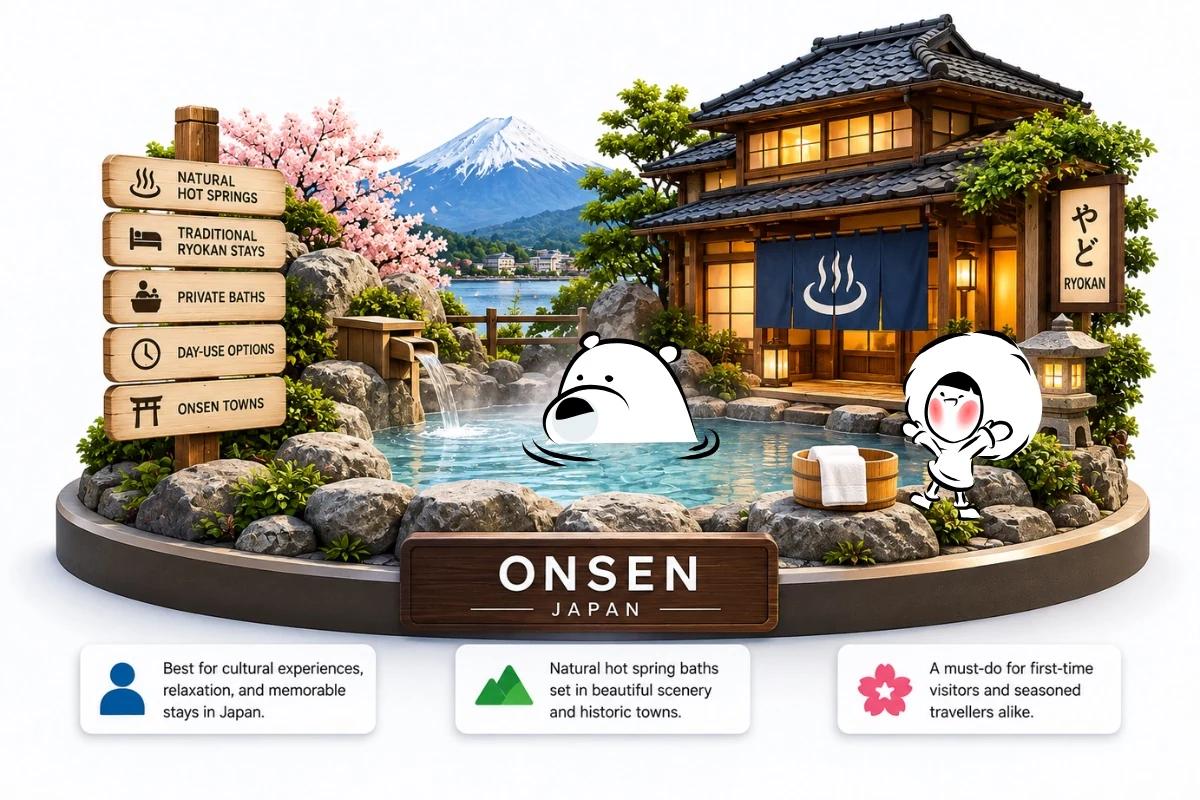
A Japanese onsen is a natural hot spring bath, but knowing how to use one matters almost as much as choosing where to go. First-time visitors should expect to wash before entering the water, keep towels and hair out of the bath, follow the property’s tattoo rules, and respect the quiet atmosphere.
The experience is also more flexible than it first appears. You can visit an onsen without staying overnight, reserve a private bath, stay at a traditional ryokan, or make an entire hot spring town part of your Japan itinerary.
If Japan is new to you, these Japan travel tips cover practical basics such as transportation, payments, connectivity in japan, and everyday travel customs.
The rules are not complicated. These are the 11 things worth knowing before your first soak.
An Onsen Is Not Just Any Hot Bath
The word onsen is often translated simply as “hot spring,” but Japan has a legal definition for it.
Under Japan’s Hot Spring Act, underground water can qualify as an onsen when it emerges at 25°C or higher, or when it contains one or more designated substances at the required concentration. That means mineral composition can qualify a spring even when its source temperature is below 25°C. Japan’s Ministry of the Environment sets out the official criteria.
This also explains why Japanese hot springs can feel different from one destination to another. Mineral content, temperature, smell, color, and bathing environment vary between springs.
A sento, by comparison, is a public bathhouse that generally uses ordinary heated water rather than natural hot spring water. The bathing experience can look similar, but the water source is different.
Most Traditional Onsen Do Not Allow Swimsuits
This is often the biggest surprise for first-time visitors.
Standard communal onsen are generally used without clothing or swimsuits. Men’s and women’s bathing areas are usually separate, although exceptions exist, including some mixed-gender facilities with their own rules. JNTO’s onsen guidance recommends checking the individual facility when you are unsure about its bathing arrangements.
You normally undress in the changing room, store your belongings in a locker or basket, and take only a small towel into the bathing area.
That towel can provide some modesty while walking around, but it does not go into the bath.
Pay attention to the entrance curtains and signs too. Women’s baths are commonly marked with 女 and men’s baths with 男. At some ryokan, bath assignments can switch during the day, so check the signs each time rather than assuming the entrance will remain the same.
If communal bathing is not for you, that does not mean skipping the experience. Private baths are available at many hot spring resorts and ryokan.
You Wash Before You Soak
An onsen is for soaking, not washing.
Before entering a communal bath, use the washing stations beside the pools. These commonly have a low stool, bucket, handheld shower, soap, and shampoo.
Sit down, wash thoroughly, and rinse away all soap before entering the shared water. JNTO identifies washing first as one of the basic rules of onsen etiquette.
You may also encounter kakeyu, where hot water is poured over the body before entering the bath. It can help you adjust to the water temperature, but it is not a substitute for washing.
Take your time when entering. Onsen water can be considerably hotter than an ordinary swimming pool, so easing yourself in is more comfortable than plunging straight into the water.
The Tiny Towel Has More Rules Than You Expect
That small towel has a job, but floating beside you is not one of them.
Use it for washing or modesty while moving around the bathing area. Before entering the bath, leave it at the side or fold it and place it on your head.
Do not put the towel in the bath water.
Long hair should also be tied up so it cannot fall into the water. JNTO lists keeping both towels and hair out of the bath among its basic onsen etiquette rules.
Phones and cameras should remain outside the bathing area. Privacy matters when everyone around you is using a communal changing and bathing space.
Keep conversations fairly quiet, avoid splashing, and do not swim. An onsen is a place for soaking rather than a recreational pool.
Tattoos Can Change Which Onsen You Can Use
Having a tattoo does not automatically rule out an onsen experience, but it does make advance checking worthwhile.
Policies are set by individual facilities. Some welcome tattooed guests, some permit small tattoos if they are covered, and others restrict tattoos in communal bathing areas. JNTO recommends checking the property’s policy before visiting because rules vary between facilities.
Small tattoo cover sheets are accepted at some properties, but never assume they will be sufficient.
If a property does not allow your tattoo in its public baths, look for a tattoo-friendly facility or book a private bath instead.
That quick check before traveling can save a long journey to a bath you cannot enter.
Private Onsen Can Completely Change The Experience
A private onsen gives you exclusive use of a hot spring bath for a set period or provides a bath attached directly to your accommodation.
Look for terms such as kashikiri-buro, referring to a reservable private bath, or rotenburo, an open-air bath.
Many ryokan rent private baths for fixed time slots. Others offer guest rooms with their own indoor or outdoor hot spring baths.
Private options are useful for couples, families, travelers uncomfortable with communal bathing, and people concerned about tattoo restrictions. JNTO also identifies private charter baths as an alternative for guests who prefer not to use communal facilities.
They are not necessarily spontaneous. Popular private baths can require advance reservations, especially at well-known ryokan, on weekends, and during busy holiday periods. Check whether the bath must be reserved when booking your room rather than waiting until check-in.
Get Eskimo eSIM to stay connected globally
Need internet? Here's what we recommend:

Fixed data plans
- No speed reduction
- No expiry, keep your data forever
- Transfer data to anyone
- Personal hotspot


You Do Not Need To Stay Overnight
One of the easiest misconceptions to make is assuming an onsen requires an expensive ryokan stay.
It does not.
Many hot spring towns have public bathhouses, standalone facilities, and ryokan offering day-use bathing. JNTO’s onsen guidance confirms that many facilities provide day plans or drop-in bathing without requiring an overnight reservation.
This makes an onsen much easier to add to an existing itinerary. You could visit Hakone from Tokyo, stop at a bath during a regional journey, or spend an afternoon in a hot spring town before continuing elsewhere.
Check admission times carefully. A ryokan may only open its baths to non-guests during specific daytime periods, and final entry can be earlier than the property’s closing time.
An Onsen Ryokan Is About More Than The Bath
If your budget and itinerary allow it, an onsen ryokan turns the hot spring into a larger cultural experience.
A traditional ryokan may include tatami rooms, futon bedding, yukata robes, Japanese meals, and several indoor or outdoor baths. Some properties also provide private baths or rooms with their own hot spring water.
The advantage of staying overnight is time. Instead of squeezing a bath between train connections, you can soak after checking in, again later in the evening, and sometimes early the next morning.
Baths can also change character with the seasons. Snow around an outdoor rotenburo creates a very different setting from autumn foliage or summer greenery.
Seasonality affects the wider trip too, so checking the best time to visit Japan can help before choosing dates for a longer itinerary.
The Water Is Not The Same Everywhere
Two onsen can look similar while providing noticeably different bathing experiences.
Japan’s hot springs contain different combinations and concentrations of naturally occurring substances. Water may appear clear, cloudy, brownish, or milky depending on the spring, while sulfur-rich water can have a distinctive smell.
Temperature varies too.
Do not assume hotter automatically means better. If the water feels uncomfortable, enter gradually, use a cooler bath if one is available, and take breaks rather than trying to endure it.
Hydration also matters. JNTO’s Kurokawa Onsen information recommends taking breaks and drinking water rather than remaining in hot baths for excessively long periods.
If a facility displays health or bathing guidance, follow its instructions, particularly if you have a medical condition affected by heat.
The Best Onsen Experience May Be An Entire Town
Japan has individual onsen across the country, but some destinations revolve around hot spring culture. The best choice depends more on your route and the experience you want than on finding one supposedly unbeatable bath.
Hakone is one of the easiest options to add to a Tokyo itinerary. Trains run from central Tokyo toward Hakone-Yumoto, making the area practical for a day trip or overnight stay. Beyond its many hot spring properties, Hakone combines Lake Ashi, museums, mountain scenery, and a well-developed local transport network. The official JNTO Hakone Onsen page provides additional destination information.
Kusatsu Onsen in Gunma has a classic hot spring town atmosphere centered around its famous Yubatake, where steaming spring water flows through the heart of town. It works particularly well for travelers who want the hot spring town itself to be a major part of the trip.
Kinosaki Onsen in Hyogo is especially well suited to bath-hopping. Guests commonly walk between public bathhouses in yukata rather than spending the entire stay inside one ryokan.
Beppu in Kyushu is a major geothermal destination with a large concentration of hot spring activity and varied bathing experiences. It fits particularly well into a Kyushu itinerary rather than a short detour from Tokyo or Kyoto.
Arima Onsen is convenient for a Kansai itinerary involving Kobe, Osaka, or Kyoto, while Noboribetsu Onsen fits naturally into a Hokkaido trip and sits near the geothermal landscape of Jigokudani.
For a first onsen trip from Tokyo, Hakone is one of the most straightforward choices. Choose Beppu if geothermal scenery and variety are priorities, Kusatsu for a dedicated mountain hot spring escape, and Kinosaki if walking between multiple public baths appeals to you.
Travelers primarily concerned with privacy should prioritize the accommodation rather than the town. Look for a private kashikiri-buro or a room with its own hot spring bath.
A Few Small Etiquette Details Make A Big Difference
A few final habits are worth remembering once the bigger rules are covered.
Do not add soap or shampoo to the bath itself, avoid swimming or splashing, and keep conversations quiet enough not to disturb other bathers.
Follow any property-specific instructions even when they differ from what you experienced somewhere else. Facilities may have their own rules around entry, bath rotation, towels, tattoos, or private-bath reservations.
Once those basics are understood, the ritual quickly becomes part of the appeal rather than something you need to navigate nervously.
Using Mobile Data On An Onsen Trip In Japan
Mobile data can help with train connections to Hakone, rural bus departures, ryokan check-in details, translation, weather updates, and last-minute reservations. Coverage is generally stronger in cities, towns, and along major transport routes, while reception may weaken in railway tunnels, mountain valleys, forests, and remote hot spring areas.
An Eskimo Japan eSIM plan is available specifically for travel in Japan. Eskimo’s wider network footprint spans 175 countries and regions overall, which can be useful if Japan is part of a longer Asia itinerary or you travel internationally again later. No-expiry fixed data means unused fixed data can remain available for a future trip rather than needing to be consumed before a validity deadline.
New users can also claim a free 250MB Global eSIM.
FAQs:
What does onsen mean in Japan?
An onsen is a natural Japanese hot spring that meets criteria established under Japan’s Hot Spring Act. The term is also commonly used for bathing facilities supplied by hot spring water.
Do you have to wash before entering an onsen?
Yes. Wash your body thoroughly and rinse off all soap before entering the shared bath water. This is one of the fundamental rules of Japanese onsen etiquette.
Can tourists with tattoos visit an onsen?
It depends on the facility. Some onsen accept tattoos, some permit small covered tattoos, and others restrict them. Check the individual property’s policy before visiting.
Can couples use a private onsen together?
Some ryokan and hot spring facilities offer reservable private baths that couples or families can use together. Availability, bathing rules, reservation periods, and additional fees depend on the property.
Can you visit an onsen without staying at a ryokan?
Yes. Many hot spring towns have public baths and facilities offering day-use or drop-in bathing, so an overnight ryokan stay is not required.