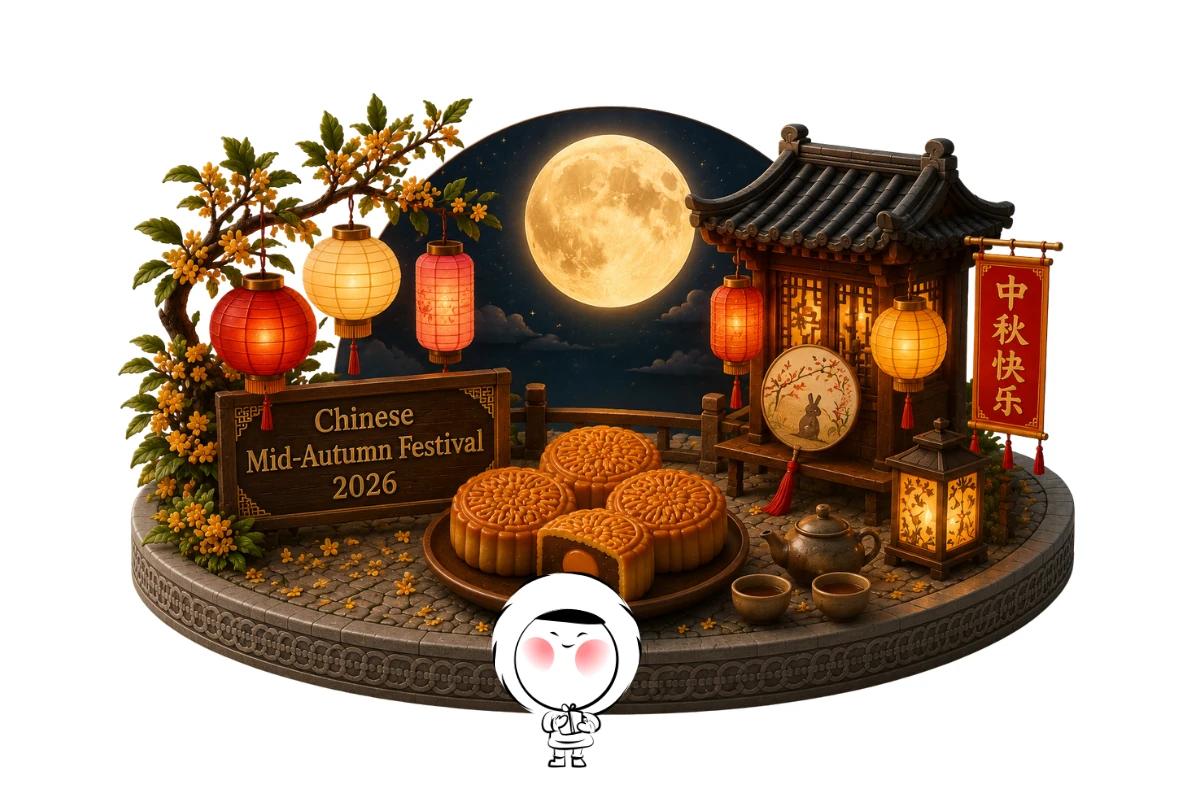
The Chinese Mid-Autumn Festival 2026 falls on Friday, September 25. Celebrated on the 15th day of the eighth lunar month, it is a major family festival centered on reunion dinners, moon viewing, lanterns, seasonal fruit, and sharing mooncakes.
Mainland China’s official holiday and Hong Kong Public Holiday period runs from September 25 to 27, 2026. Popular transport routes, attractions, and family destinations may become busier as people travel home or take short domestic trips.
What the Mid-Autumn Festival Is
The Mid-Autumn Festival, also called the Chinese Moon Festival, is one of China’s most important traditional celebrations. It falls each year on the 15th day of the eighth month in the Chinese lunar calendar, when the moon is traditionally associated with fullness and reunion.
Families often gather for dinner, share mooncakes, display lanterns, and spend time appreciating the moon. The circular shape of the moon and mooncakes represents togetherness, which is why the celebration is sometimes called the Festival of Reunion.
Mid-Autumn Festival 2026 Date
The Mid-Autumn Festival date changes in the Gregorian calendar because it follows the lunar calendar.
In 2026:
- Festival date: Friday, September 25
- Mainland China holiday: September 25 to 27
- Hong Kong public holiday: Saturday, September 26, the day following the festival
China’s State Council confirmed a three-day Mid-Autumn holiday for 2026, while Hong Kong’s government lists the following day as a general holiday.
The festival is also observed across Taiwan, Singapore, Malaysia, Vietnam, and Chinese communities worldwide, although names, foods, public-holiday rules, and local traditions differ.
Travelers visiting Taiwan can check the Taiwan public holidays for 2026, while those heading to Hong Kong should review the Hong Kong public holiday calendar.
Mid-Autumn Festival Meaning and History
The Mid-Autumn Festival meaning is closely connected with family reunion, harvest, gratitude, and the full moon.
Seasonal moon observances existed in ancient China long before the modern form of the festival developed. Historical accounts connect autumn with harvest celebrations and imperial moon worship. The celebration became established during the Tang and Song periods and grew increasingly prominent during the Ming and Qing dynasties.
The moon became a powerful symbol because its changing shape was associated with separation and reunion. A full, round moon represented loved ones coming together, even when relatives lived far apart.
The Chang’e Legend
The best-known Mid-Autumn Festival legend concerns Chang’e, the moon goddess.
Several versions of the story exist. In a widely told form, Chang’e drinks an elixir of immortality and rises to the moon, where she remains separated from her husband, the archer Hou Yi.
The legend is often accompanied by the Jade Rabbit, who is said to live on the moon and prepare an elixir. Another lunar figure, Wu Gang, is condemned to cut a tree that continually repairs itself.
These stories appear in art, lantern displays, children’s books, performances, and festival decorations. They should be understood as evolving folklore rather than one fixed historical account.
Mid-Autumn Festival Traditions
Family reunion dinners
A shared evening meal is central to many Mid-Autumn Festival celebrations. Relatives may travel home, exchange gifts, and eat dishes chosen for their seasonal or symbolic meaning.
The exact menu varies by region and household. The emphasis is less on one required dish and more on gathering around the same table.
Moon viewing
Families may sit outdoors, visit parks, or gather near windows and balconies to appreciate the full moon.
Moon viewing is tied to poetry, memory, and thoughts of relatives living elsewhere. Even people separated by distance are imagined to be looking at the same moon.
Giving mooncakes
Mooncakes are exchanged between relatives, friends, colleagues, and business contacts. They are usually round or square pastries with decorative patterns pressed into the top.
Gift boxes can range from simple local bakery packages to elaborate premium sets. Travelers should avoid overbuying, as mooncakes are rich and often sold in multi-piece boxes.
Carrying lanterns
Mid-Autumn Festival lanterns are especially popular among children and at public celebrations.
Traditional designs include rabbits, fish, stars, flowers, and fruit. Modern events may feature illuminated installations, riddles, performances, and large decorative displays.
Lantern customs vary across regions. They should not be confused with every other Asian lantern celebration, such as Thailand’s Yi Peng and Loy Krathong festivals.
Get Eskimo eSIM to stay connected globally
Need internet? Here's what we recommend:

Fixed data plans
- No speed reduction
- No expiry, keep your data forever
- Transfer data to anyone
- Personal hotspot


Mooncakes and Festival Food
Mooncakes are the best-known Mid-Autumn Festival food. Their round shape symbolizes completeness and family reunion.
Common fillings include:
- Lotus seed paste
- Red bean paste
- Salted egg yolk
- Mixed nuts and seeds
- Jujube paste
- Black sesame
- Meat or ham in some regional styles
Cantonese mooncakes usually have a thin baked crust and dense filling. Suzhou-style versions are flaky, while newer varieties include snowy-skin mooncakes, ice cream fillings, chocolate, tea, and fruit.
Salted egg yolks represent the full moon inside the pastry. Because mooncakes can be rich in sugar, oil, and salt, they are commonly sliced into small wedges and shared.
Other Mid-Autumn Festival foods may include pomelo, pears, grapes, pomegranates, taro, duck, crab, and seasonal dishes. Customs vary significantly across China and neighboring regions.
Mid-Autumn Festival Greetings
A common greeting is:
中秋快乐 Zhōngqiū kuàilè “Happy Mid-Autumn Festival”
Another reunion-focused expression is:
花好月圆 Huā hǎo yuè yuán “May the flowers bloom beautifully and the moon be full”
For families, a greeting may include:
阖家团圆 Hé jiā tuányuán “May the whole family be reunited”
Pronunciation and usage can vary between Mandarin, Cantonese, and other Chinese languages. A simple “Happy Mid-Autumn Festival” is appropriate when unsure.
Where to Experience the Festival
Beijing
Beijing combines traditional gardens, temple areas, lakes, and cultural performances. Public programmes vary each year, so check municipal event notices close to the festival.
Shanghai
Shanghai often features lantern displays, shopping promotions, cultural activities, and evening events around historic districts and waterfront areas.
Hong Kong
Hong Kong is known for evening lantern displays, neighbourhood celebrations, mooncake shopping, and seasonal events. September 26 is the public holiday in 2026, rather than the night of the festival itself.
Taiwan
Taiwanese celebrations commonly include mooncakes, pomelo, family gatherings, and outdoor barbecues. Popular transport routes may fill quickly during the holiday period.
Festival programmes can change each year. Verify locations, admission rules, and schedules through official city tourism or event websites rather than relying on previous editions.
Travel Tips for the 2026 Festival
Book intercity trains, flights, and hotels early if traveling within mainland China during the September 25 to 27 holiday.
Expect larger crowds at major attractions, historic districts, shopping areas, lantern events, and transport hubs. Evening celebrations may create road closures or temporary public transport changes.
Check whether restaurants require reservations for reunion dinners. Many families dine together on the festival evening, making popular venues busier than usual.
Buy mooncakes from reputable shops and inspect storage instructions. Snowy-skin and ice cream varieties may require refrigeration.
Avoid releasing uncontrolled sky lanterns. Fire rules and environmental restrictions vary, and many destinations prohibit them.
Travelers interested in related seasonal traditions can also explore the Dragon Boat Festival, another major Chinese lunar-calendar celebration shaped by food, folklore, and community events.
Mobile Data During a Mid-Autumn Festival Trip
Mobile data helps with digital train tickets, festival schedules, restaurant reservations, translation, and transport changes during the Mid-Autumn holiday. Coverage is generally stronger in cities and along major transport routes, while reception may weaken inside underground stations, dense event venues, mountainous areas, and remote scenic sites.
An Eskimo China eSIM plan can be prepared before arrival. Eskimo’s coverage across 175 countries and regions is useful for travelers continuing through Hong Kong, Taiwan, Singapore, or other parts of Asia, while the universal eSIM allows one reusable eSIM to support multiple eligible destinations without installing a new one for each stop.
New users can also claim free 500MB of Global Data.
FAQ
When is the Chinese Mid-Autumn Festival in 2026?
The Chinese Mid-Autumn Festival falls on Friday, September 25, 2026. Mainland China’s official holiday runs from September 25 to 27.
Why are mooncakes eaten during the Mid-Autumn Festival?
Their round shape represents the full moon, completeness, and family reunion. They are commonly shared or exchanged as gifts.
What does the Mid-Autumn Festival celebrate?
It celebrates family reunion, the harvest season, gratitude, moon appreciation, and cultural traditions connected with the eighth lunar month.
What is the story of Chang’e?
Chang’e is a legendary figure who drinks an immortality elixir and rises to the moon. Several versions of the story exist across Chinese folklore.
Are Mid-Autumn Festival events free?
Some lantern displays and public celebrations are free, while performances, attractions, or organised activities may require tickets. Check current official event details before visiting.