The iPhone 18 Pro Max is worth the extra $100 if you prioritize battery life and a larger screen. The iPhone 18 Pro makes more sense if you want essentially the same core Pro experience in a smaller, 38-gram-lighter phone.
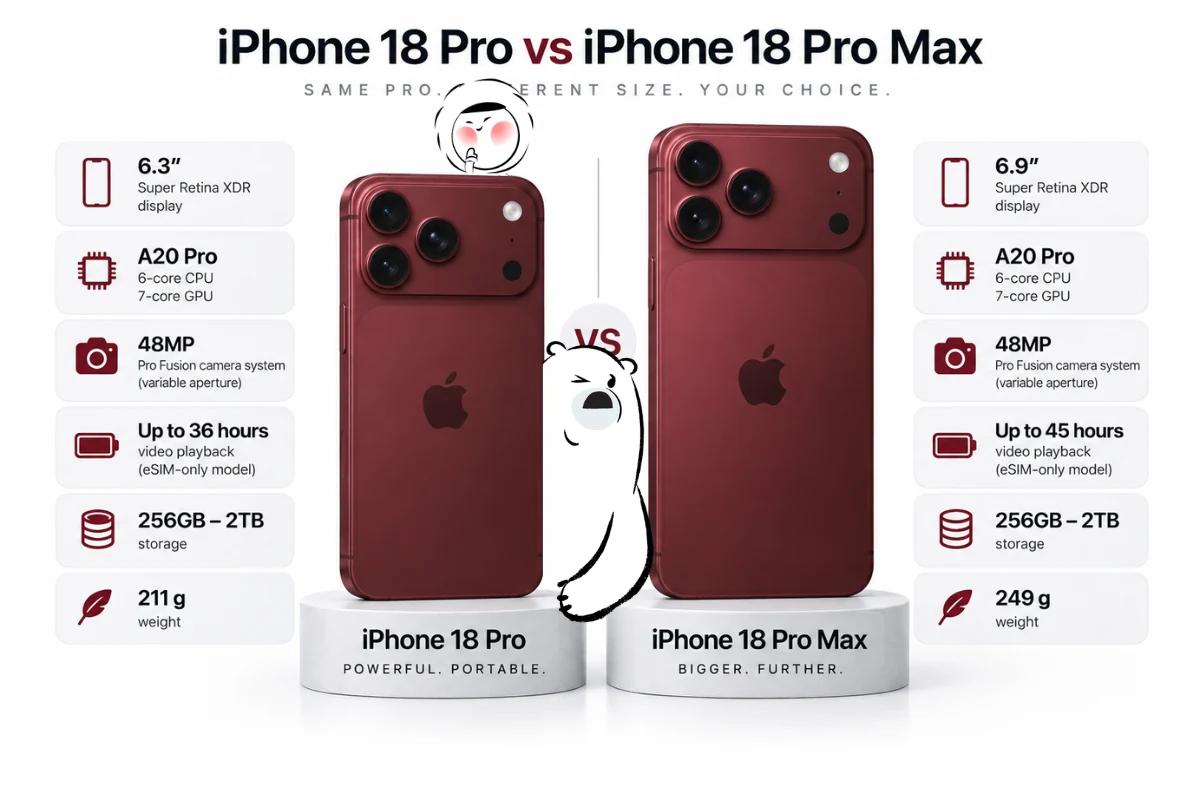
Apple launched both models on September 18, 2026. In the US, the iPhone 18 Pro starts at $1,199 and the Pro Max at $1,299, with 256GB as the starting capacity on both. The Pro has a 6.3-inch display and weighs 211 grams, while the Pro Max has a 6.9-inch display and weighs 249 grams.
For travelers, the decision is particularly clear. The Pro Max gives you more battery reserve and a bigger screen for maps, photos and entertainment. The Pro is easier to carry, easier to handle and takes up less space during a long day on the move.
The $100 Difference
The US starting-price difference between the iPhone 18 Pro and iPhone 18 Pro Max is exactly $100:
- iPhone 18 Pro: $1,199
- iPhone 18 Pro Max: $1,299
Both models start with 256GB and can be configured with 512GB, 1TB or 2TB. Paying more for the Pro Max therefore does not give you additional starting storage.
What you are primarily paying for is the larger physical format and the advantages that come with it, particularly the 6.9-inch display and longer battery life.
That makes the buying decision less complicated than the model names suggest. If you genuinely want the larger screen and battery reserve, an extra $100 is relatively small compared with the total cost of the phone. If you prefer a smaller device, paying more for the Pro Max could leave you with a phone that is less comfortable to use every day.
These are Apple’s US launch prices. Taxes, trade-in offers, carrier promotions and prices in other countries can differ.
For a broader look at the new hardware, cameras, performance and launch changes, see Eskimo’s iPhone 18 Pro overview.
Size And Weight Create The Biggest Everyday Difference
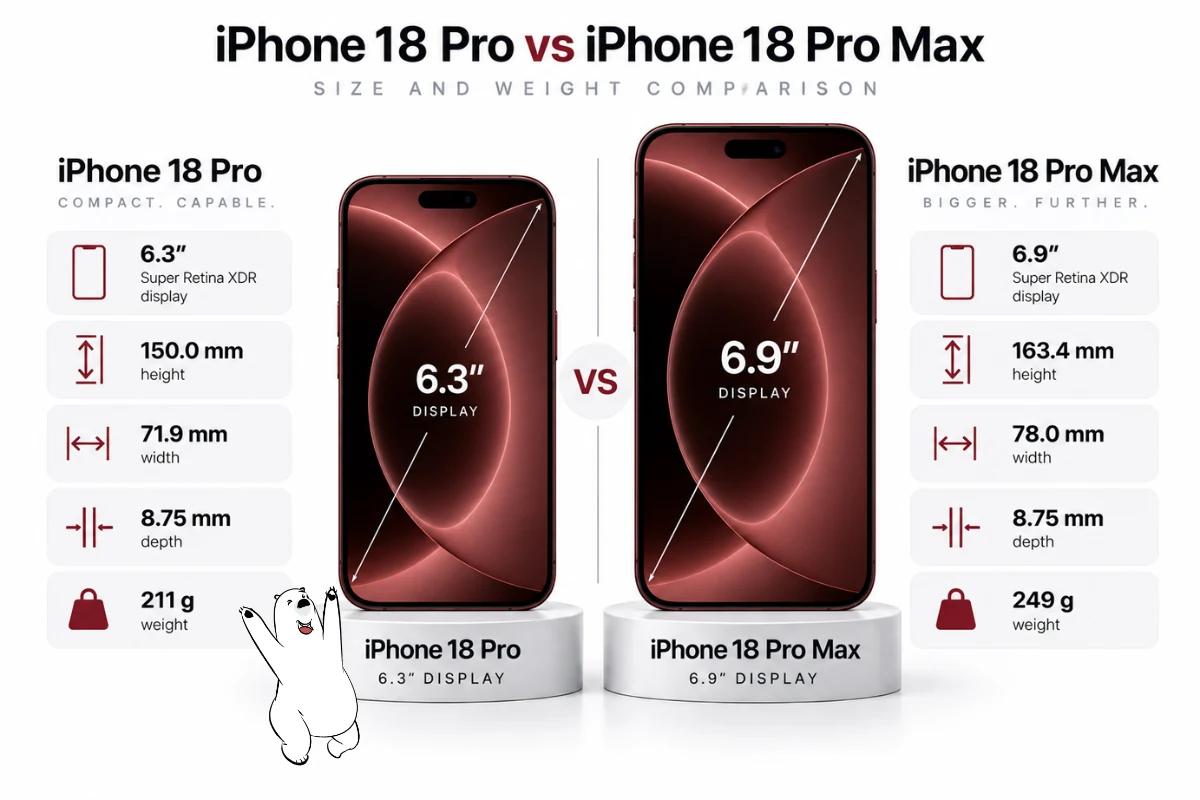
The iPhone 18 Pro has a 6.3-inch Super Retina XDR OLED display. Its body measures 150.0 mm tall and 71.9 mm wide, and it weighs 211 grams.
The iPhone 18 Pro Max increases the display to 6.9 inches. It measures 163.4 mm tall and 78.0 mm wide and weighs 249 grams. Both are 8.75 mm deep.
That means the Pro Max is 38 grams heavier, 13.4 mm taller and 6.1 mm wider.
Those numbers matter more once you stop looking at a specification sheet and start carrying the phone.
The Pro Max gives maps, photos, video and editing tools more room. It can also be more comfortable for reading travel documents, checking detailed navigation or watching downloaded entertainment during a flight.
The Pro has the opposite advantage. It occupies less space in a pocket or small travel bag and puts less weight in your hand during long periods of navigation, photography or sightseeing.
Adding a protective case increases the dimensions and weight of either model, making the underlying size difference even more relevant if portability is a priority.
Battery Life Is The Strongest Reason To Buy The Pro Max
Battery life creates the clearest practical argument for spending more on the iPhone 18 Pro Max.
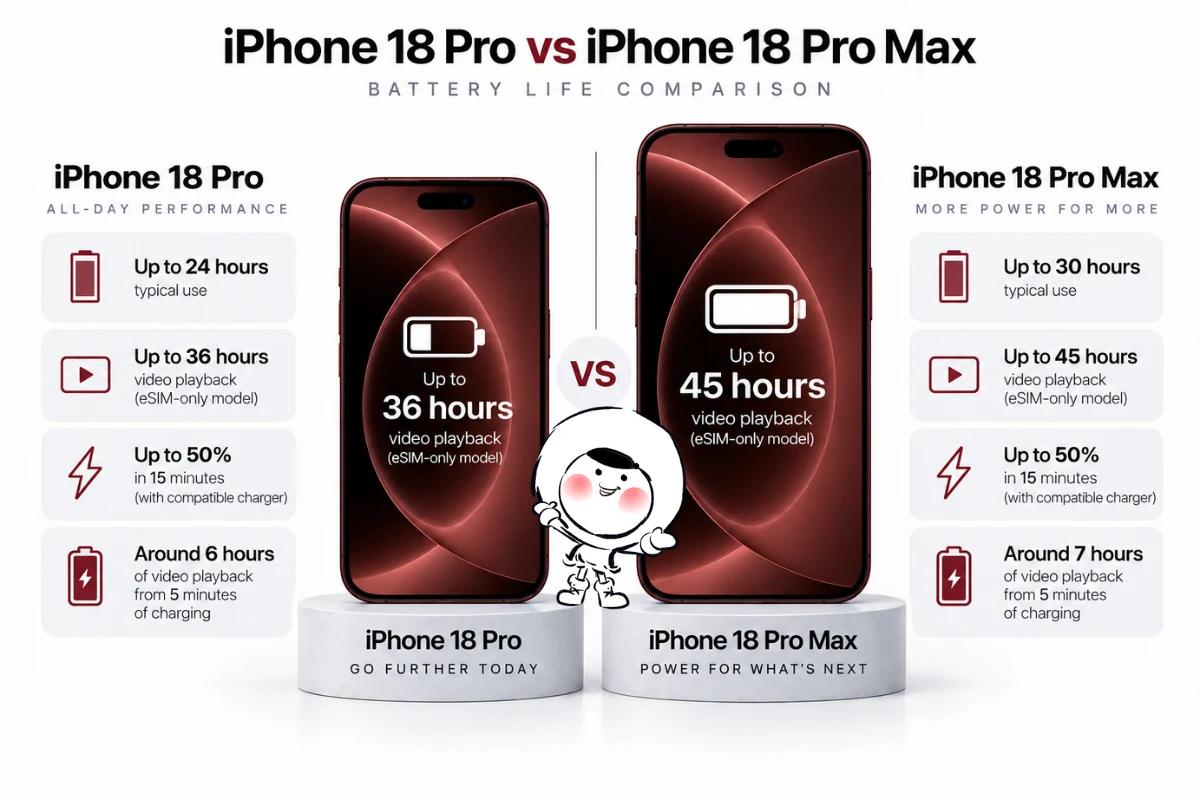
Apple rates the eSIM-only iPhone 18 Pro for up to 36 hours of video playback, compared with 45 hours for the eSIM-only iPhone 18 Pro Max. For typical use, Apple’s technical specifications list up to 24 hours for the Pro and 30 hours for the Pro Max.
Those are Apple ratings rather than a promise of how long either phone will last under every real-world workload. Navigation, 5G use, camera recording, display brightness, temperature, background activity and cellular signal strength can all affect battery consumption.
The difference is still meaningful for travel.
A long international travel day can involve maps, digital boarding passes, ride-hailing, translation, photography, video, messaging and mobile data before you even reach your hotel. The Pro Max provides a larger reserve for that kind of use.
Apple also says the Pro Max can deliver around seven hours of video playback from five minutes of wired charging under its testing conditions. Both models support fast charging to around 50% in 15 minutes with compatible equipment.
If reducing your dependence on a power bank is important, the Pro Max has the clearer advantage. If you normally have access to charging and would rather carry less weight, the Pro remains compelling.
The Displays Favor Different Types Of Travelers
The 6.9-inch Pro Max is better suited to people who regularly use their phone as their main navigation, entertainment or editing screen.
The extra display area can make maps easier to inspect and provides more room for reviewing photographs, watching downloaded video or reading detailed travel information.
The 6.3-inch Pro is easier to manage in tighter situations. Pulling out a boarding pass while carrying luggage, checking directions while walking or taking a quick photograph can all favor a smaller device.
Both displays have the same 460 ppi pixel density, although their resolutions differ because of their physical sizes. Apple lists the Pro at 2622 by 1206 pixels and the Pro Max at 2868 by 1320 pixels.
The real choice is therefore not good screen versus bad screen. It is more screen versus less phone to carry.
Camera Hardware Does Not Give The Max A Clear Advantage
The word “Max” does not mean you are buying a substantially different rear camera system.
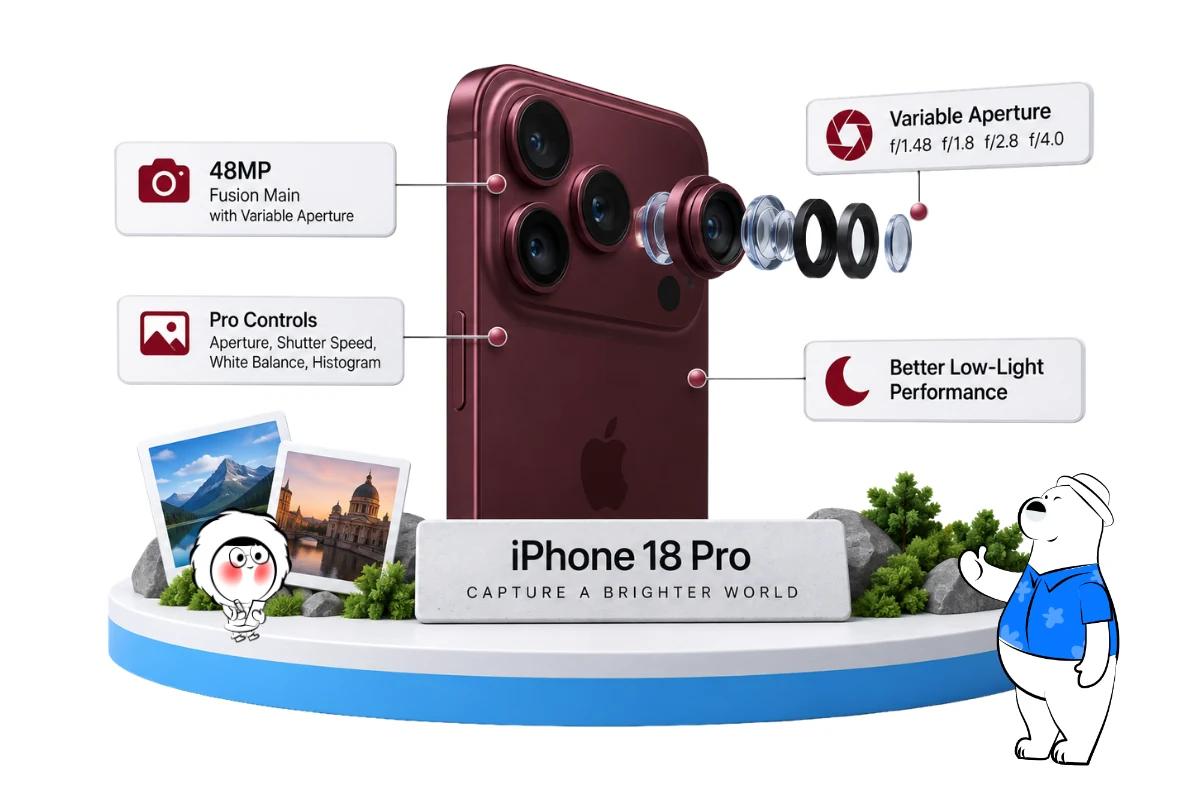
Apple gives both models its new Pro Fusion camera system, including a 48MP Fusion Main camera with variable aperture, a 48MP Fusion Ultra Wide camera and a 48MP Fusion Telephoto camera. The front camera is an 18MP Center Stage camera.
The variable-aperture Main camera is one of the major changes in the 2026 Pro generation. Apple provides four aperture settings of ƒ/1.48, ƒ/1.8, ƒ/2.8 and ƒ/4.0, giving photographers greater control over light and depth of field.
For someone choosing between the two Pro sizes, however, the camera itself is not the main reason to upgrade to the Max.
The Pro Max can indirectly be more convenient for serious mobile photography because its larger display provides more room for framing and reviewing images, while the larger battery gives you more reserve during camera-heavy days.
The smaller Pro gives you the same core camera capabilities in a lighter body.
Performance Is Much Closer Than The Size Difference Suggests
Both phones use Apple’s A20 Pro chip, built on a 2-nanometer process, with a 6-core CPU, 7-core GPU and Dual 16-core Neural Engine. Apple also equips both with its next-generation vapor chamber for sustained performance.
The smaller Pro is therefore not a reduced-performance version of the Pro Max.
For gaming, photo editing, video work, Apple Intelligence features and everyday applications, the buying decision should be based more heavily on physical size and battery life than on an expectation of dramatically different processing performance.
Both phones also run iOS 27 and support Apple’s current generation of Apple Intelligence and Siri AI features, subject to regional, language and feature availability.
Get Eskimo eSIM to stay connected globally
Need internet? Here's what we recommend:

Fixed data plans
- No speed reduction
- No expiry, keep your data forever
- Transfer data to anyone
- Personal hotspot


Storage Is Identical On Both Models
Apple offers the same four capacities on the iPhone 18 Pro and Pro Max:
- 256GB
- 512GB
- 1TB
- 2TB
There is no storage advantage to choosing the larger phone.
For travelers who record large amounts of high-resolution video, ProRAW images or offline media, moving beyond 256GB may still be useful. That decision depends on how much content you keep locally rather than whether you choose the Pro or Pro Max.
The addition of a 2TB option also gives heavy photo and video users considerably more local storage without forcing them to choose one particular screen size.
Both Models Come In The Same Four Colors
Apple offers the iPhone 18 Pro and iPhone 18 Pro Max in black, silver, glacier and burgundy.
There is no Pro Max-exclusive finish, so color does not provide another reason to spend the additional $100.
The more important physical consideration is how your preferred case affects the finished size and weight. A heavy protective case can make the already larger Pro Max substantially bulkier during travel.
eSIM Is More Important On The iPhone 18 Pro Generation
Apple has expanded its use of eSIM-only iPhones in 2026.
According to Apple, eSIM-only versions of the iPhone 18 Pro and Pro Max are sold in Bahrain, Canada, Guam, Japan, Kuwait, Mexico, Oman, Qatar, Saudi Arabia, the UAE, the US and the US Virgin Islands. Apple says removing the physical SIM tray gives those versions space for a larger battery, providing two additional hours of video playback.
The SIM configuration can therefore depend on where the phone was purchased. Travelers should check the specifications for their regional model rather than assuming every iPhone 18 Pro worldwide has the same SIM arrangement.
On Apple’s eSIM-only specifications, the iPhone 18 Pro and Pro Max can store eight or more eSIMs and keep two active simultaneously.
That can be useful when traveling because you may be able to keep your primary line available while activating a separate travel data plan.
For a deeper explanation of stored profiles, active lines and differences between iPhone generations, see Eskimo’s breakdown of how many eSIMs you can have on an iPhone.
Which iPhone 18 Pro Is Better For Travel
The iPhone 18 Pro Max is the stronger choice for battery-first travelers.
Long-haul flights, full-day excursions, navigation, photography and frequent cellular use can make additional battery capacity genuinely useful. The 6.9-inch display is also more comfortable for maps and entertainment during long journeys.
The iPhone 18 Pro is the stronger choice if portability matters more.
Its 211-gram weight is 38 grams below the Pro Max, and its smaller dimensions make it easier to carry in pockets, sling bags and compact travel setups. That advantage becomes particularly noticeable if you spend hours walking around a destination with your phone regularly in your hand.
There is no major camera, storage or processor sacrifice for choosing the smaller model. The central compromise is battery and screen area.
For travelers, that creates a clean decision:
- Choose the iPhone 18 Pro Max for maximum battery life and the largest display.
- Choose the iPhone 18 Pro for lower weight and easier everyday handling.
Who Should Buy The iPhone 18 Pro
Choose the iPhone 18 Pro if you want Apple’s current Pro hardware without carrying its largest conventional iPhone.
It suits travelers who spend a lot of time walking, keep their phone in a pocket, prefer compact bags or frequently use their phone one-handed.
You still get the A20 Pro chip, Pro Fusion camera system, 256GB to 2TB storage choices and the main software capabilities of the Pro Max.
What you give up is straightforward: screen size and battery endurance.
For someone who values portability every day and only occasionally needs maximum battery life, that may be the better compromise.
Who Should Buy The iPhone 18 Pro Max
Choose the iPhone 18 Pro Max if battery life is your highest priority or you already know that you prefer a large phone.
The larger display is useful for maps, video, photography and reading, while Apple’s battery ratings give the Max a substantial endurance advantage over the smaller Pro.
For an additional $100 at US starting prices, those are meaningful upgrades if you will use them.
The cost is physical rather than technical. You have to live with a phone that is 13.4 mm taller, 6.1 mm wider and 38 grams heavier.
If that does not bother you, the Max provides the stronger battery proposition. If it does, the smaller Pro retains most of the capabilities that matter.
Using Mobile Data With iPhone 18 Pro Abroad
International travel can put mobile data to work throughout the day for flight updates, digital boarding passes, maps, ride-hailing and accommodation bookings. Cellular reception is generally stronger in cities, airports and along major transport routes, while coverage can weaken in tunnels, mountains, rural areas and other locations with limited local network infrastructure.
An Eskimo Global eSIM plan can suit an iPhone 18 Pro or Pro Max used across multiple countries. Eskimo’s overall network footprint extends across 175 countries and regions, which can be useful for international stopovers and future trips beyond one destination, although the destinations included in a specific Global plan should be checked before travel. A Universal eSIM lets travelers keep one reusable Eskimo eSIM for supported destinations instead of installing a separate Eskimo profile for every eligible trip.
New users can also claim a free 250MB Global eSIM.
FAQs:
What is the main difference between iPhone 18 Pro and iPhone 18 Pro Max?
The main differences are screen size, dimensions, weight and battery life. The Pro has a 6.3-inch display and weighs 211 grams, while the Pro Max has a 6.9-inch display and weighs 249 grams. The two models otherwise share many of their major Pro features.
Is the iPhone 18 Pro Max worth $100 more?
The extra $100 is easier to justify if you value a 6.9-inch display and longer battery life. If portability matters more, the iPhone 18 Pro offers the same storage choices, A20 Pro platform and core camera system in a smaller and lighter device.
Does the iPhone 18 Pro Max have a better camera than the iPhone 18 Pro?
Apple lists the same core Pro Fusion camera system for both models, including 48MP Main, Ultra Wide and Telephoto cameras and an 18MP Center Stage front camera. Camera hardware is therefore not the primary reason to choose the Max.
How much better is iPhone 18 Pro Max battery life?
Apple rates eSIM-only models for up to 45 hours of video playback on the Pro Max versus 36 hours on the Pro. For typical use, Apple lists up to 30 hours for the Pro Max and 24 hours for the Pro. Actual battery life varies with usage and network conditions.
How many eSIMs can the iPhone 18 Pro and Pro Max use?
Apple’s eSIM-only iPhone 18 Pro specifications support storing eight or more eSIMs with two active simultaneously. SIM configurations vary by sales region, so travelers should confirm the specifications of the model sold in their market.