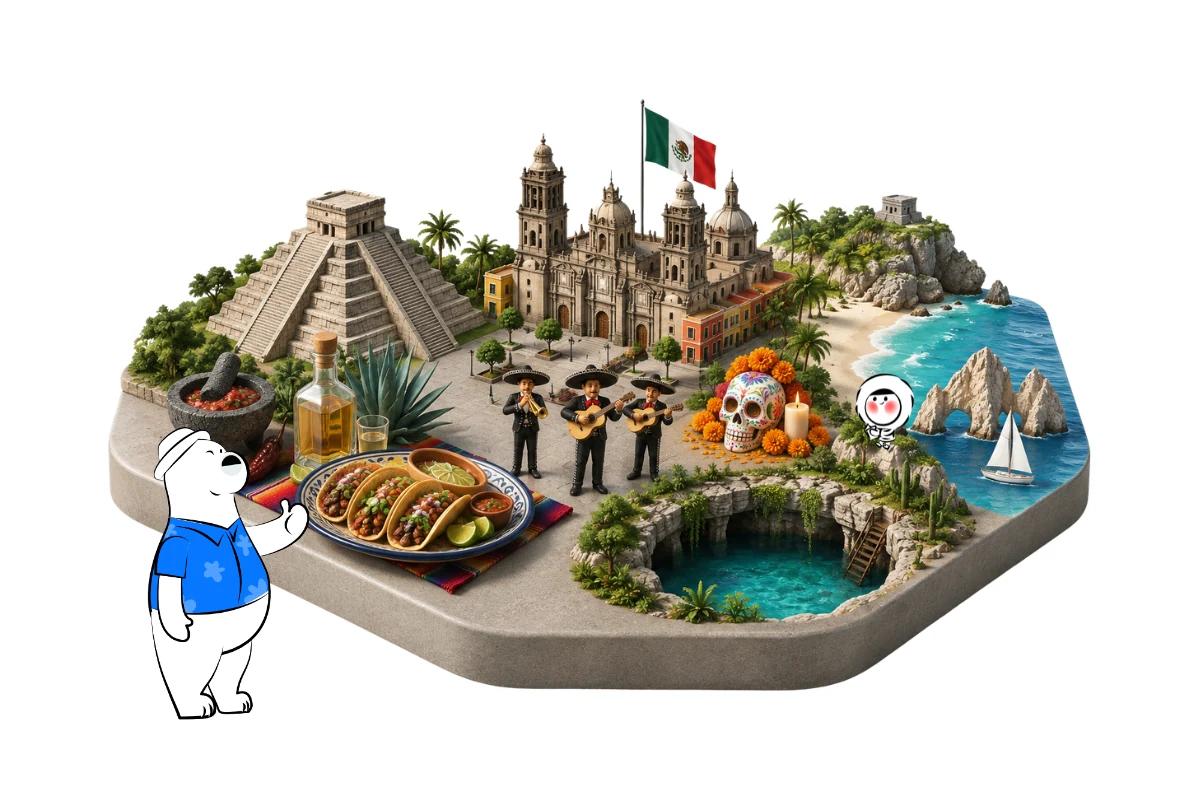
Mexico is known for its regional cuisine, ancient Maya and other Mesoamerican sites, Caribbean and Pacific beaches, Día de Muertos traditions, mariachi music, cenotes, historic cities, tequila and mezcal, art, and remarkable regional diversity.
For travelers, that variety is the main attraction. A single trip might combine museums and street food in Mexico City, archaeological sites in Yucatán, Indigenous and culinary traditions in Oaxaca, or beaches and marine life along two very different coastlines.
Mexico is also a large country, so no single destination represents it completely. The most practical trips usually focus on one or two regions rather than trying to cover the country in a few days.
What Mexico Is Known For
Mexican food
Mexican cuisine is far more regional than the tacos and burritos most familiar outside the country.
Oaxaca is associated with moles, tlayudas, chocolate, and mezcal. Yucatán cooking includes dishes such as cochinita pibil, while Puebla is closely connected with mole poblano. Coastal regions add their own seafood traditions.
Traditional Mexican cuisine was added to UNESCO’s Representative List of the Intangible Cultural Heritage of Humanity in 2010. UNESCO describes it as a cultural system involving ingredients such as corn, beans, and chili alongside farming methods, culinary techniques, and community traditions.
For many travelers, food can shape the itinerary as much as sightseeing. Markets, neighborhood restaurants, bakeries, street stalls, and regional specialties give each destination a different flavor.
Ancient Maya and Mesoamerican sites
Mexico contains archaeological sites connected with several major pre-Hispanic civilizations.
Chichén Itzá in Yucatán is one of the country’s best-known Maya sites. Its monuments include El Castillo, the Temple of the Warriors, the Great Ball Court, and El Caracol.
Teotihuacán, northeast of Mexico City, developed into one of ancient Mesoamerica’s great urban centers. Its monumental complex includes the Pyramids of the Sun and Moon and the Temple of the Feathered Serpent.
Other important archaeological destinations include Palenque, Uxmal, Monte Albán, and El Tajín. Travelers should check current opening hours, ticket arrangements, and site restrictions before visiting because conditions can change.
Mexico City
Mexico City combines major museums, archaeological remains, markets, food neighborhoods, historic architecture, parks, contemporary art, and nightlife.
The historic center and Xochimilco form a UNESCO World Heritage property, while the Museo Nacional de Antropología provides a broad introduction to Mexico’s Indigenous civilizations and regional cultures.
Different neighborhoods offer very different experiences. Centro Histórico works well for major monuments, Chapultepec combines museums with green space, and Roma and Condesa are popular for restaurants, cafés, and walkable streets.
For travelers who want culture and food concentrated in one place, Mexico City is one of the country’s strongest starting points.
Caribbean and Pacific beaches
Mexico has extensive coastlines facing several bodies of water, including the Caribbean Sea, Gulf of Mexico, Pacific Ocean, and Gulf of California.
On the Caribbean side, Cancún, Isla Mujeres, Playa del Carmen, Cozumel, and the Riviera Maya are among the most established beach destinations. Pale sand and turquoise water are defining features of many coastal areas here.
The Pacific coast has a different character. Puerto Vallarta, Riviera Nayarit, Los Cabos, Puerto Escondido, and other coastal destinations combine beaches with surfing, fishing, food, nightlife, and marine activities.
Choosing between Mexico’s coasts should depend on the trip you want rather than treating every beach region as interchangeable.
Cenotes
Cenotes are natural sinkholes or openings into groundwater systems formed in limestone landscapes, particularly across the Yucatán Peninsula.
Some are open pools surrounded by vegetation. Others are partially enclosed caves where sunlight reaches the groundwater below.
Cenotes also have cultural and archaeological importance. Natural wells and underground water systems played a major role in Maya settlements and ceremonial landscapes.
Access conditions vary widely. Some cenotes have developed visitor facilities, while others require local transport or guided access. Check swimming rules, opening hours, and conservation requirements before visiting.
Día de Muertos
Día de Muertos, or Day of the Dead, is one of Mexico’s most internationally recognized cultural traditions.
The observance takes place around the end of October and beginning of November and centers on remembrance of deceased family members and loved ones. Traditions may include family altars, flowers, candles, food, cemetery visits, and other customs that differ between communities.
UNESCO recognizes the Indigenous festivity dedicated to the dead as part of the Intangible Cultural Heritage of Humanity.
Travelers visiting during this period should remember that it is not simply a costume festival. It carries strong family, community, and spiritual meaning.
Accommodation and transport demand can also rise in places known for major celebrations. Eskimo’s Mexico public holidays and cultural events calendar covers Día de Muertos, Semana Santa, national holidays, long weekends, and other periods that can affect crowds and travel planning.
Tequila and mezcal
Mexico is the home of tequila and mezcal, but the two spirits are not interchangeable.
Tequila is closely associated with Jalisco and the town of Tequila, while mezcal production is particularly associated with Oaxaca and several other regions. Both come from agave, although production areas, permitted agave varieties, and manufacturing methods differ.
Travelers interested in the subject can visit distilleries, agave-growing areas, tasting rooms, and specialist bars.
A responsible tasting can also provide insight into agriculture, production methods, and regional traditions rather than serving only as a nightlife activity.
Oaxaca
Oaxaca is one of Mexico’s strongest destinations for travelers interested in food, crafts, archaeology, Indigenous cultures, markets, and historic architecture.
Oaxaca City provides the main urban base, while nearby Monte Albán adds an important archaeological dimension. Villages and smaller towns across the state are associated with weaving, pottery, wood carving, mezcal production, and regional cuisines.
The historic center of Oaxaca and Monte Albán form a UNESCO World Heritage property.
Oaxaca also demonstrates how difficult it is to describe Mexico as one culture. Languages, food, crafts, celebrations, and local identities can vary considerably within a single state.
Chichén Itzá
Chichén Itzá deserves separate attention because it is one of Mexico’s most recognizable landmarks.
El Castillo, also known as the Temple of Kukulkán, dominates the archaeological zone, but the wider site includes the Great Ball Court, Temple of the Warriors, El Caracol, and many other structures.
UNESCO recognizes the site for its importance to Maya-Toltec civilization and the architectural and cultural influences visible across the complex.
Chichén Itzá can be reached from destinations including Valladolid, Mérida, Cancún, and the Riviera Maya. Starting early can help with heat and crowds, although official access times should always be checked before departure.
Mariachi music
Mariachi is one of the musical traditions most closely identified with Mexico.
Modern ensembles commonly include violins, trumpets, vihuela, guitarrón, and other instruments. The repertoire can include rancheras, corridos, serenades, waltzes, and regional songs.
UNESCO added mariachi to its Representative List of the Intangible Cultural Heritage of Humanity in 2011.
Guadalajara and the wider state of Jalisco are particularly associated with the tradition, although mariachi performances can be found throughout Mexico.
Get Eskimo eSIM to stay connected in Mexico
Need internet in Mexico? Here's what we recommend:

Fixed data plans
- No speed reduction
- No expiry, keep your data forever
- Transfer data to anyone
- Personal hotspot



Unlimited data plans
- Unlimited day pass
- Daily 3GB high-speed + 1Mbps unlimited after
- Personal hotspot
Historic cities and towns
Mexico’s urban heritage extends far beyond Mexico City.
Guanajuato is known for steep streets, colorful buildings, plazas, and mining history. San Miguel de Allende combines historic architecture with galleries and restaurants, while Puebla is associated with churches, food, Talavera ceramics, and a large historic center.
Morelia and Zacatecas offer yet another architectural character.
Mexico has a large collection of cultural and natural properties on the UNESCO World Heritage List, covering archaeological sites, historic centers, cultural landscapes, and protected natural areas.
Mexican art and Frida Kahlo
Mexico has had a major influence on modern art, muralism, architecture, photography, folk art, and design.
Frida Kahlo remains the country’s most internationally recognized individual artist. Her former home, the Museo Frida Kahlo or Casa Azul in Coyoacán, is one of Mexico City’s best-known cultural attractions.
Diego Rivera, José Clemente Orozco, and David Alfaro Siqueiros were central figures in Mexican muralism, and their large-scale works remain visible in public buildings and museums.
Regional craft traditions add another layer, from textiles and ceramics to metalwork, carved wood, masks, and papel picado.
Baja California and Baja California Sur
The Baja California Peninsula gives travelers a very different view of Mexico.
Instead of tropical jungle or dense historic centers, much of the peninsula is shaped by desert landscapes, mountains, long coastlines, and the waters of the Pacific Ocean and Gulf of California.
Los Cabos is the best-known resort area, while La Paz, Loreto, and smaller coastal communities attract travelers interested in marine life, kayaking, road trips, and outdoor activities.
Seasonal wildlife experiences can include whale watching, although timing, species, and viewing areas vary. Travelers planning a trip around wildlife should check the correct season and choose responsible local operators.
Marine life and diving
Mexico has major diving and snorkeling destinations on both sides of the country.
Cozumel is particularly well known for Caribbean reef diving. The Riviera Maya combines reef access with freshwater cenotes, while Baja California and the Gulf of California offer very different marine environments.
Depending on the location and season, travelers may encounter sea turtles, rays, reef fish, whale sharks, whales, and other marine species.
Wildlife sightings are never guaranteed. Check seasonal conditions and local conservation rules before arranging a trip around a specific species.
Regional and Indigenous cultures
One of the most important things Mexico is known for cannot be reduced to a single landmark or dish: regional diversity.
Mexico is home to numerous Indigenous peoples, languages, food traditions, crafts, celebrations, and community identities. Oaxaca, Chiapas, Yucatán, Michoacán, Jalisco, Veracruz, and northern Mexico can feel dramatically different from one another.
That diversity affects what travelers eat, hear, see, and experience.
It also makes slower travel worthwhile. Spending more time in one region often reveals far more than rushing between distant headline attractions.
Best Places To Experience Mexico
For a first trip, several destinations offer useful introductions to different sides of Mexico.
Mexico City is one of the strongest choices for museums, food, architecture, markets, and urban culture.
Oaxaca suits travelers interested in regional cuisine, crafts, Indigenous traditions, mezcal, and archaeological sites.
Yucatán combines Maya heritage, cenotes, historic cities such as Mérida and Valladolid, and access to archaeological sites.
Riviera Maya and Cozumel work well for Caribbean beaches, snorkeling, diving, cenotes, and trips to nearby ruins.
Puerto Vallarta and the Pacific coast combine beaches with food, nightlife, coastal towns, and marine activities.
Baja California Sur suits travelers drawn to desert landscapes, coastal road trips, wildlife, and the Gulf of California.
Distances between these regions are substantial. Domestic flights, long-distance buses, and focused regional road trips are often more practical than trying to connect every destination overland.
Travelers combining Mexico with a longer Latin America trip can also compare destinations in Eskimo’s overview of the most visited countries in South America, including Colombia, Brazil, Peru, Argentina, and Chile.
Best Time To Visit Mexico
There is no single best month for the entire country because altitude, latitude, coastline, and regional weather create very different conditions.
For much of central and southern Mexico, November through April generally brings drier weather, making this period popular for city trips and many archaeological destinations. Coastal resorts can also be busy during winter.
Summer often brings more heat and rainfall to many central and southern regions. Tropical cyclone risk also varies by coast. The Atlantic hurricane season runs from June 1 to November 30 and can affect Mexico’s Caribbean and Gulf coasts, while the eastern Pacific hurricane season runs from May 15 to November 30.
High-altitude destinations such as Mexico City can feel considerably cooler than low-lying beach areas, particularly at night.
Domestic travel periods can matter just as much as weather. Semana Santa, Christmas, national holidays, and long weekends can increase demand for flights, buses, and accommodation. Checking Mexico’s 2026 public holidays and major cultural observances before booking can help identify periods when popular destinations may be busier.
Using Mobile Data Around Mexico
Mobile data can help with Metro and transport directions in Mexico City, intercity bus bookings, attraction tickets, restaurant reservations, ride-hailing, and road navigation between towns. Reception is generally stronger in cities and established tourist areas, while signal can vary on rural roads, in mountainous areas, remote beaches, nature reserves, and archaeological zones.
An Eskimo Mexico eSIM plan is available for trips focused on Mexico. Eskimo’s wider network footprint covers 175 countries and regions overall, which can be useful for travelers continuing beyond Mexico or planning future international trips, while no-expiry fixed data means unused eligible fixed data can remain available for another trip.
New users can also claim a free 250MB Global eSIM.
FAQs
What is Mexico most famous for?
Mexico is especially famous for its regional cuisine, Maya and other Mesoamerican archaeological sites, beaches, Día de Muertos, mariachi music, tequila and mezcal, historic cities, cenotes, and art.
What food is Mexico known for?
Mexico is known for tacos, tamales, mole, pozole, regional salsas, seafood, cochinita pibil, barbacoa, and many other dishes. Food varies considerably between regions, so Oaxaca, Yucatán, Puebla, Veracruz, and northern Mexico each offer different culinary traditions.
Which part of Mexico is best for a first visit?
Mexico City is a strong first choice for food, museums, and culture. Yucatán suits travelers interested in archaeological sites and cenotes, while Riviera Maya or the Pacific coast may suit travelers prioritizing beaches.
Is Mexico only known for beaches and resorts?
No. Beaches are a major part of Mexican tourism, but the country also has archaeological sites, historic cities, Indigenous cultures, mountains, deserts, museums, regional cuisines, wildlife areas, and internationally recognized cultural traditions.
How long should a first trip to Mexico be?
Around seven to ten days is enough for one main region or a carefully planned two-stop trip. Travelers combining distant areas such as Mexico City, Yucatán, Oaxaca, and Baja California usually need more time because of the distances involved.