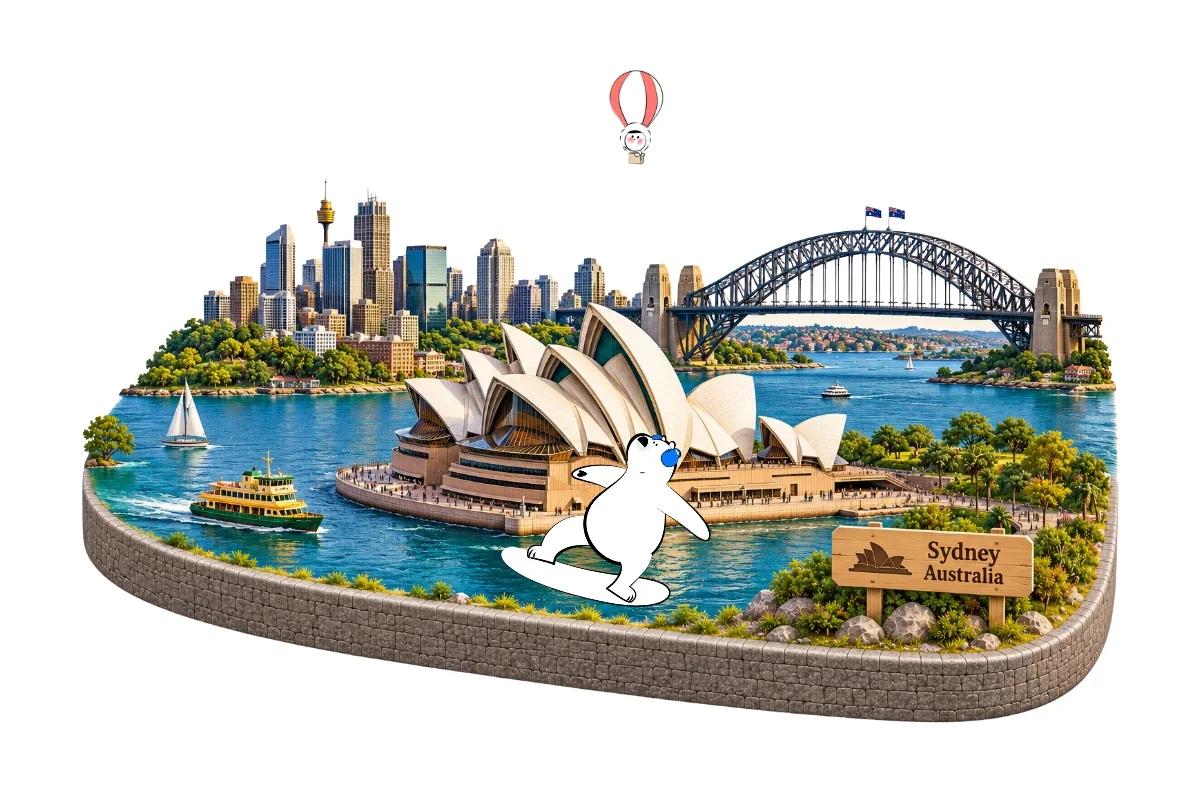
The Sydney Opera House is Australia’s most recognizable architectural landmark, located on Bennelong Point beside Sydney Harbour. Opened in 1973, it is a UNESCO World Heritage Site known for its distinctive white roof shells, innovative design and internationally renowned performances.
Visitors can explore the surrounding waterfront for free, book a guided tour to discover the building’s architecture and history, or attend an opera, concert, theatre production or other live performance.
For first-time visitors, allow one to two hours to explore the exterior, take photographs and enjoy the harbour. Guided tours and performances require additional time, and advance booking is recommended for popular dates.
Sydney Opera House Location and Visitor Information
The Sydney Opera House stands on Bennelong Point in central Sydney, New South Wales, Australia.
Its waterfront position places it between the Sydney Harbour Bridge and the Royal Botanic Garden, making it easy to combine with other major Sydney attractions.
Essential visitor information:
- Location: Bennelong Point, Sydney NSW 2000, Australia
- Opened: 20 October 1973
- Architect: Jørn Utzon
- Architectural style: Expressionist modern architecture
- UNESCO status: World Heritage Site since 2007
- Nearest train station: Circular Quay
- Walking distance from Circular Quay: Approximately 10 minutes
- Exterior access: Generally free in publicly accessible areas
- Interior access: Guided tours, performances and designated public spaces
- Best for: Architecture, photography, live performances and harbour views
The Opera House is an active performing arts venue rather than a conventional museum. Access to its interiors depends on scheduled activities, security arrangements and venue operations.
Its central location also makes it a convenient starting point for exploring Sydney Harbour.
For travelers planning a longer Australian itinerary, Eskimo’s overview of the most visited cities in Australia provides additional destinations to consider beyond Sydney.
Sydney Opera House Tickets and Tours
Sydney Opera House tickets are required for guided tours and most performances, but visitors do not need a ticket simply to admire the building from the surrounding public waterfront.
There are three main ways to experience the landmark:
- Exterior visit: Explore the publicly accessible waterfront and photograph the architecture.
- Guided tour: Discover the building’s history, engineering and selected interior spaces.
- Live performance: Attend an opera, concert, theatre production, dance performance or another scheduled event.
Each option offers a different experience, and a performance ticket does not automatically include a guided tour.
Sydney Opera House guided tours
The standard Sydney Opera House Tour lasts approximately one hour and introduces visitors to the building’s architecture, construction and cultural significance.
Depending on venue operations, visitors may see selected performance spaces and learn about the challenges involved in building the Opera House.
The official tour information states that participants may walk up to 2.5 kilometres and climb or descend approximately 300 stairs during the experience.
The standard tour is therefore not suitable for everyone, particularly visitors who use wheelchairs or walkers.
A separate Mobility Access Tour is available for visitors who require a step-free experience.
Performance venues remain operational throughout the day, so the rooms included in a tour can change.
Visitors should check the official Sydney Opera House Tour for current availability, ticket prices and accessibility requirements.
Sydney Opera House ticket prices
Ticket prices depend on the experience, date and seating category.
Exterior sightseeing: Generally free.
Standard guided tour: Paid admission, with prices varying according to the current ticket category.
Specialized tours: Separate pricing applies to experiences such as architectural or behind-the-scenes tours.
Live performances: Ticket prices vary according to the production, venue and seating location.
There is no universal admission ticket covering every performance space and experience.
For current prices, visitors should use the official booking system rather than relying on outdated third-party ticket information.
Booking advice
Advance booking is recommended for guided tours during weekends, school holidays and busy travel periods.
Popular performances may sell out well before the scheduled date.
The Opera House advises visitors taking the standard guided tour to arrive at the Welcome Centre on the Lower Concourse 15 minutes before departure.
Late arrivals may lose their booking, so allow enough time to walk from Circular Quay and locate the meeting point.
Before purchasing, check the cancellation conditions, age restrictions, accessibility arrangements and photography rules.
Sydney Opera House Opening Hours and Best Time to Visit
The Sydney Opera House does not have one opening schedule covering every visitor experience.
Guided tours, performances, restaurants and indoor public spaces operate according to their own schedules.
Outdoor access may also be affected by special events, security arrangements or maintenance.
Opening hours
The surrounding waterfront is generally accessible throughout the day, although temporary restrictions can apply.
Guided tours operate at scheduled departure times, while performance venues open according to individual events.
Restaurants and bars maintain separate trading hours.
Visitors should check the official Sydney Opera House visitor information and their specific booking details before arriving.
Best time of day
Early morning is usually the best choice for visitors who want quieter surroundings and photographs with fewer people.
The waterfront tends to become busier as sightseeing activity increases throughout the day.
Late afternoon offers attractive changing light and is convenient for combining sightseeing with dinner around Circular Quay.
Evening is particularly suitable for attending performances and photographing the illuminated waterfront.
Sunset timing and lighting conditions change throughout the year.
Best time of year
Sydney is a year-round destination, but seasonal weather can influence outdoor sightseeing.
Spring, September to November: Generally mild conditions make walking around the harbour comfortable.
Summer, December to February: Longer daylight hours suit outdoor activities, although hot weather and holiday crowds can make the waterfront busier.
Autumn, March to May: Often provides comfortable temperatures for photography and exploring central Sydney.
Winter, June to August: Cooler temperatures and shorter daylight hours can make evening sightseeing less comfortable, particularly when the harbour is windy.
Visitors planning extended outdoor activities should check the Australian Bureau of Meteorology for current conditions.
Getting to Sydney Opera House
The easiest way to reach the Sydney Opera House is usually by public transport to Circular Quay, followed by a short walk along the waterfront.
Circular Quay is a major transport interchange serving trains, ferries and buses.
Walking from Circular Quay
From Circular Quay station, follow the eastern waterfront promenade toward Bennelong Point.
The walk usually takes approximately 10 minutes.
Along the way, visitors can enjoy views of the harbour, ferry terminals and Opera House roof shells.
The route is straightforward, although pedestrian traffic can increase during major events.
Train and metro
Circular Quay is the nearest major train station.
Travelers using Sydney Metro can connect with the rail network or continue on foot from an appropriate central-city station, depending on their starting point.
The Transport for NSW journey planner provides current routes, service information and travel options.
Ferry
A ferry journey offers a scenic approach to the Opera House.
Circular Quay connects with several Sydney Harbour ferry routes, making it convenient for visitors traveling from other waterfront destinations.
Ferry schedules may change because of weather, operational conditions or special events.
Bus and car
Several bus routes serve the Circular Quay area.
Paid parking is available near the Opera House, but traffic congestion and parking costs can make public transport more convenient.
Visitors attending evening performances should allow additional travel time.
Accessibility
The Sydney Opera House provides accessible facilities, seating arrangements and mobility assistance services.
However, accessibility varies between tours and performance spaces.
The standard guided tour includes substantial walking and stairs. Visitors who need step-free access should consider the dedicated Mobility Access Tour.
A courtesy bus and accessible buggy service may also assist eligible visitors traveling between Circular Quay and the Opera House precinct, subject to operating arrangements.
Detailed information is available through the official Sydney Opera House accessibility services.
Sydney Opera House Architecture and Design
The Sydney Opera House is internationally recognized for its distinctive roof shells and innovative engineering.
Danish architect Jørn Utzon won the international design competition in 1957 with a proposal that challenged conventional performing arts architecture.
His design combined sculptural forms with a dramatic waterfront setting, creating one of the most influential buildings of the twentieth century.
The famous sail-shaped roofs
The Opera House’s roof shells are often described as sails because of their curved forms and relationship with Sydney Harbour.
However, the design was not created simply by arranging decorative sail shapes.
The shells required a complex structural system that could support their geometry while remaining practical to construct.
The eventual engineering solution used sections derived from a common sphere.
This approach allowed repeated structural components to be manufactured and assembled more efficiently.
The roof surfaces are covered with more than one million ceramic tiles in white and cream tones.
Their appearance changes throughout the day as sunlight moves across the building.
Engineering and construction
Construction began in 1959.
The project faced major technical challenges because the original roof design required engineering solutions that had not been fully developed when work started.
Engineers collaborated with the architectural team to create a practical system for constructing the shells.
The building also experienced significant financial and political difficulties.
Utzon left the project in 1966 following disagreements with the New South Wales government.
Australian architects, including Peter Hall, subsequently completed the interiors and remaining construction work.
The finished building retained Utzon’s celebrated exterior design, although parts of the interior differed from his original vision.
Architectural significance
The Sydney Opera House demonstrated how expressive architectural forms could be realized through innovative structural engineering.
Its design influenced later generations of architects and helped establish Sydney as a major cultural destination.
In 2007, the building was added to the UNESCO World Heritage List.
The UNESCO World Heritage listing recognizes the Opera House as an exceptional achievement of twentieth-century architecture.
Get Eskimo eSIM to stay connected globally
Need internet while travelling? Here's what we recommend:

Fixed data plans
- No speed reduction
- No expiry, keep your data forever
- Transfer data to anyone
- Personal hotspot


Sydney Opera House History and Interesting Facts
The Sydney Opera House was developed to provide Sydney with a major performing arts venue.
What began as an ambitious public project eventually became one of Australia’s most internationally recognized cultural institutions.
From design competition to opening
In 1956, the New South Wales government launched an international competition for a new opera house.
Jørn Utzon’s proposal was selected the following year.
Construction began at Bennelong Point in 1959, replacing an earlier tram depot.
The project experienced engineering challenges, delays and substantial cost increases.
After Utzon’s departure, Australian architect Peter Hall played a leading role in developing the building’s interiors.
The Opera House officially opened on 20 October 1973, with Queen Elizabeth II presiding over the ceremony.
Five interesting Sydney Opera House facts
1. Construction took approximately 14 years.
The project began in 1959 and was completed in 1973, considerably later than originally planned.
2. The roof contains more than one million tiles.
The tiles form the building’s distinctive pale exterior and contribute to its changing appearance in different lighting conditions.
3. It is not exclusively an opera venue.
The building hosts concerts, theatre, dance, comedy, talks and other cultural events.
4. Jørn Utzon did not attend the official opening.
He had left the project several years earlier and was absent from the 1973 ceremony.
5. The site has a much older cultural history.
Bennelong Point is also known as Tubowgule and holds significance for the Gadigal people, the Traditional Custodians of the area.
The location has long been associated with gathering and cultural activity.
Cultural importance
The Sydney Opera House remains an active performing arts institution.
Its cultural program brings together Australian and international performers across multiple disciplines.
The building also serves as a major public gathering place, connecting contemporary cultural activity with one of Sydney’s most significant waterfront locations.
Its importance extends beyond architecture because it continues to function as a working cultural venue.
Shows, Concerts and Events at Sydney Opera House
The Sydney Opera House hosts performances throughout the year, including opera, classical music, contemporary concerts, theatre, dance and comedy.
The building contains several venues with different seating capacities and performance styles.
Concert Hall
The Concert Hall is the largest performance venue within the Opera House.
It hosts orchestral concerts, contemporary music performances and major cultural events.
Its interior is known for extensive timber finishes and a dramatic vaulted ceiling.
Joan Sutherland Theatre
The Joan Sutherland Theatre is a principal venue for opera and ballet.
Named after the celebrated Australian soprano, it provides a traditional theatrical setting for staged productions.
Drama Theatre
The Drama Theatre hosts theatrical productions and other stage performances.
Its smaller scale creates a more intimate audience experience than the Concert Hall.
Playhouse and Studio
The Playhouse and Studio accommodate smaller productions, contemporary performances and experimental artistic programs.
These venues contribute to the Opera House’s broader cultural program.
Finding current performances
The official Sydney Opera House events calendar provides current performances, dates, ticket availability and venue information.
Before booking, check the production’s duration, age recommendations, accessibility arrangements and seating options.
Some performances restrict late entry, so arriving before the scheduled start time is advisable.
Best Sydney Opera House Photo Spots
The best Sydney Opera House photography locations depend on whether visitors want close architectural details or wider harbour views.
Several excellent viewpoints are within walking distance of the building.
Circular Quay
Circular Quay provides convenient views of the Opera House from the western side.
The waterfront promenade is suitable for photographing the roof shells, harbour activity and passing ferries.
This is one of the easiest locations for first-time visitors.
Royal Botanic Garden
The Royal Botanic Garden offers views of the Opera House from the eastern side.
Walking toward Mrs Macquarie’s Point reveals broader harbour panoramas.
From selected viewpoints, photographers can capture the Opera House and Sydney Harbour Bridge together.
The garden is also a convenient place to continue walking after visiting the Opera House.
Sydney Harbour Bridge
The Sydney Harbour Bridge offers elevated perspectives of the Opera House and surrounding waterfront.
Pedestrian viewpoints provide opportunities to photograph the building against the harbour.
Visitors seeking a wider architectural perspective may prefer these elevated locations.
Sydney Harbour ferries
Ferries provide changing views of the Opera House as they move across the harbour.
The building’s roof shells appear different from each angle, making ferry journeys particularly useful for photography.
Passengers should use designated viewing areas and follow onboard safety instructions.
Nearby Attractions and Restaurants
The Opera House’s central location makes it easy to combine with several major Sydney attractions.
Sydney Harbour Bridge
The Sydney Harbour Bridge is one of Australia’s most recognizable landmarks.
Visitors can photograph it from Circular Quay, walk across its pedestrian route or explore nearby viewpoints.
The bridge and Opera House are often included in the same sightseeing itinerary.
Royal Botanic Garden
The Royal Botanic Garden sits immediately southeast of the Opera House.
Its walking paths, landscaped grounds and harbour views provide a quieter contrast to the busy waterfront.
It is particularly suitable for visitors who enjoy gardens, photography and relaxed sightseeing.
The Rocks
The Rocks is a historic neighborhood west of Circular Quay.
Its heritage buildings, older streets, markets and dining options make it a convenient addition to a central Sydney visit.
Travelers can reach the area on foot from the Opera House.
Bondi Beach
Bondi Beach is farther from the Opera House but can be combined with central Sydney sightseeing during a longer stay.
Known for its surf culture, coastal scenery and ocean pool, Bondi offers a different experience from the harbour precinct.
Visitors planning to explore Sydney beyond the city centre can use Eskimo’s Bondi Beach visitor information to understand transport options, swimming conditions and the coastal walk.
Restaurants around Sydney Opera House
The Opera House precinct and Circular Quay offer dining options ranging from casual waterfront refreshments to restaurants with harbour views.
Popular restaurants can become busy before performances and during weekends.
Booking ahead is sensible for visitors planning dinner before an evening event.
A Practical Two-Hour Sydney Opera House Walking Route
Visitors who want to see the Opera House and nearby harbour attractions without booking a performance can follow a straightforward walking route.
First 20 minutes: Circular Quay
Arrive at Circular Quay and walk along the eastern waterfront.
Stop for photographs of the Opera House with the harbour in the foreground.
Next 30 minutes: Sydney Opera House
Continue to Bennelong Point and explore the publicly accessible exterior areas.
Walk around the building to appreciate the roof shells from different angles.
Next 40 minutes: Royal Botanic Garden
Follow the waterfront toward the Royal Botanic Garden.
Continue along the garden’s walking paths for views back toward the Opera House and Harbour Bridge.
Final 30 minutes: Return toward Circular Quay
Walk back toward Circular Quay, allowing time for additional photographs or a short refreshment stop.
This route is suitable for visitors who want to experience the landmark’s exterior and surroundings.
Travelers booking a guided tour should allow approximately one additional hour, plus check-in time.
Practical Tips for First-Time Visitors
A few practical considerations can make visiting the Sydney Opera House easier.
Use public transport. Circular Quay is usually the most convenient arrival point for visitors staying in central Sydney.
Wear comfortable shoes. The waterfront and surrounding attractions involve walking, while some tours include substantial stairs.
Check the weather. The exposed harbour location can be windy, and summer sunshine may be intense.
Travel light. Security procedures and bag restrictions can apply to tours and performances.
Check photography rules. Photography may be restricted in certain interior spaces and during live performances.
Confirm your venue. The Opera House contains multiple performance spaces, so check the entrance and meeting point on your ticket.
Allow extra time during major events. Crowds and temporary access restrictions can affect movement around Circular Quay and the waterfront.
Mobile Data for Visiting Sydney Opera House
Mobile data helps visitors check Sydney train and ferry services, access digital performance tickets, navigate between Circular Quay and nearby attractions, and confirm restaurant reservations. Reception is generally strong in central Sydney, although signals may weaken in underground stations, enclosed spaces and crowded venues.
An Eskimo Australia eSIM plan provides mobile data for travel around Sydney. Eskimo’s overall coverage across 175 countries and regions is useful for travelers continuing to other international destinations after Australia, subject to the coverage of their selected plans. No-expiry fixed data means unused data can remain available for a future trip rather than needing to be consumed during one holiday.
New users can also claim a free 250MB Global eSIM.
FAQs
Is the Sydney Opera House free to visit?
Visitors can generally explore the publicly accessible exterior areas of the Sydney Opera House for free. Guided tours and most performances require separate tickets.
How much are Sydney Opera House tickets?
Ticket prices depend on the guided tour, performance and seating category. Exterior sightseeing is generally free, while tours and live events have separate admission charges.
How long does the Sydney Opera House guided tour take?
The standard Sydney Opera House Tour lasts approximately one hour. Visitors should arrive 15 minutes before departure and check the tour’s walking and accessibility requirements.
Can you go inside the Sydney Opera House without seeing a show?
Yes. Visitors can access designated public spaces or book a guided tour without attending a performance. Access to individual theatres depends on venue operations and the experience booked.
Why is the Sydney Opera House a UNESCO World Heritage Site?
The Sydney Opera House received UNESCO World Heritage status in 2007 because of its exceptional architectural design, innovative engineering and influence on twentieth-century architecture.