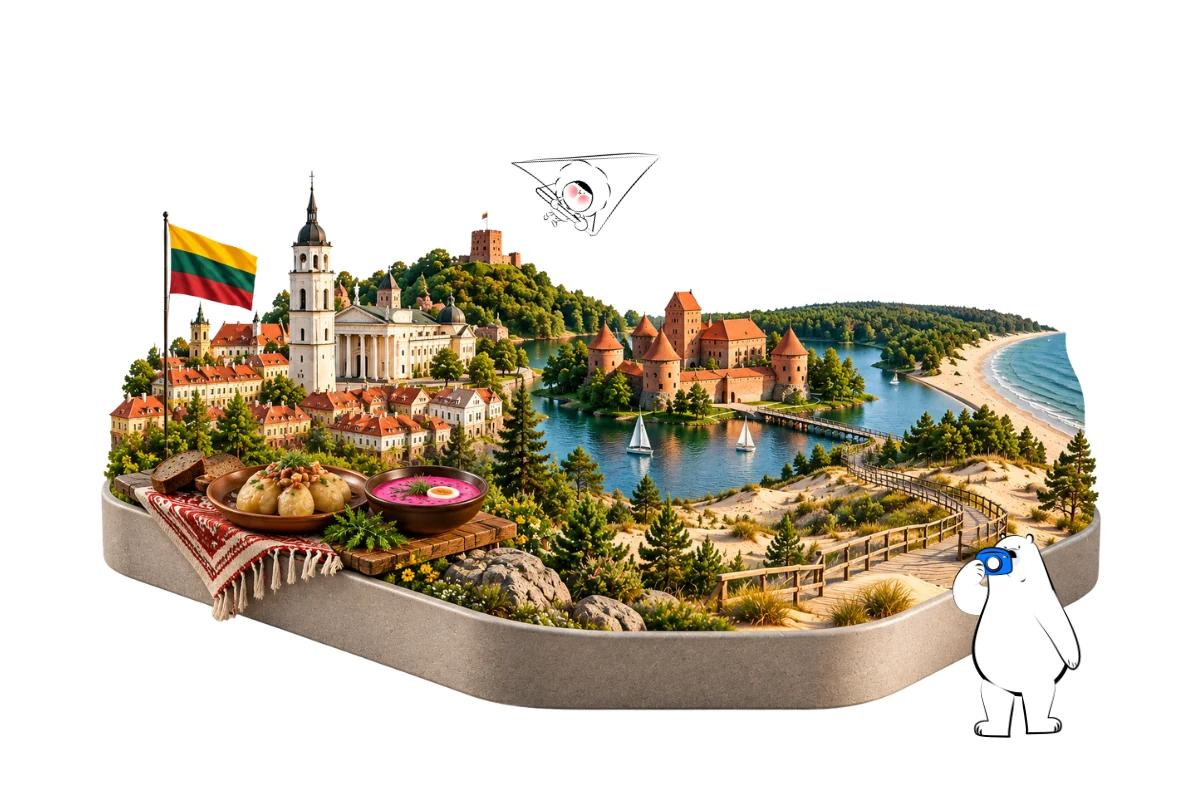
Lithuania is worth visiting for its unusually compact mix of historic cities, medieval castles, Baltic coastline, forests, distinctive food, and cultural sites. Some of the best things to do in Lithuania include exploring Vilnius Old Town, visiting Trakai Island Castle, walking through Užupis, discovering Kaunas, seeing the Hill of Crosses, and spending time on the Curonian Spit.
It works particularly well for travelers who want to combine cities and nature without covering huge distances. A few days are enough for Vilnius and a major day trip, while a longer stay makes room for Kaunas, Klaipėda, and the Baltic coast.
Best Things To Do In Lithuania
Explore Vilnius Old Town
Vilnius is the natural starting point for a first trip to Lithuania. Its historic centre combines narrow streets, church towers, courtyards, public squares, and architecture ranging from Gothic and Renaissance to Baroque and Classical.
The Vilnius Historic Centre is UNESCO-listed and developed over several centuries as the political centre of the Grand Duchy of Lithuania.
Give yourself time to walk rather than treating the Old Town as a checklist. Cathedral Square, Pilies Street, St. Anne’s Church, the university area, and the lanes around the historic centre are easy to combine on foot.
Visit Trakai Island Castle
Trakai Island Castle is one of Lithuania’s most recognisable landmarks and one of the easiest day trips from Vilnius.
The red-brick Gothic castle sits on an island in Lake Galvė, surrounded by water and forest. Lithuania’s official tourism board places Trakai about 30 minutes from Vilnius by car, making it realistic to visit without changing hotels.
The castle museum adds historical context, but the setting is a large part of the appeal. Allow extra time to walk along the lakefront and explore Trakai itself rather than arriving only for a quick photo.
Walk Through Užupis
Užupis is Vilnius at its most playful. The small district sits across the Vilnelė River from the Old Town and is known for galleries, street art, courtyards, sculptures, cafés, and its tongue-in-cheek self-declared republic.
Residents declared the Republic of Užupis on 1 April 1997, complete with its own constitution, flag, anthem, and ceremonial traditions.
The official Go Vilnius overview of Užupis is useful for locating its main sights. The district works best as an unhurried walk rather than a single attraction stop.
Try Traditional Lithuanian Food
Lithuanian food leans heavily on potatoes, rye, dairy, mushrooms, pork, beetroot, and seasonal ingredients.
One of the best-known dishes is cepelinai, large potato dumplings usually filled with meat or curd. Other foods worth trying include šaltibarščiai, the bright pink cold beet soup often served in warmer months, and dark Lithuanian rye bread.
Local markets, casual restaurants, and traditional kitchens are better places to understand the cuisine than treating one famous dish as the whole story. Food also changes with season and region, so leave room to try whatever is locally prominent during your trip.
Spend A Day In Kaunas
Kaunas offers a different urban experience from Vilnius. Lithuania’s second-largest city combines a medieval Old Town, street art, museums, interwar architecture, and a strong café and restaurant scene.
Its 20th-century modernist architecture is especially significant. UNESCO added Modernist Kaunas: Architecture of Optimism, 1919-1939 to the World Heritage List in 2023.
Start around the Old Town and Kaunas Castle, then move toward the central avenues and modernist districts. Leave enough time to experience the city beyond its main historic sights rather than treating Kaunas only as a quick stop between Vilnius and the coast.
See The Hill Of Crosses
The Hill of Crosses near Šiauliai is one of Lithuania’s most distinctive cultural and religious sites.
The hillside contains a vast number of crosses, crucifixes, rosaries, and devotional objects left by visitors and pilgrims. Lithuania Travel describes it as a symbol of faith and hope that endured repeated attempts at destruction under Tsarist and Soviet rule.
Entry to the main site is generally free. Because the Hill of Crosses sits outside Lithuania’s biggest tourism centres, it fits best into a road trip or a journey through northern Lithuania rather than a tightly scheduled Vilnius city break.
Check current visitor information through Lithuania Travel’s Hill of Crosses page.
Explore The Curonian Spit
The Curonian Spit is one of the strongest reasons to travel beyond Lithuania’s major cities.
This narrow sand peninsula stretches between the Baltic Sea and the Curonian Lagoon, with dunes, pine forests, beaches, fishing settlements, cycling routes, and walking trails. UNESCO recognises the Curonian Spit as a World Heritage cultural landscape shaped by natural forces and generations of human intervention.
Nida is the best-known settlement and makes a useful base for exploring dunes and the coast. The Lithuanian section is commonly reached by ferry from Klaipėda.
Because the landscape is protected and environmentally sensitive, follow marked paths and current local restrictions rather than walking freely across fragile dunes.
Spend Time On Lithuania’s Baltic Beaches
Lithuania may not be the first country associated with a European beach trip, but its Baltic coastline adds another dimension to a summer itinerary.
Palanga is the country’s best-known seaside resort, while the Curonian Spit offers long beaches backed by dunes and forest. Klaipėda also provides access to coastal areas and ferries toward the spit.
The Baltic is much cooler than the Mediterranean, and beach weather is highly seasonal. July and August generally provide the best chance of warm conditions, but wind, rain, and sea temperatures can change quickly.
For many travelers, Lithuania’s beaches work best as part of a wider coastal trip rather than as the sole reason to visit the country.
Hike Through Forests And Lake Country
Lithuania is a destination where nature rarely feels far from the cities. Forests, lakes, wetlands, regional parks, and national parks create plenty of options for hiking, cycling, kayaking, and slower rural travel.
Aukštaitija National Park is particularly well suited to travelers looking for lakes and woodland landscapes, while Žemaitija National Park offers a different setting in western Lithuania.
Nature trips are easier with a car, though some destinations can be reached by public transport. If you head into less-populated areas, download maps in advance and check local weather before setting out.
Visit A Museum That Explains Lithuania’s Past
Lithuania’s history becomes easier to understand once you spend time in at least one substantial museum.
In Vilnius, the Museum of Occupations and Freedom Fights examines Soviet repression and operates in a former KGB building. Kaunas has several strong options covering art, military history, city history, and Lithuania’s interwar period.
Choose the museum according to what interests you rather than trying to fit several into one afternoon. Opening days and hours can change seasonally, so check the official attraction website before visiting.
Get Eskimo eSIM to stay connected in Lithuania
Need internet in Lithuania? Here's what we recommend:

Fixed data plans
- No speed reduction
- No expiry, keep your data forever
- Transfer data to anyone
- Personal hotspot


Unlimited data plans
- Unlimited day pass
- Daily 3GB high-speed + 1Mbps unlimited after
- Personal hotspot

Take A Day Trip From Vilnius
Trakai is the obvious first choice, but it is not the only place worth leaving Vilnius for.
Kernavė is particularly important for archaeology and Lithuanian history. Its UNESCO-listed archaeological site preserves evidence of human settlement spanning thousands of years.
Another option is to combine smaller towns, countryside stops, or regional parks with a rental car. This works well for travelers who want to see beyond the capital without committing to a full multi-city trip.
Explore Klaipėda
Klaipėda is Lithuania’s main port city and a gateway to the Curonian Spit.
Its atmosphere differs from both Vilnius and Kaunas. The Old Town has strong Germanic and Prussian influences, including half-timbered architecture, cobbled streets, sculptures, museums, and waterfront areas.
The city is useful both as a destination and as a transport base. Stay overnight if you want enough time for Klaipėda itself plus a ferry trip toward the Curonian Spit.
Lithuania Travel’s Klaipėda overview provides current destination information.
Visit A Local Market
Markets add useful context to Lithuania’s food culture without requiring a formal food tour.
In Vilnius, Halės Market is a long-established indoor market where you can browse produce, meat, dairy products, baked goods, prepared food, and newer food stalls.
Markets are particularly useful if you want to try rye bread, cheese, smoked products, berries, mushrooms, or seasonal ingredients without ordering a full restaurant meal.
Go earlier in the day for a broader selection, as individual stalls may keep different hours.
Experience A Lithuanian Festival Or Tradition
Lithuania’s calendar includes religious celebrations, folk traditions, music events, city festivals, and seasonal gatherings.
Midsummer celebrations around Joninės in June are among the country’s most visible traditional events, while Klaipėda’s Sea Festival is a major summer celebration connected to the city’s maritime identity.
Events can significantly change transport demand and accommodation availability. Check dates with the relevant municipality or tourism authority before building a trip around a specific festival.
Build A Multi-City Lithuania Trip
Lithuania is compact enough to make a multi-city itinerary practical without spending the entire holiday in transit.
A simple route could combine Vilnius, Kaunas, Klaipėda, and the Curonian Spit, with Trakai added as a day trip from Vilnius. Travelers with more time can include Šiauliai and the Hill of Crosses or detour into national parks.
Lithuania also works naturally as part of a wider Baltic journey with Latvia and Estonia. If you are continuing across borders, compare train and bus schedules carefully because the fastest transport option varies by route.
Why Lithuania Is Worth Visiting
Lithuania is particularly rewarding for travelers who like historic cities, walkable neighbourhoods, castles, food, forests, Baltic landscapes, and cultural sites without needing to travel enormous distances between them.
Vilnius and Trakai can fill a short break, but the country becomes more interesting once you add Kaunas or the coast. The contrast between Vilnius Old Town, Kaunas modernism, the Hill of Crosses, and the Curonian Spit gives Lithuania more variety than its size suggests.
It also works well as part of a Baltic itinerary because onward travel to Latvia and Estonia is relatively straightforward by land.
Planning Your Time In Lithuania
For a short visit, three days is enough for Vilnius plus Trakai at a comfortable pace.
With five days, you can add Kaunas or another substantial day trip. Around seven days gives you enough room for Vilnius, Kaunas, Klaipėda, and part of the Curonian Spit without turning every day into a transport exercise.
Longer trips make more sense if you want hiking, beaches, national parks, smaller towns, or a self-drive route.
Best Time To Visit Lithuania
Late spring through early autumn generally offers the easiest conditions for sightseeing, outdoor dining, forests, lakes, and the Baltic coast.
June through August brings the warmest weather and longest days, but also higher demand in coastal destinations. May and September can suit travelers who prefer milder weather and fewer summer crowds.
Winter is much colder and daylight hours are shorter, but Vilnius and Kaunas can still work well for museums, cafés, seasonal events, and city breaks.
Weather can change quickly at any time of year, especially near the Baltic coast, so check a reliable forecast close to departure and also check the Lithuania Public Holidays.
Using Mobile Data Around Lithuania
Mobile data is useful for intercity bus and train information, digital attraction tickets, navigation through Vilnius and Kaunas, restaurant bookings, and weather checks before coastal or nature trips. Reception is generally stronger in cities and along major transport routes, while it can vary in forests, national parks, rural roads, and more remote sections of the Baltic coast.
An Eskimo Lithuania eSIM plan is the most relevant option for a trip focused on Lithuania. Eskimo’s broader coverage extends across 175 countries and regions overall, which is useful for travelers continuing through Latvia, Estonia, Poland, or elsewhere, while no-expiry fixed data can remain available for another eligible trip if the full allowance is not used in Lithuania.
New users can also claim a free 250MB Global eSIM.
FAQs:
Is Lithuania worth visiting?
Yes. Lithuania suits travelers interested in historic cities, castles, Baltic landscapes, food, forests, and cultural sites. Its compact size also makes it relatively easy to combine several destinations in one trip.
What is Lithuania best known for?
Lithuania is known for Vilnius Old Town, Trakai Island Castle, the Curonian Spit, Baltic beaches, the Hill of Crosses, forests and lakes, traditional food, and its history as part of the former Grand Duchy of Lithuania.
How many days do you need in Lithuania?
Three days works for Vilnius and Trakai. Five days allows time for another major city or day trip, while about a week is better for combining Vilnius, Kaunas, Klaipėda, and the Curonian Spit.
What are the best things to do in Lithuania?
Exploring Vilnius Old Town, visiting Trakai Island Castle, walking through Užupis, seeing the Hill of Crosses, discovering Kaunas, and exploring the Curonian Spit are among the best things to do in Lithuania on a first trip.
What is the best time to visit Lithuania?
May through September generally provides the easiest weather for sightseeing and outdoor travel. July and August are best suited to Baltic beach trips, while May, June, and September can offer a quieter city-and-nature itinerary.