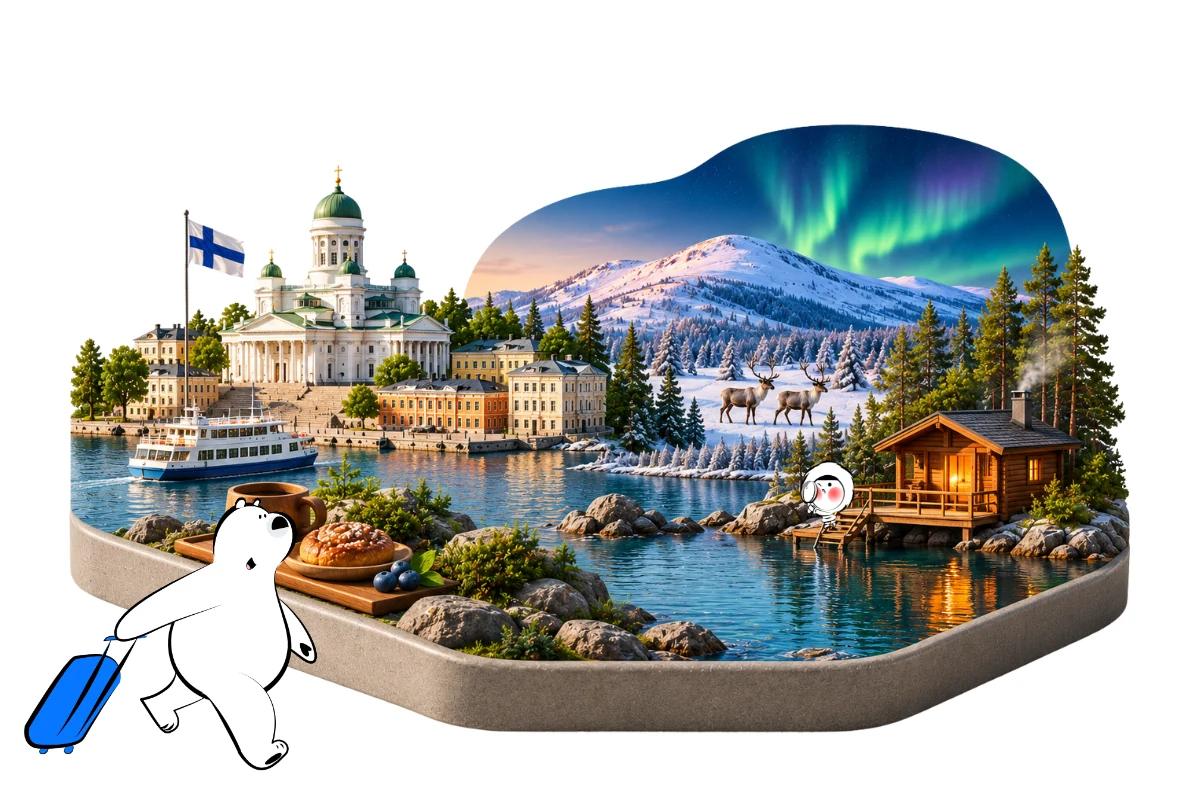
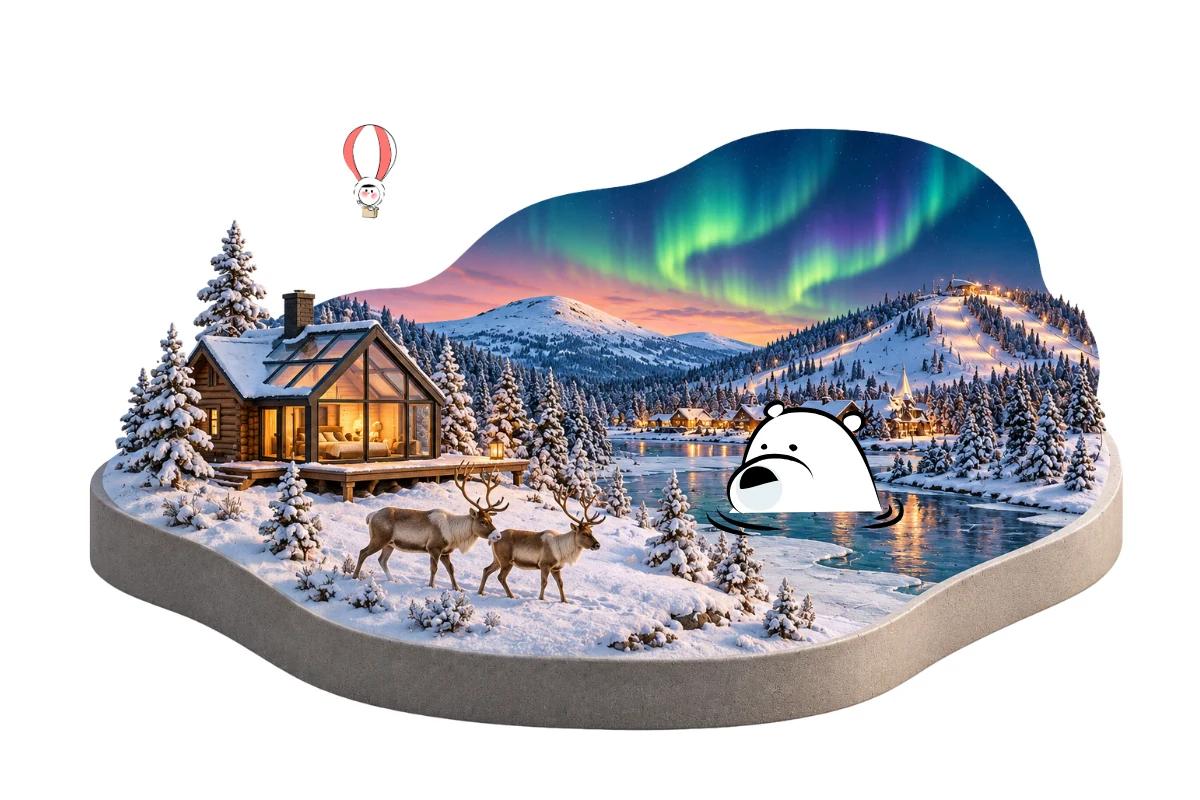
Lapland Finland is best for travelers who want a trip built around snowy landscapes, Northern Lights, skiing, reindeer, husky experiences and Arctic nature rather than conventional city sightseeing.
Rovaniemi is the easiest base for many first-time visitors, especially families. Levi and Ylläs are stronger choices for skiing, while Saariselkä, Ivalo and Inari suit travelers who want quieter surroundings farther north.
Winter is the headline season, but timing matters. December brings Christmas demand and long nights, February and March combine reliable winter conditions with more daylight, autumn brings ruska colors and aurora season, and summer replaces darkness with the Midnight Sun.
Where Lapland Finland Is
Finnish Lapland covers the northernmost part of Finland and extends well beyond the Arctic Circle.
Rovaniemi sits close to the Arctic Circle and works as the main gateway for many international visitors. Farther north, settlements become smaller and forests, fells and wilderness areas dominate the landscape.
Visit Finland’s official Lapland overview is useful for understanding the region and its main destinations.
Distances are easy to underestimate. A trip combining Rovaniemi, Levi and Inari involves considerably more travel than staying in one resort and taking local excursions.
Choosing the Right Lapland Base
The best base depends on your priorities, trip length and transport plans.
Rovaniemi for first-time visitors and families
Rovaniemi combines an airport, rail station, restaurants, organized activities and easy access to Santa Claus Village.
It works particularly well for travelers who want the Arctic Circle, reindeer and husky activities without organizing long transfers between remote resorts.
Rovaniemi offers the most city-like experience among the main Lapland bases, with broad year-round services and straightforward transport connections.
Levi for skiing and resort convenience
Levi is one of Finland’s major ski destinations and suits travelers who want downhill skiing, cross-country skiing and a compact resort environment.
For the 2026 to 2027 season, Levi opened its alpine and cross-country skiing season on 2 October 2026 using preserved snow, with more terrain opening as conditions allow.
Check Levi’s official slope and lift information before traveling because open terrain and lift operations depend on conditions.
Ylläs for skiing and nature
Ylläs describes itself as Finland’s largest ski resort and sits between the villages of Äkäslompolo and Ylläsjärvi.
It suits travelers who want skiing combined with easier access to Pallas-Yllästunturi National Park and a quieter village atmosphere.
The area also has an extensive cross-country skiing network and slopes extending for more than three kilometers. Current lift operations and conditions are available from the official Ylläs ski website.
Saariselkä and Inari for northern landscapes
Saariselkä sits beside Urho Kekkonen National Park and has a compact center where many services are within walking distance.
Visit Finland states that Ivalo Airport is about 15 minutes from Saariselkä and around 40 minutes from Inari. Inari also gives travelers easier access to Sámi culture and quieter northern landscapes.
Visit Finland’s Saariselkä and Inari information is useful when comparing the two areas.
Best Time to Visit Lapland Finland
The best time depends on whether your priority is Christmas atmosphere, skiing, Northern Lights or outdoor travel.
December for Christmas atmosphere
December is one of the busiest periods around Rovaniemi and other popular winter destinations.
Snowy landscapes, festive activities and long nights make it appealing, but Christmas and New Year also bring strong demand for flights, accommodation and organized tours.
Book well ahead if traveling from late November through early January.
January to March for deep winter
January usually brings deep winter conditions and very short daylight hours, particularly farther north.
February and March are often easier for active trips because daylight increases while snow conditions generally remain suitable for skiing, snowshoeing and other winter activities.
These months can work particularly well for travelers who want snow without building the whole trip around Christmas.
Late August to early April for Northern Lights
Visit Finland identifies late August to early April as the main Northern Lights season in northern Finland. September to October and February to March are among the stronger periods, although clear skies and suitable solar activity are still essential.
Check Visit Finland’s current Northern Lights timing advice before planning an aurora-focused trip.
Do not build a Lapland itinerary around one evening. Staying for several nights gives you more chances to work around cloud cover and changing conditions.
Summer for the Midnight Sun
Lapland changes completely in summer.
Above the Arctic Circle, the sun can remain above the horizon for extended periods. In the far north, continuous daylight can last for weeks.
Visit Finland’s Midnight Sun information explains how the phenomenon changes across northern Finland.
Summer suits hiking, cycling, paddling and national parks rather than snow-based activities.
September for ruska
Autumn foliage in Finland is known as ruska.
The season begins earlier in Lapland than in southern Finland, turning forests and fells shades of yellow, orange and red.
September can combine autumn landscapes with increasingly dark nights and the beginning of aurora season.
See the Northern Lights
For many travelers, the Northern Lights are one of the main reasons to visit Lapland Finland.
Darkness, clear skies, low light pollution and solar activity all matter. Moving away from brightly lit town centers can improve viewing conditions, but no destination or tour can guarantee an aurora.
Rovaniemi offers convenience and a large choice of organized excursions. Levi combines aurora viewing with skiing, while Inari, Ivalo and Saariselkä place travelers farther north and closer to less developed surroundings.
Check the weather and aurora conditions each evening rather than assuming a tour booked weeks in advance will produce a display.
Visit Santa Claus Village
Santa Claus Village sits on the Arctic Circle outside Rovaniemi and is one of Lapland’s best-known attractions.
Visitors can cross the marked Arctic Circle, browse shops and restaurants and meet Santa Claus.
The official Santa Claus Office states that meeting Santa is free, while photographs and videos are optional paid extras. The office operates throughout the year, although opening hours vary by season.
Late November through early January is particularly busy. Families traveling around Christmas should expect larger crowds and should reserve accommodation and major paid activities early.
Ride the Night Train to Lapland
The overnight train is one of the most practical ways to travel from southern Finland to Lapland without using a daytime flight.
VR operates night trains to Rovaniemi, Kemijärvi and Kolari. From those stations, travelers can continue by bus, taxi, rental car or pre-booked transfer depending on their destination.
Sleeping cabins make the journey more comfortable, and some cabins include private showers.
Check VR’s current night-train schedules before booking because departures, fares and availability can change.
Popular trains can fill around Christmas, New Year and Finnish holiday periods. Travelers visiting at these times can also check Finland’s 2026 public holidays before finalizing plans.
Go Skiing or Snowshoeing
Lapland has downhill ski resorts as well as extensive cross-country skiing terrain.
Levi is convenient for travelers who want a developed resort with restaurants, rentals and organized services nearby. Ylläs offers long slopes, two resort villages and strong access to nature.
For the 2026 to 2027 season, Ylläs lists a normal-season adult one-day lift pass at €60. Prices, operating dates and open terrain can change, so confirm the latest rate on the official Ylläs lift-ticket page.
Snowshoeing requires less technical experience and works well for quieter forest and fell excursions. Guided outings can be useful if you are unfamiliar with Arctic winter conditions or navigation.
Get Eskimo eSIM to stay connected in Finland
Need internet in Finland? Here's what we recommend:
Fixed data plans
- No speed reduction
- No expiry, keep your data forever
- Transfer data to anyone
- Personal hotspot


Unlimited data plans
- Unlimited day pass
- Daily 3GB high-speed + 1Mbps unlimited after
- Personal hotspot

Try a Husky or Reindeer Experience
Husky sledding and reindeer experiences are widely available around Lapland, particularly near Rovaniemi and major resorts.
Experiences range from short rides to longer journeys through forest terrain. Prices depend on distance, transfers, group size and what is included.
As a 2026 price example, Visit Rovaniemi listed a five-kilometer husky ride from €110 per adult outside its stated high-season period. Current prices should be checked directly because operators can revise rates between seasons.
Compare ride length and inclusions rather than price alone. A cheaper booking may involve only a short time on the sled.
Stay in a Glass Cabin
Glass-roof cabins are one of Lapland’s most recognizable accommodation styles.
They are designed to provide views of the night sky from indoors, but paying for a glass roof does not improve the weather. Cloud can obscure the Northern Lights regardless of how expensive the room is.
If the experience matters to you, consider spending one or two nights in a glass cabin rather than using premium accommodation for the entire trip.
Locations outside the brightest town centers may also provide darker surroundings.
Experience a Finnish Sauna
A sauna fits naturally into a Lapland trip, especially after skiing or several hours outdoors.
Many hotels, cabins and resorts include private or shared saunas. Some organized experiences combine sauna sessions with cold-water swimming, snow or other winter activities.
Follow local instructions carefully, particularly when moving between a hot sauna and extremely cold outdoor conditions.
Explore Lapland’s National Parks
National parks offer a quieter alternative to resort-centered activities.
Lapland includes major protected areas with hiking, skiing, snowshoeing and wilderness landscapes. Visit Finland highlights destinations including Lemmenjoki and Pyhä-Luosto, while Saariselkä sits beside Urho Kekkonen National Park.
Visit Finland’s Lapland national park overview can help with choosing an area.
Conditions can become demanding quickly in winter. Check weather, daylight and route conditions, and avoid treating a remote winter trail like an ordinary city park walk.
Getting to Lapland
Flying is the fastest option for many travelers.
Rovaniemi and Ivalo are useful airport gateways, while Kittilä serves Levi and other destinations in western Lapland. Rail works particularly well for Rovaniemi and western Lapland through VR’s night-train network.
Choose your airport according to your final destination rather than simply booking the cheapest flight into Lapland.
Flying to Rovaniemi and then traveling several hours north may make less sense than arriving through an airport closer to your resort.
Getting Around Lapland
Public transport works on specific routes but is less comprehensive than in Finland’s larger southern cities.
Major resorts usually have airport transfers, buses, taxis and excursion pickups. Compact destinations such as Saariselkä can work without a rental car if accommodation and activities are centrally located.
A car gives you more flexibility for remote cabins, independent aurora trips and national parks, but winter driving requires additional preparation.
Check the exact distance between your accommodation, restaurants, shops and tour meeting points before booking. Properties described simply as being “in Lapland” can sit far from the nearest settlement.
Driving in Lapland in Winter
Winter roads require more caution than their distance alone suggests.
Finland requires winter tyres from 1 November to 31 March when weather or road conditions require them. The same rule applies to vehicles registered abroad.
Traficom provides the current winter tyre rules for drivers in Finland.
Snow, ice and darkness can make maintained roads slower than expected. Before setting out, check Fintraffic’s road and weather information for current conditions.
Avoid planning tight flight, train or activity connections after long winter drives.
Lapland Finland Costs
Lapland can be expensive, particularly around Christmas and New Year.
Accommodation is usually the biggest variable. Standard hotels and apartments can cost considerably less than glass cabins, private wilderness lodges and premium resorts.
Activities can add up quickly because husky rides, snowmobile safaris, reindeer experiences, aurora tours and ski passes are often priced separately unless you buy a package.
Transport costs depend on whether you fly, use the night train, rent a car or rely on transfers.
A more economical trip usually means avoiding Christmas week, staying in conventional accommodation and choosing a smaller number of paid activities rather than scheduling one every day.
Bookings to Make Early
Accommodation, flights, overnight trains and popular winter activities are generally the most time-sensitive bookings.
Christmas and New Year require the most advance planning.
Glass cabins and family-oriented accommodation can also fill well before peak winter dates.
At Santa Claus Village, meeting Santa at the Santa Claus Office can be free, but queues grow during busy periods and paid activities nearby may require separate reservations.
Packing for Lapland
Layers matter more than relying on one oversized winter coat.
A practical winter setup usually includes:
- Thermal base layers
- An insulating middle layer
- A windproof and weather-resistant outer layer
- Warm gloves or mittens
- A hat that covers the ears
- Insulated winter footwear
- Warm socks
- Neck protection
- Hand or foot warmers if you get cold easily
Visit Finland’s weather and clothing advice recommends layering and appropriate footwear for changing Finnish conditions.
Tour operators often provide thermal overalls and boots for specific winter excursions, but confirm what is included before packing light.
Lapland Beyond Winter
Lapland is worth considering outside snow season if hiking, cycling, wilderness and long daylight matter more than winter activities.
Summer brings the Midnight Sun, while September adds ruska colors and the return of darker nights.
National parks become especially attractive during these seasons because routes that can be demanding in winter are often easier to explore on foot.
A summer or autumn Lapland trip feels very different from December, which is part of the region’s appeal.
Using Mobile Data Around Lapland
Mobile data helps with VR train tickets, airport transfers, road-condition updates and aurora forecasts when moving between Rovaniemi, ski resorts and more remote areas. Coverage is generally stronger in towns and along major transport routes, while signal can weaken in forests, national parks and sparsely populated stretches of northern Lapland.
An Eskimo Finland eSIM plan is the most relevant option for a Lapland trip within Finland. Eskimo’s overall network extends across 175 countries and regions, which is useful if the journey continues through Sweden, Norway or elsewhere in Europe. No-expiry fixed data means unused fixed data can remain available for a later international trip.
New users can also claim a free 250MB Global eSIM.
FAQs:
How many days do you need in Lapland Finland?
Four to five days is enough for one base and several winter activities. A week gives you more flexibility for changing weather, additional Northern Lights attempts and a second destination.
Is Rovaniemi or Levi better for a first Lapland trip?
Rovaniemi usually works better for families, Santa Claus Village and simpler first-time logistics. Levi is generally better if skiing and a compact resort atmosphere are the main priorities.
When is the best time to see the Northern Lights in Lapland Finland?
The main aurora season runs from late August to early April. September to October and February to March can be particularly favorable, but clear skies and suitable solar activity are still required.
Does Lapland Finland have snow at Christmas?
Lapland generally experiences winter conditions around Christmas, particularly farther north, but snowfall and snow depth vary by year and location. Snow on an exact date should never be treated as guaranteed.
Can you visit Lapland Finland without a car?
Yes. Rovaniemi and compact resorts such as Saariselkä can work without a car when you use flights, trains, transfers, buses, taxis and organized excursions. A rental car becomes more useful for remote cabins and independent travel.