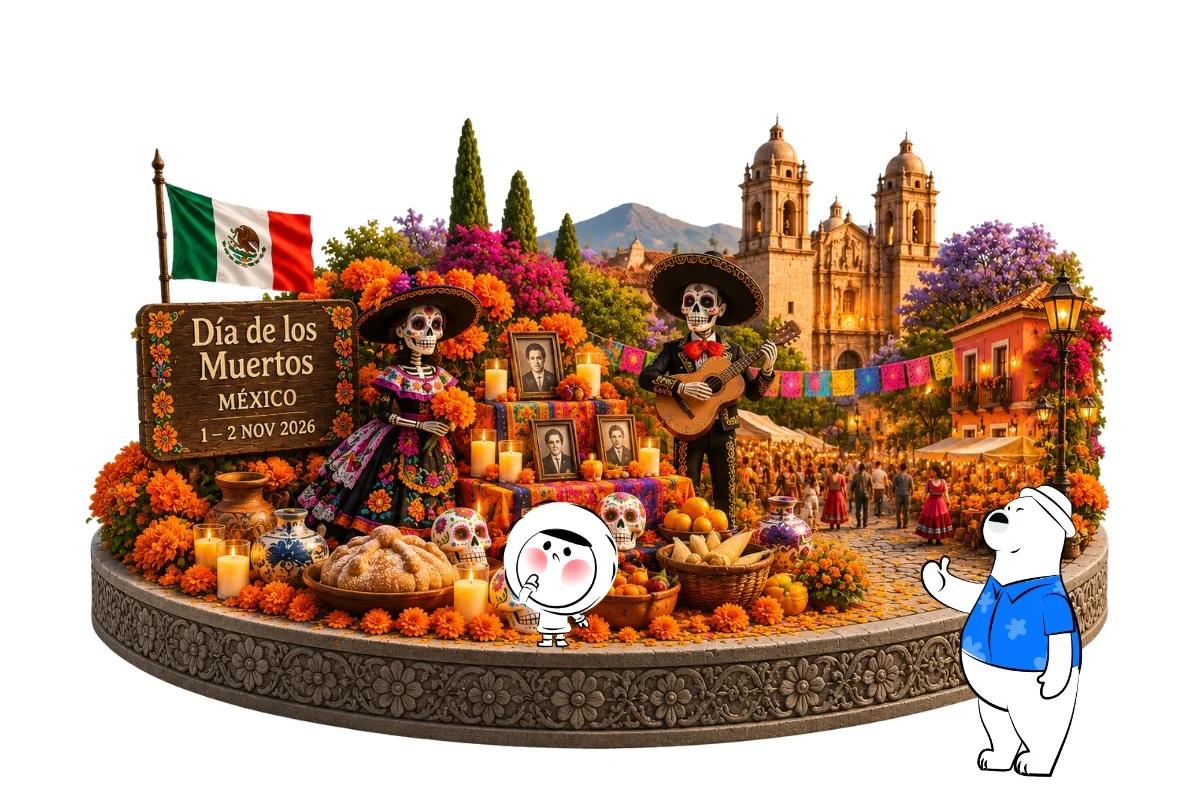
The Day of the Dead in Mexico is not simply a celebration of death. It is a celebration of life, memory and the people who are no longer here. Families honor deceased loved ones with flowers, candles, photographs, favorite foods and gatherings that bring generations together.
Known as Día de los Muertos, the tradition is observed mainly on November 1 and 2, although preparations and local celebrations often begin in late October.
For travelers, the surprising part is that colorful skulls, elaborate altars and lively streets are only one side of the occasion. Behind them is a deeply personal tradition rooted in family remembrance.
What the Day of the Dead Means in Mexico
Día de los Muertos reflects traditions shaped by Indigenous Mexican cultures and Catholic observances associated with All Saints’ Day and All Souls’ Day. Its history is complex, and customs have developed differently across Mexico’s communities.
Many families believe that the spirits of departed loved ones temporarily return to visit the living during this period. They prepare welcoming spaces with food, flowers, candles and personal objects associated with those they remember.
The tradition holds particular significance in Indigenous communities, where remembrance practices have been passed down through generations.
In 2008, UNESCO inscribed the Indigenous festivity dedicated to the dead on its Representative List of the Intangible Cultural Heritage of Humanity, following its original proclamation in 2003.
However, there is no single way to observe Día de los Muertos. Traditions vary between regions, communities and families.
When Día de los Muertos Takes Place in 2026
Day of the Dead is observed mainly on November 1 and 2, 2026, with some activities beginning during the final days of October.
The two principal dates have different traditional associations:
- Sunday, November 1: Often associated with remembering deceased children, sometimes called Día de los Angelitos.
- Monday, November 2: Commonly associated with remembering deceased adults and visiting family graves.
These associations vary by community, and some observances begin earlier.
Public celebrations, cultural exhibitions and community activities may extend across several days. However, the traditional dates should not be confused with the schedules of individual parades or festivals.
In Mexico City, the official 2026 Día de Muertos program includes activities across October and November, with locations and dates varying by event.
Day of the Dead is not a nationwide mandatory rest day for every worker. Travelers should check local schedules rather than assume businesses, attractions and transport services will close.
Eskimo’s Mexico public holidays and cultural events calendar provides additional context on national holidays, cultural celebrations and periods that may affect travel plans.
Why Families Celebrate and Remember the Dead
The central idea behind Día de los Muertos is that remembering someone keeps their presence meaningful within the family.
Relatives may gather to share stories, prepare favorite dishes, decorate graves or spend time together. In some communities, families visit cemeteries with flowers, candles and food, while others observe the occasion primarily at home.
Music, laughter and colorful decorations can be part of the celebration, but quieter moments of reflection are equally important.
The occasion does not erase grief. Instead, it creates space for families to remember loved ones through familiar rituals, shared experiences and traditions that connect generations.
What Marigolds, Ofrendas and Sugar Skulls Symbolize
Many of the most recognizable Day of the Dead decorations carry meanings beyond their appearance.
Marigolds guide the way home
Bright orange marigolds, known as cempasúchil, are among the celebration’s most recognizable flowers.
According to tradition, their color and fragrance help guide returning spirits toward their families. Petals may be arranged along pathways, around graves or across household altars.
The flowers are also associated with the sun and the relationship between life and death.
Mexico’s National Institute of Anthropology and History explains the flower’s traditional symbolism and its role in welcoming the souls of loved ones.
Ofrendas welcome loved ones
An ofrenda is an arrangement of offerings, often displayed on a decorated altar.
Families may include photographs, candles, flowers, water, food and personal possessions associated with the deceased.
Each element can carry a particular meaning. Candles traditionally help guide spirits, while water and food welcome them after their journey.
Some altars also include religious images, incense and colorful papel picado, or decorative cut-paper banners.
An ofrenda is more than a decoration. It is a personal expression of remembrance, and its contents vary according to family and regional traditions.
Sugar skulls represent mortality
Colorful sugar skulls, called calaveras de azúcar, are another familiar symbol.
They may be decorated with icing, bright colors and names. Although skulls can appear frightening in other cultural settings, their role during Día de los Muertos is often playful or symbolic.
They reflect the idea that death is part of human life rather than something that must always be represented through fear.
La Catrina represents death with elegance
La Catrina is the elegantly dressed skeleton frequently associated with modern Day of the Dead imagery.
Her origins lie in Mexican satirical art, particularly the work of illustrator José Guadalupe Posada. Artist Diego Rivera later helped popularize the familiar full-length figure.
Today, La Catrina appears in public celebrations, artwork and elaborate face painting.
She is a recognizable cultural figure, but she should not be mistaken for the central spiritual meaning of Día de los Muertos.
Day of the Dead Traditions, Food and Family Customs
Food plays an important role in the celebration because it connects remembrance with family traditions.
Many households prepare dishes that deceased relatives particularly enjoyed. Other foods have strong associations with the season.
Pan de muerto
Pan de muerto is a traditional sweet bread commonly prepared around Day of the Dead.
Recipes vary by region, but many versions are round and decorated with dough shaped to resemble bones.
The bread may be placed on an altar or shared with family members.
Tamales, mole and regional dishes
Families may prepare tamales, mole, fruit, chocolate and other traditional foods.
There is no universal Day of the Dead menu. In Oaxaca, Michoacán and other regions, local ingredients and family recipes shape the dishes prepared for the occasion.
Cemetery visits and family gatherings
In some communities, families clean and decorate graves with flowers and candles.
They may spend time remembering relatives, sharing food or participating in religious observances.
These gatherings are meaningful family occasions rather than performances arranged for visitors. Travelers should respect local expectations, particularly when visiting cemeteries or smaller communities.
Where Travelers Can Experience Día de los Muertos
The best destination depends on whether you want large public celebrations, cultural exhibitions or opportunities to learn about longstanding community traditions.
Get Eskimo eSIM to stay connected in Mexico
Need internet in Mexico? Here's what we recommend:

Fixed data plans
- No speed reduction
- No expiry, keep your data forever
- Transfer data to anyone
- Personal hotspot
Unlimited data plans
- Unlimited day pass
- Daily 3GB high-speed + 1Mbps unlimited after
- Personal hotspot
Mexico City
Best for: Large public celebrations, cultural exhibitions and convenient city travel.
Mexico City is one of the most accessible destinations for international travelers interested in Día de los Muertos.
Public celebrations have included major parades, decorated streets, exhibitions and large-scale ofrendas. The historic center is often a focal point for cultural activities.
For 2026, the city’s official tourism program lists the Festival Flores de Cempasúchil from October 18 to November 1, along Paseo de la Reforma between the Ángel de la Independencia and the Ahuehuete.
The festival features marigold displays and sales connected with the season’s traditions.
Other celebrations have separate schedules, so travelers should consult the official Mexico City Día de Muertos calendar for current event dates, locations and arrangements.
Expect substantial crowds around major public events, particularly in central areas.
Oaxaca City
Best for: Regional traditions, historic streets, markets and cultural activities.
Oaxaca is widely associated with Day of the Dead celebrations.
During the season, parts of the city feature decorated altars, marigold displays, markets and community activities. The surrounding region also has distinctive traditions shaped by local communities.
Oaxaca is particularly appealing to travelers interested in regional food, crafts and Indigenous cultural heritage.
Accommodation demand can rise considerably around late October and early November, so booking early is advisable.
Travelers exploring Mexico beyond its major festivals can also discover the country’s regional cuisine, historic cities and Indigenous heritage through Eskimo’s overview of what Mexico is known for.
Pátzcuaro and Lake Pátzcuaro, Michoacán
Best for: Learning about Purépecha remembrance traditions.
The Lake Pátzcuaro region is known for distinctive Day of the Dead observances associated with Purépecha communities.
Cemetery gatherings, candlelight and family remembrance are important parts of the occasion in some communities.
Places around the lake, including Janitzio, attract considerable visitor interest.
However, these are living cultural and spiritual traditions. Visitors should follow community guidance and never assume that private ceremonies are open to tourists.
Transport around the lake can become crowded during the main observance period. Boat availability, access arrangements and local restrictions should be confirmed before traveling.
San Andrés Mixquic, Mexico City
Best for: Community remembrance traditions within the wider Mexico City area.
San Andrés Mixquic, in the Tláhuac area of Mexico City, is known for its Day of the Dead observances.
The community’s traditions have included cemetery decorations, candles and family gatherings.
Although Mixquic is part of Mexico City, reaching it from central neighborhoods can take considerable time, especially during busy celebrations.
Visitors should check local access arrangements, allow extra travel time and respect residential streets and cemetery spaces where families are commemorating relatives.
How Day of the Dead Differs From Halloween
Day of the Dead and Halloween take place close together, but their cultural meanings are different.
Halloween is commonly associated with costumes, trick-or-treating, supernatural imagery and entertainment.
Día de los Muertos centers on honoring deceased loved ones through family remembrance, offerings and community traditions.
Both celebrations can feature costumes, skulls and elaborate decorations, which helps explain why they are sometimes confused.
However, Day of the Dead is not simply Mexico’s version of Halloween.
The distinction becomes clearer when visitors look beyond public parades and recognize the importance of household altars, family gatherings and cemetery observances.
Visiting Mexico During Day of the Dead
Día de los Muertos can be a rewarding time to visit Mexico, but popular destinations require advance planning.
Book accommodation early
Hotels in Oaxaca, central Mexico City and popular Michoacán destinations can experience strong demand during the celebration.
Booking early generally provides more choices, particularly for travelers who want accommodation within walking distance of public events.
Check official event announcements
Not every city follows the same schedule.
Public parades, exhibitions, performances and temporary road closures can change from year to year.
For Mexico City, the official 2026 tourism calendar is a useful starting point. Travelers visiting Oaxaca, Michoacán or smaller communities should also consult local tourism authorities and event organizers.
Most public street celebrations can be experienced without a general admission ticket, but individual exhibitions, performances or organized experiences may have separate booking requirements.
Prepare for crowds and transport changes
Large public celebrations can attract substantial crowds.
Allow extra time for airport transfers, buses and journeys through historic centers. In Mexico City, some streets or public transport access points may be affected by major events.
Travelers visiting smaller towns should also consider that parking and local transport may be limited during peak celebrations.
Respect family ceremonies
Cemeteries and household altars are not automatically public attractions.
Ask permission before photographing people, graves or private offerings. Avoid touching decorations or moving items on an altar.
Follow local instructions about access, photography and appropriate behavior.
Plan for late-October weather
Weather varies considerably across Mexico.
Mexico City and Oaxaca can experience warm afternoons and cooler evenings because of their elevation.
A light jacket can be useful for evening events, particularly when spending several hours outdoors. Comfortable walking shoes are also practical for crowded streets and uneven historic surfaces.
Mobile Data During Day of the Dead in Mexico
Mobile data can help with digital event tickets, checking parade routes, navigating road closures and arranging meeting points during crowded celebrations in Mexico City or Oaxaca. It is also useful for checking intercity bus departures when traveling to Michoacán. Reception is generally stronger in major cities and towns, but networks may become congested around large parades and busy public squares.
An Eskimo Mexico eSIM plan provides a country-specific option for visitors attending Día de los Muertos. Eskimo’s overall coverage across 175 countries and regions is useful for travelers continuing to other destinations in North or Central America, provided they select plans covering those countries. No-expiry fixed data means unused data from a short festival trip can remain available for a future visit to Mexico.
New users can also claim a free 250MB Global eSIM.
FAQs:
What is the Day of the Dead in Mexico?
The Day of the Dead, or Día de los Muertos, is a Mexican remembrance tradition honoring deceased loved ones through family gatherings, altars, flowers, food and cemetery visits.
When is Day of the Dead in Mexico in 2026?
Day of the Dead is observed mainly on November 1 and 2, 2026, which fall on Sunday and Monday. Some community celebrations and public events begin in late October.
Why are marigolds used during Día de los Muertos?
Marigolds, known as cempasúchil, are traditionally believed to help guide the spirits of deceased loved ones through their bright color and fragrance.
Where is the best place to experience Day of the Dead in Mexico?
Mexico City suits travelers seeking large public celebrations, Oaxaca offers distinctive regional traditions, and the Lake Pátzcuaro area is known for Purépecha remembrance practices. The best choice depends on the experience you want and the access permitted by local communities.
Is Day of the Dead the same as Halloween?
No. Halloween is commonly associated with costumes and entertainment, while Day of the Dead focuses on remembering deceased loved ones through family and community traditions