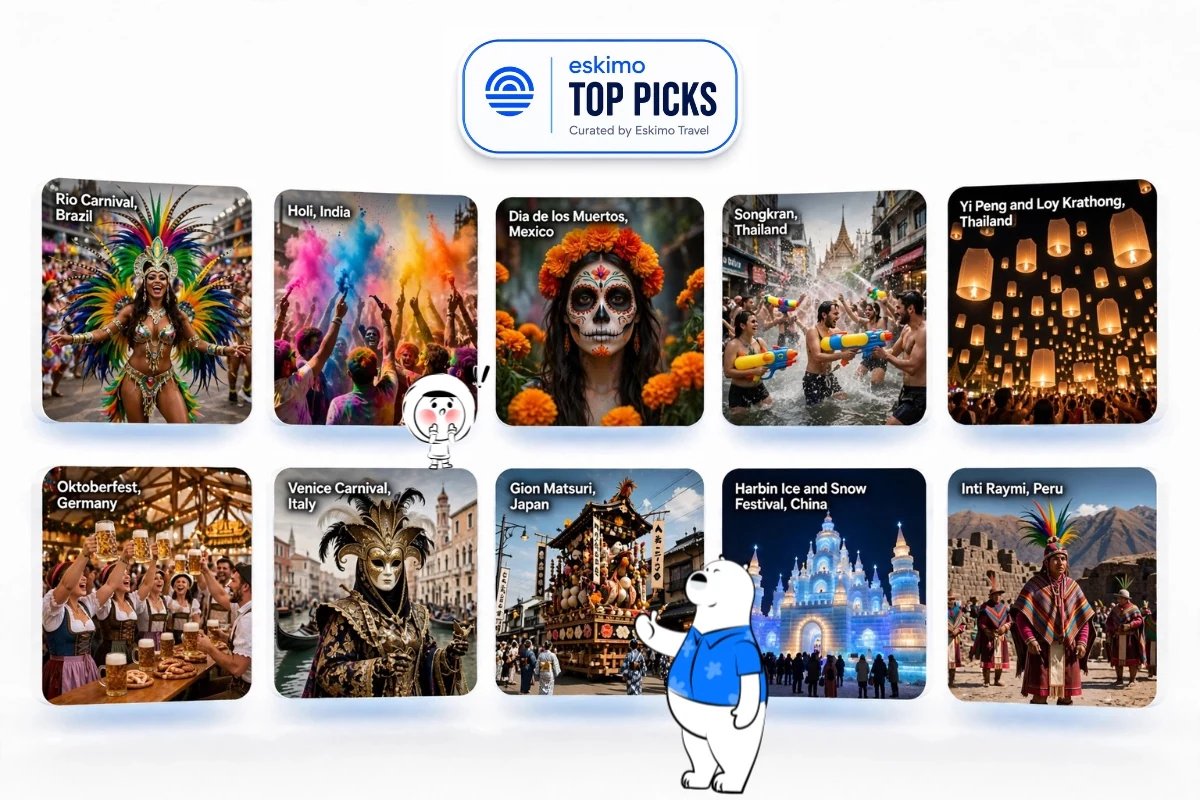
The best festivals in the world include Rio Carnival in Brazil, Holi in India, Day of the Dead in Mexico, Songkran in Thailand, and Oktoberfest in Germany. Some fill entire cities with music and color, while others preserve religious, seasonal, and cultural traditions that stretch back generations.
These 10 celebrations stand out for their cultural significance, distinctive atmosphere, international recognition, and appeal to travelers. Exact dates can change each year, particularly for festivals tied to religious or lunar calendars, so always confirm the latest schedule with the official organizer before booking.
10 Best Festivals in the World
Rio Carnival, Brazil
Where: Rio de Janeiro, Brazil Typical timing: February or March
Rio Carnival is one of the world’s most recognizable celebrations. Samba schools spend months preparing elaborate costumes, floats, music, and choreography for performances at the Sambadrome, while hundreds of street parties known as blocos bring the celebration into neighborhoods across Rio.
Carnival dates move with the Christian calendar, and accommodation can become expensive during the busiest days. Travelers planning to attend the Sambadrome parades should arrange tickets and accommodation well ahead.
Eskimo’s Rio Carnival travel coverage goes deeper into the celebration, while the Brazil public holiday and Carnival calendar can help with trip timing.
Holi, India
Where: Across India, with famous celebrations in Mathura, Vrindavan and other cities Typical timing: February or March
Holi is famous for clouds of colored powder, but the Hindu festival has much deeper cultural meaning. It celebrates the arrival of spring and is associated with renewal, community, and stories from Hindu tradition.
Celebrations vary considerably across India. Mathura and Vrindavan are particularly associated with Holi traditions, while cities and communities elsewhere may celebrate differently.
Wear clothes you do not mind staining, protect phones and cameras, and be respectful around temples and religious ceremonies. Eskimo’s India public holidays and festival calendar can help with planning around the festival period.
Día de los Muertos, Mexico
Where: Across Mexico, particularly Oaxaca, Michoacán and Mexico City Typical timing: November 1 and 2
Día de los Muertos, or Day of the Dead, honors deceased family members through altars, flowers, food, music, cemetery visits, and community traditions.
It is not simply a Mexican version of Halloween. The celebration has deep cultural and spiritual significance, and UNESCO recognizes the Indigenous festivity dedicated to the dead as part of humanity’s intangible cultural heritage.
Travelers should be especially respectful around cemeteries, family altars, and ceremonies. Eskimo’s explanation of Day of the Dead traditions and symbols provides more cultural background, while UNESCO’s heritage listing explains its cultural importance.
Songkran, Thailand
Where: Across Thailand, especially Bangkok, Chiang Mai and Pattaya Typical timing: April
Songkran marks the traditional Thai New Year. Water traditionally represents cleansing and renewal, although celebrations in major cities have evolved into enormous public water fights.
Expect wet clothes, crowded streets, and changes to normal transport around major celebration zones. Keep passports, phones, wallets, and cameras protected from water.
Songkran also retains important cultural and religious traditions, so visitors should respect temples and people who are not participating in water fights. Eskimo’s Songkran Festival Thailand coverage explains what travelers can expect.
Yi Peng And Loy Krathong, Thailand
Where: Chiang Mai and other parts of Thailand Typical timing: Usually November
Yi Peng and Loy Krathong take place around the same period but are distinct celebrations. Yi Peng is particularly associated with northern Thailand and illuminated lanterns, while Loy Krathong involves floating decorated baskets known as krathongs on rivers and waterways.
Chiang Mai is one of the most popular places to experience the celebrations, with ceremonies, processions, lantern displays, and crowded evening events.
Lantern releases can be restricted to designated locations and times because of aviation and fire-safety rules. Check current local arrangements before planning around a release.
Eskimo’s coverage of Yi Peng and Loy Krathong explains how the two traditions connect and differ.
Oktoberfest, Germany
Where: Munich, Germany Typical timing: Mid-September to early October
Oktoberfest combines Bavarian food, traditional clothing, music, fairground rides, parades, brewery tents, and several weeks of celebration on Munich’s Theresienwiese.
Entry to the festival grounds is generally free, although drinks, food, rides, and some reservations cost extra. The most popular tents can become extremely busy, especially during evenings and weekends.
Check the official Oktoberfest website for current dates and visitor information. Eskimo also covers the best places to experience Oktoberfest in Europe for travelers considering a wider European trip.
Venice Carnival, Italy
Where: Venice, Italy Typical timing: February, before Lent
Venice Carnival transforms the city’s squares, canals, palaces, and narrow streets with masks, elaborate costumes, performances, and public events.
You do not need a ticket to experience much of the atmosphere around Venice, although formal masquerade balls and special performances may require advance reservations.
Piazza San Marco attracts some of the largest crowds. Start early if you want quieter streets and easier photographs, then explore neighborhoods beyond the busiest central routes.
The official Venice Carnival website publishes the latest program and event information.
Get Eskimo eSIM to stay connected globally
Need internet while travelling? Here's what we recommend:

Fixed data plans
- No speed reduction
- No expiry, keep your data forever
- Transfer data to anyone
- Personal hotspot


Gion Matsuri, Japan
Where: Kyoto, Japan Typical timing: July
Gion Matsuri is one of Japan’s most famous traditional festivals and takes place across much of July. Its best-known spectacles are the enormous yamaboko floats that move through central Kyoto during major processions.
Evenings around the main events bring decorated floats, traditional music, food stalls, pedestrianized streets, and substantial crowds.
Kyoto can also be hot and humid in July. Carry water, plan breaks indoors, and expect temporary road closures and busy public transport around major procession dates.
Harbin Ice And Snow Festival, China
Where: Harbin, China Typical timing: Winter, generally from late December or early January
The Harbin Ice and Snow Festival turns China’s northeastern winter into part of the attraction. Enormous illuminated ice structures, snow sculptures, and outdoor installations create a festival landscape that looks completely different after dark.
Winter temperatures can be severe. Thermal layers, insulated footwear, gloves, and protection for phone batteries are essential for spending long periods outdoors.
Eskimo’s feature on the Harbin Ice and Snow Festival has more practical information for planning a winter visit.
Inti Raymi, Peru
Where: Cusco, Peru Typical timing: June 24
Inti Raymi, the Festival of the Sun, is one of Peru’s major cultural celebrations. Modern festivities recreate elements of ceremonies associated with the Inca Empire through processions, traditional clothing, music, performances, and events at important sites around Cusco.
The main celebrations draw large crowds, and some viewing areas require tickets. Accommodation in Cusco can also fill quickly around the festival.
Cusco sits at high altitude, so arriving several days before the main celebration can give your body more time to adjust before long days of sightseeing and festival events.
How To Plan A Trip Around A Major Festival
Festival travel rewards early planning. Popular celebrations can put unusual pressure on accommodation, flights, public transport, restaurants, and even local mobile networks.
Confirm the official dates. Religious calendars, lunar cycles, weather, and local authorities can affect schedules from year to year.
Book accommodation early. For Rio Carnival, Oktoberfest, Gion Matsuri, and other major events, centrally located rooms may disappear months ahead.
Check which events require tickets. Many festivals mix free public celebrations with paid parades, grandstands, ceremonies, performances, or reserved areas.
Plan around transport disruption. Street closures and crowds can make taxis and ride-hailing slower than trains, metros, or walking.
Respect local traditions. Several of these celebrations are religious observances or culturally significant community events. Follow local expectations around clothing, photography, temples, cemeteries, ceremonies, and sacred objects.
Prepare for crowded networks. Mobile data can be slower inside packed festival venues when thousands of people connect to the same local network.
Choosing The Right Festival For Your Trip
For huge crowds and high-energy street celebrations, Rio Carnival and Songkran are standout choices. Oktoberfest offers a more structured festival environment, while Venice Carnival brings spectacle into the historic streets of the city.
For travelers most interested in cultural and spiritual traditions, Holi, Día de los Muertos, Gion Matsuri, and Inti Raymi offer deeper connections to local history, belief, and identity.
Season matters too. Harbin is firmly a winter experience, Holi and Venice Carnival fall around late winter or early spring, Gion Matsuri takes place in summer, and Oktoberfest leads into autumn.
There is no objective winner. The best choice is the festival that matches the culture, climate, crowd level, and travel experience you actually want.
Mobile Data For Festival Trips Around The World
Festival travel makes mobile data particularly useful for digital tickets, event schedules, temporary transport changes, meeting points, translation, and last-minute booking updates. Reception is generally stronger in cities and populated areas, but network performance can weaken inside crowded festival venues when thousands of attendees connect at once.
An Eskimo Global eSIM plan suits an itinerary that combines festivals across several countries. Eskimo’s coverage across 175 countries and regions can support festival trips, stopovers, and onward destinations without setting up a separate eSIM for every eligible country, while the universal eSIM lets travelers keep one reusable Eskimo eSIM for multiple international trips.
New users can also claim free 500MB of Global Data.
FAQs:
What are the 10 best festivals in the world?
Ten standout festivals are Rio Carnival, Holi, Día de los Muertos, Songkran, Yi Peng and Loy Krathong, Oktoberfest, Venice Carnival, Gion Matsuri, Harbin Ice and Snow Festival, and Inti Raymi.
Which cultural festivals are worth traveling for?
Día de los Muertos, Holi, Gion Matsuri, Inti Raymi, Songkran, and Yi Peng and Loy Krathong are strong choices for travelers interested in celebrations with deep cultural or religious traditions.
When is the best time to travel for world festivals?
There is no single festival season. Venice Carnival and Rio Carnival usually fall early in the year, Holi follows around February or March, Gion Matsuri takes place in July, Oktoberfest begins in September, and Día de los Muertos is celebrated in November.
How far ahead should I book travel for a major festival?
For internationally popular festivals, booking accommodation three to six months ahead is often sensible. Major ticketed events or particularly limited accommodation may require even earlier planning.
Do festival dates change every year?
Some do. Festivals tied to religious or lunar calendars can move each year, while others have fixed or relatively predictable dates. Confirm the latest schedule through the official festival organizer or tourism authority before booking non-refundable travel