Milford Sound / Piopiotahi is a glacier-carved fiord in Fiordland National Park, despite the word “Sound” in its English name. For most first-time South Island travelers, Milford Sound is worth visiting, especially if you treat the Milford Road and the cruise as parts of the same experience rather than judging the destination by the boat trip alone. Check our New Zealand road trip details! whre to go? is Milford Sound including?.
The trade-off is time. Milford Sound is remote, weather can change quickly, and traveling from Queenstown can turn it into a very long day. Starting from Te Anau makes the journey considerably easier, while scenic flights can reduce travel time but depend more heavily on flying conditions.
Rain does not automatically spoil Milford Sound. Wet weather feeds temporary waterfalls down the cliffs, while clearer conditions reveal more of the surrounding peaks. Both can produce a memorable visit.
Milford Sound at a Glance
Milford Sound / Piopiotahi lies in Fiordland National Park on New Zealand’s South Island, opening toward the Tasman Sea.
Although it is commonly called Milford Sound, the landscape is technically a fiord, formed as glaciers carved a steep valley that was later flooded by the sea. The historical English name remained even after its glacial geography was understood.
Tourism New Zealand highlights Mitre Peak, Lady Bowen Falls, Stirling Falls, cruises, kayaking, and walking among the main experiences around Piopiotahi.
The Māori name Piopiotahi is equally important. The Department of Conservation says Piopiotahi means “one native thrush,” referring to the piopio, a native bird now thought to be extinct.
Why It Is Called Milford Sound
The name has a geographical twist: Milford Sound is called a sound because the historical name stuck, not because it is technically one.
Welsh sealer John Grono named the place Milford Haven in the early 19th century after Milford Haven in Pembrokeshire, Wales. Royal Navy surveyor John Lort Stokes, another Welshman, later changed the European name to Milford Sound. Te Ara, New Zealand’s national encyclopedia, records HMS Acheron, captained by Stokes, anchoring there in March 1851.
Geographically, Piopiotahi is a fiord. A fiord is a deep coastal inlet carved by glaciers, while a sound is generally associated with a flooded river valley or a broader channel between landmasses.
The English name survived the classification. That is why travelers can visit something called Milford Sound while standing in a landscape shaped unmistakably by glaciers.
The European naming story is only one layer of the place’s history. Māori knew and traveled through the region long before those names appeared, and Piopiotahi carries its own cultural history.
The Case for Visiting Milford Sound
Milford Sound is especially worthwhile for travelers who value large-scale landscapes, scenic road trips, cruises, photography, waterfalls, and Fiordland scenery.
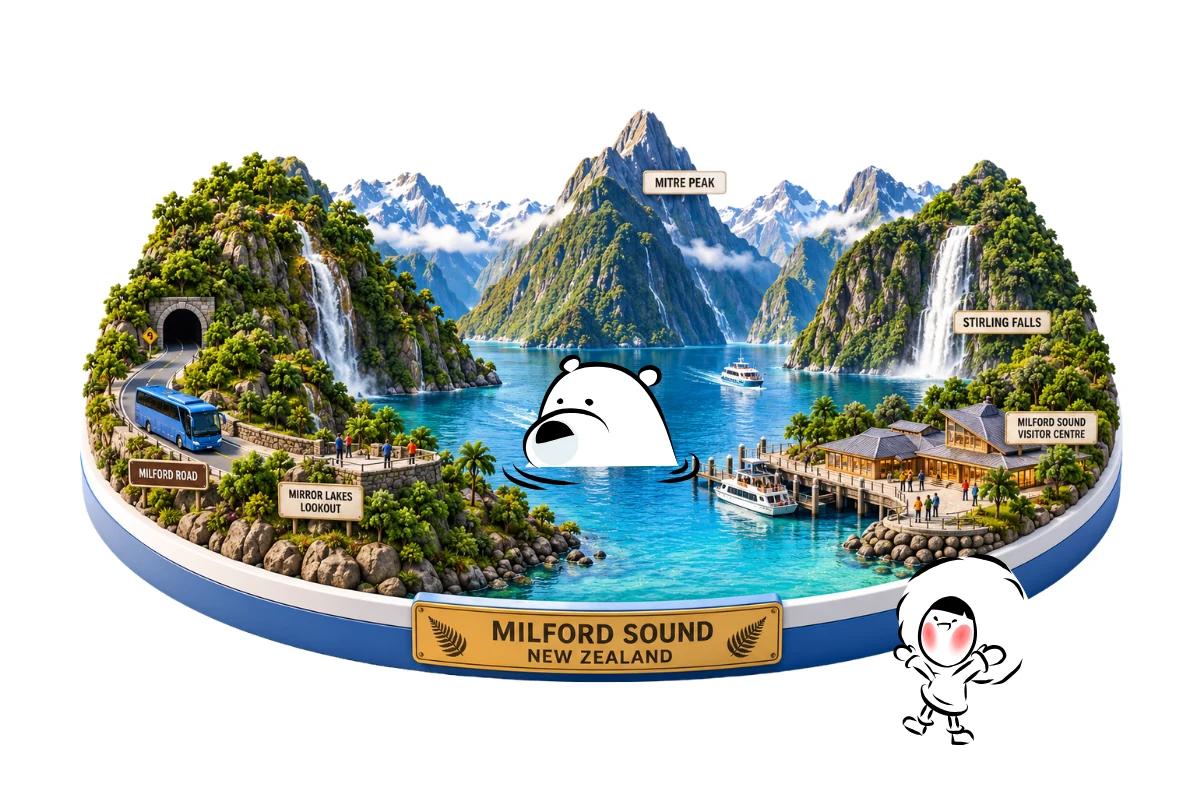
The experience is larger than the wharf. The Milford Road passes through mountains, rainforest, valleys, lakes, and the Homer Tunnel before descending toward Piopiotahi.
Once on the water, the cliffs rise directly from the fiord and the scale becomes easier to appreciate. A typical cruise passes landmarks such as Mitre Peak, Lady Bowen Falls, and Stirling Falls before traveling toward the Tasman Sea. Tourism New Zealand identifies Lady Bowen and Stirling as the two waterfalls that flow year-round, while many smaller falls appear after rain.
Milford Sound is less compelling if your South Island itinerary is extremely short and reaching it would consume most of your available time. A same-day return from Queenstown involves many hours of transport even before adding the cruise.
Travelers seeking a quieter Fiordland experience may also prefer spending longer in the region rather than treating Milford Sound as a quick out-and-back excursion.
Milford Sound Location
Milford Sound sits deep inside Fiordland on the southwest coast of New Zealand’s South Island.
Road access is via State Highway 94, the Milford Road, from Te Anau. Travelers coming from Queenstown generally travel toward Te Anau before continuing through Fiordland.
Tourism New Zealand currently estimates the direct road journey from Queenstown at around 3 hours 50 minutes, without allowing for sightseeing stops or significant delays. In practice, a Milford day from Queenstown is much longer once scenic stops, breaks, the cruise, and the return journey are included.
Best Things to Do in Milford Sound
Most visits center on the water, but the Milford Road and short walks around the fiord add considerably more to the trip.
Take a Milford Sound cruise
A cruise is the easiest way to experience the scale of the fiord.
Boats travel beneath steep rock walls and past major waterfalls, with many routes continuing toward the Tasman Sea before returning to the terminal.
Cruise length, vessel size, departure times, and prices differ between operators. Some experiences focus mainly on sightseeing, while others combine the cruise with coach transport, walks, or overnight stays.
Book with a reputable operator and check current departure times rather than relying on an old itinerary.
See Mitre Peak
Mitre Peak rises sharply above Milford Sound and is one of the landscape’s most recognizable features.
You can see it from around the foreshore and from boats on the fiord, although low cloud can conceal some or all of the mountain.
Clear visibility is never guaranteed in Fiordland, so weather should be treated as part of the experience rather than a photographic contract.
See the waterfalls
Lady Bowen Falls and Stirling Falls are the best-known permanent waterfalls around Milford Sound.
Rain creates many additional cascades along the cliffs. Because Fiordland receives substantial rainfall, a wet day can turn otherwise bare rock faces into curtains of water.
Heavy rain can also affect driving conditions and visibility, so dramatic waterfalls do not remove the need to monitor road and weather information.
Go kayaking
Kayaking puts you much closer to the water and cliffs than a larger sightseeing boat.
Guided trips are the practical option for most visitors because conditions can change and the water remains cold.
Availability depends on season, wind, weather, and operator schedules, so book ahead if paddling is one of the main reasons for your trip.
Take a scenic flight
Scenic flights connect Milford Sound with Queenstown and can dramatically shorten the return journey.
They also provide a different view of Fiordland’s mountains, valleys, and waterways.
The drawback is weather dependency. Cloud, wind, and visibility can affect flight operations, so avoid building an itinerary that fails if a flight cannot operate.
Walk around Milford Sound
You do not need to begin the multi-day Milford Track to walk near the fiord.
Short options around the area include the Milford Sound Foreshore Walk and nearby lookout areas, while several worthwhile stops sit along the Milford Road.
If hiking forms a larger part of your New Zealand trip, leave enough flexibility for Fiordland weather rather than assigning every hour in advance.
Look for wildlife
Seals are associated with the Fiordland coast, while dolphins and penguins may also be seen in the wider marine environment.
Wildlife sightings are never guaranteed. Treat an encounter as an addition to the landscape experience rather than a promised part of your cruise.
DOC records seals and occasional bottlenose dolphins within the Piopiotahi marine environment.
Milford Sound in Rain and Clear Weather
Rain is not necessarily bad news in Milford Sound.
Clear conditions provide broader mountain views and often make Mitre Peak easier to see. Dry weather can also be more comfortable for outdoor decks, short walks, and photography.
Rain changes the scene. Temporary waterfalls appear across the cliffs, cloud settles between the mountains, and the landscape can become more dramatic.
That does not mean rainy weather is automatically better. Heavy rain can reduce visibility and contribute to more difficult road conditions. The practical approach is to expect Fiordland weather to shape the day.
If conditions become severe, transport, cruises, or flights may be disrupted.
Get Eskimo eSIM to stay connected in New Zealand
Need internet in New Zealand? Here's what we recommend:

Fixed data plans
- No speed reduction
- No expiry, keep your data forever
- Transfer data to anyone
- Personal hotspot



Unlimited data plans
- Unlimited day pass
- Daily 3GB high-speed + 1Mbps unlimited after
- Personal hotspot

Getting to Milford Sound
Milford Sound can be reached by self-drive, coach, organized tour, or scenic flight.
The most important decision is often not the transport itself but where you start.
From Te Anau
Te Anau is the most practical road base for Milford Sound.
The journey is about 120 km each way, but the road deserves more time than the distance suggests. Scenic stops, mountain conditions, slower traffic, and the Homer Tunnel all affect the journey.
Starting in Te Anau lets you experience the Milford Road without adding the Queenstown-to-Te Anau section at both ends of the day.
It is generally the better choice for travelers who want a less compressed visit or plan to self-drive.
From Queenstown
Queenstown is a convenient base for travelers who do not want to change accommodation, but the day is substantially longer.
Coach-and-cruise tours remove the burden of driving and let you watch the landscape instead of concentrating on the road.
Self-driving from Queenstown gives more independence but creates a long return journey. If you are already planning several days around Fiordland, spending a night in Te Anau usually creates a more comfortable itinerary.
Self-drive or coach
Self-driving provides control over stops and timing, but Milford Road requires attention.
A coach can be easier if you would rather avoid alpine driving, winter conditions, parking concerns, or fatigue after the cruise.
Neither option is universally better. Choose according to your driving confidence, season, and how much of the road you want to experience independently.
Driving the Milford Road
State Highway 94 is one of the most rewarding parts of the Milford Sound journey, but it is an alpine road rather than a routine city transfer.
Weather, rockfalls, snow, and avalanche risk can cause delays or closures. The Department of Conservation advises travelers to prepare for changing conditions, particularly during winter.
Check the live SH94 Milford Road status before leaving. NZ Transport Agency updates the page with current road conditions, avalanche information, chain requirements, and operational notices.
Do not rely on yesterday’s road status.
DOC advises travelers to leave Te Anau with a full fuel tank because there are no fuel stations between Te Anau and Milford Sound. Carry food, water, warm clothing, and essential booking information offline as well.
Mobile reception along the route is limited rather than continuous. DOC currently lists reception at Te Anau Downs, Totara Campsite, The Divide, and Milford Sound, but travelers should expect substantial gaps between those locations.
Best Time to Visit Milford Sound
Milford Sound can be visited year-round, and there is no single month that guarantees the best experience.
Summer, from December to February, brings longer daylight and generally milder conditions, but it is also a popular travel period.
Autumn can bring cooler conditions, while spring is often variable as alpine weather changes.
Winter can be striking when snow covers the surrounding mountains, but road conditions require more planning. Snow, ice, avalanche management, and chain requirements can affect State Highway 94.
Rain is possible throughout the year. It is part of Fiordland’s climate rather than a seasonal anomaly.
If your trip overlaps a national long weekend or public holiday, accommodation and popular transport options can fill earlier. Eskimo’s New Zealand public holidays 2026 can help identify dates that may affect travel demand.
How Long to Spend in Milford Sound
A cruise itself occupies only part of the day. The road journey determines how much time you really need.
From Te Anau, allow a full day so you can drive without rushing and make scenic stops.
From Queenstown, expect Milford Sound to consume most of the day if traveling by road. Trying to stack another major activity before or after it usually creates an unnecessarily tight schedule.
A night near Milford or an additional night in Te Anau gives you more breathing room if Fiordland is an important part of the trip.
Staying Near Milford Sound
Accommodation at Milford Sound itself is limited, which is one reason many visitors stay in Te Anau.
Te Anau offers a wider choice of accommodation, restaurants, supermarkets, fuel, and services while keeping you much closer to Milford Road than Queenstown.
Queenstown offers considerably more accommodation and activities but creates a much longer road journey.
Choose Queenstown if Milford is one day within a broader Queenstown itinerary. Choose Te Anau if Fiordland itself is the priority.
Practical Milford Sound Travel Tips
Book cruises and organized transport ahead during busy travel periods, but keep enough flexibility for changing weather.
Check SH94 conditions before departure, particularly in winter or after severe weather.
If self-driving, leave Te Anau with a full fuel tank and avoid turning the road into a stopwatch exercise. The landscape between Te Anau and Milford is part of the experience.
Bring waterproof clothing even when the forecast looks reasonable. Fiordland weather can change quickly.
Carry offline maps, booking confirmations, and important contact details because mobile reception is intermittent along the Milford Road.
Sandflies can be persistent around Fiordland, so insect repellent is useful whenever you spend time outside.
Mobile Data Around Fiordland
Mobile data is useful in Queenstown and Te Anau for checking SH94 road conditions, weather forecasts, accommodation messages, cruise bookings, and route planning before entering Fiordland. Reception becomes much less reliable along the Milford Road. DOC currently lists service at several specific points, including Te Anau Downs, Totara Campsite, The Divide, and Milford Sound, so download maps and booking details before departure rather than assuming continuous coverage.
An Eskimo New Zealand eSIM plan is the relevant option for travel around New Zealand. Eskimo’s July 2026 product update states that its overall coverage extends to 175 countries and regions, which can be useful if New Zealand is one stop on a longer international itinerary or you have future trips planned. No-expiry fixed data means eligible unused fixed data can remain available after your Fiordland trip instead of needing to be used before leaving New Zealand.
New users can also claim a free 250MB Global eSIM.
FAQs:
Why is Milford Sound called a sound if it is a fiord?
John Grono originally named it Milford Haven after Milford Haven in Wales. John Lort Stokes later changed the European name to Milford Sound, and the historical name remained even though the inlet is geographically a glacier-carved fiord.
How far is Milford Sound from Queenstown?
Tourism New Zealand currently estimates the direct drive from Queenstown at about 3 hours 50 minutes. Sightseeing stops, traffic, weather, the cruise, and the return trip make a Milford Sound road excursion a full-day commitment.
Is Te Anau or Queenstown better for visiting Milford Sound?
Te Anau is the more practical base if Milford Sound and Fiordland are priorities because it removes several hours of additional driving. Queenstown works well if Milford is one day within a larger Queenstown stay and you prefer an organized coach or flight option.
Can you drive yourself to Milford Sound?
Yes. State Highway 94 connects Te Anau with Milford Sound, but alpine weather, snow, avalanche management, and occasional closures can affect the road. Check the official SH94 status before setting out.
Does Milford Sound have mobile phone reception?
Reception is limited. DOC currently lists service at several points along the route, including Te Anau Downs, Totara Campsite, The Divide, and Milford Sound, but travelers should expect gaps and download essential information before leaving Te Anau.