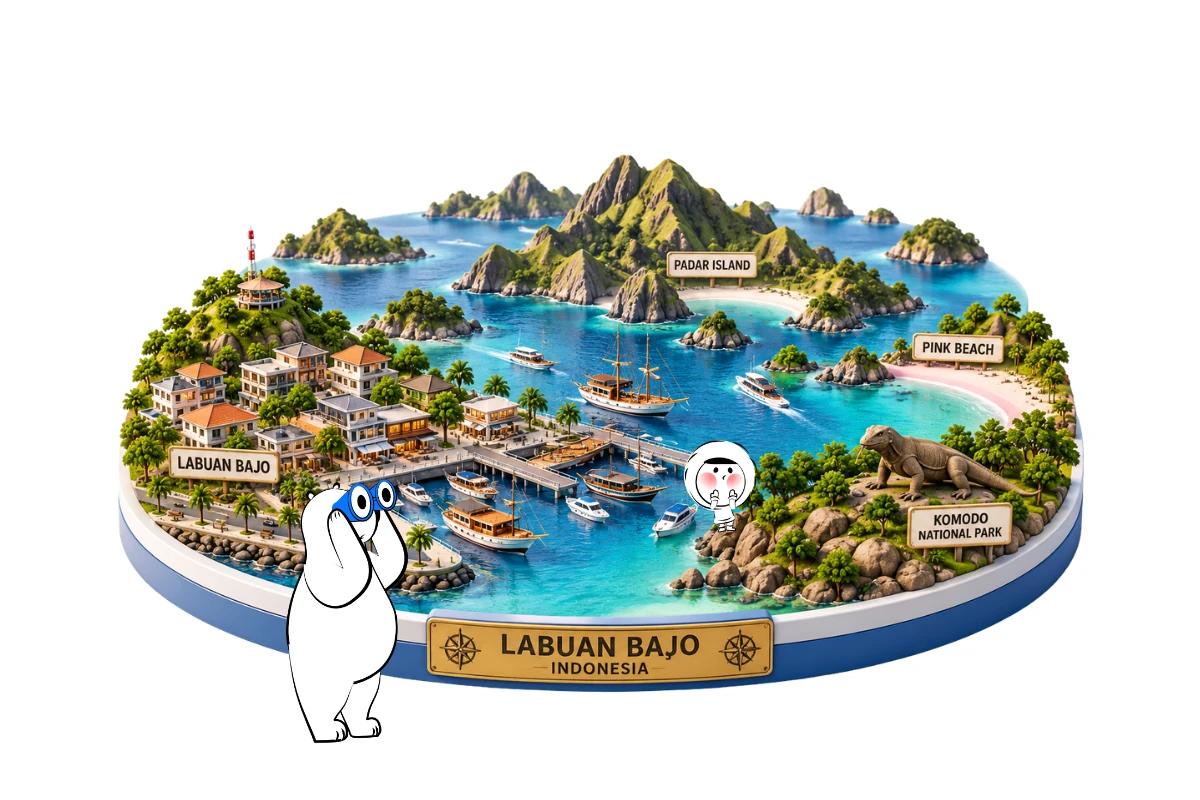
Labuan Bajo is a coastal town on the western end of Flores in East Nusa Tenggara, Indonesia, and the main gateway to Komodo National Park. Most travelers come for Komodo dragons, Padar Island, Pink Beach, snorkeling, diving, and boat trips, but the town is also a useful base for exploring western Flores.
A three- or four-day stay works well for a first visit, especially if you want one full day or an overnight boat trip in Komodo National Park plus time around Labuan Bajo. Travelers combining Flores with other Indonesian destinations can also use Eskimo’s Indonesia travel guide to plan the wider trip.
One important change applies in 2026. From April 1, 2026, Komodo National Park has a maximum visitor quota of 1,000 people per day, and visitors must register through the SIORA online reservation system. Booking the park portion of your trip ahead is therefore more important than it used to be.
Labuan Bajo Location
Labuan Bajo sits at the western tip of Flores in East Nusa Tenggara, facing the islands between Flores and Sumbawa. It is part of West Manggarai Regency and has developed into the main transport and tourism base for western Flores and Komodo National Park.
Labuan Bajo itself is not inside Komodo National Park. The town is the gateway. Travelers leave from its harbor by tourist boat, speedboat, or pinisi to reach the protected islands.
This distinction matters when planning accommodation. You can stay in Labuan Bajo and take day trips into the park, or book an overnight boat itinerary that spends more time among the islands.
For a broader look at where Labuan Bajo fits into an Indonesia itinerary, see Eskimo’s best cities and destinations in Indonesia.
Best Things to Do in Labuan Bajo
The best things to do in Labuan Bajo combine the islands and wildlife of Komodo National Park with diving, snorkeling, viewpoints, caves, and time around the town itself.
Visit Komodo National Park
Komodo National Park is the main reason many travelers reach Labuan Bajo. The UNESCO-listed protected area includes Komodo, Rinca, Padar, numerous smaller islands, and extensive marine ecosystems.
The park protects the habitat of the Komodo dragon, the world’s largest living lizard. Visits to areas inhabited by the animals must follow park rules and ranger instructions.
Never approach, feed, chase, or provoke a Komodo dragon. These are wild predators, not animals to approach for photographs. Follow conservation rules and instructions from park staff throughout the visit.
Hike Padar Island
Padar Island provides one of the most recognizable views in Indonesia. The climb leads above a rugged landscape of steep hills and curving bays, with the surrounding islands spreading across the horizon.
The trail is exposed, so heat can become the main challenge. Carry water, use sun protection, and wear shoes with reasonable grip.
Many boat itineraries schedule Padar early in the day, when temperatures are cooler. Conditions and access arrangements can vary, so follow your boat operator and park instructions.
See Komodo dragons
Wild Komodo dragons can be encountered on designated visits within Komodo National Park, particularly around Komodo and Rinca.
Sightings should never be treated as guaranteed. The animals move naturally through their habitat, and wildlife encounters depend on conditions at the time of the visit.
Stay with your ranger, maintain the instructed distance, and avoid carrying or displaying food around the animals.
Visit Pink Beach
Pink Beach is one of the best-known coastal stops in Komodo National Park. Its sand has a pink tint created by the mixture of pale sand and red material associated with microscopic organisms and coral fragments.
The beach is reached by sea from Labuan Bajo and is commonly incorporated into multi-stop boat tours through the national park.
Snorkeling is also possible around the beach, but avoid standing on or touching coral. Conditions can change with currents, tides, and weather.
Travelers planning a longer beach-focused trip through the country can find more options in Eskimo’s best beaches in Indonesia.
Snorkel around Manta Point and Taka Makassar
The waters around Komodo are a major part of the experience. Manta Point is known for manta ray encounters, while Taka Makassar is a shallow sandbank stop commonly included on snorkeling and island-hopping routes.
Manta sightings are not guaranteed, and currents around Komodo can be powerful. Follow your guide’s assessment rather than entering the water simply because a location appears on the itinerary.
Less confident swimmers should tell the boat crew before snorkeling and use appropriate flotation equipment where available.
Go diving
Labuan Bajo is an established base for diving around Komodo National Park, where reefs, strong currents, pelagic species, manta rays, turtles, and other marine life attract experienced divers.
Conditions vary considerably between sites. Some dives involve strong currents and are unsuitable for beginners, while others are more accessible.
Choose a reputable dive operator and be accurate about your certification level and recent diving experience. Sea conditions should determine the day’s sites rather than a fixed wish list.
Take an island-hopping boat trip
Boat travel is central to a Labuan Bajo trip. Day tours can combine several major locations, while overnight pinisi trips allow more time among the islands.
Common itineraries may include Padar, Komodo or Rinca, Pink Beach, Taka Makassar, Manta Point, Kelor, and other nearby islands. The exact route depends on the operator, weather, park regulations, and sea conditions.
Before paying, check exactly what is included. Ask about park fees, meals, snorkeling equipment, transfers, cabin type, guide services, insurance, and any additional charges.
Watch the sunset
Labuan Bajo is particularly well suited to sunset views because the town faces a landscape of bays, hills, and offshore islands.
Bukit Cinta and other hills around town are popular options, while some waterfront hotels and restaurants provide easier alternatives if you do not want another climb after a day at sea.
The dry-season months generally provide a better chance of clearer sunset conditions, although cloud, haze, and changing weather can affect the view at any time of year.
Explore Batu Cermin Cave
Batu Cermin, or Mirror Cave, provides an easy land-based alternative to another day on a boat. The limestone cave is only a few kilometers from central Labuan Bajo.
Its rock formations and cave environment offer a different side of the region from the beaches and offshore islands.
Wear practical footwear and check current access arrangements locally before visiting.
Visit Rangko Cave
Rangko Cave is known for a natural saltwater pool inside a limestone cavern. Reaching it normally involves traveling north from Labuan Bajo and then continuing by boat.
Light conditions inside the cave change during the day, so local advice can help with timing.
Treat it as a separate half-day excursion rather than trying to squeeze it into a full Komodo boat day.
Komodo National Park from Labuan Bajo
Most travelers visit Komodo National Park by joining a boat trip from Labuan Bajo. Options range from speedboat day tours to slower overnight pinisi journeys.
A speedboat day trip suits travelers with limited time. It can cover several major stops in one long day, although the pace is faster.
An overnight boat trip gives you more time among the islands and reduces the need to return to Labuan Bajo each evening. Accommodation standards vary widely, from simple shared arrangements to private cabins on higher-end vessels.
Travel time varies substantially by destination, vessel type, weather, and the route taken through the park. Speedboats are considerably faster than traditional pinisi vessels.
Check recent reviews and safety equipment before booking. A beautiful wooden boat is not automatically a well-run boat.
Komodo National Park Visitor Rules for 2026
The most important planning change is the daily visitor limit introduced on April 1, 2026.
The official Indonesia tourism portal states that Komodo National Park now has a maximum quota of 1,000 visitors per day, with prospective visitors required to register through the SIORA online reservation system.
The same official information currently lists national park admission at Rp50,000 for Indonesian visitors on weekdays, Rp75,000 on weekends and public holidays, and Rp250,000 for foreign visitors. Additional charges may apply for activities such as diving, while boat transport, accommodation, and tour-operator services are separate.
Fees and procedures can change, so confirm the latest requirements through Indonesia’s official tourism information for Komodo National Park and your licensed operator before paying for a trip.
Best Time to Visit Labuan Bajo
April to November is generally the most practical period for a Labuan Bajo trip, particularly for travelers prioritizing boat excursions, hiking, snorkeling, and diving.
Indonesia’s tourism authority specifically identifies April to June and September to November as generally favorable periods for visiting Komodo National Park. Rainy-season conditions can affect the sea and boat schedules.
Indonesia has tropical wet and dry seasons rather than four temperate seasons. Seasonal timing varies between regions, and weather patterns are not completely predictable.
July and August fall within the dry-season travel period and can be busy, so booking boats and accommodation ahead is sensible if your dates are fixed.
For diving and snorkeling, do not choose dates based only on sunshine. Currents, visibility, wind, and marine conditions can vary between sites and seasons, so consult a reputable local operator for conditions suited to your experience level.
Get Eskimo eSIM to stay connected in Indonesia
Need internet in Indonesia? Here's what we recommend:

Fixed data plans
- No speed reduction
- No expiry, keep your data forever
- Transfer data to anyone
- Personal hotspot



Unlimited data plans
- Unlimited day pass
- Daily 3GB high-speed + 1Mbps unlimited after
- Personal hotspot

Getting to Labuan Bajo
Flying is the simplest way to reach Labuan Bajo for most travelers. Flights arrive at Komodo Airport (LBJ), close to town.
Bali to Labuan Bajo
Bali is one of the most practical gateways to Flores, especially for travelers combining the two destinations. Flights operate between Denpasar and Labuan Bajo, but frequencies, airlines, and fares can change.
If Bali is part of the same trip, Eskimo’s things to do in Bali can help you decide how to divide your time before flying east to Flores.
Leave some flexibility around separately booked flights and boat departures. A delayed flight should not leave you racing directly from the airport to a non-refundable boat.
Jakarta to Labuan Bajo
Flights operate between Jakarta and Labuan Bajo, although availability and schedules vary by date.
Check the live airline schedule before booking rather than relying on a fixed weekly frequency.
Arriving by sea
Sea travel is possible, but it takes much longer and schedules are more vulnerable to weather and operational changes.
It can suit travelers deliberately making an overland and island-hopping journey through Indonesia. For a short holiday, flying to Komodo Airport is generally much easier.
Getting Around Labuan Bajo
Central Labuan Bajo is relatively compact, but hills, heat, and the location of some resorts can make distances feel longer than they look.
Taxis, private drivers, motorcycle taxis, rental vehicles, and hotel transfers are commonly used. Transport arrangements vary, so agree on prices before departure when a service does not use a meter or app-based fare.
For places farther into Flores, a private car with a driver can be more practical than arranging separate short rides.
The harbor is the main departure point for Komodo boat trips. Confirm the exact meeting point with your operator because transfers and departure arrangements differ.
Where to Stay in Labuan Bajo
The best area depends on how much you value harbor access, sea views, quiet surroundings, or convenience.
Central Labuan Bajo is practical for restaurants, tour offices, shops, and harbor access. It works particularly well if you have early boat departures or only a few nights.
Hillside accommodation can provide broad views over the harbor and islands, but walking back uphill in tropical heat can be tiring.
Resorts outside the center suit travelers who want a quieter stay and more time at the property. Check whether the hotel provides transfers because you may otherwise need transport whenever you go into town.
If you are taking an overnight Komodo boat, consider booking the same hotel before and after the trip and asking whether it can store luggage.
Eating in Labuan Bajo
Labuan Bajo has a growing mix of Indonesian restaurants, seafood places, cafés, and international options.
Seafood is a natural choice in a harbor town. Local restaurants and markets can also be good places to try Indonesian staples and dishes from Flores and eastern Indonesia.
Busy restaurants with good food turnover are usually a sensible choice. Drink treated or bottled water, and be more cautious with food that has been sitting unrefrigerated in hot conditions.
Keep some cash available. Cards and digital payments are increasingly common, but smaller businesses and local services may still prefer cash.
A 3-Day Labuan Bajo Itinerary
Three days is enough for a compact first visit if your priority is Komodo National Park.
Day 1: Labuan Bajo and sunset
Arrive at Komodo Airport and transfer to your hotel.
Keep the first afternoon flexible rather than booking an activity immediately after your flight. Explore the waterfront, arrange any remaining boat details, and head to a viewpoint for sunset.
An early night is useful if your boat leaves before sunrise the following morning.
Day 2: Komodo National Park
Use the full day for a Komodo boat trip.
A typical itinerary may combine Padar Island with a ranger-led wildlife stop on Komodo or Rinca, followed by Pink Beach and snorkeling locations such as Taka Makassar or Manta Point.
Routes vary according to weather, currents, park requirements, and the boat operator. Treat the published itinerary as a plan rather than a guarantee.
Day 3: Labuan Bajo or western Flores
Use the final day for Batu Cermin, Rangko Cave, a local viewpoint, or a relaxed morning around town.
If your flight leaves early, skip the excursion and keep the morning simple. If you have another full day, consider extending the trip into Flores rather than adding another rushed sequence of short stops.
Travelers who want an overnight Komodo cruise should allow at least four days so the itinerary does not become dependent on tight flight connections.
Diving and Snorkeling Around Labuan Bajo
Komodo’s marine environment is one of the strongest reasons to spend more than a single day in Labuan Bajo.
Snorkelers can visit reefs, sandbars, and manta areas on boat trips, while certified divers have access to a much wider range of sites.
The region is also known for currents. Conditions that create rich marine environments can make some locations technically demanding.
Choose an operator that matches sites to conditions and diver experience. If you have not dived recently, discuss whether a refresher is appropriate before committing to more demanding sites.
For snorkeling, listen carefully to the crew’s entry and exit instructions. A calm-looking surface does not necessarily mean there is no current underneath.
Practical Labuan Bajo Travel Tips
Book your Komodo National Park dates before building the rest of the trip around them, particularly during busy travel periods and now that the 2026 visitor quota is in effect.
For boat trips, bring sun protection, drinking water, swimwear, a dry bag, and footwear suitable for Padar or other land stops. Reef-safe practices matter: do not stand on coral, feed wildlife, or remove shells, sand, or other natural material.
Weather and sea conditions can change boat itineraries. Keep some flexibility and avoid scheduling a major international connection immediately after a multi-day sailing trip.
Travel insurance is particularly useful for a destination involving boats, diving, snorkeling, hiking, and travel away from major medical centers. Divers should check that their policy covers the type and depth of diving they intend to do.
Labuan Bajo uses Central Indonesia Time (WITA), UTC+8, the same time zone as Bali.
Mobile Data in Labuan Bajo
Mobile data helps with boat departure messages, Komodo reservation details, weather checks, airport transfers, navigation, and contacting accommodation around Labuan Bajo. Coverage is generally stronger in town and populated parts of Flores, while reception may weaken during sea crossings, around remote islands, and in parts of Komodo National Park. Signal depends on terrain, location, and local partner networks.
An Eskimo Indonesia eSIM plan is the relevant option for a trip focused on Labuan Bajo and Flores. Eskimo’s wider network footprint covers 175 countries and regions overall, which can be useful if Indonesia is one stop on a longer itinerary or you have international travel planned later. No-expiry fixed data means unused fixed data can remain available for a future trip instead of needing to be consumed before leaving Indonesia.
New users can also claim a free 250MB Global eSIM.
FAQs:
How many days do you need in Labuan Bajo?
Three days is enough for a short first trip with one full Komodo National Park excursion. Four or five days is more comfortable if you want an overnight boat trip, diving, or additional time around Flores.
What is the best time to visit Labuan Bajo?
April to November is generally favorable for outdoor and marine activities. Official tourism guidance specifically identifies April to June and September to November as good periods for Komodo National Park, while rain can affect sea conditions and boat schedules.
How do you get from Bali to Labuan Bajo?
Flying from Denpasar to Komodo Airport is the simplest option for most travelers. Flights operate on the route, but schedules and fares vary, so check current availability before booking.
Do you need to book Komodo National Park in advance?
Advance planning is strongly recommended. Since April 1, 2026, the park has a maximum quota of 1,000 visitors per day, and visitors are required to register through the SIORA reservation system.
Can you visit Komodo National Park without staying overnight on a boat?
Yes. Speedboat day trips from Labuan Bajo can visit several major park locations without an overnight stay. Multi-day boats provide more time among the islands, but they are not required for visiting the park.