
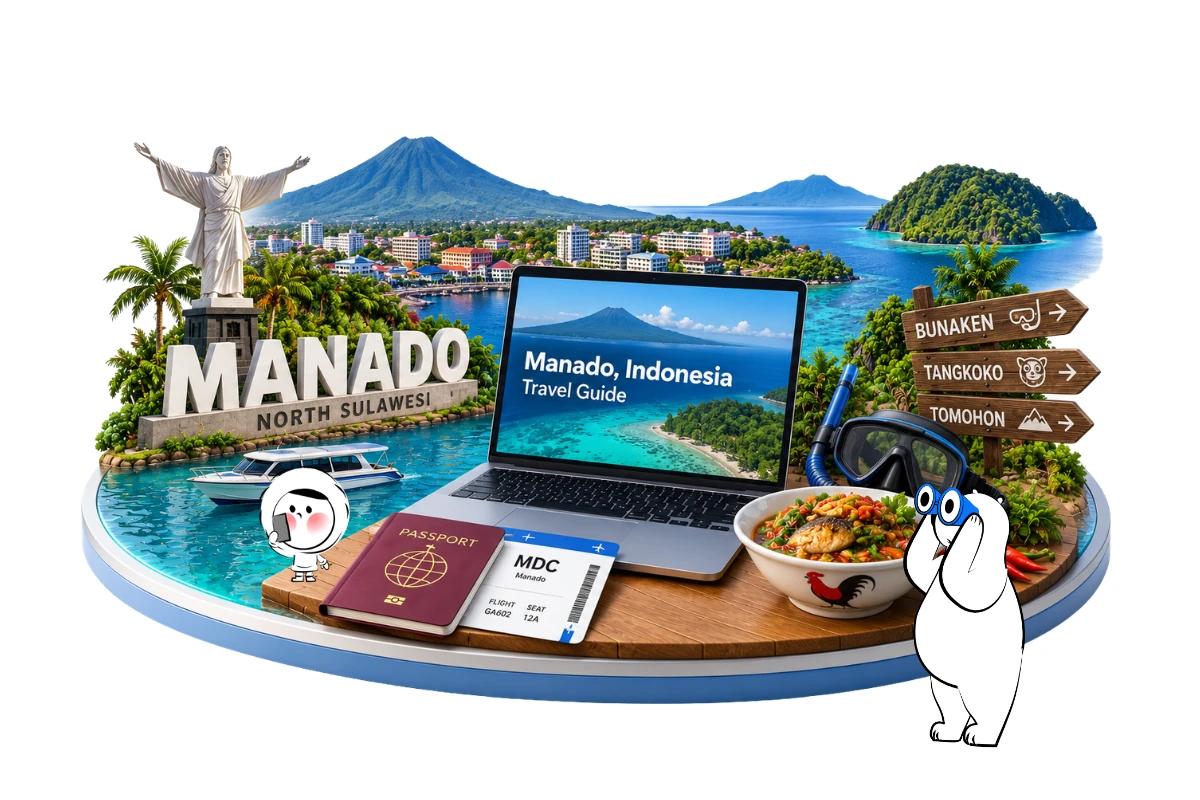
Manado is the capital of North Sulawesi, Indonesia, and one of the main gateways to Bunaken National Park. It suits travelers who want diving, snorkeling, wildlife, spicy Minahasan food, and easy access to both islands and volcanic highlands.
The city itself is compact compared with Indonesia’s major metropolitan areas, but many of Manado’s strongest experiences lie outside the center. Bunaken is reached by boat, while Tomohon, Tangkoko, Lake Tondano, and other North Sulawesi attractions require road trips.
For most visitors, three to five days gives enough time for Manado, Bunaken, local food, and at least one inland or wildlife excursion. Travelers building a wider trip can also use Eskimo’s Indonesia travel guide to compare Manado with other regions of the country.
Manado At A Glance
Manado sits on the northern tip of Sulawesi beside the Celebes Sea. It is the provincial capital of North Sulawesi and the region’s main aviation, commercial, and tourism hub. Indonesia’s Ministry of Tourism highlights marine parks, Minahasan culture, highland landscapes, and regional cuisine among North Sulawesi’s defining attractions.
For orientation, the Bunaken islands sit offshore from Manado, Tomohon lies inland in the highlands, and Bitung and the Lembeh Strait are reached by traveling east across the peninsula.
Travelers often use Manado as a base rather than spending every day within the city. That makes it especially suitable for travelers who prefer nature, food, diving, and day trips over a dense urban sightseeing schedule.
Best Things To Do In Manado
The strongest Manado itinerary combines marine activities with cultural and inland experiences rather than treating the city as a conventional urban sightseeing destination.
Dive or snorkel in Bunaken National Park
Bunaken National Park is the main reason many international visitors come to Manado. The protected marine area sits within the Coral Triangle and supports extensive coral reefs alongside fish, mollusks, reptiles, and marine mammals.
Indonesia’s official tourism portal identifies dive sites including Sachiko’s Point, Ron’s Point, Siladen Jetty, Pangulingan, and Barracuda Point. Bunaken is especially known for steep reef walls, while snorkeling gives non-divers another way to experience the marine park.
Detailed boat options, trip length, and diving conditions are covered below in the dedicated Bunaken section.
Visit the Lembeh Strait
Travelers with a serious interest in underwater photography can continue east toward Bitung and the Lembeh Strait.
Lembeh is associated with muck diving, where divers search volcanic sand and seabeds for unusually small or well-camouflaged marine creatures. Official Indonesian tourism information places the area near Bitung, roughly an hour by road from Manado depending on traffic.
It works best as a dedicated diving day or overnight extension rather than something squeezed between city attractions.
See tarsiers at Tangkoko
Tangkoko Nature Reserve is one of North Sulawesi’s most distinctive wildlife trips. Travelers typically visit with a local guide and time their walk around wildlife activity, particularly toward late afternoon when tarsiers become easier to observe.
The reserve is around two hours from Manado under normal conditions, although travel times vary.
Wear closed shoes, bring insect repellent, and avoid treating wildlife encounters as guaranteed. Animals move freely, and sightings depend on conditions and timing.
Spend a day in Tomohon
Tomohon provides a sharp change from Manado’s tropical coast. The highland city sits among volcanic terrain and generally feels cooler than the waterfront.
Popular stops around the area include Lake Linow, flower-growing districts, viewpoints, and volcanic landscapes. Tomohon is approximately an hour from Manado by road in ordinary traffic conditions.
A private car with a driver is often the simplest option if combining several highland stops in one day.
Visit Ban Hin Kiong Temple
Ban Hin Kiong is one of Manado’s important Chinese cultural landmarks and sits in the Calaca area.
Visitors should dress respectfully and remember that it remains a place of worship rather than simply a sightseeing backdrop.
Watch sunset over Manado Bay
Manado’s waterfront is a good place to slow down after an excursion. On clear evenings, views stretch across Manado Bay toward the offshore islands.
Malalayang Beach, about 15 minutes from central Manado depending on traffic, is another popular local waterfront area with food stalls and coastal views.
Travelers comparing Manado with other Indonesian destinations can also see where North Sulawesi fits among Eskimo’s places to visit in Indonesia.
Bunaken National Park
Bunaken deserves more time than a hurried sightseeing stop.
The national park protects a large marine ecosystem around Bunaken, Manado Tua, Siladen, Mantehage, Nain, and surrounding waters. Its position within the Coral Triangle helps explain the diversity that has made the area internationally known for diving.
The official Indonesia tourism information for Bunaken is useful for checking current destination information before arranging a trip.
Getting to Bunaken
Boat travel from Manado to Bunaken generally takes about 20 to 60 minutes, depending on the vessel, departure point, weather, and sea conditions.
Chartered speedboats can make the crossing in roughly 20 to 30 minutes, while local public boats may take around 45 to 60 minutes.
Public boats, resort transfers, dive boats, and private charters can operate on different schedules. Confirm the departure point and return arrangement directly with your accommodation or operator instead of relying on an old timetable.
Day trip or overnight stay
A day trip works well for travelers who want one snorkeling or diving excursion while keeping Manado as their base.
Staying overnight makes more sense if diving is the main purpose of the trip. It reduces repeated boat transfers and gives easier access to early dives, multiple dive sites, and quieter island evenings.
Travelers staying several nights can also consider Siladen, particularly if they prefer a resort-style island base.
Diving and snorkeling conditions
Official tourism guidance identifies May to October as a particularly favorable period for Bunaken, with generally calmer seas and better underwater visibility.
The marine park remains accessible at other times, but rainfall, wind, currents, and sea conditions can affect individual trips. Marine conditions can also change during the day, so confirm plans shortly before departure.
Choose a reputable operator, follow briefing instructions, and avoid touching coral or marine wildlife.
Best Time To Visit Manado
May to October is generally the easiest period for a Manado trip focused on diving, snorkeling, islands, and outdoor excursions. The period often brings clearer conditions and calmer seas around Bunaken.
Manado has a tropical climate, so warm temperatures and humidity are normal throughout the year. Rain can still occur during the drier months.
November through the early part of the year tends to bring wetter conditions. A rainy-season visit is still possible, but travelers planning boat trips should leave some flexibility in case marine conditions change.
For diving-focused holidays, sea conditions matter more than simply choosing the driest-looking month on a weather app. Check forecasts and ask your dive operator about local conditions shortly before departure.
Manado Food To Try
Food is one of Manado’s strongest reasons to spend time in the city instead of immediately leaving for Bunaken.
Minahasan cooking is known for pronounced herbs, chilies, aromatics, seafood, and bold seasoning. Travelers who enjoy spicy food will have plenty to work through.
Get Eskimo eSIM to stay connected in Indonesia
Need internet in Indonesia? Here's what we recommend:

Fixed data plans
- No speed reduction
- No expiry, keep your data forever
- Transfer data to anyone
- Personal hotspot



Unlimited data plans
- Unlimited day pass
- Daily 3GB high-speed + 1Mbps unlimited after
- Personal hotspot

Tinutuan
Tinutuan, commonly called Manado porridge, combines rice with vegetables and is frequently eaten for breakfast.
It is one of the easiest regional dishes for first-time visitors to try and appears throughout the city.
Ikan bakar with sambal dabu-dabu
Grilled fish is particularly well suited to a coastal city. Sambal dabu-dabu typically adds fresh chili, tomato, shallot, and citrus-like acidity rather than the heavily cooked texture of some Indonesian sambals.
Rica-rica
Rica-rica refers to a spicy preparation built around chili and aromatics. It can be served with several kinds of protein.
Woku
Woku is another strongly aromatic North Sulawesi preparation using herbs and spices.
Indonesia’s tourism authority identifies tinutuan, rica-rica, woku, grilled fish, and sambal dabu-dabu among characteristic foods of North Sulawesi.
Travelers with dietary restrictions should ask what meat or seafood a dish contains before ordering. Minahasan cuisine includes ingredients that may be unfamiliar to international visitors, and menu translations are not always detailed.
Where To Stay In Manado
The best base depends on what you plan to do.
Central Manado is convenient for restaurants, shopping, city services, and transport arrangements. It works particularly well for travelers combining several different day trips.
The Malalayang side of the city can suit travelers who prefer waterfront surroundings while remaining on the mainland.
Bunaken or Siladen is better for a diving-centered itinerary. Staying on an island reduces the need for repeated transfers from Manado.
If you plan to split your time between diving and inland attractions such as Tomohon or Tangkoko, spending the first few nights in Manado and then moving to an island often creates a more efficient itinerary.
Getting To Manado
Most travelers arrive through Sam Ratulangi International Airport, the main airport serving Manado and North Sulawesi.
The airport connects Manado with major Indonesian cities. International schedules can change by season and airline, so check current routes rather than assuming that a previously available nonstop service is still operating.
Taxis and app-based transport are commonly used for airport transfers and travel within the city.
Travelers arriving from abroad should also verify Indonesia’s current immigration requirements before departure. Visa eligibility depends on nationality. Indonesian immigration states that eligible e-VOA travelers must present a passport valid for more than six months and a return ticket.
Check the official Indonesian immigration portal for the requirements applying to your passport before traveling.
Getting Around Manado And North Sulawesi
Transport inside Manado is relatively straightforward, while regional sightseeing requires more planning.
App-based ride services and taxis are useful for city trips. Local mikrolet minibuses also operate along established routes.
For Tomohon, Tangkoko, Bitung, or multiple stops in the Minahasa highlands, hiring a car with a driver can be more practical than arranging separate rides.
Boat travel is required for Bunaken and other offshore destinations. Departure arrangements vary between public boats, resort transfers, dive boats, and private charters.
Keep some Indonesian rupiah in cash when traveling beyond central Manado. Digital payment acceptance can become less predictable around smaller islands and rural areas.
A Practical Manado Itinerary
Two days
Use the first day for Manado, local food, the waterfront, and a cultural stop.
Spend the second day diving or snorkeling in Bunaken.
This works for a short stop but leaves almost no room for weather disruption.
Three days
Day one can cover Manado and its food scene.
Use day two for Bunaken.
Spend day three in Tomohon and the Minahasa highlands, or travel east for a wildlife or diving experience.
Four to five days
A longer stay makes it easier to combine Bunaken with Tangkoko, Tomohon, Lembeh, and slower meals in Manado.
Divers may want to use the extra time for two or more days in Bunaken rather than trying to see every inland attraction.
Practical Manado Travel Tips
Bring reef-conscious sun protection, a lightweight rain layer, mosquito repellent, and clothing that works in humid weather.
Book diving through an established operator and tell the crew about your certification level, recent diving experience, and any equipment needs before departure.
Allow flexibility around boat trips. Weather and sea conditions can affect departure times even when conditions in central Manado look fine.
Dress modestly at places of worship and follow local instructions about photography.
Travel demand can rise around national holidays and collective leave periods. Eskimo’s Indonesia public holidays overview can help identify dates when domestic transport and accommodation may become busier.
Mobile Data In Manado And Bunaken
Mobile data is useful in Manado for airport transport, ride-hailing, restaurant directions, weather checks, and coordinating boat departures. Reception is generally stronger in Manado and other populated areas, while signal can vary during sea crossings, on smaller islands, and in remote parts of North Sulawesi.
An Eskimo Indonesia eSIM plan can be set up for a Manado trip. Eskimo’s wider network footprint covers 175 countries and regions overall, which is useful if Indonesia forms part of a longer Southeast Asian trip or you have another international journey planned later. No-expiry fixed data means any unused fixed-plan allowance can remain available for a future trip instead of having to be used before the Manado holiday ends.
New users can also claim a free 250MB Global eSIM.
FAQs:
What is Manado famous for?
Manado is best known as the gateway to Bunaken National Park, along with its diving, marine biodiversity, Minahasan cuisine, and access to the volcanic and wildlife destinations of North Sulawesi.
How many days do you need in Manado?
Three to five days works well for most travelers. Three days allows time for Manado, Bunaken, and one regional trip, while four or five days gives more flexibility for diving, Tomohon, Tangkoko, or Lembeh.
How far is Bunaken from Manado?
Boat travel from Manado to Bunaken generally takes about 20 to 60 minutes. Chartered speedboats can take roughly 20 to 30 minutes, while local public boats may take around 45 to 60 minutes, depending on conditions and the departure point.
What is the best time to visit Manado?
May to October is generally the most convenient period for outdoor and marine activities, particularly diving and snorkeling around Bunaken. Rainfall and sea conditions can still vary from day to day.
Can you visit Bunaken without scuba diving?
Yes. Bunaken can also be visited for snorkeling, boat trips, island stays, and coastal scenery, so scuba certification is not required to enjoy the national park