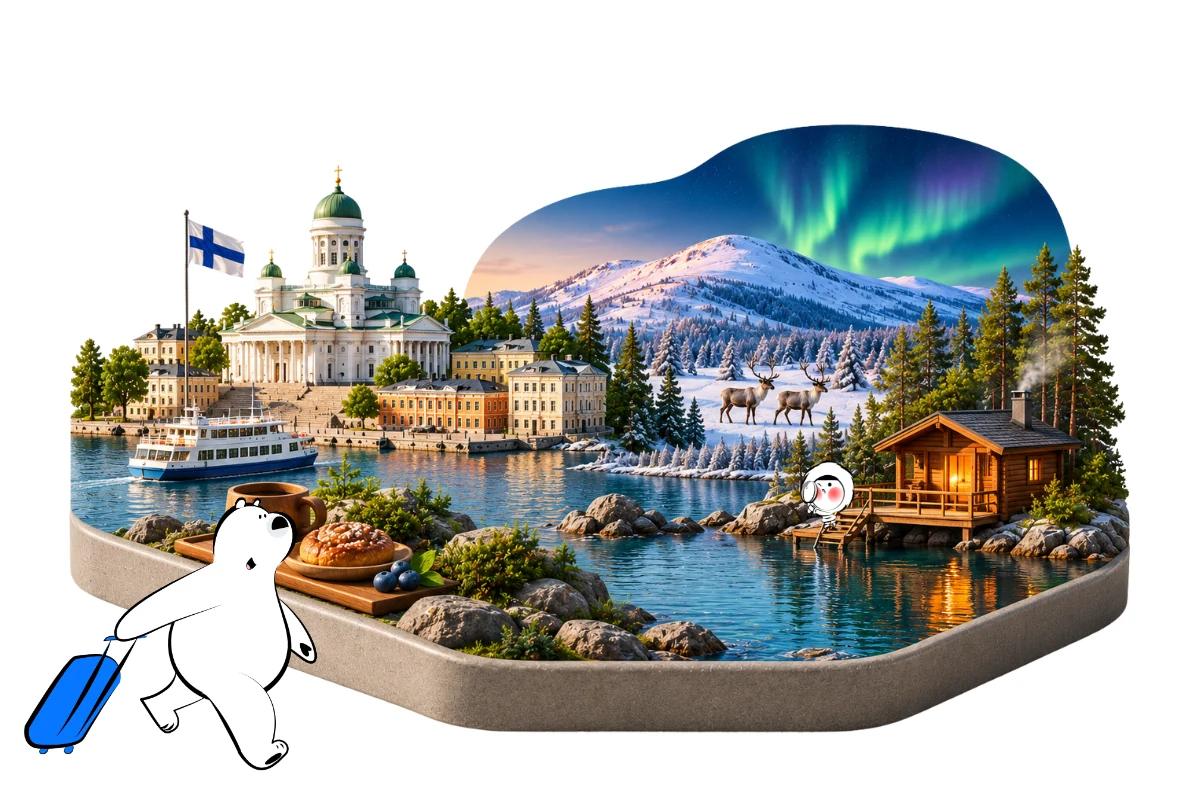
The best things to do in Finland go well beyond seeing Helsinki and hoping for the Northern Lights. Finland is at its best when you combine city life with sauna culture, forests, lakes and, if the season is right, a journey north into Lapland.
First-time visitors can start in Helsinki, take a ferry to Suomenlinna, try a Finnish sauna and then choose between Lakeland, the coast or Lapland. Winter suits travelers looking for snow, skiing and Arctic experiences, while summer brings long daylight hours, hiking, cottages and island trips.
Finland is also highly seasonal, so check Finland Public Holiday. A December trip to Lapland feels almost like visiting a different country from southern Finland in July, so the experiences worth prioritizing depend heavily on when and where you travel.
1. Explore Helsinki Beyond the Main Sights
Helsinki is the natural starting point for many Finland trips, but it works best when you treat it as more than a checklist of landmarks.
Walk around Senate Square and Helsinki Cathedral, browse the Old Market Hall, explore the Design District and spend time along the waterfront. Finnish architecture and design are particularly visible around the capital, from Art Nouveau neighborhoods to buildings associated with Alvar Aalto.
Helsinki is compact enough to explore extensively on foot, while trams, buses, metro services and ferries make longer journeys straightforward. Visit Finland describes the capital region as a combination of architecture, public saunas, food, design and easy access to nature.
Leave enough time for the city rather than treating Helsinki purely as an airport stop.
2. Take the Ferry to Suomenlinna
Suomenlinna is a sea fortress spread across islands just off Helsinki and one of Finland’s UNESCO World Heritage Sites.
The ferry ride itself is part of the appeal, giving you a different perspective on Helsinki’s waterfront before reaching the fortress. Once there, you can walk between historic fortifications, tunnels, museums and coastal viewpoints.
Allow at least a few hours. Weather matters because much of the experience is outdoors, and opening hours for museums, restaurants and other facilities vary through the year.
3. Experience a Real Finnish Sauna
Sauna is one Finnish experience that deserves its reputation.
Public saunas in Helsinki and Tampere provide an easy introduction, while cottages and resorts across Lakeland and Lapland offer more traditional settings. Depending on the location, a sauna session may be paired with a swim in a lake or the Baltic Sea.
Finnish sauna culture is generally calm and straightforward rather than ceremonial. Temperatures often sit around 70°C to 90°C, and water is thrown onto hot stones to produce löyly, the steam that changes how the heat feels.
Visit Finland’s official sauna information is useful for first-time visitors who want to understand local etiquette before going.
4. See the Northern Lights in Finnish Lapland
Northern Finland is one of Europe’s strongest destinations for aurora trips, but the Northern Lights are never guaranteed.
Visit Finland identifies late August to early April as the main Northern Lights season in northern Finland. September to October and February to March can be particularly favorable periods, although clear skies and solar activity still determine whether anything appears.
Rovaniemi is convenient for first-time Lapland trips, while Levi, Saariselkä, Ivalo and Inari take you farther north and often closer to darker surroundings.
Give yourself several nights rather than building the entire trip around one evening. Cloud can ruin an otherwise active aurora night, so think of the Northern Lights as a possibility rather than a scheduled attraction.
5. Cross the Arctic Circle in Rovaniemi
Rovaniemi is the most accessible introduction to Finnish Lapland for many travelers.
The Arctic Circle runs through Santa Claus Village, where visitors can cross the marked line, visit Santa-themed attractions and find restaurants and shops in one compact area.
Families will find the strongest appeal here, particularly around Christmas. Travelers without children can still use Rovaniemi as a practical base for winter activities, aurora tours and journeys deeper into Lapland.
December is extremely popular. Book flights, accommodation and major activities well ahead if your dates fall around Christmas or New Year.
6. Ride the Night Train to Lapland
Flying is faster, but the overnight train from southern Finland to Lapland turns the journey itself into part of the trip.
VR operates night trains to Rovaniemi, Kemijärvi and Kolari, with onward connections available for several Lapland destinations. Private sleeping cabins are available, including cabins with their own showers on some services.
The train is particularly useful if you want to travel from Helsinki north without losing most of a sightseeing day.
Book early for Christmas, New Year and peak ski periods. Current schedules and fares should always be checked directly with VR, as timetables and availability change.
7. Sleep Under the Arctic Sky
Glass-roof cabins and igloos have become one of Finnish Lapland’s most recognizable experiences.
Properties around Saariselkä, Levi, Rovaniemi and other northern destinations offer rooms designed around views of the sky. They can be spectacular when the weather cooperates, but paying for a glass roof does not guarantee an aurora.
Think of the accommodation itself as the experience. If the Northern Lights appear above it, that is the bonus.
Prices can rise sharply during the winter peak, so compare a glass-cabin night with conventional hotels or cabins rather than assuming the entire trip needs to be spent under glass.
8. Go Skiing or Snowshoeing in Lapland
Finnish Lapland is not only about Santa Claus and the Northern Lights. Its snow-covered forests and fells also make it one of the best parts of Finland for winter activities.
Levi and Ylläs are among the better-known ski areas, while cross-country skiing is widespread across northern Finland. Snowshoeing offers a slower alternative and can be easier for travelers who have little or no skiing experience.
Guided snowshoe walks are particularly useful if you want to explore forests or fell landscapes without worrying about navigation in winter conditions.
Check snow conditions, daylight and weather before heading out independently. Winter temperatures can change quickly, and suitable clothing matters as much as the activity itself.
9. Spend a Night in a Finnish Cottage
Finland becomes easier to understand once you leave the city and spend time beside a lake or forest.
A Finnish cottage, or mökki, may include a sauna, lake access, a rowing boat and little else beyond trees and water. Some are simple and traditional, while others have modern kitchens, heating and resort-style facilities.
Lakeland is the obvious region for this experience, particularly during the warmer months.
Check transport carefully before booking. Remote cottages can be difficult to reach without a car, and nearby shops or restaurants may be much farther away than they appear on a map.
10. Discover Finnish Lakeland
Lapland gets the winter headlines, but Lakeland shows another side of Finland.
The region is dominated by forests, islands and waterways, making it particularly good for swimming, paddling, hiking, cycling and cottage stays. Summer evenings are long, while early autumn brings changing foliage and quieter trails.
Savonlinna is a useful destination for combining lake scenery with history, while areas around Saimaa work well for slower trips built around nature.
If your image of Finland involves a wooden cottage, sauna and still water surrounded by forest, this is the region that most closely matches it.
Get Eskimo eSIM to stay connected in Finland
Need internet in Finland? Here's what we recommend:
Fixed data plans
- No speed reduction
- No expiry, keep your data forever
- Transfer data to anyone
- Personal hotspot


Unlimited data plans
- Unlimited day pass
- Daily 3GB high-speed + 1Mbps unlimited after
- Personal hotspot
11. Hike Through a National Park
You do not need to travel deep into Lapland to experience Finnish wilderness.
Finland has 41 national parks, ranging from Arctic landscapes to forests, lakes and coastal islands. Many are free to enter, although transport, equipment, huts and organized activities can involve additional costs.
Nuuksio and Sipoonkorpi are accessible from the Helsinki region, making them useful for travelers with limited time. Farther north, parks become larger and more remote.
Use marked trails, check seasonal conditions and understand local rules before camping or lighting fires. Visit Finland’s national park overview is a useful starting point for choosing where to go.
12. Visit Porvoo for an Easy Day Trip
Porvoo offers one of the easiest changes of pace from Helsinki.
Its Old Town is known for cobbled streets, colorful wooden buildings and the red riverside warehouses that have become the town’s most recognizable view.
It works well as a half-day or full-day trip, particularly for travelers who want somewhere smaller after spending time in the capital.
Porvoo can also be combined with cafés, local food and independent shops rather than approached purely as a sightseeing stop.
13. Explore Turku and Finland’s Coast
Turku provides a different city experience from Helsinki.
Finland’s former capital sits on the Aura River and offers a mix of medieval history, restaurants, museums and easy access to the southwest coast. Turku Castle and Turku Cathedral are the obvious historical anchors.
The wider coast becomes especially appealing in summer, when ferries and boats open up more opportunities for island trips.
Travelers with extra time can continue into the Archipelago Sea, where the emphasis shifts from urban sightseeing to cycling, boating and small coastal communities.
14. Spend Time in Tampere
Tampere is a strong choice if you want Finnish city life without simply repeating Helsinki.
The city sits between two large lakes and has a strong industrial heritage, museums, restaurants and a particularly visible sauna culture.
Public saunas are one of the main reasons to visit. Tampere also works well as part of a rail itinerary because it is connected to Helsinki and other major Finnish cities.
A night or two is enough for many first-time visitors, although sauna enthusiasts can easily justify staying longer.
15. Try Finnish Food
Finnish food makes more sense when you eat it in context rather than searching for one definitive national dish.
Look for Karelian pies, salmon soup, rye bread, cinnamon buns known as korvapuusti, local berries and seasonal fish. Reindeer appears frequently on menus in Lapland, while Helsinki’s market halls provide an accessible introduction to Finnish ingredients and everyday foods.
Coffee also occupies a large place in daily life, so a café stop fits naturally into sightseeing.
Regional and seasonal dishes vary, which gives you a good excuse to keep trying things as you move around the country.
16. Experience the Midnight Sun
Finland’s dramatic light is not limited to winter.
Around midsummer, northern Finland experiences a period when the sun does not set below the horizon. Even farther south, summer nights remain exceptionally bright.
This changes how a trip feels. Hiking, paddling and outdoor meals can stretch late into the evening, while sleeping may require blackout curtains or an eye mask.
Travel north for the most dramatic effect. The exact dates and amount of daylight depend on latitude.
17. Visit Finland in Autumn for Ruska
Finland’s autumn foliage season is known as ruska.
Forests and fells turn shades of yellow, orange and red, creating one of the most attractive periods for hiking in northern Finland. The timing changes with latitude and weather, so there is no single date that works across the country.
September is particularly useful for travelers who want a chance of combining autumn landscapes with increasingly dark nights and possible Northern Lights in Lapland.
It is also a very different experience from the deep-winter version of Finland most visitors know from photographs.
When Is the Best Time to Visit Finland?
There is no single best season for all the things to do in Finland.
Winter is best for snow, skiing, reindeer and husky activities, Arctic landscapes and long nights for aurora hunting. Lapland has the strongest winter infrastructure, but daylight can be very limited and temperatures can be severe.
Summer suits cottages, national parks, cycling, lake activities, island trips and the Midnight Sun. Helsinki and the coast also feel particularly lively during the long days.
Autumn brings foliage and the return of darker aurora-friendly nights, while spring offers longer daylight and lingering snow in northern areas.
If winter events are part of your trip, check Finland’s 2026 public holidays because holiday periods can affect opening hours and transport demand.
How Should You Plan a Finland Itinerary?
Finland looks manageable on a map until Helsinki and northern Lapland appear on the same itinerary.
The distance between the capital and Arctic destinations means a five-day trip should usually be selective. Helsinki plus Rovaniemi is feasible with a flight or overnight train, but adding Lakeland, Turku and several Lapland resorts can turn the holiday into a transport marathon.
For a first visit of about a week, choose Helsinki plus one major region. With 10 days or more, combining the capital, another southern destination and Lapland becomes more comfortable.
Using Mobile Data Around Finland
Mobile data is useful for VR train tickets, HSL transport information in Helsinki, weather forecasts and aurora updates when traveling north. Reception is generally stronger in cities, towns and along major transport routes, while signal can weaken in remote forests, national parks and sparsely populated parts of Lapland.
An Eskimo Finland eSIM plan is the most relevant option for a Finland-only trip. Eskimo’s overall network extends across 175 countries and regions, which can be useful if the journey continues into Sweden, Norway or elsewhere in Europe. No-expiry fixed data also means unused fixed data can remain available for a later international trip.
New users can also claim a free 250MB Global eSIM.
FAQs
What are the best things to do in Finland for a first trip?
Start with Helsinki, Suomenlinna and a Finnish sauna, then add either Lapland, Lakeland or the southwest coast depending on the season and length of your trip. For a winter visit, Lapland adds experiences such as the Northern Lights, skiing, snowshoeing and Arctic landscapes.
How many days do you need in Finland?
Around seven days is enough for Helsinki plus one major region. Ten days or more gives you more room to combine southern Finland with Lapland without spending too much of the trip in transit.
What is the best month to visit Finland?
June to August is best for long days, lakes and outdoor travel. December to March suits snowy Lapland trips, while September can combine autumn foliage with darker nights and potential Northern Lights.
When can you see the Northern Lights in Finland?
Northern Lights are generally visible in northern Finland from late August to early April when skies are sufficiently dark and clear. Sightings are never guaranteed, so staying for several nights gives you a better chance than planning around a single evening.
Is Lapland worth visiting if you do not see the Northern Lights?
Yes. Lapland also offers Arctic scenery, skiing, snowshoeing, winter trails, reindeer and husky activities, sauna experiences and distinctive seasonal light. Treat an aurora sighting as a bonus rather than the only reason to travel north.